
Conversation Topics | The Truth About Human Population Decline (video)
Embora o crescimento populacional total ainda aparente prosperar na superfície, o planeta enfrenta uma profunda e irreversível transição rumo ao declínio demográfico e ao envelhecimento generalizado. Se as nações insistirem em manter modelos econômicos arcaicos que dependem de uma expansão infinita, correm o risco de sobrecarregar os sistemas sociais, alimentar o autoritarismo e paralisar a cooperação global diante de crises transfronteiriças. Para evitar esse colapso, a humanidade precisa urgentemente adotar uma postura resiliente que repense a economia, modernize a força de trabalho idosa, valorize os avanços na saúde e utilize a imigração de forma estratégica. Desse modo, o objetivo central do discurso é alertar sobre a inevitabilidade de uma população global menor e mais velha, convidando a sociedade a planejar o futuro com inteligência em vez de temer o inevitável.
| Audio | |
|---|---|
Normal | Slow |
| English Transcript | Tradução |
| The Truth About Human Population Decline | A Verdade sobre o Declínio Populacional |
| Astronomers tell us that when we look to the night sky, we’re actually looking back in time. Light from those faraway stars takes so long to reach our eyes here on Earth that, by the time we wish upon a particular star, it may no longer even exist. | Os astrônomos nos dizem que, quando olhamos para o céu noturno, estamos na verdade olhando para o passado. A luz daquelas estrelas distantes leva tanto tempo para alcançar nossos olhos aqui na Terra que, no momento em que fazemos um pedido a uma estrela específica, ela pode nem existir mais. |
| I’m here to tell you the population of Earth is a lot like those stars. In parts of the globe, the human population is already, or will soon be, shrinking. I know what you’re thinking, and yes, total population is still growing—from 8 billion today to a peak of probably 9 or 10 billion. | Estou aqui para lhes dizer que a população da Terra se parece muito com essas estrelas. Em partes do planeta, a população humana já está, ou logo estará, encolhendo. Eu sei o que vocês estão pensando e, sim, a população total ainda está crescendo, de 8 bilhões hoje para um pico provável de 9 ou 10 bilhões. |
| But when we track total increase, we’re looking at this star that seems to be shining brightly, but in actuality has already imploded. And that’s because there’s a difference between what’s happening on the surface, which is obvious total growth, and the tectonic forces beneath. | Mas, quando acompanhamos o aumento total, estamos olhando para essa estrela que parece brilhar intensamente, mas que, na realidade, já implodiu. E isso acontece porque há uma diferença entre o que ocorre na superfície, que é o evidente crescimento total, e as forças tectônicas subjacentes. |
| Since the 1960s, world population has more than doubled, but the growth rate has been falling the entire time. We are witnessing the most fundamental shift to take place in modern human history: the shift towards pervasive and permanent low fertility, population aging, and eventual depopulation. | Desde a década de 1960, a população mundial mais que dobrou, mas a taxa de crescimento vem caindo durante todo esse tempo. Estamos testemunhando a mudança mais fundamental a ocorrer na história humana moderna: a transição em direção a uma fertilidade baixa generalizada e permanente, ao envelhecimento populacional e ao eventual despovoamento. |
| Fertility is down everywhere, just at different rates in different places. If fertility stays the same as it is today—just holds still—by the end of this century, China’s population will be less than half of its current size. It’s a loss of 800 million people. South Korea’s will be down by 63%, Poland’s and Japan’s by half, Italy’s and Thailand’s by 44%, and Eastern Europe’s by 40%. | A fertilidade caiu em todos os lugares, apenas em ritmos distintos em locais diferentes. Se a fertilidade permanecer no mesmo patamar de hoje, apenas se mantiver estável, até o final deste século a população da China será inferior à metade do seu tamanho atual. Trata-se de uma perda de 800 milhões de pessoas. A da Coreia do Sul diminuirá em 63%, as da Polônia e do Japão pela metade, as da Itália e da Tailândia em 44%, e a do Leste Europeu em 40%. |
| An even greater number of countries are already aging. Again, just 20 years ago, if we’d lined up everyone in Japan, or Italy, or Germany from the youngest person to the oldest, and we asked that person in the middle their age, they would have been 40 years old. Today, the populations of Thailand, Kuwait, and Cuba are just as old, with Chile, Iran, and Vietnam close behind. And even India, as it seems to be this bright star assuming the throne as the world’s most populous country, has below-replacement fertility. The number of young people entering into India’s workforce has already peaked. | Um número ainda maior de países já está envelhecendo. Repito: há apenas 20 anos, se alinhássemos todas as pessoas no Japão, na Itália ou na Alemanha, da mais jovem à mais velha, e perguntássemos a idade da pessoa do meio, ela teria 40 anos. Hoje, as populações da Tailândia, do Kuwait e de Cuba são igualmente idosas, com Chile, Irã e Vietnã logo atrás. E até mesmo a Índia, ao mesmo tempo em que parece ser essa estrela brilhante assumindo o trono de país mais populoso do mundo, apresenta uma fertilidade abaixo do nível de reposição. O número de jovens que ingressam na força de trabalho da Índia já atingiu o pico. |
| People are the foundation of everything in a society. We’re the workers, and the voters, and the soldiers, and the caregivers. So how many of us there are, and who we are, that matters. | As pessoas são a base de tudo em uma sociedade. Somos os trabalhadores, os eleitores, os soldados e os cuidadores. Portanto, quantos somos e quem somos realmente importa. |
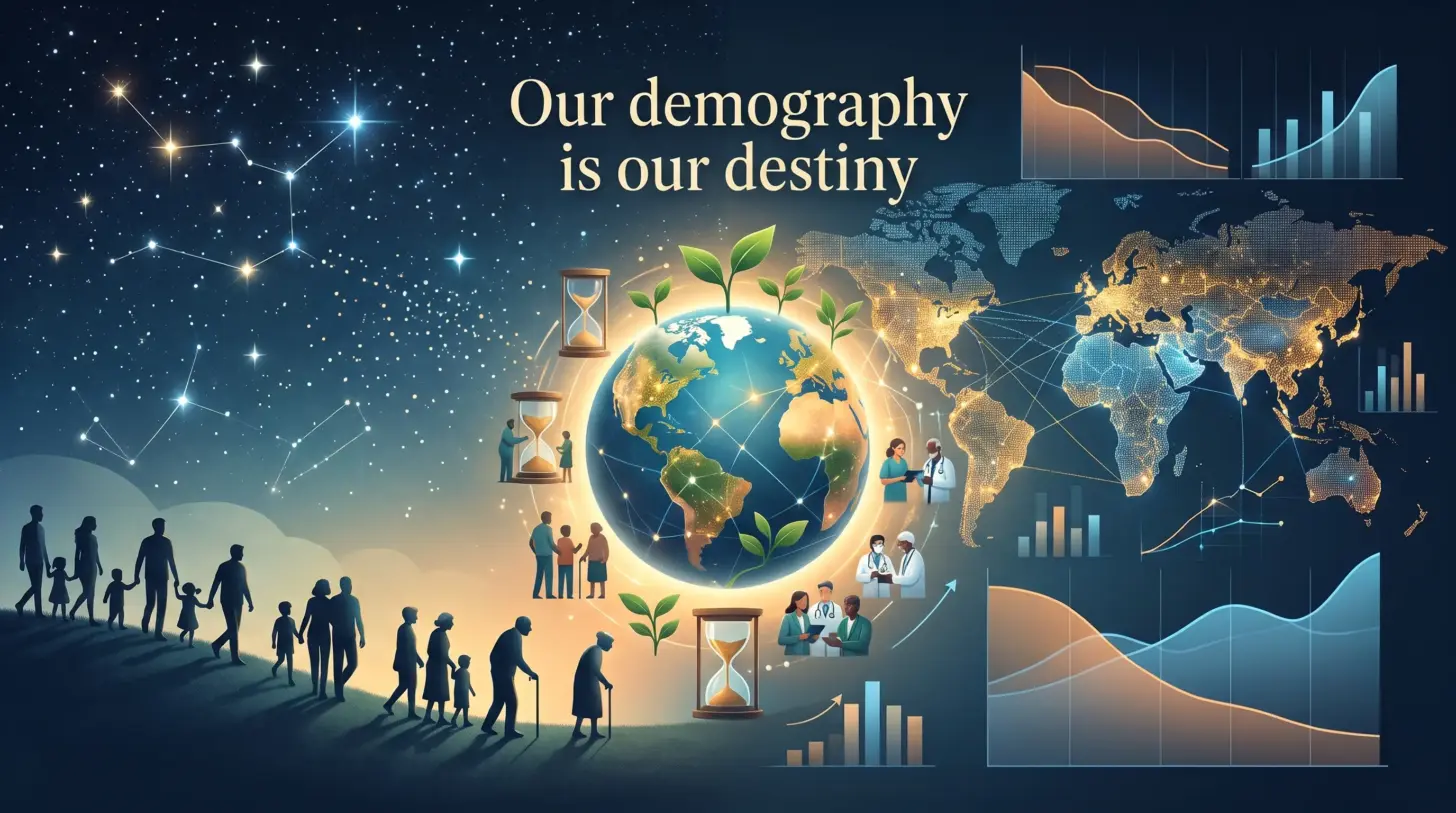
| We’re on track for there to be more people over age 60 than under the age of 14 by the middle of this century. That radical shift in modern human society presents us with a world of possibilities. Our demography is our destiny, yes, but how we react to that demography is not pre-ordained. What possible worlds might we create if we thoughtfully plan for an older, smaller population? | Estamos a caminho de ter mais pessoas com mais de 60 anos do que menores de 14 anos até a metade deste século. Essa mudança radical na sociedade humana moderna nos apresenta um mundo de possibilidades. Nossa demografia é o nosso destino, sim, mas a forma como reagimos a essa demografia não é algo pré-determinado. Que mundos possíveis poderíamos criar se planejássemos cuidadosamente uma população mais idosa e reduzida? |
| In one possible world, we put our heads in the sand and keep going about our business as usual. We have seen most societies react like they’re living in this world, and throw money at people to have more babies. But it doesn’t work. South Korea has spent $210 billion dollars over the last 16 years trying to raise fertility, and they keep hitting record lows: under one child per woman, on average. | Em um mundo possível, enterramos a cabeça na areia e seguimos nossas vidas como de costume. Vimos a maioria das sociedades reagir como se vivesse nesse mundo, despejando dinheiro sobre as pessoas para que tenham mais bebês. Mas isso não funciona. A Coreia do Sul gastou 210 bilhões de dólares nos últimos 16 anos tentando elevar a fertilidade e continua atingindo mínimas históricas: menos de um filho por mulher, em média. |
| In this status quo world, we keep the same economic models that assume infinite population growth, and amass more debt to pay for our public spending. Our social safety nets stay the same, which rely on more inputs from workers than withdrawals from retirees. That’s what we call a pay-as-you-go system. | Nesse mundo do status quo, mantemos os mesmos modelos econômicos que pressupõem um crescimento populacional infinito e acumulamos mais dívidas para bancar nossos gastos públicos. Nossas redes de proteção social permanecem inalteradas, as quais dependem de mais contribuições de trabalhadores do que retiradas de aposentados. É isso que chamamos de sistema de repartição simples (pay-as-you-go). |
| Western Europe is already struggling to keep these systems afloat, because in many of those countries, there are only two workers for every retiree. You can see how top-heavy the population’s age structure is here, and how in the next few years it will grow even more so that way. In a status quo world, the world’s most powerful countries continue to increase military spending and try to project power beyond their borders, even as their national budgets strain and the recruiting pool for soldiers shrinks—hello Russia, China, and maybe even the United States. | A Europa Ocidental já enfrenta dificuldades para manter esses sistemas à tona, porque, em muitos desses países, existem apenas dois trabalhadores para cada aposentado. É visível como a estrutura etária da população é desproporcionalmente pesada no topo aqui e como, nos próximos anos, ela ficará ainda mais concentrada dessa maneira. Em um mundo de status quo, os países mais poderosos do mundo continuam a aumentar os gastos militares e tentam projetar poder além de suas fronteiras, mesmo quando seus orçamentos nacionais se esgotam e o contingente de recrutamento para soldados diminui, olá, Rússia, China e talvez até os Estados Unidos. |
| So what results from failing to adapt and clinging to the status quo? Systems overload and break. We have higher labor costs, which lead to inflation, and that just makes it even more expensive to have children. Social security systems go bankrupt, and we lose the gains we’ve made in reducing old-age poverty. | Então, o que resulta de não se adaptar e de se apegar ao status quo? Os sistemas entram em sobrecarga e entram em colapso. Passamos a ter custos trabalhistas mais altos, o que gera inflação, tornando ainda mais caro ter filhos. Os sistemas previdenciários vão à falência e perdemos os avanços conquistados na redução da pobreza na terceira idade. |
| But a head-in-the-sand world isn’t as bad as a fearful one. In a fearful world, the ability to choose how many children to have and when to have them gets taken away, something that’s easier in less democratic settings, and not good news here either. | No entanto, um mundo com a cabeça na areia não é tão ruim quanto um mundo dominado pelo medo. Em um mundo dominado pelo medo, a autonomia de escolher quantos filhos ter e quando tê-los é revogada, algo que ocorre com maior facilidade em regimes menos democráticos e que também não traz boas notícias por aqui. |
| Twenty years ago, almost all of our aging countries were democracies; now a quarter of them—those with median ages of 35 or higher—aren’t free. And I know we see this idea of coercion in science fiction, but it’s not just science fiction. In 1965, when Nicolae Ceaușescu took the helm in Romania and he wanted more Romanian babies, he forced it to happen through invasive measures. Fertility temporarily spiked, but not without dire consequences for women and for those children, many of whom were abandoned to orphanages. | Há 20 anos, quase todos os nossos países em envelhecimento eram democracias; hoje, um quarto deles, aqueles com idade média de 35 anos ou superior, não é livre. E sei que enxergamos essa ideia de coerção na ficção científica, mas ela não se restringe à ficção científica. Em 1965, quando Nicolae Ceaușescu assumiu o poder na Romênia e quis mais bebês romenos, ele forçou esse cenário por meio de medidas invasivas. A fertilidade subiu temporariamente, mas não sem consequências drásticas para as mulheres e para aquelas crianças, muitas das quais acabaram abandonadas em orfanatos. |
| In a fearful world, immigration becomes more restricted. There’s more hatred and division as majority groups fear being replaced by people who don’t look like them. There’s less global cooperation as aging, shrinking countries lose the willingness and ability to think about causes outside their borders and fund those. We can’t come together on pandemics, or climate change, or other transboundary issues. Does any of this sound familiar? I actually don’t think we’re fully in this world yet, even if way too much of this hits close to home. But I can imagine how we might get there if we aren’t proactive to shape the world we want. | Em um mundo dominado pelo medo, a imigração se torna mais restrita. Há mais ódio e divisão, à medida que grupos majoritários temem ser substituídos por pessoas diferentes deles. Há menor cooperação global, já que países envelhecidos e em declínio populacional perdem a disposição e a capacidade de pensar em causas externas às suas fronteiras e de financiá-las. Não conseguimos nos unir no combate a pandemias, mudanças climáticas ou outras crises transfronteiriças. Algo disso soa familiar? Na verdade, não creio que estejamos plenamente inseridos nesse mundo ainda, embora uma parte excessiva disso nos toque de perto. Mas consigo vislumbrar como poderíamos chegar lá se não agirmos de forma proativa para moldar o mundo que desejamos. |
| And what kind of world would we want? Well, in a resilient world, we compete to attract talent from across the globe and set aside our nationalist tendencies. A shrinking world is in our future, but obviously some places are much closer than others. In the Democratic Republic of the Congo, Ethiopia, Nigeria, and Tanzania, fertility is still high enough that each generation is twice the size of the one before it. Those young and growing populations can be a tremendous resource for their national economies if we have investments in human capital and other policies that can help these countries reap a demographic dividend. And they can be a resource for the global economy, too. I mean, the US and Canada stand out as still growing despite below-replacement fertility in both. And in fact, Canada had record population growth last year, 96% of which was due to immigration. They aren’t the only models for immigration, and there are obvious trade-offs to opening your borders, but no one said this would be easy. | E que tipo de mundo nós desejaríamos? Bem, em um mundo resiliente, competimos para atrair talentos do mundo inteiro e deixamos de lado nossas tendências nacionalistas. Um mundo em encolhimento está no nosso futuro, mas, obviamente, alguns lugares estão muito mais próximos dele do que outros. Na República Democrática do Congo, na Etiópia, na Nigéria e na Tanzânia, a fertilidade ainda é alta o suficiente para que cada geração tenha o dobro do tamanho da anterior. Essas populações jovens e em crescimento podem representar um recurso extraordinário para suas economias nacionais, caso haja investimentos em capital humano e outras políticas públicas que ajudem esses países a colher um bônus demográfico. E elas também podem servir de motor para a economia global. Digo, os Estados Unidos e o Canadá se destacam por continuarem crescendo, apesar da fertilidade abaixo da taxa de reposição em ambos. De fato, o Canadá registrou um crescimento populacional recorde no ano passado, dos quais 96% foram decorrentes da imigração. Eles não constituem os únicos modelos de imigração e existem concessões óbvias ao abrir as fronteiras, mas ninguém disse que isso seria fácil. |
| And speaking of things not being easy, we’re going to have to work longer—me too, you too. And that’s because, in nearly half of the economies that the OECD tracks, fewer than 10% of people over the age of 65 still work. That is not going to fly in a resilient world. But in a resilient world, we’ve rethought what work looks like at older ages, and we strategically leverage technology to maximize our productivity. And we can work longer because we’re healthier. | E por falar em coisas que não são fáceis, teremos que trabalhar por mais tempo, eu também, você também. E isso se deve ao fato de que, em quase metade das economias monitoradas pela OCDE, menos de 10% das pessoas com mais de 65 anos continuam trabalhando. Isso simplesmente não vai funcionar em um mundo resiliente. Contudo, em um mundo resiliente, repensamos o formato do trabalho em idades avançadas e aproveitamos estrategicamente a tecnologia para maximizar nossa produtividade. E poderemos trabalhar por mais tempo porque seremos mais saudáveis. |
| In a resilient world, we finally realize that investing in health is a much better use of time and resources than trying to dictate population size. Similarly, in a resilient world, we’ve put in place policies, incentives, and technologies that recognize how we consume is just as important as how many of us consume, and the environment is healing. | Em um mundo resiliente, finalmente nos conscientizamos de que investir em saúde é um uso muito mais sensato de tempo e recursos do que tentar ditar o tamanho da população. Da mesma forma, em um mundo resiliente, implementamos políticas, incentivos e tecnologias que reconhecem que a forma como consumimos é tão relevante quanto a quantidade de pessoas que consome, e o meio ambiente se regenera. |
| In a resilient world, those societies closer to the start of this demographic transition take advantage of the time to plan and institute sustainable systems in the face of their demographic change. This is important because, for the population aged 60-plus to go from 15% of the total to 30%, it’ll take Ireland 92 years, the United Kingdom 89 years, and Germany 70 years. | Em um mundo resiliente, as sociedades mais próximas do início dessa transição demográfica aproveitam a oportunidade de tempo para planejar e instituir sistemas sustentáveis diante de sua transformação populacional. Isso é crucial porque, para a fatia de pessoas com mais de 60 anos subir de 15% para 30% do total, a Irlanda levará 92 anos, o Reino Unido 89 anos e a Alemanha 70 anos. |
| For that same demographic shift to happen now, it’ll take India 34 years, Mexico 32, Iran 20, and Thailand only 19. It’s happening faster now. We really need to realize this, because those countries have to act, including suites of policies like moving away from informal economies that increase the risk of poverty in older ages. | Para que essa mesma mudança demográfica ocorra agora, a Índia levará 34 anos, o México 32, o Irã 20 e a Tailândia apenas 19. O processo ocorre de forma mais veloz atualmente. Precisamos de fato tomar consciência disso, porque essas nações precisam intervir, inclusive adotando conjuntos de diretrizes como o distanciamento de economias informais que elevam o risco de pobreza na velhice. |
| You know, there are so many people on the planet right now just between the ages of 65 and 74 that, all together, they’d be the third most populous country in the world. There’s far more of them than there are global migrants, which we don’t hear about, right? | Vejam bem, existem tantas pessoas no planeta agora somente na faixa etária entre 65 e 74 anos que, juntas, constituiriam o terceiro país mais populoso do mundo. Há muito mais pessoas nessa faixa do que o total de migrantes globais, algo sobre o qual quase não ouvimos falar, não é? |
| And there’ll be 800 million of them by the middle of this century. They’re a vast untapped resource in most places in the world right now, but a well-utilized one in a resilient world, and to mutual benefit. We should run from a fearful world, get our heads out of the sand, and be able to imagine a much better, more resilient world. | E serão 800 milhões delas até a metade deste século. Trata-se de um imenso recurso inexplorado na maioria das regiões do planeta atualmente, mas que seria plenamente aproveitado em um mundo resiliente, gerando benefício mútuo. Devemos fugir de um mundo governado pelo medo, desenterrar a cabeça da areia e sermos capazes de idealizar um mundo muito superior e mais resiliente. |
| I’ve always thought that the way we feel about population aging to a large extent reflects the really negative way we feel about our individual aging, and that bias has held us back. But just as with our own aging, this shift is inevitable. | Sempre julguei que o sentimento que nutrimos pelo envelhecimento populacional reflete, em grande medida, a percepção profundamente negativa que temos sobre o nosso próprio envelhecimento individual, e esse preconceito tem freado o nosso progresso. No entanto, tal como ocorre com a nossa própria maturidade, essa transformação é inevitável. |
| So what are we going to do about it? As individuals, we know that our actions now set us up to live longer, healthier, more financially secure lives. Our society’s actions set us up for one of these three worlds to become our reality. Let’s make it a resilient world, and reimagine a grayer, smaller world as a beautiful one. Thank you. | Portanto, o que faremos a respeito? Como indivíduos, compreendemos que nossos atos no presente nos preparam para viver de maneira mais duradoura, saudável e financeiramente segura. As atitudes da nossa sociedade nos preparam para transformar um desses três mundos na nossa realidade. Façamos dele um mundo resiliente e reimaginemos um planeta mais grisalho e menor como um lugar admirável. Muito obrigado. |
Contagem de palavras
A tabela abaixo exibe as palavras encontradas neste vídeo, bem como o número de vezes em que aparecem.
Veja também: Para que serve esta tabela?
| Freq. | Palavra | Freq. | Palavra | Freq. | Palavra |
|---|---|---|---|---|---|
| 73 | the | 61 | and | 49 | to |
| 45 | we | 45 | in | 44 | of |
| 34 | a | 32 | is | 28 | world |
| 26 | that | 24 | are | 17 | our |
| 17 | as | 16 | this | 15 | it |
| 14 | population | 14 | not | 14 | have |
| 14 | but | 13 | more | 13 | for |
| 12 | there | 12 | be | 9 | years |
| 9 | us | 9 | resilient | 9 | from |
| 8 | what | 8 | those | 8 | than |
| 8 | people | 8 | one | 8 | just |
| 8 | how | 8 | fertility | 8 | even |
| 8 | by | 7 | you | 7 | will |
| 7 | they | 7 | or | 7 | on |
| 7 | I | 7 | has | 7 | countries |
| 7 | aging | 7 | about | 6 | their |
| 6 | so | 6 | now | 6 | most |
| 6 | many | 6 | if | 6 | can |
| 6 | because | 6 | age | 5 | would |
| 5 | work | 5 | which | 5 | time |
| 5 | shift | 5 | like | 5 | human |
| 5 | already | 4 | with | 4 | when |
| 4 | way | 4 | total | 4 | too |
| 4 | them | 4 | take | 4 | systems |
| 4 | still | 4 | same | 4 | much |
| 4 | know | 4 | keep | 4 | here |
| 4 | growth | 4 | going | 4 | fearful |
| 4 | do | 4 | demographic | 4 | at |
| 4 | ages | 3 | workers | 3 | up |
| 3 | these | 3 | thailand | 3 | status |
| 3 | star | 3 | society | 3 | size |
| 3 | shrinking | 3 | set | 3 | sand |
| 3 | right | 3 | resource | 3 | quo |
| 3 | policies | 3 | places | 3 | over |
| 3 | only | 3 | older | 3 | old |
| 3 | middle | 3 | longer | 3 | less |
| 3 | india | 3 | increase | 3 | immigration |
| 3 | half | 3 | go | 3 | global |
| 3 | economies | 3 | children | 3 | century |
| 3 | borders | 3 | billion | 2 | young |
| 2 | yes | 2 | worlds | 2 | who |
| 2 | were | 2 | well | 2 | want |
| 2 | united | 2 | under | 2 | trying |
| 2 | track | 2 | together | 2 | today |
| 2 | think | 2 | tell | 2 | stars |
| 2 | spending | 2 | south | 2 | soldiers |
| 2 | societies | 2 | social | 2 | smaller |
| 2 | seems | 2 | see | 2 | science |
| 2 | replacement | 2 | record | 2 | really |
| 2 | realize | 2 | react | 2 | put |
| 2 | poverty | 2 | possible | 2 | populous |
| 2 | populations | 2 | plan | 2 | place |
| 2 | person | 2 | pay | 2 | out |
| 2 | other | 2 | obvious | 2 | number |
| 2 | no | 2 | national | 2 | modern |
| 2 | models | 2 | million | 2 | might |
| 2 | lose | 2 | looking | 2 | look |
| 2 | last | 2 | korea | 2 | japan |
| 2 | italy | 2 | iran | 2 | important |
| 2 | imagine | 2 | healthier | 2 | heads |
| 2 | he | 2 | happening | 2 | happen |
| 2 | growing | 2 | globe | 2 | get |
| 2 | germany | 2 | fiction | 2 | feel |
| 2 | europe | 2 | easy | 2 | earth |
| 2 | down | 2 | does | 2 | different |
| 2 | demography | 2 | democratic | 2 | country |
| 2 | consume | 2 | closer | 2 | close |
| 2 | china | 2 | change | 2 | canada |
| 2 | between | 2 | better | 2 | below |
| 2 | being | 2 | been | 2 | back |
| 2 | babies | 2 | away | 2 | an |
| 2 | all | 2 | ago | 2 | actually |
| 2 | actions | 2 | ability | 1 | your |
| 1 | youngest | 1 | yet | 1 | year |
| 1 | workforce | 1 | women | 1 | woman |
| 1 | witnessing | 1 | without | 1 | withdrawals |
| 1 | wish | 1 | willingness | 1 | whom |
| 1 | western | 1 | was | 1 | wanted |
| 1 | voters | 1 | vietnam | 1 | vast |
| 1 | utilized | 1 | usual | 1 | use |
| 1 | upon | 1 | untapped | 1 | two |
| 1 | twice | 1 | twenty | 1 | try |
| 1 | truth | 1 | tremendous | 1 | transition |
| 1 | transboundary | 1 | trade | 1 | tracks |
| 1 | towards | 1 | top | 1 | took |
| 1 | todayjust | 1 | throw | 1 | through |
| 1 | throne | 1 | three | 1 | thoughtfully |
| 1 | thought | 1 | third | 1 | thinking |
| 1 | things | 1 | themthose | 1 | thank |
| 1 | tendencies | 1 | temporarily | 1 | tectonic |
| 1 | technology | 1 | technologies | 1 | tanzania |
| 1 | talent | 1 | takes | 1 | taken |
| 1 | system | 1 | sustainable | 1 | surface |
| 1 | suites | 1 | struggling | 1 | structure |
| 1 | strategically | 1 | strain | 1 | stillby |
| 1 | stays | 1 | stay | 1 | states |
| 1 | start | 1 | stand | 1 | spiked |
| 1 | spent | 1 | speaking | 1 | sound |
| 1 | soon | 1 | something | 1 | some |
| 1 | sky | 1 | since | 1 | similarly |
| 1 | shrinkshello | 1 | should | 1 | shining |
| 1 | shape | 1 | settings | 1 | seen |
| 1 | security | 1 | secure | 1 | said |
| 1 | safety | 1 | s | 1 | russia |
| 1 | run | 1 | romanian | 1 | romania |
| 1 | risk | 1 | retirees | 1 | retiree |
| 1 | rethought | 1 | results | 1 | restricted |
| 1 | resources | 1 | republic | 1 | replaced |
| 1 | rely | 1 | reimagine | 1 | reflects |
| 1 | reducing | 1 | recruiting | 1 | recognize |
| 1 | reap | 1 | reality | 1 | reach |
| 1 | rates | 1 | rate | 1 | raise |
| 1 | radical | 1 | quarter | 1 | public |
| 1 | project | 1 | productivity | 1 | probably |
| 1 | proactive | 1 | presents | 1 | pre |
| 1 | powerful | 1 | power | 1 | possibilities |
| 1 | pool | 1 | poland | 1 | plus |
| 1 | planet | 1 | pervasive | 1 | permanent |
| 1 | per | 1 | peaked | 1 | peak |
| 1 | parts | 1 | particular | 1 | pandemics |
| 1 | own | 1 | overload | 1 | outside |
| 1 | others | 1 | orphanages | 1 | ordained |
| 1 | opening | 1 | oldest | 1 | offs |
| 1 | oecd | 1 | obviously | 1 | night |
| 1 | nigeria | 1 | nicolae | 1 | next |
| 1 | news | 1 | nets | 1 | negative |
| 1 | need | 1 | nearly | 1 | nationalist |
| 1 | mutual | 1 | moving | 1 | money |
| 1 | military | 1 | migrants | 1 | mexico |
| 1 | median | 1 | measures | 1 | mean |
| 1 | maybe | 1 | may | 1 | maximize |
| 1 | matters | 1 | makes | 1 | make |
| 1 | majority | 1 | made | 1 | lows |
| 1 | low | 1 | lot | 1 | loss |
| 1 | looks | 1 | longerme | 1 | long |
| 1 | living | 1 | lives | 1 | live |
| 1 | lined | 1 | light | 1 | leverage |
| 1 | let | 1 | lead | 1 | large |
| 1 | labor | 1 | kuwait | 1 | kingdom |
| 1 | kind | 1 | its | 1 | issues |
| 1 | ireland | 1 | investments | 1 | investing |
| 1 | invasive | 1 | into | 1 | institute |
| 1 | inputs | 1 | informal | 1 | inflation |
| 1 | infinite | 1 | inevitable | 1 | individuals |
| 1 | individual | 1 | including | 1 | incentives |
| 1 | imploded | 1 | idea | 1 | home |
| 1 | holds | 1 | hitting | 1 | hits |
| 1 | history | 1 | higherare | 1 | higher |
| 1 | high | 1 | help | 1 | helm |
| 1 | held | 1 | heavy | 1 | hear |
| 1 | health | 1 | healing | 1 | head |
| 1 | hatred | 1 | had | 1 | growingfrom |
| 1 | grow | 1 | groups | 1 | greater |
| 1 | grayer | 1 | good | 1 | gets |
| 1 | generation | 1 | gains | 1 | future |
| 1 | fundamental | 1 | fund | 1 | fully |
| 1 | free | 1 | foundation | 1 | forces |
| 1 | forced | 1 | fly | 1 | financially |
| 1 | finally | 1 | fewer | 1 | few |
| 1 | fear | 1 | faster | 1 | faraway |
| 1 | far | 1 | familiar | 1 | falling |
| 1 | failing | 1 | fact | 1 | face |
| 1 | eyes | 1 | extent | 1 | expensive |
| 1 | exist | 1 | everywhere | 1 | everything |
| 1 | everyone | 1 | every | 1 | eventual |
| 1 | ethiopia | 1 | environment | 1 | entire |
| 1 | entering | 1 | enough | 1 | end |
| 1 | either | 1 | economy | 1 | economic |
| 1 | eastern | 1 | easier | 1 | each |
| 1 | due | 1 | doubled | 1 | dollars |
| 1 | division | 1 | dividend | 1 | dire |
| 1 | difference | 1 | dictate | 1 | destiny |
| 1 | despite | 1 | depopulation | 1 | democracies |
| 1 | decline | 1 | debt | 1 | current |
| 1 | cuba | 1 | create | 1 | costs |
| 1 | cooperation | 1 | continue | 1 | consequences |
| 1 | congo | 1 | compete | 1 | come |
| 1 | coercion | 1 | clinging | 1 | climate |
| 1 | choose | 1 | chile | 1 | child |
| 1 | ceaușescu | 1 | causes | 1 | caregivers |
| 1 | capital | 1 | cannot | 1 | call |
| 1 | business | 1 | budgets | 1 | brightly |
| 1 | bright | 1 | break | 1 | both |
| 1 | bias | 1 | beyond | 1 | benefit |
| 1 | beneath | 1 | behind | 1 | before |
| 1 | becomes | 1 | become | 1 | beautiful |
| 1 | bankrupt | 1 | bad | 1 | average |
| 1 | attract | 1 | astronomers | 1 | assuming |
| 1 | assume | 1 | asked | 1 | aside |
| 1 | any | 1 | amass | 1 | am |
| 1 | always | 1 | almost | 1 | aged |
| 1 | again | 1 | afloat | 1 | advantage |
| 1 | adapt | 1 | actuality | 1 | act |
| 1 | across | 1 | able | 1 | abandoned |