
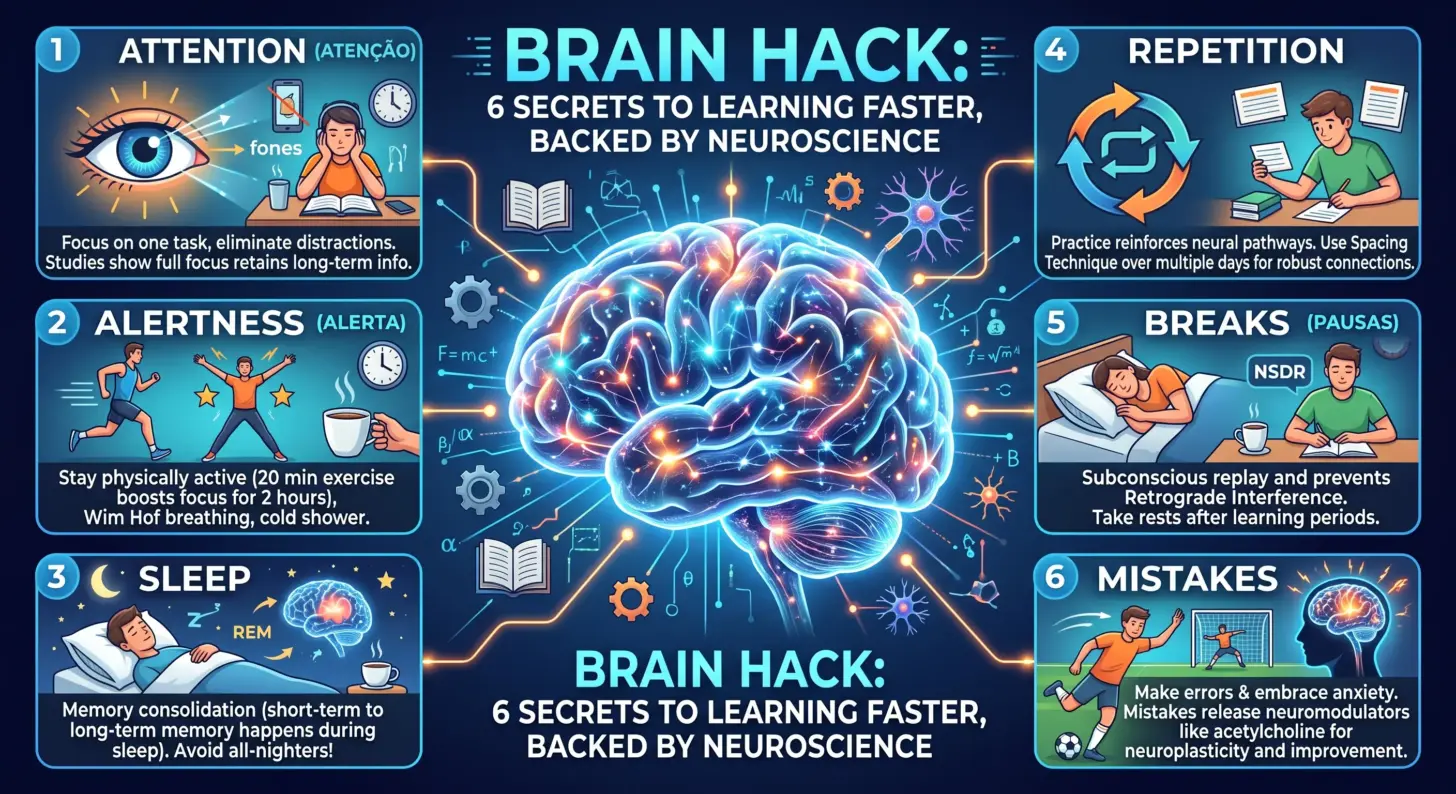
Learning Strategies | Brain Hack: 6 secrets to learning faster backed by neuroscience (vídeo)
Descubra como a neurociência pode destravar o potencial do seu cérebro para aprender qualquer coisa mais rápido e melhor, usando seis ingredientes fundamentais ao seu alcance.
| Audio | |
|---|---|
Normal | Slow |
| English Transcript | Tradução |
| Brain Hack: 6 secrets to learning faster, backed by neuroscience | Hack Cerebral: 6 segredos para aprender mais rápido, comprovados pela neurociência |
| I'm angry, and I'm angry because I wish I knew this when I was younger. | Estou com raiva, e estou com raiva porque queria ter sabido disso quando era mais jovem. |
| So, I'm a neuroscientist and a lecturer. As a neuroscientist, I study the brain and the nerves that span out into the body, and as a lecturer, I teach the next generation of healthcare professionals. Look, I see some students struggle with their learning, especially the older ones, but it's not their fault. You know, we don't get taught how to learn; we just kind of expect it to happen. I think the worst curse of all, really, is that it gets harder to learn as we age. But what if I told you that there are things we can do to learn faster and more effectively? | Então, sou neurocientista e palestrante. Como neurocientista, estudo o cérebro e os nervos que se espalham pelo corpo, e como palestrante, ensino a próxima geração de profissionais de saúde. Olhe, vejo alguns alunos lutarem com seu aprendizado, especialmente os mais velhos, mas não é culpa deles. Sabe, não nos ensinam como aprender; nós apenas esperamos que aconteça. Acho que a pior maldição de todas, na verdade, é que fica mais difícil aprender à medida que envelhecemos. Mas e se eu lhe dissesse que há coisas que podemos fazer para aprender mais rápido e com mais eficácia? |
| I'm going to take you through the neuroscience behind six critical ingredients that can help you learn faster: attention, alertness, sleep, repetition, breaks, and mistakes. | Vou levá-lo pela neurociência por trás de seis ingredientes críticos que podem ajudá-lo a aprender mais rápido: atenção, alerta, sono, repetição, pausas e erros. |
| First things first: how do we actually learn? We need neuroplasticity to happen. Neuroplasticity is the scientific term that essentially means our brain's ability to physically change in response to experience. So when we're learning something, whether it's learning information or a skill, tiny little connections called synapses form between neighboring neurons in the brain. The more we do that thing, the more robust those connections become, and the better we get at doing whatever it is. | Primeiras coisas primeiro: como nós realmente aprendemos? Precisamos que a neuroplasticidade aconteça. Neuroplasticidade é o termo científico que essencialmente significa a capacidade do nosso cérebro de mudar fisicamente em resposta à experiência. Então, quando estamos aprendendo algo, seja aprendendo informação ou uma habilidade, pequenas conexões chamadas sinapses se formam entre neurônios vizinhos no cérebro. Quanto mais fazemos essa coisa, mais robustas essas conexões se tornam, e melhores ficamos em fazer o que quer que seja. |
| Now, what you're looking at here are two neurons that I filmed in a petri dish connecting. Actually, this was a petri dish that I was about to throw away, but I could see that they were about to connect, so I quickly took this video. These incredible, hand-like structures here are called growth cones, and every neuron has one. They actively sense the environment around them, helping each and every one of the 86 billion neurons in your brain find the correct place to connect to, for example, from here to here, or here to here. | Agora, o que você está olhando aqui são dois neurônios que filmei em uma placa de Petri se conectando. Na verdade, esta era uma placa de Petri que eu estava prestes a jogar fora, mas pude ver que eles estavam prestes a se conectar, então gravei rapidamente este vídeo. Estas estruturas incríveis semelhantes a mãos aqui são chamadas de cones de crescimento, e cada neurônio tem um. Eles sensoreiam ativamente o ambiente ao seu redor, ajudando cada um dos 86 bilhões de neurônios no seu cérebro a encontrar o lugar correto para se conectar, por exemplo, daqui para cá, ou daqui para cá. |
| This doesn't represent learning itself; what it represents is how our brain wires itself during development. When things go wrong with that wiring process, or when it doesn't happen in the usual way, you can end up with issues regarding learning and memory. | Isso não representa o aprendizado em si; o que representa é como nosso cérebro se conecta durante o desenvolvimento. Quando as coisas dão errado com esse processo de conexão, ou quando não acontece da maneira habitual, você pode acabar com problemas em relação ao aprendizado e à memória. |
| Kids are a little bit like sponges, right? They just seem to need to be exposed to stuff, and they remember it, languages, skills, sports, whatever it is. The learning just happens really quickly. | As crianças são um pouco como esponjas, certo? Elas só parecem precisar ser expostas às coisas, e elas se lembram, idiomas, habilidades, esportes, seja o que for. O aprendizado simplesmente acontece muito rápido. |
| Have you ever met someone who's incredibly talented and thought, "Okay, they must have some magic thing about them that the rest of us don't have"? What if I told you that's probably not true? It mostly comes down to practice, perseverance, and when in development they started learning that skill, so the earlier, the better. People like Serena Williams wasn't born with her skills; she practiced, and she actually started by age five. | Você já conheceu alguém que é incrivelmente talentoso e pensou: "Ok, eles devem ter alguma coisa mágica sobre eles que o resto de nós não tem"? E se eu lhe dissesse que isso provavelmente não é verdade? Isso se resume principalmente à prática, perseverança e a quando, no desenvolvimento, eles começaram a aprender essa habilidade, então, quanto mais cedo, melhor. Pessoas como Serena Williams não nasceram com suas habilidades; ela praticou, e ela realmente começou aos cinco anos de idade. |
| Really, our ability to learn kind of goes downhill after age five. It certainly gets harder through our childhood and our teens, and once we hit our mid-20s, it gets exponentially harder to learn. But the good news is that I'm going to tell you what you can actually do about it, because there are things you can do. You can use attention, alertness, sleep, repetition, breaks, and mistakes to make your learning better. | Sério, nossa capacidade de aprender meio que vai ladeira abaixo após os cinco anos de idade. Com certeza fica mais difícil ao longo da nossa infância e da nossa adolescência, e quando atingimos nossos vinte e poucos anos, fica exponencialmente mais difícil aprender. Mas a boa notícia é que vou lhe dizer o que você pode realmente fazer a respeito, porque há coisas que você pode fazer. Você pode usar atenção, alerta, sono, repetição, pausas e erros para melhorar seu aprendizado. |
| 1. Attention | 1. Atenção |
| In order to learn well, we need to pay attention, right? Attention is a really important function. For example, if I were to ask you to close your eyes and focus on the contact between your feet and the floor, you'd suddenly be aware of maybe the texture of your socks, how tight your shoes are, or how firm the floor is, and you weren't aware of any of that a second ago. What that means is that we have the ability to choose how much attention we pay to something. Studies have shown that when we are fully focused on a task, we are much more likely to retain that information, especially for the long term. | Para aprender bem, precisamos prestar atenção, certo? A atenção é uma função realmente importante. Por exemplo, se eu pedisse para você fechar os olhos e focar no contato entre seus pés e o chão, você de repente estaria consciente de talvez a textura das suas meias, quão apertados estão seus sapatos ou quão firme é o chão, e você não estava consciente de nada disso um segundo atrás. O que isso significa é que temos a capacidade de escolher quanta atenção prestamos a algo. Estudos mostraram que quando estamos totalmente focados em uma tarefa, somos muito mais propensos a reter essa informação, especialmente a longo prazo. |
| Until the last little blip in human history, we have never had to work this hard to pay attention. Let's be honest: how many times do you find yourself rereading or replaying something because you got a bit distracted? Yeah, we're designed to focus on one thing at a time. It's no secret that the frequent context-switching that happens when we use social media, scrolling through our phones and seeing lots of completely unrelated bits of information like news, ads, and cat videos, results in significantly measurable attention deficits. I'm not saying it causes ADHD, but studies have shown that using your phone for more than an hour a day in teens results in these attention deficits. So, try to use your phone a little bit less. | Até o último pequeno ponto na história humana, nunca tivemos que trabalhar tão duro para prestar atenção. Vamos ser honestos: quantas vezes você se pega relendo ou reproduzindo algo porque se distraiu um pouco? Sim, somos projetados para focar em uma coisa de cada vez. Não é segredo que a frequente troca de contexto que acontece quando usamos as redes sociais, rolando nossos telefones e vendo muitos pedaços de informação completamente não relacionados, como notícias, anúncios e vídeos de gatos, resulta em déficits de atenção significativamente mensuráveis. Não estou dizendo que causa TDAH, mas estudos mostraram que usar seu telefone por mais de uma hora por dia em adolescentes resulta nesses déficits de atenção. Então, tente usar seu telefone um pouco menos. |
| If you want to improve your attention in the long term, there are things like focused-attention meditation that you can do. If you want to improve your attention in the really short term, you can actually just exercise. I know what you're thinking: "Oh, my doctor always says I have to exercise and eat well." But hear me out for a second. Did you know that exercise can actually increase the size of the part of your brain involved in learning and memory? It also helps you make new brain cells. Studies have shown that regular exercise improves memory and cognition (your ability to think), and just 20 minutes of moderate exercise, not even intense exercise, will actually improve your attention for about two hours afterwards. | Se você quer melhorar sua atenção a longo prazo, há coisas como meditação de atenção focada que você pode fazer. Se você quer melhorar sua atenção no curto prazo, você pode simplesmente se exercitar. Eu sei o que você está pensando: "Ah, meu médico sempre diz que tenho que me exercitar e comer bem." Mas me ouça por um segundo. Você sabia que o exercício pode realmente aumentar o tamanho da parte do seu cérebro envolvida no aprendizado e na memória? Ele também ajuda você a fazer novas células cerebrais. Estudos mostraram que o exercício regular melhora a memória e a cognição (sua capacidade de pensar), e apenas 20 minutos de exercício moderado, nem mesmo exercício intenso, vão realmente melhorar sua atenção por cerca de duas horas depois. |
| ⚫ What you should do: If you're sitting down to study, go for a jog or do some star jumps (it's even better if you challenge your balance). If you're at work, run up and down the stairs. There are lots of things you can do to make this happen. | ⚫ O que você deve fazer: Se você estiver sentado para estudar, vá dar uma corrida ou faça alguns polichinelos (é ainda melhor se você desafiar seu equilíbrio). Se você estiver no trabalho, corra subindo e descendo as escadas. Há muitas coisas que você pode fazer para fazer isso acontecer. |
| 2. Alertness | 2. Alerta |
| In order to learn, you've got to be alert, right? It's not rocket science. But here's the thing: if you're not fully focused on a task, you're going to have a harder time retaining that information. Activating our body's fight-or-flight system (or activating our sympathetic nervous system, as it's also known) results in the release of things like adrenaline and noradrenaline, which, among other things, increases our alertness. | Para aprender, você tem que estar alerta, certo? Não é ciência de foguetes. Mas aqui está a coisa: se você não estiver totalmente focado em uma tarefa, terá mais dificuldade em reter essa informação. Ativar o sistema de luta ou fuga do nosso corpo (ou ativar nosso sistema nervoso simpático, como também é conhecido) resulta na liberação de coisas como adrenalina e noradrenalina, o que, entre outras coisas, aumenta nosso alerta. |
| What are some things we can do to trigger our fight-or-flight system? Obviously, we can't go around blasting air horns all the time. | Quais são algumas coisas que podemos fazer para disparar nosso sistema de luta ou fuga? Obviamente, não podemos sair por aí buzinando buzinas de ar o tempo todo. |
| ⚫ Again, exercise (a bit of a recurring theme here). | ⚫ Novamente, exercício (um pouco de um tema recorrente aqui). |
| ⚫ Certain breathing techniques, like Wim Hof breathing. | ⚫ Certas técnicas de respiração, como a respiração Wim Hof. |
| ⚫ Ending your shower with a cold blast of water, which will certainly make you feel very alert. | ⚫ Terminar seu banho com um jato de água fria, o que certamente fará você se sentir muito alerta. |
| We also know that stress does the same thing. If you sit down to learn after a small stressor, that will enhance your learning. However, you can have too much stress. When you've been experiencing long-term or chronic stress, it physically changes your brain and causes issues with learning and memory. If you have been experiencing stress for a long period of time, you will have impairments in memory, it is that simple. So, do be kind to yourself. | Também sabemos que o estresse faz a mesma coisa. Se você se sentar para aprender após um pequeno estressor, isso aumentará seu aprendizado. No entanto, você pode ter estresse demais. Quando você vem experimentando estresse de longo prazo ou crônico, isso muda fisicamente seu cérebro e causa problemas com aprendizado e memória. Se você tem experimentado estresse por um longo período de tempo, você terá deficiências na memória, é simples assim. Portanto, seja gentil consigo mesmo. |
| Little bits of stress are good; they actually help you reach peak performance. Having a slight increase in adrenaline after a learning task will enhance your learning as well. | Pequenas doses de estresse são boas; elas realmente ajudam você a atingir o pico de desempenho. Ter um leve aumento de adrenalina após uma tarefa de aprendizado também aumentará seu aprendizado. |
| You can also ingest substances to enhance your alertness, such as caffeine. A growing body of evidence shows that having caffeine before a learning task, or simply being a regular caffeine drinker, can enhance your learning and memory through a range of different mechanisms in the brain. Conversely, we know that when you eat, you are less alert because that switches off our fight-or-flight system. So, maybe don't sit down to study after a big meal. | Você também pode ingerir substâncias para aumentar seu alerta, como cafeína. Um corpo crescente de evidências mostra que tomar cafeína antes de uma tarefa de aprendizado, ou simplesmente ser um consumidor regular de cafeína, pode aumentar seu aprendizado e memória por meio de uma variedade de mecanismos diferentes no cérebro. Por outro lado, sabemos que quando você come, fica menos alerta porque isso desliga nosso sistema de luta ou fuga. Então, talvez você não deva se sentar para estudar depois de uma grande refeição. |
| There is also a natural limit to our alertness. It's still a little bit contentious, but studies show we are constantly going through what we call an ultradian rhythm. About every 90 minutes, we go in and out of peak alertness. The reality is that you can't be 100% alert all the time; there's going to be a chunk of about 8 to 30 minutes in the middle where you'll be most alert. | Há também um limite natural para o nosso alerta. Ainda é um pouco controverso, mas estudos mostram que estamos constantemente passando pelo que chamamos de ritmo ultradiano. A cada 90 minutos aproximadamente, entramos e saímos do pico de alerta. A realidade é que você não pode estar 100% alerta o tempo todo; haverá um bloco de cerca de 8 a 30 minutos no meio em que você estará mais alerta. |
| 3. Sleep | 3. Sono |
| If you haven't been sleeping, you won't be as alert, but sleep is critical for learning for another major reason. Sleep serves an important constellation of functions: it resets our immune system, metabolism, and emotional control, and it even gets rid of the waste that builds up in our brain over the course of the day. Most importantly, sleep is critical for memory consolidation, turning short-term memories into long-term memories. | Se você não tem dormido, não estará tão alerta, mas o sono é crítico para o aprendizado por outra grande razão. O sono serve a uma constelação importante de funções: ele reinicia nosso sistema imunológico, metabolismo e controle emocional, e até se livra dos resíduos que se acumulam em nosso cérebro ao longo do dia. Mais importante ainda, o sono é crítico para a consolidação da memória, transformar memórias de curto prazo em memórias de longo prazo. |
| There's a particular part of the brain called the hippocampus, which is vital for learning and memory. When you do things throughout the day, your hippocampus keeps track of it, a bit like a diary. If I were to ask you what you were doing before you sat down to listen to this talk, you'd use your hippocampus to recall that information. However, it only keeps information there for the short term. When you sleep, all of those short-term memories get flitted off to other parts of the brain (the cortex) and turned into long-term memories. | Há uma parte particular do cérebro chamada hipocampo, que é vital para o aprendizado e a memória. Quando você faz coisas ao longo do dia, seu hipocampo rastreia isso, um pouco como um diário. Se eu perguntasse o que você estava fazendo antes de se sentar para ouvir esta palestra, você usaria seu hipocampo para recordar essa informação. No entanto, ele só guarda informações lá a curto prazo. Quando você dorme, todas essas memórias de curto prazo são transferidas para outras partes do cérebro (o córtex) e transformadas em memórias de longo prazo. |
| If you don't sleep, you can't turn those short-term memories into long-term memories. That's why pulling an all-nighter and cramming is kind of the worst thing you can do for studying, you simply are not going to retain that information for the long term. | Se você não dorme, não pode transformar essas memórias de curto prazo em memórias de longo prazo. É por isso que virar a noite estudando e acumulando matéria é meio que a pior coisa que você pode fazer para estudar, você simplesmente não vai reter essa informação a longo prazo. |
| ⚫ What you should do: Prioritize your sleep before you study so you can be more alert, but especially prioritize sleep after learning, as you need it to retain that information for the long term. | ⚫ O que você deve fazer: Priorize seu sono antes de estudar para que possa estar mais alerta, mas especialmente priorize o sono depois de aprender, pois você precisa dele para reter essa informação a longo prazo. |
| 4. Repetition | 4. Repetição |
| The old adage says that practice makes perfect, and there's so much truth to that. Repetition is key when it comes to learning. It's not enough to just hear or see something once and expect to remember it forever. Just like exercising builds muscle, repetitive patterns of thinking or doing things will reinforce those pathways and connections in the brain associated with that action, making it easier to recall. | O velho ditado diz que a prática leva à perfeição, e há tanta verdade nisso. A repetição é a chave quando se trata de aprender. Não basta apenas ouvir ou ver algo uma vez e esperar lembrar para sempre. Assim como exercitar constrói músculos, padrões repetitivos de pensamento ou de fazer as coisas vão reforçar esses caminhos e conexões no cérebro associados a essa ação, tornando mais fácil de recordar. |
| Through the process of neuroplasticity, you are making brand-new connections. That takes energy: it requires fatty acids and lots of little proteins to be made. It's a big job that takes a lot of energy, and the brain isn't going to want to invest all this energy in creating new connections for something you've only done once. Repetition basically flags to your brain at the cellular level: "Hey, this is the thing that keeps coming up in my life, so in order to be more efficient, I need to reinforce this." | Através do processo de neuroplasticidade, você está fazendo conexões novinhas em folha. Isso exige energia: requer ácidos graxos e muitas pequenas proteínas para serem feitas. É um grande trabalho que exige muita energia, e o cérebro não vai querer investir toda essa energia na criação de novas conexões para algo que você só fez uma vez. A repetição basicamente sinaliza para o seu cérebro no nível celular: "Ei, esta é a coisa que continua surgindo na minha vida, então, para ser mais eficiente, preciso reforçar isso." |
| ⚫ What you should do: Repeat the thing you are trying to learn as many times as you can in that learning period, and use the spacing technique (space your learning out over multiple days). That way, your brain has a chance to build on those new long-term memories. We know that two shorter learning periods over different days will result in significantly better learning than using that same amount of time on a single day. | ⚫ O que você deve fazer: Repita a coisa que você está tentando aprender o máximo de vezes que puder nesse período de aprendizado e use a técnica de espaçamento (espace seu aprendizado ao longo de vários dias). Dessa forma, seu cérebro tem a chance de construir sobre essas novas memórias de longo prazo. Sabemos que dois períodos de aprendizado mais curtos em dias diferentes resultarão em um aprendizado significativamente melhor do que usar a mesma quantidade de tempo em um único dia. |
| Sometimes we can learn things in one go, a phenomenon called *one-trial learning* in psychology and neuroscience. This basically happens when there's a really strong emotional component tied to the experience (e.g., if it makes us really happy, sad, or scared). There's an important biological reason for that: your brain wants to remember everything to do with a scary event in exquisite detail so you know how to respond next time you encounter it, or so you can avoid it completely. When things go wrong with that process, we can end up with conditions like PTSD. | Às vezes podemos aprender coisas de uma vez só, um fenômeno chamado aprendizado de tentativa única na psicologia e na neurociência. Isso basicamente acontece quando há um componente emocional muito forte ligado à experiência (por exemplo, se nos deixa muito felizes, tristes ou assustados). Há uma razão biológica importante para isso: seu cérebro quer lembrar de tudo relacionado a esse evento assustador em detalhes requintados para que você saiba como responder da próxima vez que o encontrar, ou apenas para que possa evitá-lo completamente. Quando as coisas dão errado com esse processo, podemos acabar com condições como o TEPT. |
| 5. Breaks | 5. Pausas |
| Breaks are incredibly important for learning as well, for two main reasons: | As pausas são incrivelmente importantes para o aprendizado também, por duas razões principais: |
| 1. Subconscious Replay: It gives our brains a chance to replay that information. This happens completely subconsciously. For example, if you were learning a sequence on the piano and took a 10-second break afterwards, your brain would actually be replaying that sequence 20 times faster. It looks like it might be even better if you spend 10 to 20 minutes afterwards having a quiet break (no phones, of course!), taking a nap, or doing a round of Non-Sleep Deep Rest (NSDR). | 1. Repetição Subconsciente: Dá ao nosso cérebro a chance de reprisar essa informação. Isso acontece de forma completamente subconsciente. Por exemplo, se você estivesse aprendendo uma sequência no piano e fizesse uma pausa de 10 segundos depois, seu cérebro estaria realmente reprisando essa sequência 20 vezes mais rápido. Parece que pode ser ainda melhor se você passar de 10 a 20 minutos depois tendo uma pausa tranquila (sem telefones, é claro!), tirando uma soneca ou fazendo uma rodada de Repouso Profundo Sem Sono (NSDR). |
| 2. Preventing Retrograde Interference: Newly encoded information isn't very stable. If you were to use those same networks to learn something else very soon afterwards, that newly encoded information could be destroyed in a process called *retrograde interference*. In kids, memories stabilize pretty quickly (within a few minutes), but in adults, they remain unstable for an hour or maybe longer. | 2. Prevenção de Interferência Retroativa: A informação recém-codificada não é muito estável. Se você usasse essas mesmas redes para aprender outra coisa logo em seguida, essa informação recém-codificada poderia ser destruída em um processo chamado interferência retroativa. Em crianças, as memórias se estabilizam de forma bastante rápida (em poucos minutos), mas em adultos, elas permanecem instáveis por uma hora ou talvez mais. |
| ⚫ What you should do: Take a 10-to-20-minute break after you finish learning. If you're at work, try to do mundane tasks that you can do without thinking too much, and wait at least an hour before trying to learn something similar, preferably doing it on a different day. | ⚫ O que você deve fazer: Faça uma pausa de 10 a 20 minutos depois de terminar de aprender. Se você estiver no trabalho, tente fazer tarefas mundanas que possa realizar sem pensar muito e espere pelo menos uma hora antes de tentar aprender algo semelhante, de preferência fazendo isso em um dia diferente. |
| 6. Mistakes | 6. Erros |
| Making mistakes can feel terrifying, but there's a biological reason behind that. The feeling of anxiety and stress you get when you make a mistake serves a critical purpose: you release neuromodulators like *acetylcholine* and get increased activity in your focused-attention networks. That spike in attention and anxiety is basically your brain saying: "Hey, you made a mistake. You need to change, do better, and become more efficient." It opens up a window for neuroplasticity so that whatever happens next, your brain is ready to take it in. | Cometer erros pode parecer aterrorizante, mas há uma razão biológica por trás disso. A sensação de ansiedade e estresse que você sente quando comete um erro serve a um propósito crítico: você libera neuromoduladores como a acetilcolina e obtém maior atividade em suas redes de atenção focada. Esse pico de atenção e ansiedade é basicamente seu cérebro dizendo: "Ei, você cometeu um erro. Você precisa mudar, fazer melhor e se tornar mais eficiente." Ele abre uma janela para a neuroplasticidade para que, aconteça o que acontecer a seguir, seu cérebro esteja pronto para absorver. |
| If you make a mistake, feel anxious, and walk away, you won't learn the task, and you're actually training yourself to be less capable of coping with failure. | Se você cometer um erro, se sentir ansioso e se afastar, você não aprenderá a tarefa e estará realmente se treinando para ser menos capaz de lidar com o fracasso. |
| ⚫ What you should do: Set yourself up for a little bit of failure. Quiz yourself on a topic as you go, don't wait until you feel ready. If you're practicing a sport like soccer, don't just kick straight at the goal; change the angle and make it more difficult so you make mistakes. Don't wait for everything to be perfect before you have a go. | ⚫ O que você deve fazer: Prepare-se para um pouco de fracasso. Faça testes a si mesmo sobre um tópico à medida que avança, não espere até se sentir "pronto". Se você estiver praticando um esporte como o futebol, não chute apenas direto para o gol; mude o ângulo e torne mais difícil para cometer erros. Não espere que tudo esteja perfeito antes de tentar. |
| At the end of the day, if you make a mistake, you release neuromodulators that improve your attention. If you get it right, you release dopamine in your reward circuits, which makes you feel good, increases motivation, and consolidates the learning of what you just did correctly. That's why turning learning into a bit of a game works so well, it's a win-win situation for your brain either way. When you make a mistake, don't view that anxiety as a bad thing; lean into that feeling and keep going. It's really your brain's way of helping you be better than the person you were yesterday. | No final do dia, se você comete um erro, libera neuromoduladores que melhoram sua atenção. Se você acerta, libera dopamina em seus circuitos de recompensa, o que faz você se sentir bem, aumenta a motivação e consolida o aprendizado do que você acabou de fazer corretamente. É por isso que transformar o aprendizado em um pequeno jogo funciona tão bem, é uma situação ganha-ganha para o seu cérebro de qualquer maneira. Quando você cometer um erro, não veja essa ansiedade como algo ruim; incline-se para esse sentimento e continue. É realmente a maneira do seu cérebro ajudá-lo a ser melhor do que a pessoa que você era ontem. |
| As you can see, I'm not angry anymore! I'm still quite nervous, but that's because, by understanding the brain, I know that you have the keys to unlock your potential to learn faster and more effectively. Those keys are attention, alertness, sleep, repetition, breaks, and mistakes. | Como você pode ver, não estou mais com raiva! Ainda estou bastante nervosa, mas é porque, ao entender o cérebro, sei que você tem as chaves para desbloquear seu potencial para aprender mais rápido e com mais eficácia. Essenciais chaves são atenção, alerta, sono, repetição, pausas e erros. |
| So next time you're sitting down to learn: get rid of those distractions, increase your attention, boost your alertness (maybe through a little bit of exercise), repeat what you're trying to do as many times as you can in that training period across multiple days, prioritize your sleep in between, embrace your mistakes, and make sure you take a 10-to-20-minute break after learning. Your brain is going to thank you! | Então, da próxima vez que você se sentar para aprender: livre-se dessas distrações, aumente sua atenção, aumente seu alerta (talvez através de um pouco de exercício), repita o que está tentando fazer o máximo de vezes que puder nesse período de treinamento ao longo de vários dias, priorize seu sono no intervalo, abrace seus erros e certifique-se de fazer uma pausa de 10 a 20 minutos após o aprendizado. Seu cérebro vai lhe agradecer! |
| Thank you for your attention, and I hope you learned something new. | Obrigado pela sua atenção, e espero que você tenha aprendido algo novo. |
Contagem de palavras
A tabela abaixo exibe as palavras encontradas neste vídeo, bem como o número de vezes em que aparecem.
Veja também: Para que serve esta tabela?
| Freq. | Palavra | Freq. | Palavra | Freq. | Palavra |
|---|---|---|---|---|---|
| 107 | you | 92 | to | 74 | the |
| 72 | a | 64 | that | 59 | and |
| 49 | of | 46 | it | 46 | is |
| 42 | your | 40 | in | 32 | are |
| 31 | learning | 31 | do | 28 | we |
| 28 | I | 27 | for | 26 | not |
| 25 | brain | 24 | can | 23 | if |
| 19 | have | 19 | attention | 18 | or |
| 18 | be | 17 | what | 17 | learn |
| 16 | when | 16 | so | 16 | our |
| 16 | as | 15 | term | 13 | things |
| 13 | sleep | 13 | like | 13 | but |
| 12 | this | 12 | there | 11 | with |
| 11 | make | 11 | information | 10 | will |
| 10 | more | 10 | long | 10 | actually |
| 9 | thing | 9 | on | 9 | little |
| 9 | just | 9 | going | 9 | bit |
| 9 | at | 9 | alertness | 8 | x |
| 8 | were | 8 | time | 8 | those |
| 8 | they | 8 | something | 8 | really |
| 8 | memory | 8 | memories | 8 | know |
| 8 | how | 8 | here | 8 | go |
| 8 | exercise | 8 | better | 8 | am |
| 7 | through | 7 | mistakes | 7 | get |
| 7 | down | 7 | an | 7 | alert |
| 7 | after | 7 | about | 6 | use |
| 6 | stress | 6 | repetition | 6 | need |
| 6 | into | 6 | day | 6 | all |
| 5 | yourself | 5 | well | 5 | task |
| 5 | system | 5 | should | 5 | short |
| 5 | one | 5 | new | 5 | much |
| 5 | mistake | 5 | minutes | 5 | happens |
| 5 | feel | 5 | faster | 5 | doing |
| 5 | connections | 5 | called | 5 | breaks |
| 5 | before | 5 | because | 5 | also |
| 4 | which | 4 | way | 4 | was |
| 4 | two | 4 | times | 4 | take |
| 4 | study | 4 | studies | 4 | some |
| 4 | see | 4 | right | 4 | release |
| 4 | process | 4 | out | 4 | next |
| 4 | neuroplasticity | 4 | maybe | 4 | kind |
| 4 | improve | 4 | important | 4 | harder |
| 4 | happen | 4 | gets | 4 | focused |
| 4 | even | 4 | enhance | 4 | critical |
| 4 | break | 4 | afterwards | 4 | ability |
| 3 | would | 3 | work | 3 | whatever |
| 3 | want | 3 | wait | 3 | very |
| 3 | us | 3 | trying | 3 | thinking |
| 3 | than | 3 | shown | 3 | second |
| 3 | same | 3 | retain | 3 | results |
| 3 | remember | 3 | reason | 3 | quickly |
| 3 | prioritize | 3 | period | 3 | pay |
| 3 | over | 3 | order | 3 | once |
| 3 | neuroscience | 3 | neurons | 3 | many |
| 3 | making | 3 | makes | 3 | lots |
| 3 | less | 3 | keeps | 3 | increase |
| 3 | hour | 3 | hippocampus | 3 | having |
| 3 | good | 3 | flight | 3 | fight |
| 3 | example | 3 | every | 3 | especially |
| 3 | energy | 3 | end | 3 | does |
| 3 | different | 3 | days | 3 | completely |
| 3 | change | 3 | cannot | 3 | caffeine |
| 3 | by | 3 | body | 3 | between |
| 3 | been | 3 | basically | 3 | anxiety |
| 3 | angry | 3 | age | 2 | wrong |
| 2 | worst | 2 | win | 2 | why |
| 2 | using | 2 | until | 2 | turning |
| 2 | try | 2 | training | 2 | took |
| 2 | too | 2 | told | 2 | think |
| 2 | these | 2 | them | 2 | their |
| 2 | thank | 2 | teens | 2 | takes |
| 2 | still | 2 | started | 2 | skills |
| 2 | skill | 2 | sitting | 2 | sit |
| 2 | simply | 2 | significantly | 2 | she |
| 2 | serves | 2 | sequence | 2 | says |
| 2 | saying | 2 | rid | 2 | retrograde |
| 2 | rest | 2 | replaying | 2 | replay |
| 2 | repeat | 2 | reinforce | 2 | regular |
| 2 | recall | 2 | ready | 2 | practice |
| 2 | physically | 2 | phones | 2 | phone |
| 2 | petri | 2 | perfect | 2 | peak |
| 2 | part | 2 | other | 2 | only |
| 2 | off | 2 | no | 2 | news |
| 2 | newly | 2 | neuroscientist | 2 | neuromodulators |
| 2 | networks | 2 | nervous | 2 | my |
| 2 | multiple | 2 | most | 2 | minute |
| 2 | means | 2 | made | 2 | lecturer |
| 2 | kids | 2 | keys | 2 | itself |
| 2 | issues | 2 | interference | 2 | incredibly |
| 2 | increases | 2 | however | 2 | hey |
| 2 | helping | 2 | help | 2 | hear |
| 2 | has | 2 | got | 2 | fully |
| 2 | focus | 2 | floor | 2 | five |
| 2 | first | 2 | find | 2 | feeling |
| 2 | failure | 2 | experiencing | 2 | experience |
| 2 | expect | 2 | everything | 2 | encoded |
| 2 | emotional | 2 | efficient | 2 | effectively |
| 2 | eat | 2 | dish | 2 | did |
| 2 | development | 2 | deficits | 2 | course |
| 2 | could | 2 | connect | 2 | comes |
| 2 | chance | 2 | certainly | 2 | causes |
| 2 | builds | 2 | breathing | 2 | bits |
| 2 | biological | 2 | big | 2 | behind |
| 2 | become | 2 | away | 2 | aware |
| 2 | ask | 2 | around | 2 | adrenaline |
| 2 | activating | 1 | younger | 1 | yesterday |
| 1 | yeah | 1 | works | 1 | without |
| 1 | within | 1 | wish | 1 | wiring |
| 1 | wires | 1 | window | 1 | wim |
| 1 | williams | 1 | who | 1 | whether |
| 1 | where | 1 | water | 1 | waste |
| 1 | wants | 1 | walk | 1 | vital |
| 1 | view | 1 | videos | 1 | video |
| 1 | usual | 1 | unstable | 1 | unrelated |
| 1 | unlock | 1 | understanding | 1 | ultradian |
| 1 | turned | 1 | turn | 1 | truth |
| 1 | true | 1 | trigger | 1 | trial |
| 1 | track | 1 | topic | 1 | tiny |
| 1 | tight | 1 | tied | 1 | throw |
| 1 | throughout | 1 | thought | 1 | theme |
| 1 | texture | 1 | terrifying | 1 | tell |
| 1 | techniques | 1 | technique | 1 | teach |
| 1 | taught | 1 | tasks | 1 | talk |
| 1 | talented | 1 | taking | 1 | synapses |
| 1 | sympathetic | 1 | switching | 1 | switches |
| 1 | sure | 1 | suddenly | 1 | such |
| 1 | substances | 1 | subconsciously | 1 | subconscious |
| 1 | stuff | 1 | studying | 1 | students |
| 1 | struggle | 1 | structures | 1 | strong |
| 1 | stressor | 1 | straight | 1 | star |
| 1 | stairs | 1 | stable | 1 | stabilize |
| 1 | sports | 1 | sport | 1 | sponges |
| 1 | spike | 1 | spend | 1 | span |
| 1 | spacing | 1 | space | 1 | soon |
| 1 | sometimes | 1 | someone | 1 | socks |
| 1 | social | 1 | soccer | 1 | small |
| 1 | slight | 1 | sleeping | 1 | size |
| 1 | six | 1 | situation | 1 | single |
| 1 | simple | 1 | similar | 1 | shows |
| 1 | shower | 1 | show | 1 | shorter |
| 1 | shoes | 1 | set | 1 | serena |
| 1 | sense | 1 | seem | 1 | seeing |
| 1 | secrets | 1 | secret | 1 | scrolling |
| 1 | scientific | 1 | science | 1 | scary |
| 1 | scared | 1 | sat | 1 | sad |
| 1 | s | 1 | run | 1 | round |
| 1 | rocket | 1 | robust | 1 | rhythm |
| 1 | reward | 1 | retaining | 1 | result |
| 1 | response | 1 | respond | 1 | resets |
| 1 | rereading | 1 | requires | 1 | represents |
| 1 | represent | 1 | repetitive | 1 | remain |
| 1 | regarding | 1 | recurring | 1 | reasons |
| 1 | reality | 1 | reach | 1 | range |
| 1 | quiz | 1 | quite | 1 | quiet |
| 1 | purpose | 1 | pulling | 1 | ptsd |
| 1 | psychology | 1 | proteins | 1 | professionals |
| 1 | probably | 1 | preventing | 1 | pretty |
| 1 | preferably | 1 | practicing | 1 | practiced |
| 1 | potential | 1 | place | 1 | piano |
| 1 | phenomenon | 1 | person | 1 | perseverance |
| 1 | periods | 1 | performance | 1 | people |
| 1 | patterns | 1 | pathways | 1 | parts |
| 1 | particular | 1 | opens | 1 | ones |
| 1 | older | 1 | old | 1 | okay |
| 1 | oh | 1 | obviously | 1 | nsdr |
| 1 | now | 1 | noradrenaline | 1 | non |
| 1 | nighter | 1 | never | 1 | neuron |
| 1 | nerves | 1 | neighboring | 1 | natural |
| 1 | nap | 1 | must | 1 | muscle |
| 1 | mundane | 1 | motivation | 1 | mostly |
| 1 | moderate | 1 | might | 1 | middle |
| 1 | mid | 1 | metabolism | 1 | met |
| 1 | meditation | 1 | media | 1 | mechanisms |
| 1 | measurable | 1 | meal | 1 | me |
| 1 | major | 1 | main | 1 | magic |
| 1 | lot | 1 | looks | 1 | looking |
| 1 | look | 1 | longer | 1 | listen |
| 1 | limit | 1 | likely | 1 | life |
| 1 | level | 1 | let | 1 | least |
| 1 | learned | 1 | lean | 1 | last |
| 1 | languages | 1 | known | 1 | knew |
| 1 | kick | 1 | key | 1 | keep |
| 1 | jumps | 1 | jog | 1 | job |
| 1 | involved | 1 | invest | 1 | intense |
| 1 | ingredients | 1 | ingest | 1 | incredible |
| 1 | increased | 1 | improves | 1 | importantly |
| 1 | impairments | 1 | immune | 1 | human |
| 1 | hours | 1 | horns | 1 | hope |
| 1 | honest | 1 | hof | 1 | hit |
| 1 | history | 1 | her | 1 | helps |
| 1 | healthcare | 1 | hard | 1 | happy |
| 1 | hand | 1 | had | 1 | hack |
| 1 | growth | 1 | growing | 1 | goes |
| 1 | goal | 1 | gives | 1 | generation |
| 1 | game | 1 | g | 1 | functions |
| 1 | function | 1 | from | 1 | frequent |
| 1 | form | 1 | forever | 1 | flitted |
| 1 | flags | 1 | firm | 1 | finish |
| 1 | filmed | 1 | few | 1 | feet |
| 1 | fault | 1 | fatty | 1 | eyes |
| 1 | exquisite | 1 | exposed | 1 | exponentially |
| 1 | exercising | 1 | evidence | 1 | ever |
| 1 | event | 1 | essentially | 1 | environment |
| 1 | enough | 1 | ending | 1 | encounter |
| 1 | embrace | 1 | else | 1 | either |
| 1 | easier | 1 | earlier | 1 | each |
| 1 | e | 1 | during | 1 | drinker |
| 1 | downhill | 1 | dopamine | 1 | done |
| 1 | doctor | 1 | distractions | 1 | distracted |
| 1 | difficult | 1 | diary | 1 | detail |
| 1 | destroyed | 1 | designed | 1 | deep |
| 1 | curse | 1 | creating | 1 | cramming |
| 1 | cortex | 1 | correctly | 1 | correct |
| 1 | coping | 1 | conversely | 1 | control |
| 1 | context | 1 | contentious | 1 | contact |
| 1 | constellation | 1 | constantly | 1 | consolidation |
| 1 | consolidates | 1 | connecting | 1 | cones |
| 1 | conditions | 1 | component | 1 | coming |
| 1 | cold | 1 | cognition | 1 | close |
| 1 | circuits | 1 | chunk | 1 | chronic |
| 1 | choose | 1 | childhood | 1 | changes |
| 1 | challenge | 1 | certain | 1 | cellular |
| 1 | cells | 1 | cat | 1 | capable |
| 1 | call | 1 | build | 1 | brand |
| 1 | brains | 1 | born | 1 | boost |
| 1 | blip | 1 | blasting | 1 | blast |
| 1 | billion | 1 | being | 1 | balance |
| 1 | bad | 1 | backed | 1 | avoid |
| 1 | associated | 1 | anymore | 1 | any |
| 1 | anxious | 1 | another | 1 | angle |
| 1 | amount | 1 | among | 1 | always |
| 1 | air | 1 | ago | 1 | again |
| 1 | adults | 1 | ads | 1 | adhd |
| 1 | adage | 1 | activity | 1 | actively |
| 1 | action | 1 | across | 1 | acids |
| 1 | acetylcholine |