Vídeo | The smallest solution to one of our biggest problems
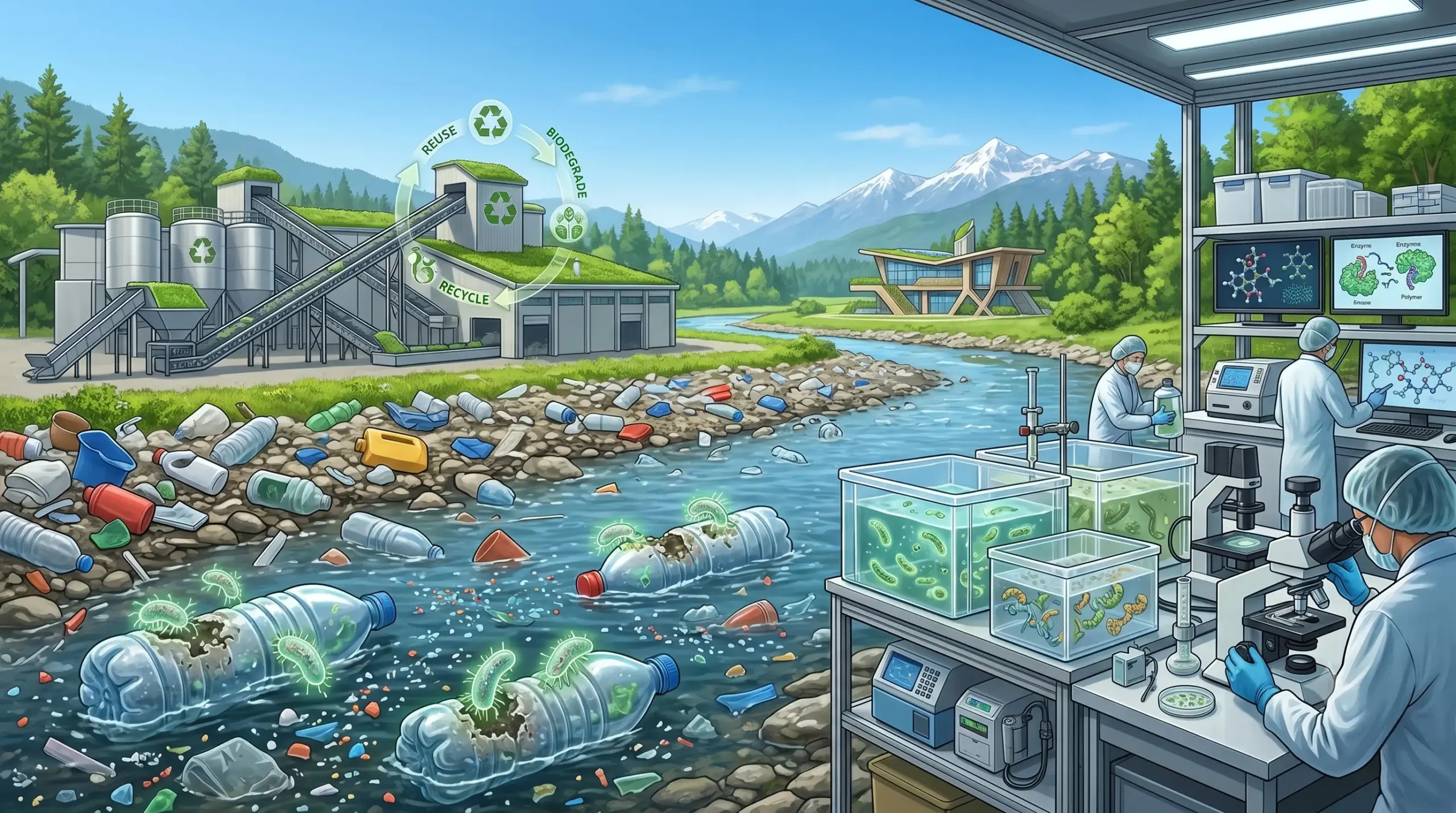
O plástico foi feito para durar séculos, mas a ciência acabou de recrutar um exército invisível para acelerar esse relógio: os “plastívoros”, micróbios e superenzimas modificados em laboratório que aprenderam a devorar nossos resíduos mais resistentes. Da descoberta de bactérias em usinas de reciclagem no Japão à engenharia de organismos capazes de resistir a temperaturas extremas, a corrida biológica para salvar o planeta do sufocamento por polímeros já começou, revelando que a resposta para a nossa enorme bagunça global pode estar escondida nas menores criaturas da Terra.
| Audio | |
|---|---|
Normal | Slow |
| English Transcript | Tradução |
| The Plastic Problem and the Rise of Plastivores | O Problema do Plástico e a Ascensão dos Plastívoros. |
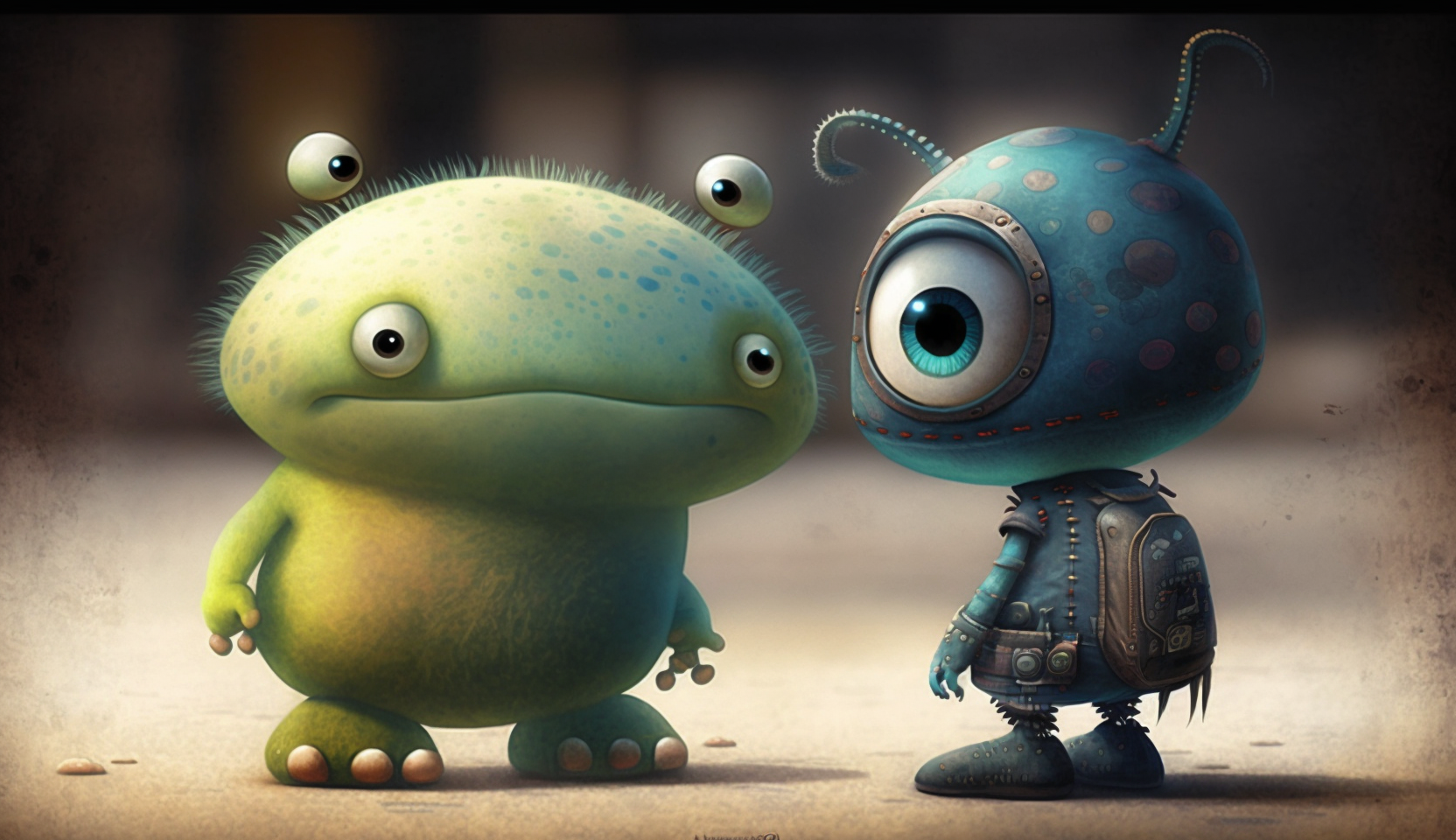
| At this very moment, almost everything around you is being eaten. Invisible to the naked eye, organisms called microbes swarm every surface. Hordes of bacteria, archaea, and fungi have evolved to produce powerful enzymes that break down tough organic material into digestible nutrients. | Neste exato momento, quase tudo ao seu redor está sendo comido. Invisíveis a olho nu, organismos chamados micróbios lotam todas as superfícies. Hordas de bactérias, archaea e fungos evoluíram para produzir enzimas poderosas que quebram materiais orgânicos resistentes em nutrientes digeríveis. |
| But there's one particularly widespread type of material that almost no microbes can biodegrade: plastics. | Mas existe um tipo de material particularmente difundido que quase nenhum micróbio consegue biodegradar: os plásticos. |
| To make most plastics, molecules from oil, gas, and coal are refined and turned into long, repeating chains called polymers. This process often requires temperatures above 100°C, incredibly high pressure, and various chemical modifications. The resulting man-made polymers are quite different from the polymers found in nature, and since they've only been around since the 1950s, most microbes haven't had time to evolve enzymes to digest them. | Para fazer a maioria dos plásticos, moléculas de petróleo, gás e carvão são refinadas e transformadas em longas cadeias repetitivas chamadas polímeros. Esse processo frequentemente requer temperaturas acima de 100°C, pressão incrivelmente alta e várias modificações químicas. Os polímeros artificiais resultantes são bastante diferentes dos polímeros encontrados na natureza e, como eles só existem desde a década de 1950, a maioria dos micróbios não teve tempo de evoluir enzimas para digeri-los. |
| Making matters even more difficult, breaking most plastics' chemical bonds requires high temperatures comparable to those used to create them—and such heat is deadly to most microbes. This means that most plastics never biologically degrade; they just turn into countless tiny, indigestible pieces. | Tornando as coisas ainda mais difíceis, quebrar as ligações químicas da maioria dos plásticos exige altas temperaturas comparáveis àquelas usadas para criá-los — e esse calor é mortal para a maioria dos micróbios. Isso significa que a maioria dos plásticos nunca se degrada biologicamente; eles apenas se transformam em incontáveis pedaços minúsculos e indigestíveis. |
| Pieces from the most common plastics—like polyethylene, polypropylene, and polyester terephthalate (PET)—have been piling up for decades. Each year, humanity produces roughly 400 million more tons of plastic, 80% of which is discarded as trash. | Pedaços dos plásticos mais comuns — como polietileno, polipropileno e tereftalato de polietileno (PET) — vêm se acumulando há décadas. A cada ano, a humanidade produz aproximadamente 400 milhões de toneladas a mais de plástico, 80% das quais são descartadas como lixo. |
| Of that plastic waste only 10% is recycled, 60% gets incinerated or goes into landfills and 30% leaks out into the environment, where it will pollute natural ecosystems for centuries. | Daquele lixo plástico apenas 10% são reciclados, 60% são incinerados ou vão para aterros sanitários e 30% vazam para o meio ambiente, onde poluirão os ecossistemas naturais por séculos. |
| An estimated 10 million tons of plastic waste end up in the ocean each year, mostly in the form of microplastic fragments that pollute the food chain. | Estima-se que 10 milhões de toneladas de resíduos plásticos acabem no oceano a cada ano, principalmente na forma de fragmentos de microplásticos que poluem a cadeia alimentar. |
| Fortunately, there are microbes that may be able to take a bite out of this growing problem. | Felizmente, existem micróbios que podem ser capazes de dar uma mordida nesse problema crescente. |
| In 2016, a team of Japanese researchers sampling sludge at a plastic bottle recycling plant discovered *Ideonella sakaiensis* 201-F6. This never-before-identified bacterium contained two enzymes capable of slowly breaking down PET polymers at relatively low temperatures. Researchers isolated the genes coding for these plastic-digesting enzymes, allowing other bioengineers to combine and improve the pair, creating "super-enzymes" that could break down PET up to six times faster. | Em 2016, uma equipe de pesquisadores japoneses coletando amostras de lodo em uma fábrica de reciclagem de garrafas plásticas descobriu a *Ideonella sakaiensis* 201-F6. Esta bactéria nunca antes identificada continha duas enzimas capazes de quebrar lentamente os polímeros de PET em temperaturas relativamente baixas. Os pesquisadores isolaram os genes que codificam essas enzimas digestoras de plástico, permitindo que outros bioengenheiros combinassem e aprimorassem a dupla, criando "superenzimas" que podiam quebrar o PET até seis vezes mais rápido. |
| Even with this boost, these lab-grown enzymes still took weeks to degrade a thin film of PET, and they operated best at temperatures below 40°C. However, another group of scientists in Japan had been researching bacterial enzymes adapted to high-temperature environments, like compost piles. Within one particularly warm pile of rotting leaves and branches, they found gene sequences for powerful degrading enzymes known as leaf-branch compost cutinases. | Mesmo com esse avanço, essas enzimas cultivadas em laboratório ainda levavam semanas para degradar uma fina película de PET, e funcionavam melhor em temperaturas abaixo de 40°C. No entanto, outro grupo de cientistas no Japão vinha pesquisando enzimas bacterianas adaptadas a ambientes de alta temperatura, como pilhas de compostagem. Dentro de uma pilha particularmente quente de folhas e galhos podres, eles encontraram sequências genéticas para enzimas degradadoras poderosas conhecidas como cutinases de composto de folhas e galhos. |
| Using fast-growing microorganisms, other researchers were able to genetically engineer high quantities of these enzymes. They then enhanced and selected special variants of the cutinase that could degrade PET plastic in environments reaching 70°C—a high temperature that can weaken PET polymers and make them digestible. | Usando microrganismos de crescimento rápido, outros pesquisadores conseguiram fazer a engenharia genética de grandes quantidades dessas enzimas. Eles então aprimoraram e selecionaram variantes especiais da cutinase que podiam degradar o plástico PET em ambientes que atingiam 70°C — uma alta temperatura que pode enfraquecer os polímeros de PET e torná-los digeríveis. |
| With the help of these and other tiny die-hards, the future of PET recycling looks promising. But PET is just one type of plastic. We still need ways to biologically degrade all the other types, including abundant PEs and PPs, which only begin breaking down at temperatures well above 130°C. Researchers don't currently know of any microbes or enzymes tough enough to tolerate such temperatures, so for now, the main way we deal with these plastics is through energy-intensive physical and chemical processes. | Com a ajuda desses e de outros pequenos guerreiros obstinados, o futuro da reciclagem de PET parece promissor. Mas o PET é apenas um tipo de plástico. Nós ainda precisamos de maneiras para degradar biologicamente todos os outros tipos, incluindo os abundantes PEs e PPs, que só começam a se quebrar em temperaturas bem acima de 130°C. Os pesquisadores não conhecem atualmente nenhum micróbio ou enzima resistente o suficiente para tolerar tais temperaturas, então, por enquanto, a principal maneira de lidarmos com esses plásticos é por meio de processos físicos e químicos de uso intenso de energia. |
| Today, only a small fraction of plastic waste can be biologically degraded by microbes. Researchers are looking for more heat-tolerant "plastivores" in the planet's most hostile environments and engineering better plastivorous enzymes in the lab. | Hoje, apenas uma pequena fração do lixo plástico pode ser biologicamente degradada por micróbios. Os pesquisadores estão procurando por "plastívoros" mais tolerantes ao calor nos ambientes mais hostis do planeta e projetando melhores enzimas plastívoras em laboratório. |
| But we can't rely solely on these tiny helpers to clean up our enormous mess. We need to completely rethink our relationship with plastics: | Mas não podemos confiar unicamente nesses pequenos ajudantes para limpar a nossa enorme bagunça. Nós precisamos repensar completamente nossa relação com os plásticos: |
| Make better use of existing plastics and stop producing more of the same, and we urgently to design more environmentally friendly types of polymers that our growing entourage of plastivores can easily break down. | Fazer melhor uso dos plásticos existentes e parar de produzir mais do mesmo, e nós precisamos urgentemente projetar tipos de polímeros mais amigáveis ao meio ambiente que nossa crescente comitiva de plastívoros possa facilmente quebrar. |
| Plastic has only been used widely since the early 20th century, so how did it come to be everywhere? Take a look back at the invention of plastic with this video, or find out what really happens to the plastic bottles you throw away with this video. | O plástico só tem sido amplamente utilizado desde o início do século XX, então como ele passou a estar em todos os lugares? Relembre a invenção do plástico com este vídeo, ou descubra o que realmente acontece com as garrafas plásticas que você joga fora com este vídeo. |
Contagem de palavras
A tabela abaixo exibe as palavras encontradas neste vídeo, bem como o número de vezes em que aparecem.
Veja também: Para que serve esta tabela?
| Freq. | Palavra | Freq. | Palavra | Freq. | Palavra |
|---|---|---|---|---|---|
| 26 | of | 24 | the | 21 | to |
| 19 | and | 12 | plastic | 11 | enzymes |
| 10 | that | 8 | this | 8 | pet |
| 8 | in | 7 | plastics | 7 | most |
| 7 | microbes | 7 | is | 6 | with |
| 6 | these | 6 | temperatures | 6 | polymers |
| 6 | for | 6 | at | 6 | a |
| 5 | we | 5 | they | 5 | researchers |
| 5 | only | 5 | more | 5 | into |
| 5 | high | 5 | down | 4 | up |
| 4 | other | 4 | have | 4 | degrade |
| 4 | can | 4 | been | 4 | are |
| 3 | waste | 3 | tiny | 3 | since |
| 3 | plastivores | 3 | out | 3 | our |
| 3 | or | 3 | one | 3 | make |
| 3 | growing | 3 | from | 3 | environments |
| 3 | chemical | 3 | °c | 3 | but |
| 3 | breaking | 3 | break | 3 | biologically |
| 3 | be | 2 | you | 2 | year |
| 2 | which | 2 | video | 2 | used |
| 2 | types | 2 | type | 2 | tough |
| 2 | tons | 2 | there | 2 | them |
| 2 | temperature | 2 | take | 2 | such |
| 2 | still | 2 | so | 2 | requires |
| 2 | recycling | 2 | problem | 2 | powerful |
| 2 | pollute | 2 | pieces | 2 | particularly |
| 2 | not | 2 | never | 2 | need |
| 2 | million | 2 | material | 2 | lab |
| 2 | just | 2 | it | 2 | heat |
| 2 | had | 2 | found | 2 | even |
| 2 | each | 2 | digestible | 2 | could |
| 2 | compost | 2 | called | 2 | better |
| 2 | as | 2 | around | 2 | almost |
| 2 | above | 2 | able | 1 | within |
| 1 | will | 1 | widespread | 1 | widely |
| 1 | where | 1 | what | 1 | were |
| 1 | well | 1 | weeks | 1 | weaken |
| 1 | ways | 1 | way | 1 | warm |
| 1 | very | 1 | various | 1 | variants |
| 1 | using | 1 | use | 1 | urgently |
| 1 | two | 1 | turned | 1 | turn |
| 1 | trash | 1 | took | 1 | tolerate |
| 1 | tolerant | 1 | today | 1 | times |
| 1 | time | 1 | throw | 1 | through |
| 1 | those | 1 | thin | 1 | then |
| 1 | themand | 1 | th | 1 | terephthalate |
| 1 | team | 1 | swarm | 1 | surface |
| 1 | super | 1 | stop | 1 | special |
| 1 | solely | 1 | small | 1 | sludge |
| 1 | slowly | 1 | six | 1 | sequences |
| 1 | selected | 1 | scientists | 1 | sampling |
| 1 | same | 1 | sakaiensis | 1 | s |
| 1 | roughly | 1 | rotting | 1 | rise |
| 1 | rethink | 1 | resulting | 1 | researching |
| 1 | repeating | 1 | rely | 1 | relatively |
| 1 | relationship | 1 | refined | 1 | recycled |
| 1 | really | 1 | reaching | 1 | quite |
| 1 | quantities | 1 | promising | 1 | producing |
| 1 | produces | 1 | produce | 1 | processes |
| 1 | process | 1 | pressure | 1 | pps |
| 1 | polypropylene | 1 | polyethylene | 1 | polyester |
| 1 | plastivorous | 1 | plasticslike | 1 | plant |
| 1 | planet | 1 | piling | 1 | piles |
| 1 | pile | 1 | physical | 1 | pes |
| 1 | pair | 1 | organisms | 1 | organic |
| 1 | operated | 1 | on | 1 | oil |
| 1 | often | 1 | ocean | 1 | nutrients |
| 1 | now | 1 | no | 1 | nature |
| 1 | natural | 1 | naked | 1 | mostly |
| 1 | moment | 1 | molecules | 1 | modifications |
| 1 | microplastic | 1 | microorganisms | 1 | mess |
| 1 | means | 1 | may | 1 | matters |
| 1 | man | 1 | making | 1 | main |
| 1 | made | 1 | low | 1 | looks |
| 1 | looking | 1 | look | 1 | long |
| 1 | like | 1 | leaves | 1 | leaks |
| 1 | leaf | 1 | landfills | 1 | known |
| 1 | know | 1 | japanese | 1 | japan |
| 1 | isolated | 1 | invisible | 1 | invention |
| 1 | intensive | 1 | indigestible | 1 | incredibly |
| 1 | including | 1 | incinerated | 1 | improve |
| 1 | ideonella | 1 | identified | 1 | humanity |
| 1 | however | 1 | how | 1 | hostile |
| 1 | hordes | 1 | helpers | 1 | help |
| 1 | has | 1 | hards | 1 | happens |
| 1 | grown | 1 | group | 1 | goes |
| 1 | gets | 1 | genetically | 1 | genes |
| 1 | gene | 1 | gas | 1 | future |
| 1 | fungi | 1 | friendly | 1 | fragments |
| 1 | fraction | 1 | fortunately | 1 | form |
| 1 | food | 1 | find | 1 | film |
| 1 | faster | 1 | fast | 1 | f |
| 1 | eye | 1 | existing | 1 | evolved |
| 1 | evolve | 1 | everywhere | 1 | everything |
| 1 | every | 1 | estimated | 1 | environmentally |
| 1 | environment | 1 | entourage | 1 | enough |
| 1 | enormous | 1 | enhanced | 1 | engineering |
| 1 | engineer | 1 | energy | 1 | end |
| 1 | ecosystems | 1 | eaten | 1 | easily |
| 1 | early | 1 | do | 1 | discovered |
| 1 | discarded | 1 | digesting | 1 | digest |
| 1 | difficult | 1 | different | 1 | die |
| 1 | did | 1 | design | 1 | degrading |
| 1 | degraded | 1 | decades | 1 | deal |
| 1 | deadly | 1 | cutinases | 1 | cutinase |
| 1 | currently | 1 | creating | 1 | create |
| 1 | countless | 1 | contained | 1 | completely |
| 1 | comparable | 1 | common | 1 | come |
| 1 | combine | 1 | coding | 1 | coal |
| 1 | clean | 1 | chains | 1 | chain |
| 1 | century | 1 | centuries | 1 | capable |
| 1 | cannot | 1 | °ca | 1 | by |
| 1 | branches | 1 | branch | 1 | bottles |
| 1 | bottle | 1 | boost | 1 | bonds |
| 1 | bite | 1 | bioengineers | 1 | biodegrade |
| 1 | best | 1 | below | 1 | being |
| 1 | begin | 1 | before | 1 | bacterium |
| 1 | bacterial | 1 | bacteria | 1 | back |
| 1 | away | 1 | archaea | 1 | any |
| 1 | another | 1 | an | 1 | allowing |
| 1 | all | 1 | adapted | 1 | abundant |