
Vídeo | The Neurology of Learning
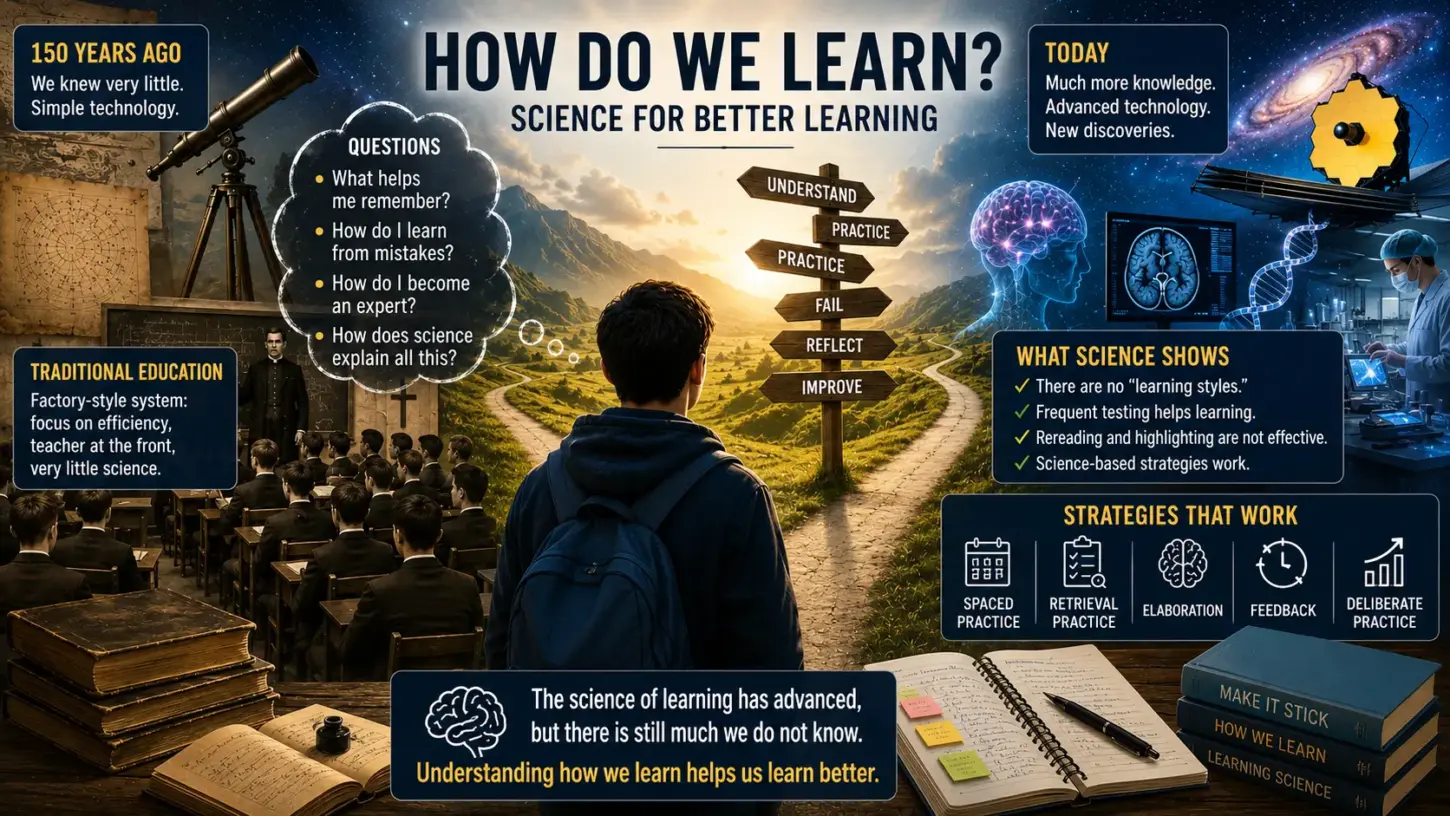
Muitos de nós passamos anos na escola, mas saímos de lá sem ter a menor ideia de como fixar um conhecimento de verdade, recorrendo a métodos ineficazes como reler e grifar textos quando, na realidade, a ciência prova que a aprendizagem real exige esforço físico do cérebro e a construção de novos caminhos neurais. Seja para dominar um idioma, um esporte ou uma nova habilidade profissional, o segredo não está em colocar informação para dentro da cabeça, mas sim em conseguir tirá-la de lá através de estratégias científicas como a recuperação espaçada, a intercalação de conceitos e o ato de abraçar os próprios erros. Deixar de lado os mitos educacionais e aplicar a ciência do aprendizado no seu dia a dia é o único caminho real para transformar o esforço em maestria e se tornar um verdadeiro especialista por conta própria.
| Audio | |
|---|---|
Normal | Slow |
| English Transcript | Tradução |
| The Neurology of Learning | A Neurologia do Aprendizado |
| I want to talk to you about one thing today, and that's, uh, learning, um… And I want you to consider one thing in particular: I want you to think about one thing that you want to learn. That might be as a student, as a high school teacher, or as a working professional like some of us here. It might be a sport, a hobby, a language, anything. And with that one thing, I want you to hold onto that for the remainder of this talk, okay? | Quero falar com vocês sobre uma coisa hoje, e isso é a aprendizagem… E quero que considerem uma coisa em particular: quero que pensem em uma coisa que vocês querem aprender. Pode ser como estudante, como professor de ensino médio ou como um profissional atuante, como alguns de nós aqui. Pode ser um esporte, um hobby, um idioma, qualquer coisa. E com essa única coisa em mente, quero que vocês a segurem pelo restante desta conversa, tudo bem? |
| About a year ago, I realized I wasn't exercising enough, so I took up the challenge of learning racket sports. Now, alongside the challenge of being genuinely useless at hitting a ball, I experienced this genuine question, which was: are the strategies I'm using to learn the sport the most effective? | Cerca de um ano atrás, percebi que não estava me exercitando o suficiente, então assumi o desafio de aprender esportes de raquete. Agora, junto com o desafio de ser genuinamente inútil em rebater uma bola, vivenciei esta pergunta real: as estratégias que estou usando para aprender o esporte são as mais eficazes? |
| So, with that thing that you're considering, whatever it might be: a hobby, a sport, a language, even just cooking, do you know what causes you to remember something? Do you know what helps you learn from failure of that thing that you want to learn? And do you know how to teach yourself something and become an expert with no one else helping you? And for all of that, can you base that and justify your methods using science? | Então, com essa coisa que você está considerando, seja o que for, um hobby, um esporte, um idioma, até mesmo cozinhar, você sabe o que faz você se lembrar de algo? Você sabe o que o ajuda a aprender com o fracasso daquela coisa que você quer aprender? E você sabe como ensinar a si mesmo algo e se tornar um especialista sem ninguém te ajudando? E, para tudo isso, você pode basear e justificar seus métodos usando a ciência? |
| Now, the reality of which is that many of us leave schooling with not much clarity and ideas about how we learn and about what is it makes us effective learners. So, I want to talk about two main things today: the first is that we don't fully understand how we learn; the second is some strategies that we can use to improve our learning, based in science. | A realidade é que muitos de nós saímos da escola sem muita clareza e ideias sobre como aprendemos e sobre o que é que nos torna alunos eficazes. Por isso, quero falar sobre duas coisas principais hoje: a primeira é que não entendemos totalmente como aprendemos; a segunda são algumas estratégias que podemos usar para melhorar nossa aprendizagem, baseadas na ciência. |
| So, as an aside to illustrate this first point, 150 years ago, astronomical sciences were quite basic. We knew little more than our solar system, and the technology we used was very, very simple. If we fast-forward to today, well, we've already landed people on the moon more than once, we've landed people on Mars more than once, and we're about to launch the most advanced telescope in human history that can look back billions of years. And I don't need to go much further than just mentioning medicine to consider this science fiction era that we live in, in terms of medical marvels and medical technology, compared to where we were 150 years ago. | Como um parêntese para ilustrar este primeiro ponto, 150 anos atrás, as ciências astronômicas eram bastante básicas. Sabíamos pouco mais do que o nosso sistema solar, e a tecnologia que usávamos era muito, muito simples. Se avançarmos para o presente, bem, já pousamos pessoas na Lua mais de uma vez, pousamos pessoas em Marte mais de uma vez, e estamos prestes a lançar o telescópio mais avançado da história humana, que pode olhar para trás bilhões de anos. E não preciso ir muito além de apenas mencionar a medicina para considerar esta era de ficção científica em que vivemos, em termos de prodígios médicos e tecnologia médica, em comparação com onde estávamos 150 anos atrás. |
| So, how does it stand for education and learning? Well, about 150 years ago, we began the first experiments in what we call universal education, education for all. And these are loosely based on the factory system, they often call it, with a focus on efficiency: so, students in year groupings, and timetables, and the, the church system of the priest or teacher at the front, at the front telling people what to know. And these practices that were being used were not much based in science, and there was virtually no neuroscience behind the approaches. | Então, como está a situação para a educação e a aprendizagem? Bem, cerca de 150 anos atrás, começamos os primeiros experimentos no que chamamos de educação universal, educação para todos. E estes foram frouxamente baseados no sistema de fábrica, como costumam chamar, com foco na eficiência: alunos em grupos por idade, horários definidos, e o sistema clerical do padre ou professor na frente dizendo às pessoas o que saber. E essas práticas que estavam sendo usadas não eram muito baseadas na ciência, e praticamente não havia neurociência por trás das abordagens. |
| So, where are we now? Well, first off, um, the reality is is we know a lot more. The factory system might be with us to some extent, if you want to call it that, but this, we've made so much progress in terms of the science of learning. | Então, onde estamos agora? Bem, em primeiro lugar, a realidade é que sabemos muito mais. O sistema de fábrica pode estar conosco até certo ponto, se você quiser chamar assim, mas fizemos muito progresso em termos de ciência da aprendizagem. |
| But there's so much we don't know. I was quite shocked to discover from my university lecturer, when I first became a school teacher, that in her view, education was among the worst fields in terms of the quality of research being done; that the quality of research into schooling, teaching, and learning was far worse than what you'd find in other fields of research. Now, that's no particular blame, that's for a range of reasons: for example, one, it's hard to get consent; two, the experiments are experimenting with people, with people's lives; there are so many variables to consider; and also, we just don't prioritize funding into education and schooling and learning-based research as compared to other fields like medicine. | Mas há tanta coisa que não sabemos. Fiquei chocado ao descobrir por meio da minha professora universitária, quando me tornei professor pela primeira vez, que, na visão dela, a educação estava entre os piores campos em termos de qualidade de pesquisa sendo feita; que a qualidade da pesquisa em escolaridade, ensino e aprendizagem era muito pior do que o que você encontraria em outros campos de pesquisa. Isso não é uma culpa específica, isso acontece por uma série de razões: por exemplo, um, é difícil obter consentimento; dois, os experimentos são experimentos com pessoas, com vidas de pessoas; há tantas variáveis a considerar; e também, nós simplesmente não priorizamos o financiamento para pesquisas baseadas em educação, escolaridade e aprendizagem em comparação com outros campos como a medicina. |
| So, first off, I just want to highlight that we still know very little about how humans learn best, that you, you know, might not know very much about how you learn best. So, I want to move into, rather than just slagging on education for the quality of research, or which we can question, I want to go into what we do know. | Então, primeiro, eu só quero destacar que ainda sabemos muito pouco sobre como os humanos aprendem melhor, e que você pode não saber muito sobre como você aprende melhor. Então, em vez de apenas criticar a educação pela qualidade da pesquisa, a qual podemos questionar, quero entrar no que nós sabemos. |
| So, I want a little bit of interaction from all of you right now. I want you to put your hands up in terms of you: what type of learning style are you? So, when you put your hands up, if you're the type of learner who learns best when you receive information visually, all right. What about kinesthetic, or in a physical way? What if it's auditory, you can hear it? Some of you are a bit of all of those three, all right. And what about this: hands up if you think that exams and testing are a dated method of learning that need to change. All right, a lot of consensus on that one. Let's get rid of exams, love it. And what about this: do you think that reviewing, rereading, and highlighting are effective study methods? Some mixed views on that, all right. | Quero um pouco de interação de todos vocês agora. Quero que levantem as mãos: que tipo de estilo de aprendizagem você é? Quando você levantar a mão, se for o tipo de aluno que aprende melhor quando recebe informações visualmente, tudo bem. E quanto ao cinestésico, ou de uma forma física? E se for auditivo, quando você consegue ouvir? Alguns de vocês são um pouco de todos esses três, tudo bem. E quanto a isso: levantem as mãos se vocês acham que os exames e testes são um método de aprendizagem ultrapassado que precisa mudar. Certo, muito consenso sobre isso. Vamos nos livrar dos exames, adorei. E quanto a isso: você acha que revisar, reler e grifar são métodos de estudo eficazes? Algumas opiniões divididas sobre isso, tudo bem. |
| So, what do we know? Well, the reality of the current science is everything I said is just false. Learning styles are a myth, they don't exist. You are not a visual learner; we are all visual learners in some extent. Exams and testing definitely have their problems, but regular testing is still a proven learning method, and there are much better methods than just rereading something, okay? | Então, o que sabemos? Bem, a realidade da ciência atual é que tudo o que eu disse é simplesmente falso. Estilos de aprendizagem são um mito, eles não existem. Você não é um aluno visual; todos nós somos alunos visuais até certo ponto. Exames e testes definitivamente têm seus problemas, mas testes regulares ainda são um método de aprendizagem comprovado, e existem métodos muito melhores do que apenas reler algo, tudo bem? |
| Now, in terms of learning style, the reality is there is no evidence in favor of learning styles. For all we know, all humans share the same fundamental learning algorithm. That's from the French cognitive scientist, Dehaene. What he's essentially saying is that we all learn in the same fundamental way. We share the same neurological processes of mammals, birds, even fish. That if we better understand the fundamentals of how our neurological processes work, then we can better understand how all of us can learn more effectively. | Agora, em termos de estilo de aprendizagem, a realidade é que não há evidências a favor dos estilos de aprendizagem. Pelo que sabemos, todos os humanos compartilham o mesmo algoritmo fundamental de aprendizagem. Isso vem do cientista cognitivo francês Stanislas Dehaene. O que ele está essencialmente dizendo é que todos nós aprendemos da mesma forma fundamental. Compartilhamos os mesmos processos neurológicos de mamíferos, aves e até peixes. Se entendermos melhor os fundamentos de como nossos processos neurológicos funcionam, então poderemos entender melhor como todos nós podemos aprender de forma mais eficaz. |
| So, much of what I'm about to present comes from these two texts: "Make It Stick" and "How We Learn", both exploring the science of learning and the studies associated with those two texts. I would also highlight that I'm not a cognitive scientist, I don't have a PhD in neurology or educational research. I'm a school teacher, and I'm someone who's passionate about this, and therefore I'm pursuing a better understanding of this because I think it's something we ignore far too often. | Muito do que estou prestes a apresentar vem destes dois textos, Make It Stick e How We Learn, ambos explorando a ciência da aprendizagem e os estudos associados a esses dois textos. Eu também destacaria que não sou um cientista cognitivo, não tenho doutorado em neurobiologia ou pesquisa educacional. Sou um professor de escola e alguém apaixonado por isso, e, portanto, estou buscando uma melhor compreensão disso porque acho que é algo que ignoramos com frequência de mais. |
| So, first off, I'm going to go through essentially a whole bunch of science. I apologize if it's a lot, but I'm gonna try and make it as simple as possible. | Primeiro, vou passar essencialmente por um monte de ciência. Peço desculpas se for muito, mas vou tentar tornar o mais simples possível. |
| The first of is: what is learning? Okay, well, your brain is made up of neural pathways. Any thought or action that you do activates a set of neural pathways. If a neural pathway is activated repeatedly, that neural connection becomes stronger. So, when you learn something for the first time, in other words, you're creating a neural connection inside your brain between two points, and if you use it repeatedly, that connection becomes stronger. Essentially, learning is the construction and rewiring of neural pathways inside your brain; it is a physical thing inside your head. Therefore, though you would like to think that learning should be easy, the research shows the opposite. When your mind has to work, learning sticks better. Essentially, learning that requires effort is effective learning. Just like lifting weights is hard, effective learning is also hard. | O primeiro ponto é: o que é aprendizagem? Bem, seu cérebro é feito de caminhos neurais. Qualquer pensamento ou ação que você faz ativa um conjunto de caminhos neurais. Se um caminho neural é ativado repetidamente, essa conexão neural se torna mais forte. Quando você aprende algo pela primeira vez, em outras palavras, você está criando uma conexão neural dentro do seu cérebro entre dois pontos, e se você a usa repetidamente, essa conexão se torna mais forte. Essencialmente, a aprendizagem é a construção e a fiação de caminhos neurais dentro do seu cérebro; é uma coisa física dentro da sua cabeça. No entanto, embora você queira pensar que a aprendizagem deveria ser fácil, a pesquisa mostra o oposto. Quando sua mente tem que trabalhar, a aprendizagem se fixa melhor. Essencialmente, a aprendizagem que exige esforço é uma aprendizagem eficaz. Assim como levantar pesos é difícil, a aprendizagem eficaz também é difícil. |
| So, I'm going to go through four main strategies I've picked out from some of this research, it's not all of it, but it's four that we can use a starting point for how we might reconsider how we approach learning. | Vou passar por quatro estratégias principais que selecionei de algumas dessas pesquisas. Não são todas, mas são quatro que podemos usar como ponto de partida para reconsiderarmos como abordamos a aprendizagem. |
| The first is this idea of spaced retrieval. When you experience something for the first time, that goes into what we call your sensory memory, and then it goes into your working memory if you use it. But if you do nothing with that information, it's going to fade away; it will disappear. But let's say the next day you recall something you remember a few days ago, and then the day after that, and then the day after that, gradually, you're going to solidify that into long-term memory. | A primeira é esta ideia de recuperação espaçada. Quando você vivencia algo pela primeira vez, isso vai para o que chamamos de sua memória sensorial, e depois vai para a sua memória de trabalho se você a utilizar. Mas se você não fizer nada com essa informação, ela vai desaparecer; ela vai sumir. Mas digamos que no dia seguinte você se lembre de algo de que se recordou alguns dias atrás, e depois no dia seguinte a esse, e no dia seguinte a esse, gradualmente você vai solidificar isso na memória de longo prazo. |
| So, what does this look like in practice? Well, they did one study, well, high school students learning French. They had them to learn French vocabulary: one group by doing a 10-minute lesson each day for three days; the other group doing the same lessons, but all back together on a single day over 30 minutes. Seven days later, they gave them an unannounced test. Which group did better? The group that did spaced practice, spreading their learning over multiple days, by a far point, did a lot better. And this is showing again and again and again, the same thing in research: that when we spread out learning, it leads to better retention, and that the effort for you to recall something, even if it's hard, that you've almost forgotten, helps to strengthen that neural pathway. | Como isso se parece na prática? Fizeram um estudo com estudantes de ensino médio aprendendo francês. Eles tinham que aprender vocabulário de francês: um grupo fazendo uma lição de 10 minutos a cada dia durante três dias; o outro grupo fazendo as mesmas lições, mas todas juntas em um único dia ao longo de 30 minutos. Sete dias depois, deram a eles um teste surpresa. Qual grupo se saiu melhor? O grupo que fez a prática espaçada, distribuindo sua aprendizagem ao longo de vários dias, por uma grande margem, se saiu muito melhor. E isso se mostra repetidamente na pesquisa: que quando distribuímos a aprendizagem, isso leva a uma melhor retenção, e que o esforço para você se lembrar de algo, mesmo que seja difícil e você quase tenha esquecido, ajuda a fortalecer esse caminho neural. |
| Furthermore, it's not just the effort, it's something else. We've already seen that learning is much more efficient when we spread out the learning. The reason is simple: every night, your brain consolidates your learning and what it's done during the day. This is one of the most important neuroscience discoveries of the last 30 years, which is as follows: while you sleep, your brain remains active, translating effective learning into a more efficient compartment of your memory. In other words, spaced retrieval of memory strengthens that neural network for that learning, and good, healthy sleep consolidates your learning. So, your parents are correct: go to bed early, please. | Além disso, não é apenas o esforço, é algo mais. Já vimos que a aprendizagem é muito mais eficiente quando a distribuímos. A razão é simples: todas as noites, seu cérebro consolida sua aprendizagem e o que ele fez durante o dia. Esta é uma das descobertas mais importantes da neurociência dos últimos 30 anos, que é a seguinte: enquanto você dorme, seu cérebro permanece ativo, traduzindo a aprendizagem eficaz em um compartimento mais eficiente da sua memória. Em outras palavras, a recuperação espaçada da memória fortalece essa rede neural para aquela aprendizagem, e um sono bom e saudável consolida sua aprendizagem. Seus pais estão certos: vão para a cama cedo, por favor. |
| In addition to this, we'll just expand on this in the words of Pooja Agarwal: "learning is not getting information into your head; learning is getting information out of your head." Essentially, learning that is not used is not learned. And I don't mean testing or exams when I say "spaced retrieval" or reaching and recalling something; any method that you use that requires you to use something you previously learned counts. | Somado a isso, vamos expandir isto nas palavras de Pooja Agarwal: a aprendizagem não é colocar informação na sua cabeça; a aprendizagem é tirar informação da sua cabeça. Essencialmente, a aprendizagem que não é usada não é aprendida. E não me refiro a testes ou exames quando digo recuperação espaçada ou alcançar e recordar algo; qualquer método que você use e que exija que você use algo que aprendeu anteriormente conta. |
| Consider this baseball team study. They had a team do massed practice where they had to do a set of baseball batting, they wanted to improve their baseball batting, okay?, and they got one set of 15 fastballs back-to-back, and they hit 15 fastballs. Then they had one set of curveballs, 15 curveballs, and then one set of 15 changeups, twice a week for six weeks. And during practice, they were able to refine their skill and get much better at performing well to those different pitches or throws. What was the results after six weeks? Well, as we expect, all players showed an improvement. Great, the science is true, lovely. | Considerem este estudo com um time de beisebol. Eles fizeram um time realizar a prática concentrada, onde tinham que fazer uma série de rebatidas de beisebol, eles queriam melhorar suas rebatidas, e receberam uma série de 15 bolas rápidas consecutivas, e rebateram 15 bolas rápidas. Depois tiveram uma série de bolas de curva, 15 bolas de curva, e depois uma série de 15 bolas de mudança de velocidade, duas vezes por semana durante seis semanas. E durante a prática, eles foram capazes de refinar sua habilidade e melhorar bastante no desempenho diante desses diferentes arremessos ou lançamentos. Quais foram os resultados após seis semanas? Como esperávamos, todos os jogadores mostraram uma melhora. Ótimo, a ciência está certa, que bom. |
| Well, what about the other half of the team? What did they do? Well, they just gave them a complete, highly random sequence of 45 pitches, the same types of balls, the same number, but the order was completely randomized. What did it feel like? Well, it was just frustrating. They made lots of errors, they didn't perform as well, they didn't know what was coming, and it was just a difficult time. Who did better? The group that had the random sequence, that constantly made mistakes, did much better in the actual performance six weeks later. Why did it work? Relatively simple. | O que aconteceu com a outra metade do time? O que eles fizeram? Eles apenas receberam uma sequência completa e altamente aleatória de 45 arremessos, os mesmos tipos de bolas, a mesma quantidade, mas a ordem foi completamente aleatória. Como foi a sensação? Foi simplesmente frustrante. Eles cometeram muitos erros, não tiveram um desempenho tão bom, não sabiam o que estava por vir e foi um momento difícil. Quem se saiu melhor? O grupo que teve a sequência aleatória, que constantemente cometia erros, se saiu muito melhor no desempenho real seis semanas depois. Por que funcionou? Relativamente simples. |
| The next strategy I want to present to you is what we call interleaving and variation. The first half of the team did what we call massed practice, which is kind of how I learned maths when I was at school. The other half of the team did interleaving, which is much more effective. This is essentially when you mix up closely related concepts once you have learned them, don't make it hard on yourself, learn it first, and then mix it up. | A próxima estratégia que quero apresentar a vocês é o que chamamos de intercalação e variação. A primeira metade do time fez o que chamamos de prática concentrada, que é mais ou menos como eu aprendia matemática quando estava na escola. A outra metade do time fez a intercalação, que é muito mais eficaz. Isso acontece essencialmente quando você mistura conceitos intimamente relacionados depois de já tê-los aprendido. Não torne as coisas difíceis para si mesmo no início, aprenda primeiro e depois misture. |
| Here's another study to illustrate the point. They had children throw beanbags three feet away, just do it over and over again, three feet. They had another group throw beanbags every possible distance except three feet away. What's your challenge? Just throw it three feet away. Who's going to do better: the group who doing the same thing over and over again, or those who are changing it up? Those who won were those who never threw the beanbag three feet away. The reason why is because their varied practice improved their skill at taking the learning from one situation and applying it to another. In order to throw that beanbag different distances, they were making micro-adjustments, which improved their accuracy overall. Essentially, learning is not effective when you put it in a small box by itself; learning that is connected to other learning is powerful learning. | Aqui está outro estudo para ilustrar o ponto. Eles fizeram crianças lançarem sacos de areia a três pés de distância, apenas fazendo isso repetidamente, três pés. Eles fizeram outro grupo lançar sacos de areia a todas as distâncias possíveis, exceto a três pés de distância. Qual é o desafio final? Apenas lançar a três pés de distância. Quem vai se sair melhor: o grupo que estava fazendo a mesma coisa repetidamente ou aqueles que estavam mudando? Aqueles que venceram foram os que nunca lançaram o saco de areia a três pés de distância durante o treino. A razão é porque a prática variada melhorou a habilidade deles de pegar a aprendizagem de uma situação e aplicá-la a outra. Para lançar aquele saco de areia a diferentes distâncias, eles estavam fazendo microajustes, o que melhorou a precisão geral. Essencialmente, a aprendizagem não é eficaz quando você a coloca em uma caixa pequena sozinha; a aprendizagem que está conectada a outra aprendizagem é uma aprendizagem poderosa. |
| Furthermore, so what do we know from this overall? So what I've told you so far is: one, learning is a physical action inside your head; effective learning is spread out over time, connected to other learning, and it requires effort. | Além disso, o que sabemos disso tudo? O que eu disse até agora é: um, a aprendizagem é uma ação física dentro da sua cabeça; a aprendizagem eficaz é distribuída ao longo do tempo, conectada a outra aprendizagem e exige esforço. |
| Which is why the third strategy I want to present to you is embracing difficulties and reflecting. So already, the science shows us that if you embrace errors and correct them, that leads to effective learning. Even if you're doing, say, this spaced practice with interleaving, by mixing up related learning, and you make a lot of mistakes, if you correct that, though, that leads to effective learning. But it goes further than just this. Consider, well, actually, going back to the last point about those children, the mistakes that you make in your practice, and they made in their practice, are adjusting and refining their skill, and being better at applying that learning in different circumstances. Essentially, to make zero mistakes leads to ineffective learning. | É por isso que a terceira estratégia que quero apresentar a vocês é abraçar as dificuldades e refletir. A ciência já nos mostra que, se você abraçar os erros e os corrigir, isso leva a uma aprendizagem eficaz. Mesmo se você estiver fazendo esta prática espaçada com intercalação, misturando aprendizagens relacionadas, e cometer muitos erros, se você corrigir isso, isso leva a uma aprendizagem eficaz. Voltando ao último ponto sobre aquelas crianças, os erros que você comete na sua prática, e que elas cometeram na prática delas, servem para ajustar e refinar a habilidade, tornando-os melhores em aplicar essa aprendizagem em diferentes circunstâncias. Essencialmente, cometer zero erros leva a uma aprendizagem ineficaz. |
| It goes further than this. Consider the story of Captain Sully. He was an American pilot doing a routine flight over New York City, and just as he was leaving, suddenly the engines collapsed, they stopped working. In the matter of the next three to four minutes, he crash-landed, or shall we say, safely landed, the plane into a river in the middle of the city. He was able to do that because he'd spend thousands of hours mastering the art of being a pilot, but also because he did one thing that all of us can apply in our learning, which is to mentally rehearse and review your learning. | Isso vai além disso. Considerem a história do Capitão Sully. Ele era um piloto americano fazendo um voo de rotina sobre a cidade de Nova York e, assim que estava saindo, de repente os motores falharam, eles pararam de funcionar. Em questão dos próximos três a quatro minutos, ele fez um pouso forçado, ou digamos, pousou o avião em segurança em um rio no meio da cidade. Ele foi capaz de fazer isso porque tinha passado milhares de horas dominando a arte de ser piloto, mas também porque fez uma coisa que todos nós podemos aplicar em nossa aprendizagem, que é ensaiar mentalmente e revisar sua aprendizagem. |
| Professionals across multiple fields do this all the time. Sully was doing it as a pilot to prepare for possible problems. A professional kayaker doing a difficult maneuver prepares for a difficult move by mentally rehearsing what could go wrong. A chess champion, before and after chess matches, is rehearsing different games and different approaches. Or just you, trying to master that fancy French omelet that's rather tricky. To mentally rehearse and review your learning helps to consolidate that learning and create what they call mental models to apply it in different circumstances. | Profissionais de vários campos fazem isso o tempo todo. Sully estava fazendo isso como piloto para se preparar para possíveis problemas. Um canoísta profissional realizando uma manobra difícil se prepara para um movimento complicado ensaiando mentalmente o que poderia dar errado. Um campeão de xadrez, antes e depois das partidas de xadrez, está ensaiando diferentes jogos e diferentes abordagens. Ou apenas você, tentando dominar aquela omelete francesa sofisticada que é bastante complicada. Ensaiar mentalmente e revisar sua aprendizagem ajuda a consolidar esse conhecimento e a criar o que chamam de modelos mentais para aplicá-lo em diferentes circunstâncias. |
| So, just to add to this, consider this list of random digits, there's 501 digits there, okay? About eight years ago, Johannes Mallow, a world memorization competitor, went to a competition to, about memorization, and he won the competition. What he did was, he was given a random list of numbers, he sat down for five minutes, and tried to memorize as many of them. And after five minutes, he was able to recite 501 digits in perfect order without a single mistake. | Para acrescentar a isso, considerem esta lista de dígitos aleatórios, há 501 dígitos ali. Cerca de oito anos atrás, Johannes Mallow, um competidor mundial de memorização, foi a uma competição sobre memorização e venceu a competição. O que ele fez foi receber uma lista aleatória de números, sentar-se por cinco minutos e tentar memorizar o máximo possível deles. E após cinco minutos, ele foi capaz de recitar 501 dígitos em ordem perfeita, sem um único erro. |
| Now, the reality is, is an extraordinary part, is that we currently don't know how much you can learn. There's no known limit. But I don't want to discuss how much you can learn; I want to discuss how we are learning. So, for Mallow, he was able to do that because he used very precise, precise strategies to improve how much he could learn in the time that he had. | A realidade é uma parte extraordinária, atualmente não sabemos o quanto uma pessoa pode aprender. Não há limite conhecido. Mas não quero discutir o quanto você pode aprender; quero discutir como estamos aprendendo. Para Mallow, ele foi capaz de fazer isso porque usou estratégias muito precisas para melhorar o quanto podia aprender no tempo que tinha. |
| Which is why the fourth and last strategy I want to cover is high-quality encoding of learning, or shall we say, high-quality thinking in your learning. Consider this Bloom's Taxonomy. It's a hierarchy of learning: lower down, less complex thinking; higher up, more complex thinking. Just to recall something, say spaced retrieval, is actually fairly low in terms of complexity of thinking, whereas we want to aim for things higher up on that list. One thing that comes again and again in people who discuss what effective learning looks like based on science, they talk about elaboration. Elaboration is to process your learning, make sense of it, and relate it to prior learning. | É por isso que a quarta e última estratégia que quero cobrir é a codificação de alta qualidade da aprendizagem, ou digamos, o pensamento de alta qualidade na sua aprendizagem. Considerem a Taxonomia de Bloom. É uma hierarquia de aprendizagem: mais abaixo, pensamento menos complexo; mais acima, pensamento mais complexo. Apenas recordar algo, como na recuperação espaçada, é na verdade bastante baixo em termos de complexidade de pensamento, enquanto queremos buscar coisas mais altas nessa lista. Uma coisa que surge repetidamente entre as pessoas que discutem como é a aprendizagem eficaz com base na ciência é a elaboração. Elaboração significa processar sua aprendizagem, dar sentido a ela e relacioná-la com a aprendizagem anterior. |
| In other words, let's say this in practice: so, say you're wanting to learn about nutrition, so you're reading Michael Pollan. The typical approach is you finish a part of the book, you do nothing with that, and you're probably going to forget a lot of it. But say we want to apply these principles: so, we finish the first part of the book, we space out a self-check over the next week, and we want, we want to apply some elaboration. So, we elaborate on what we've learned by explaining it, written or verbally. We elaborate by writing down what you remember in checking, teaching it to someone else, or simplifying it, and with all of that, varying the different concepts we're covering. | Em outras palavras, digamos isso na prática: se você quer aprender sobre nutrição, você lê Michael Pollan. A abordagem típica é terminar uma parte do livro, não fazer nada com aquilo e você provavelmente vai esquecer muito disso. Mas digamos que queremos aplicar estes princípios: terminamos a primeira parte do livro, espaçamos uma verificação própria ao longo da semana seguinte e queremos aplicar alguma elaboração. Elaboramos o que aprendemos explicando de forma escrita ou verbal. Elaboramos escrevendo o que você se lembra e verificando, ensinando para outra pessoa ou simplificando, e com tudo isso, variando os diferentes conceitos que estamos cobrindo. |
| So, what am I saying? Effective learning is more than just remembering something; effective learning is elaborating or mentally rehearsing different approaches, elaborating on what you know, reflecting on how it went, and applying it in new situations. | O que estou dizendo? Aprendizagem eficaz é mais do que apenas lembrar algo; aprendizagem eficaz é elaborar ou ensaiar mentalmente diferentes abordagens, elaborar sobre o que você sabe, refletir sobre como foi e aplicar em novas situações. |
| So, lastly, let's consider you're learning tennis, for example, and you've learned a brand-new serve. You're going to apply some varied practice and spaced retrieval over the next week, but you'll stay, all the foundations, you still will practice that same serve for muscle memory. You will use variation to change the spot you're aiming at, you'll mix the new serve with old serves, and you're going to mentally rehearse and review your game before, after, and during a game in practice. What I'm saying is these principles are presented here can be applied to both cognitive thinking as well as physical things. That thing that you're thinking about, the very beginning of what I started talking, that thing you wanted to learn, you can apply all these principles to, no matter what it is: cooking, cleaning, whatever, okay? | Por fim, consideremos que você está aprendendo tênis, por exemplo, e aprendeu um saque totalmente novo. Você vai aplicar um pouco de prática variada e recuperação espaçada ao longo da semana seguinte, mas todos os fundamentos permanecem, você ainda vai praticar o mesmo saque para a memória muscular. Você vai usar a variação para mudar o local onde está mirando, vai misturar o saque novo com saques antigos e vai ensaiar mentalmente e revisar seu jogo antes, depois e durante um jogo no treino. O que estou dizendo é que estes princípios apresentados aqui podem ser aplicados tanto ao pensamento cognitivo quanto a coisas físicas. Aquela coisa em que você estava pensando logo no início de quando comecei a falar, aquela coisa que você queria aprender, você pode aplicar todos estes princípios a ela, não importa o que seja: cozinhar, limpar, o que for, tudo bem? |
| So, the last thing I want to highlight is that the reality is we know far less about how to learn than we should, at least in my view, in comparison with astronomical sciences and medicine. I also want to practice what I preach. So, if you found what I said interesting and you want to review this and look back on it, I've made a QR code and a link that you can access right now. But what I've presented is, in reality, just a small snapshot of what we do and we don't know, which is why I ask all of you to move past and beyond value judgments and stories we say about what effective or good learning is, and actually, much like we base medicine in science, we too should be basing learning in science. Thank you very much. | A última coisa que quero destacar é que a realidade é que sabemos muito menos sobre como aprender do que deveríamos, pelo menos na minha visão, em comparação com as ciências astronômicas e a medicina. Também quero praticar o que prego. Se você achou o que eu disse interessante e quer revisar isso e olhar de volta, criei um código QR e um link que você pode acessar agora mesmo. Mas o que apresentei é, na realidade, apenas um pequeno recorte do que sabemos e não sabemos, e é por isso que peço a todos vocês que avancem além dos julgamentos de valor e das histórias que contamos sobre o que é uma aprendizagem eficaz ou boa, e realmente, assim como baseamos a medicina na ciência, nós também deveríamos basear a aprendizagem na ciência. Muito obrigado. |
Contagem de palavras
A tabela abaixo exibe as palavras encontradas neste vídeo, bem como o número de vezes em que aparecem.
Veja também: Para que serve esta tabela?
| Freq. | Palavra | Freq. | Palavra | Freq. | Palavra |
|---|---|---|---|---|---|
| 113 | the | 103 | to | 94 | and |
| 88 | is | 87 | of | 86 | you |
| 83 | that | 69 | a | 65 | learning |
| 64 | we | 56 | it | 52 | I |
| 50 | in | 45 | what | 35 | so |
| 33 | are | 30 | do | 28 | this |
| 26 | your | 25 | want | 25 | not |
| 24 | they | 24 | about | 22 | just |
| 22 | for | 22 | all | 21 | was |
| 20 | learn | 18 | know | 18 | how |
| 17 | or | 17 | one | 17 | much |
| 16 | on | 16 | if | 16 | he |
| 15 | with | 15 | well | 15 | effective |
| 15 | did | 15 | but | 15 | as |
| 14 | thing | 14 | practice | 14 | have |
| 14 | first | 14 | can | 13 | something |
| 13 | science | 13 | better | 12 | which |
| 12 | when | 11 | us | 11 | up |
| 11 | than | 11 | am | 10 | say |
| 10 | over | 10 | other | 10 | more |
| 10 | into | 9 | who | 9 | their |
| 9 | some | 9 | same | 9 | research |
| 9 | going | 9 | consider | 9 | at |
| 8 | three | 8 | there | 8 | now |
| 8 | neural | 8 | like | 8 | had |
| 8 | from | 8 | essentially | 8 | different |
| 7 | were | 7 | very | 7 | use |
| 7 | those | 7 | then | 7 | spaced |
| 7 | reality | 7 | make | 7 | group |
| 7 | doing | 7 | call | 7 | by |
| 7 | be | 7 | again | 6 | years |
| 6 | will | 6 | time | 6 | thinking |
| 6 | these | 6 | them | 6 | terms |
| 6 | right | 6 | people | 6 | out |
| 6 | okay | 6 | no | 6 | might |
| 6 | memory | 6 | made | 6 | lot |
| 6 | learned | 6 | go | 6 | education |
| 6 | day | 6 | back | 6 | apply |
| 6 | an | 6 | ago | 6 | after |
| 5 | why | 5 | two | 5 | think |
| 5 | team | 5 | set | 5 | school |
| 5 | retrieval | 5 | quality | 5 | point |
| 5 | next | 5 | mentally | 5 | hard |
| 5 | feet | 5 | far | 5 | brain |
| 5 | being | 5 | because | 5 | based |
| 5 | away | 5 | also | 4 | would |
| 4 | words | 4 | used | 4 | throw |
| 4 | testing | 4 | teacher | 4 | talk |
| 4 | system | 4 | study | 4 | strategies |
| 4 | simple | 4 | review | 4 | random |
| 4 | physical | 4 | our | 4 | new |
| 4 | mistakes | 4 | minutes | 4 | medicine |
| 4 | let | 4 | leads | 4 | last |
| 4 | landed | 4 | inside | 4 | information |
| 4 | high | 4 | head | 4 | goes |
| 4 | french | 4 | fields | 4 | exams |
| 4 | even | 4 | effort | 4 | days |
| 4 | able | 3 | working | 3 | work |
| 3 | where | 3 | weeks | 3 | week |
| 3 | understand | 3 | today | 3 | things |
| 3 | strategy | 3 | still | 3 | spread |
| 3 | sport | 3 | skill | 3 | six |
| 3 | should | 3 | serve | 3 | schooling |
| 3 | saying | 3 | requires | 3 | remember |
| 3 | rehearsing | 3 | rehearse | 3 | recall |
| 3 | put | 3 | principles | 3 | present |
| 3 | possible | 3 | pilot | 3 | pathways |
| 3 | part | 3 | order | 3 | once |
| 3 | off | 3 | move | 3 | most |
| 3 | mix | 3 | methods | 3 | method |
| 3 | many | 3 | look | 3 | little |
| 3 | list | 3 | interleaving | 3 | improve |
| 3 | highlight | 3 | here | 3 | helps |
| 3 | hands | 3 | half | 3 | get |
| 3 | further | 3 | four | 3 | else |
| 3 | elaboration | 3 | during | 3 | down |
| 3 | discuss | 3 | digits | 3 | difficult |
| 3 | correct | 3 | connection | 3 | cognitive |
| 3 | challenge | 3 | best | 3 | baseball |
| 3 | approaches | 3 | applying | 3 | another |
| 3 | already | 3 | actually | 2 | yourself |
| 2 | year | 2 | won | 2 | whatever |
| 2 | went | 2 | way | 2 | wanted |
| 2 | visual | 2 | view | 2 | varied |
| 2 | variation | 2 | using | 2 | um |
| 2 | type | 2 | too | 2 | through |
| 2 | though | 2 | therefore | 2 | texts |
| 2 | technology | 2 | teaching | 2 | sully |
| 2 | styles | 2 | style | 2 | students |
| 2 | stronger | 2 | someone | 2 | small |
| 2 | sleep | 2 | single | 2 | shows |
| 2 | share | 2 | shall | 2 | sequence |
| 2 | scientist | 2 | sciences | 2 | said |
| 2 | rereading | 2 | repeatedly | 2 | related |
| 2 | reflecting | 2 | reason | 2 | rather |
| 2 | quite | 2 | question | 2 | professional |
| 2 | processes | 2 | problems | 2 | presented |
| 2 | precise | 2 | pitches | 2 | pathway |
| 2 | particular | 2 | overall | 2 | often |
| 2 | nothing | 2 | neuroscience | 2 | neurology |
| 2 | neurological | 2 | need | 2 | my |
| 2 | multiple | 2 | memorization | 2 | medical |
| 2 | matter | 2 | massed | 2 | mallow |
| 2 | main | 2 | less | 2 | learners |
| 2 | learner | 2 | later | 2 | language |
| 2 | improved | 2 | illustrate | 2 | humans |
| 2 | hobby | 2 | higher | 2 | has |
| 2 | good | 2 | getting | 2 | gave |
| 2 | game | 2 | furthermore | 2 | fundamental |
| 2 | front | 2 | five | 2 | finish |
| 2 | fastballs | 2 | factory | 2 | extent |
| 2 | experiments | 2 | example | 2 | every |
| 2 | errors | 2 | elaborating | 2 | elaborate |
| 2 | efficient | 2 | done | 2 | does |
| 2 | curveballs | 2 | could | 2 | cooking |
| 2 | consolidates | 2 | connected | 2 | concepts |
| 2 | complex | 2 | competition | 2 | compared |
| 2 | comes | 2 | city | 2 | circumstances |
| 2 | children | 2 | chess | 2 | change |
| 2 | both | 2 | book | 2 | bit |
| 2 | before | 2 | becomes | 2 | beanbags |
| 2 | beanbag | 2 | batting | 2 | base |
| 2 | astronomical | 2 | approach | 2 | any |
| 2 | action | 1 | zero | 1 | york |
| 1 | wrong | 1 | written | 1 | writing |
| 1 | worst | 1 | worse | 1 | world |
| 1 | without | 1 | whole | 1 | while |
| 1 | whereas | 1 | weights | 1 | wanting |
| 1 | vocabulary | 1 | visually | 1 | virtually |
| 1 | views | 1 | verbally | 1 | varying |
| 1 | variables | 1 | value | 1 | useless |
| 1 | university | 1 | universal | 1 | understanding |
| 1 | unannounced | 1 | uh | 1 | typical |
| 1 | types | 1 | twice | 1 | trying |
| 1 | try | 1 | true | 1 | tried |
| 1 | tricky | 1 | translating | 1 | took |
| 1 | told | 1 | together | 1 | timetables |
| 1 | throws | 1 | threw | 1 | thousands |
| 1 | thought | 1 | third | 1 | thank |
| 1 | test | 1 | term | 1 | tennis |
| 1 | telling | 1 | telescope | 1 | teach |
| 1 | taxonomy | 1 | talking | 1 | taking |
| 1 | suddenly | 1 | studies | 1 | student |
| 1 | strengthens | 1 | strengthen | 1 | story |
| 1 | stories | 1 | stopped | 1 | sticks |
| 1 | stick | 1 | stay | 1 | starting |
| 1 | started | 1 | stand | 1 | spreading |
| 1 | spot | 1 | sports | 1 | spend |
| 1 | space | 1 | solidify | 1 | solar |
| 1 | snapshot | 1 | slagging | 1 | situations |
| 1 | situation | 1 | simplifying | 1 | showing |
| 1 | showed | 1 | shocked | 1 | seven |
| 1 | serves | 1 | sensory | 1 | sense |
| 1 | self | 1 | seen | 1 | second |
| 1 | sat | 1 | safely | 1 | routine |
| 1 | river | 1 | rid | 1 | rewiring |
| 1 | reviewing | 1 | retention | 1 | results |
| 1 | remembering | 1 | remains | 1 | remainder |
| 1 | relatively | 1 | relate | 1 | regular |
| 1 | refining | 1 | refine | 1 | reconsider |
| 1 | recite | 1 | receive | 1 | recalling |
| 1 | reasons | 1 | realized | 1 | reading |
| 1 | reaching | 1 | range | 1 | randomized |
| 1 | racket | 1 | qr | 1 | pursuing |
| 1 | proven | 1 | progress | 1 | professionals |
| 1 | process | 1 | probably | 1 | prioritize |
| 1 | prior | 1 | priest | 1 | previously |
| 1 | prepares | 1 | prepare | 1 | preach |
| 1 | practices | 1 | powerful | 1 | pooja |
| 1 | pollan | 1 | points | 1 | please |
| 1 | players | 1 | plane | 1 | picked |
| 1 | phd | 1 | performing | 1 | performance |
| 1 | perform | 1 | perfect | 1 | past |
| 1 | passionate | 1 | parents | 1 | opposite |
| 1 | onto | 1 | omelet | 1 | old |
| 1 | nutrition | 1 | numbers | 1 | number |
| 1 | night | 1 | never | 1 | network |
| 1 | myth | 1 | muscle | 1 | moon |
| 1 | models | 1 | mixing | 1 | mixed |
| 1 | mistake | 1 | minute | 1 | mind |
| 1 | middle | 1 | micro | 1 | michael |
| 1 | mentioning | 1 | mental | 1 | memorize |
| 1 | mean | 1 | maths | 1 | matches |
| 1 | mastering | 1 | master | 1 | marvels |
| 1 | mars | 1 | maneuver | 1 | mammals |
| 1 | making | 1 | makes | 1 | lower |
| 1 | low | 1 | lovely | 1 | love |
| 1 | lots | 1 | loosely | 1 | looks |
| 1 | long | 1 | lives | 1 | live |
| 1 | link | 1 | limit | 1 | lifting |
| 1 | lessons | 1 | lesson | 1 | lecturer |
| 1 | leaving | 1 | leave | 1 | least |
| 1 | learns | 1 | launch | 1 | lastly |
| 1 | known | 1 | knew | 1 | kinesthetic |
| 1 | kind | 1 | kayaker | 1 | justify |
| 1 | judgments | 1 | johannes | 1 | itself |
| 1 | interesting | 1 | interaction | 1 | ineffective |
| 1 | improvement | 1 | important | 1 | ignore |
| 1 | ideas | 1 | idea | 1 | human |
| 1 | hours | 1 | hold | 1 | hitting |
| 1 | hit | 1 | history | 1 | highly |
| 1 | highlighting | 1 | hierarchy | 1 | her |
| 1 | helping | 1 | hear | 1 | healthy |
| 1 | groupings | 1 | great | 1 | gradually |
| 1 | got | 1 | gonna | 1 | given |
| 1 | genuinely | 1 | genuine | 1 | games |
| 1 | funding | 1 | fundamentals | 1 | fully |
| 1 | frustrating | 1 | fourth | 1 | foundations |
| 1 | found | 1 | forward | 1 | forgotten |
| 1 | forget | 1 | follows | 1 | focus |
| 1 | flight | 1 | fish | 1 | find |
| 1 | fiction | 1 | few | 1 | feel |
| 1 | favor | 1 | fast | 1 | fancy |
| 1 | false | 1 | fairly | 1 | failure |
| 1 | fade | 1 | extraordinary | 1 | exploring |
| 1 | explaining | 1 | expert | 1 | experimenting |
| 1 | experienced | 1 | experience | 1 | expect |
| 1 | expand | 1 | exist | 1 | exercising |
| 1 | except | 1 | evidence | 1 | everything |
| 1 | era | 1 | enough | 1 | engines |
| 1 | encoding | 1 | embracing | 1 | embrace |
| 1 | eight | 1 | efficiency | 1 | effectively |
| 1 | educational | 1 | easy | 1 | early |
| 1 | each | 1 | distances | 1 | distance |
| 1 | discoveries | 1 | discover | 1 | disappear |
| 1 | difficulties | 1 | dehaene | 1 | definitely |
| 1 | dated | 1 | currently | 1 | current |
| 1 | creating | 1 | create | 1 | crash |
| 1 | covering | 1 | cover | 1 | counts |
| 1 | construction | 1 | constantly | 1 | consolidate |
| 1 | considering | 1 | consent | 1 | consensus |
| 1 | complexity | 1 | completely | 1 | complete |
| 1 | competitor | 1 | compartment | 1 | comparison |
| 1 | coming | 1 | collapsed | 1 | code |
| 1 | closely | 1 | cleaning | 1 | clarity |
| 1 | church | 1 | checking | 1 | check |
| 1 | changing | 1 | changeups | 1 | champion |
| 1 | causes | 1 | captain | 1 | bunch |
| 1 | brand | 1 | box | 1 | bloom |
| 1 | blame | 1 | birds | 1 | billions |
| 1 | beyond | 1 | between | 1 | behind |
| 1 | beginning | 1 | began | 1 | bed |
| 1 | become | 1 | became | 1 | basing |
| 1 | basic | 1 | balls | 1 | ball |
| 1 | auditory | 1 | associated | 1 | ask |
| 1 | aside | 1 | art | 1 | applied |
| 1 | apologize | 1 | anything | 1 | among |
| 1 | american | 1 | alongside | 1 | almost |
| 1 | algorithm | 1 | aiming | 1 | aim |
| 1 | agarwal | 1 | advanced | 1 | adjustments |
| 1 | adjusting | 1 | addition | 1 | add |
| 1 | actual | 1 | active | 1 | activates |
| 1 | activated | 1 | across | 1 | accuracy |
| 1 | access |