
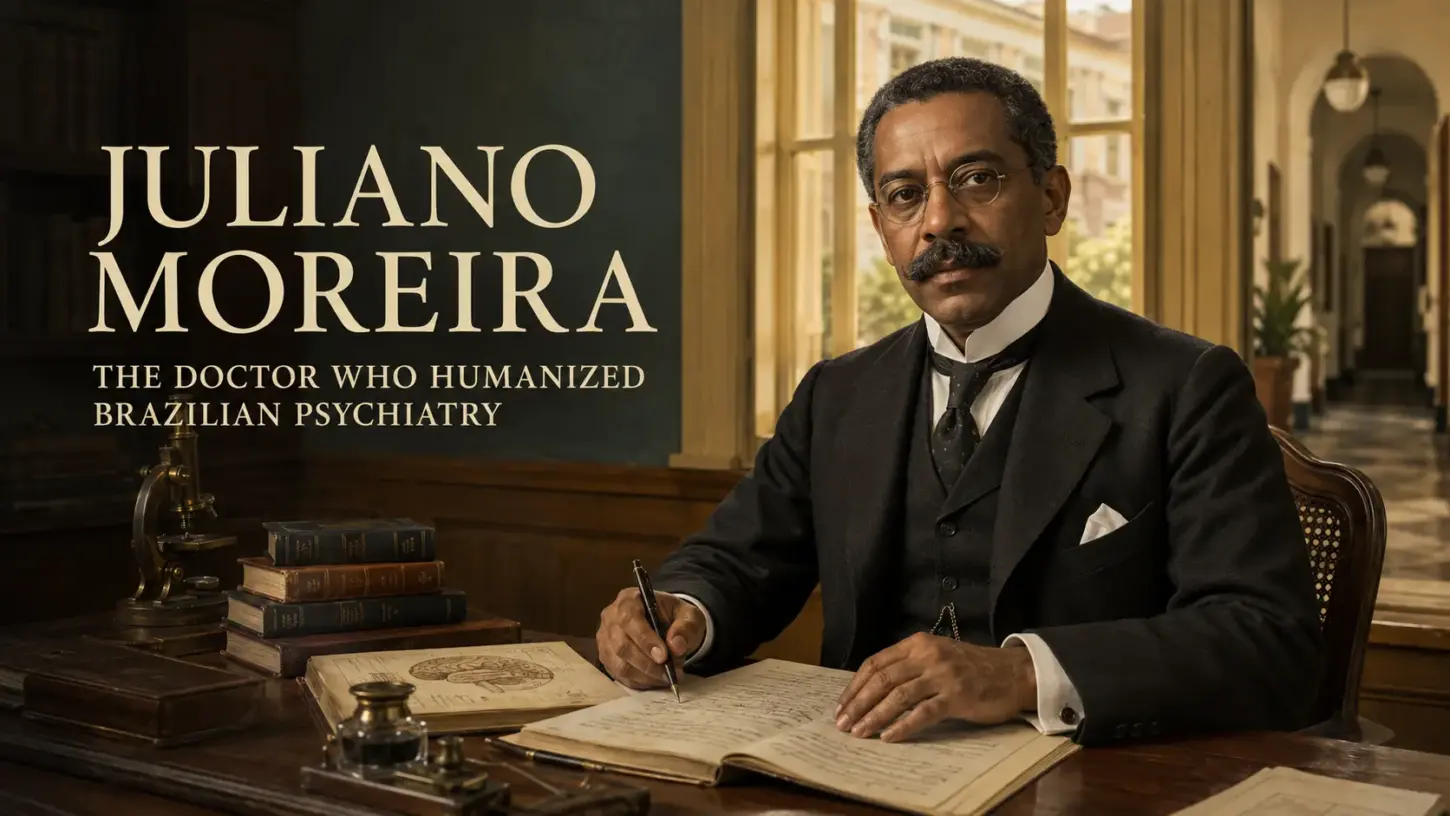
Story | Juliano Moreira: The Doctor Who Humanized Brazilian Psychiatry
Nascido negro e pobre poucos anos antes da abolição da escravidão, Juliano Moreira superou o preconceito para se tornar um dos maiores médicos brasileiros. Ao contestar as falsas teorias que associavam doenças mentais à raça e substituir castigos e confinamento por cuidados mais humanos, ele revolucionou a psiquiatria no país e deixou um legado de ciência, coragem e respeito à dignidade humana.
| Audio | |
|---|---|
Normal | Slow |
| English Transcript | Tradução |
| Juliano Moreira: The Doctor Who Humanized Brazilian Psychiatry | Juliano Moreira: o médico que humanizou a psiquiatria brasileira |
| At the end of the nineteenth century, a dangerous theory found acceptance in universities, hospitals, and among some of Brazil’s most influential intellectuals. According to its supporters, the Black population and racial mixing were responsible for the country’s physical and mental degeneration. It was in this environment dominated by scientific racism that a Black doctor, born into a poor family in Salvador, rose to challenge such ideas and profoundly transform Brazilian psychiatry. His name was Juliano Moreira. | No final do século XIX, uma perigosa teoria encontrava espaço nas universidades, nos hospitais e entre alguns dos intelectuais mais influentes do Brasil. Segundo seus defensores, a população negra e a miscigenação seriam responsáveis pela degeneração física e mental do país. Foi nesse ambiente dominado pelo racismo científico que um médico negro, nascido em uma família pobre de Salvador, ergueu-se para contestar tais ideias e transformar profundamente a psiquiatria brasileira. Seu nome era Juliano Moreira. |
| Juliano Moreira was born on January 6, 1872, in the former Sé Parish, in the central region of Salvador. Some older sources record the year as 1873, but biographical studies and institutions dedicated to preserving his memory recognize 1872. He was the son of Galdina Joaquina do Amaral, a Black woman who worked as a domestic servant in the home of the physician and professor Luís Adriano Alves de Lima Gordilho, the Baron of Itapuã. His father was Manoel do Carmo Moreira Júnior, a Portuguese civil servant who worked as a public lighting inspector. Juliano was initially raised by his mother and was officially acknowledged by his father only after her death, which occurred when he was approximately 13 years old. | Juliano Moreira nasceu em 6 de janeiro de 1872, na antiga Freguesia da Sé, região central de Salvador. Algumas fontes antigas registram o ano de 1873, mas estudos biográficos e instituições ligadas à sua memória adotam 1872. Era filho de Galdina Joaquina do Amaral, uma mulher negra que trabalhava como doméstica na residência do médico e professor Luís Adriano Alves de Lima Gordilho, o Barão de Itapuã. Seu pai era Manoel do Carmo Moreira Júnior, português e funcionário público, que trabalhava como inspetor de iluminação. Juliano foi criado inicialmente pela mãe e somente reconhecido oficialmente pelo pai depois da morte dela, ocorrida quando ele tinha aproximadamente 13 anos. |
| The Baron of Itapuã, his godfather, recognized the boy’s exceptional intelligence and helped him continue his education. Juliano entered the Bahia School of Medicine at a very young age, one of the country’s most important scientific institutions. The precocious nature of his education has caused some disagreement among sources, but it is certain that he graduated in 1891, at only 19 years of age, after defending the thesis Early Malignant Syphilis. In a society that had officially abolished slavery only three years earlier, seeing a young Black man from a humble background become a doctor was extraordinary. | O Barão de Itapuã, seu padrinho, percebeu a inteligência excepcional do menino e o ajudou a prosseguir nos estudos. Juliano ingressou ainda muito jovem na Faculdade de Medicina da Bahia, uma das mais importantes instituições científicas do país. A precocidade de sua formação causa algumas divergências nas fontes, mas é certo que concluiu o curso em 1891, com apenas 19 anos, defendendo a tese Sífilis maligna precoce. Em uma sociedade que havia abolido oficialmente a escravidão somente três anos antes, ver um jovem negro e de origem humilde tornar-se médico era algo extraordinário. |
| His competence, however, did not protect him from prejudice. When he applied for a teaching position at the Bahia School of Medicine, he faced opposition motivated both by his youth and by the color of his skin. Even so, he finished first in the competitive examination held in 1896 and became a professor at the institution. He devoted himself to the study of nervous and mental illnesses, dermatology, syphilis, and infectious diseases. He was also among the first researchers to study mucocutaneous leishmaniasis in Brazil. | Sua competência, entretanto, não o livrou do preconceito. Ao concorrer a uma vaga para lecionar na Faculdade de Medicina da Bahia, enfrentou resistências motivadas tanto por sua juventude quanto pela cor de sua pele. Mesmo assim, foi aprovado em primeiro lugar no concurso realizado em 1896, tornando-se professor da instituição. Dedicou-se ao estudo das doenças nervosas e mentais, da dermatologia, da sífilis e das enfermidades infecciosas. Também esteve entre os primeiros pesquisadores a estudar a leishmaniose cutâneo-mucosa no Brasil. |
| Between 1895 and 1902, he traveled to Germany, France, England, Scotland, and Italy for further study. He visited clinics and hospitals, attended courses, and maintained contact with important European researchers. These experiences enabled him to learn about new understandings of mental illness. Juliano realized that psychiatry needed to move away from explanations based on racial prejudice and move closer to clinical observation, science, and the actual living conditions of each patient. | Entre 1895 e 1902, realizou viagens de estudo pela Alemanha, França, Inglaterra, Escócia e Itália. Visitou clínicas e hospitais, frequentou cursos e manteve contato com importantes pesquisadores europeus. Essas experiências permitiram que conhecesse novas concepções sobre as doenças mentais. Juliano compreendeu que a psiquiatria deveria se afastar das explicações baseadas em preconceitos raciais e aproximar-se da observação clínica, da ciência e das condições reais de vida de cada paciente. |
| In 1903, he moved to Rio de Janeiro and became director of the National Hospital for the Insane, a position he held until 1930. At that time, the institutions known as asylums often resembled prisons more than hospitals. Patients could be kept behind bars, subjected to punishment, and treated as dangerous people incapable of possessing feelings or dignity. Juliano Moreira began a comprehensive reform of patient care. He ordered the removal of bars, abolished the unnecessary use of straitjackets, condemned physical punishment, and sought to replace the logic of punishment with the logic of care. | Em 1903, transferiu-se para o Rio de Janeiro e assumiu a direção do Hospício Nacional de Alienados, cargo que ocupou até 1930. Naquela época, os chamados hospícios frequentemente se pareciam mais com prisões do que com hospitais. Os internos podiam ser mantidos atrás de grades, submetidos a castigos e tratados como pessoas perigosas, incapazes de possuir sentimentos ou dignidade. Juliano Moreira iniciou uma ampla reforma no atendimento. Mandou retirar grades, aboliu o uso desnecessário de camisas de força, condenou os castigos físicos e procurou substituir a lógica da punição pela do cuidado. |
| The doctor also advocated the creation of laboratories, occupational workshops, and spaces dedicated to patient recovery. He encouraged professional training, clinical monitoring, and the individual observation of each case. In his view, hospitalized people should not be reduced to their illnesses. They were human beings who needed to be heard, treated, and respected. This view, which may seem elementary today, represented a profound change from the practices adopted in psychiatric hospitals at that time. | O médico também defendeu a criação de laboratórios, oficinas de trabalho e espaços destinados à recuperação dos pacientes. Incentivou a formação dos profissionais, o acompanhamento clínico e a observação individual de cada caso. Para ele, a pessoa internada não deveria ser reduzida à sua doença. Era um ser humano que precisava ser ouvido, tratado e respeitado. Essa visão, hoje aparentemente elementar, representava uma mudança profunda diante das práticas adotadas nos hospitais psiquiátricos daquele período. |
| Another fundamental part of his work was the fight against the association between race and mental illness. Some doctors claimed that racial mixing produced degenerate individuals and that the Black population had a natural tendency toward criminality, backwardness, and insanity. Juliano Moreira rejected these conclusions. In his studies and public statements, he argued that mental disorders were related to biological, social, and environmental factors, including disease, alcoholism, poor sanitary conditions, poverty, and lack of access to education. Skin color and the mixing of different populations were not causes of mental illness. | Outra parte fundamental de sua obra foi o combate à associação entre raça e doença mental. Alguns médicos afirmavam que a miscigenação produzia indivíduos degenerados e que a população negra possuía uma tendência natural à criminalidade, ao atraso e à loucura. Juliano Moreira rejeitou essas conclusões. Em seus estudos e pronunciamentos, argumentou que os transtornos mentais estavam relacionados a fatores biológicos, sociais e ambientais, entre eles doenças, alcoolismo, condições sanitárias precárias, pobreza e falta de acesso à educação. A cor da pele e a mistura entre diferentes populações não eram causas da doença mental. |
| His position carried particular force because it came from a Black scientist who personally understood the effects of prejudice. Juliano did not treat his origins merely as an element of his private history. He used the authority earned through his competence to challenge a scientific establishment that attempted to present racism as medical truth. His own life demonstrated the falsehood of the theories that associated the Black population with intellectual inferiority. | Sua posição possuía uma força especial porque vinha de um cientista negro que conhecia pessoalmente os efeitos do preconceito. Juliano não fez de sua origem apenas um elemento de sua história particular. Utilizou a autoridade conquistada pela competência para desafiar uma estrutura científica que tentava apresentar o racismo como verdade médica. Sua trajetória demonstrava, por si mesma, a falsidade das teorias que associavam a população negra à inferioridade intelectual. |
| Juliano Moreira also played a decisive role in establishing psychiatry as a scientific field in Brazil. He participated in the creation of specialized publications and, in 1907, helped found the Brazilian Society of Neurology, Psychiatry, and Legal Medicine. He welcomed students to the National Hospital, helped train new professionals, and represented Brazil at international conferences. In 1917, he joined the Brazilian Academy of Sciences, an institution he presided over between 1926 and 1929. He was also one of the first Brazilian professors to present Sigmund Freud’s ideas in medical education, contributing to the introduction of psychoanalysis in the country. His importance to medicine is recognized by the Brazilian National Academy of Medicine and by studies published in the Brazilian Journal of Psychiatry. | Juliano Moreira também teve papel decisivo na organização da psiquiatria como área científica no Brasil. Participou da criação de publicações especializadas e da fundação, em 1907, da Sociedade Brasileira de Neurologia, Psiquiatria e Medicina Legal. Recebeu estudantes no Hospício Nacional, ajudou a formar novos profissionais e representou o Brasil em congressos internacionais. Em 1917, ingressou na Academia Brasileira de Ciências, instituição que presidiu entre 1926 e 1929. Foi ainda um dos primeiros professores brasileiros a apresentar as ideias de Sigmund Freud no ensino médico, contribuindo para a introdução da psicanálise no país. Sua importância para a medicina é reconhecida pela Academia Nacional de Medicina e por estudos publicados na Revista Brasileira de Psiquiatria. |
| His personal life was marked by his struggle against tuberculosis, a disease that accompanied him for many years and prompted some of his trips abroad. During a period of treatment in Egypt, he met Augusta Peick, a German nurse born in Hamburg. They married in the early 1910s and came to live in Brazil. Augusta remained his lifelong companion and assisted him during the periods when his health deteriorated. The couple had no children. | Sua vida pessoal foi marcada pela luta contra a tuberculose, doença que o acompanhou durante muitos anos e motivou algumas de suas viagens ao exterior. Durante um período de tratamento no Egito, conheceu Augusta Peick, uma enfermeira alemã nascida em Hamburgo. Os dois se casaram no início da década de 1910 e vieram morar no Brasil. Augusta tornou-se sua companheira por toda a vida e prestou-lhe auxílio durante os períodos em que sua saúde se agravou. O casal não teve filhos. |
| Although he firmly opposed racial explanations for mental illness, Juliano Moreira was not entirely removed from some of the controversial ideas of his time. Like other scientists of the early twentieth century, he participated in debates related to eugenics and even accepted measures now regarded as unacceptable, such as the sterilization of certain groups. Acknowledging this contradiction does not diminish the importance of his fight against scientific racism, but it helps us understand that great historical figures also carry the marks and limitations of the periods in which they lived. | Embora tenha sido um opositor firme das explicações raciais para as doenças mentais, Juliano Moreira não esteve completamente afastado de algumas ideias controversas de seu tempo. Como outros cientistas do início do século XX, participou de debates ligados à eugenia e chegou a admitir medidas atualmente consideradas inaceitáveis, como a esterilização de determinados grupos. Reconhecer essa contradição não diminui a importância de seu combate ao racismo científico, mas ajuda a compreender que grandes personalidades também carregam marcas e limitações da época em que viveram. |
| After the Revolution of 1930, Juliano was removed from the leadership of the National Hospital. Already weakened by tuberculosis, he gradually withdrew from public life, although he continued to see some patients and attend scientific meetings whenever his health allowed. He died on May 2, 1933, at a sanatorium in the Correias area of Petrópolis, at the age of 61. | Após a Revolução de 1930, Juliano foi afastado da direção do Hospício Nacional. Já debilitado pela tuberculose, retirou-se gradualmente da vida pública, embora continuasse acompanhando alguns pacientes e participando de reuniões científicas sempre que sua saúde permitia. Morreu em 2 de maio de 1933, em um sanatório na região de Correias, em Petrópolis, aos 61 anos. |
| Juliano Moreira left behind a legacy of transformation that extended far beyond hospital walls. He demonstrated that medicine should be based on evidence and patient observation, rather than on prejudices presented as science. He argued that people with mental disorders deserved treatment, respect, and dignity. In a country that still made it difficult for Black people to enter universities and occupy positions of authority, he became a professor, researcher, director of an important institution, and president of the Brazilian Academy of Sciences. | Juliano Moreira deixou como legado uma transformação que ultrapassou os limites dos hospitais. Demonstrou que a medicina deveria se apoiar em evidências e na observação dos pacientes, e não em preconceitos apresentados como ciência. Defendeu que pessoas com transtornos mentais mereciam tratamento, respeito e dignidade. Em um país que ainda dificultava o acesso da população negra às universidades e aos espaços de poder, tornou-se professor, pesquisador, diretor de uma importante instituição e presidente da Academia Brasileira de Ciências. |
| His story is that of a poor Black boy from Salvador who overcame extraordinary barriers and became one of Brazil’s greatest doctors. More than a century after his reforms, his example remains relevant. Juliano Moreira showed that true science does not exist to justify prejudice. It should help fight prejudice and, above all, serve human dignity. | Sua história é a de um menino negro e pobre de Salvador que venceu barreiras extraordinárias e se tornou um dos maiores médicos brasileiros. Mais de um século depois de suas reformas, seu exemplo permanece atual. Juliano Moreira mostrou que a verdadeira ciência não serve para justificar preconceitos. Ela deve ajudar a combatê-los e, acima de tudo, deve estar a serviço da dignidade humana. |
Contagem de palavras
A tabela abaixo exibe as palavras encontradas neste texto, bem como o número de vezes em que aparecem.
Veja também: Para que serve esta tabela?
| Freq. | Palavra | Freq. | Palavra | Freq. | Palavra |
|---|---|---|---|---|---|
| 69 | the | 58 | of | 48 | and |
| 31 | in | 31 | his | 31 | a |
| 30 | he | 28 | to | 19 | that |
| 15 | was | 14 | juliano | 11 | as |
| 10 | moreira | 10 | at | 9 | from |
| 9 | by | 9 | black | 8 | mental |
| 8 | brazilian | 7 | some | 7 | not |
| 7 | for | 6 | who | 6 | scientific |
| 6 | psychiatry | 6 | medicine | 6 | it |
| 6 | brazil | 5 | prejudice | 5 | on |
| 5 | him | 5 | also | 4 | years |
| 4 | with | 4 | were | 4 | racial |
| 4 | people | 4 | patient | 4 | national |
| 4 | illness | 4 | hospitals | 4 | hospital |
| 4 | education | 4 | doctor | 4 | country |
| 4 | became | 4 | be | 4 | after |
| 3 | which | 3 | when | 3 | time |
| 3 | this | 3 | they | 3 | than |
| 3 | study | 3 | studies | 3 | should |
| 3 | science | 3 | salvador | 3 | racism |
| 3 | punishment | 3 | public | 3 | professor |
| 3 | position | 3 | population | 3 | poor |
| 3 | only | 3 | one | 3 | observation |
| 3 | mixing | 3 | life | 3 | is |
| 3 | institutions | 3 | institution | 3 | important |
| 3 | ideas | 3 | helped | 3 | had |
| 3 | first | 3 | fight | 3 | early |
| 3 | dignity | 3 | century | 3 | but |
| 3 | born | 3 | between | 3 | an |
| 3 | among | 3 | age | 3 | against |
| 3 | academy | 2 | young | 2 | worked |
| 2 | view | 2 | universities | 2 | tuberculosis |
| 2 | treatment | 2 | treated | 2 | these |
| 2 | syphilis | 2 | such | 2 | sources |
| 2 | society | 2 | skin | 2 | servant |
| 2 | sciences | 2 | school | 2 | researchers |
| 2 | represented | 2 | removed | 2 | related |
| 2 | recognized | 2 | present | 2 | physical |
| 2 | periods | 2 | patients | 2 | participated |
| 2 | officially | 2 | new | 2 | needed |
| 2 | move | 2 | most | 2 | more |
| 2 | medical | 2 | may | 2 | logic |
| 2 | itapuã | 2 | importance | 2 | illnesses |
| 2 | human | 2 | held | 2 | health |
| 2 | found | 2 | father | 2 | extraordinary |
| 2 | explanations | 2 | even | 2 | each |
| 2 | during | 2 | does | 2 | doctors |
| 2 | do | 2 | disorders | 2 | disease |
| 2 | director | 2 | did | 2 | demonstrated |
| 2 | dedicated | 2 | de | 2 | dangerous |
| 2 | creation | 2 | conditions | 2 | competence |
| 2 | color | 2 | clinical | 2 | challenge |
| 2 | certain | 2 | care | 2 | came |
| 2 | boy | 2 | behind | 2 | based |
| 2 | bars | 2 | baron | 2 | bahia |
| 2 | authority | 2 | augusta | 2 | argued |
| 2 | although | 2 | abolished | 1 | youth |
| 1 | year | 1 | workshops | 1 | work |
| 1 | woman | 1 | withdrew | 1 | whenever |
| 1 | welcomed | 1 | weakened | 1 | walls |
| 1 | visited | 1 | very | 1 | used |
| 1 | use | 1 | us | 1 | until |
| 1 | unnecessary | 1 | understood | 1 | understandings |
| 1 | understand | 1 | unacceptable | 1 | twentieth |
| 1 | truth | 1 | true | 1 | trips |
| 1 | treat | 1 | traveled | 1 | transformation |
| 1 | transform | 1 | training | 1 | train |
| 1 | toward | 1 | today | 1 | through |
| 1 | three | 1 | thesis | 1 | theory |
| 1 | theories | 1 | their | 1 | tendency |
| 1 | teaching | 1 | supporters | 1 | subjected |
| 1 | students | 1 | struggle | 1 | straitjackets |
| 1 | story | 1 | still | 1 | sterilization |
| 1 | statements | 1 | specialized | 1 | spaces |
| 1 | sought | 1 | son | 1 | social |
| 1 | so | 1 | slavery | 1 | sigmund |
| 1 | showed | 1 | serve | 1 | seem |
| 1 | seeing | 1 | see | 1 | sé |
| 1 | scotland | 1 | scientists | 1 | scientist |
| 1 | sanitary | 1 | sanatorium | 1 | s |
| 1 | rose | 1 | role | 1 | rio |
| 1 | revolution | 1 | responsible | 1 | respected |
| 1 | respect | 1 | resembled | 1 | researcher |
| 1 | replace | 1 | removal | 1 | remains |
| 1 | remained | 1 | relevant | 1 | rejected |
| 1 | region | 1 | regarded | 1 | reforms |
| 1 | reform | 1 | reduced | 1 | recovery |
| 1 | record | 1 | recognize | 1 | realized |
| 1 | rather | 1 | raised | 1 | race |
| 1 | published | 1 | publications | 1 | psychoanalysis |
| 1 | psychiatric | 1 | protect | 1 | prompted |
| 1 | profoundly | 1 | profound | 1 | professors |
| 1 | professionals | 1 | professional | 1 | produced |
| 1 | private | 1 | prisons | 1 | president |
| 1 | presided | 1 | preserving | 1 | presented |
| 1 | prejudices | 1 | precocious | 1 | practices |
| 1 | poverty | 1 | possessing | 1 | positions |
| 1 | portuguese | 1 | populations | 1 | played |
| 1 | physician | 1 | petrópolis | 1 | personally |
| 1 | personal | 1 | period | 1 | peick |
| 1 | particular | 1 | part | 1 | parish |
| 1 | own | 1 | overcame | 1 | over |
| 1 | other | 1 | origins | 1 | ordered |
| 1 | or | 1 | opposition | 1 | opposed |
| 1 | older | 1 | old | 1 | often |
| 1 | occurred | 1 | occupy | 1 | occupational |
| 1 | nurse | 1 | now | 1 | no |
| 1 | nineteenth | 1 | neurology | 1 | nervous |
| 1 | nature | 1 | natural | 1 | name |
| 1 | mucocutaneous | 1 | moved | 1 | motivated |
| 1 | mother | 1 | monitoring | 1 | met |
| 1 | merely | 1 | memory | 1 | meetings |
| 1 | measures | 1 | married | 1 | marks |
| 1 | marked | 1 | many | 1 | manoel |
| 1 | man | 1 | malignant | 1 | maintained |
| 1 | made | 1 | luís | 1 | living |
| 1 | lived | 1 | live | 1 | limitations |
| 1 | lima | 1 | like | 1 | lighting |
| 1 | lifelong | 1 | leishmaniasis | 1 | legal |
| 1 | legacy | 1 | left | 1 | learn |
| 1 | leadership | 1 | lack | 1 | laboratories |
| 1 | known | 1 | kept | 1 | justify |
| 1 | júnior | 1 | journal | 1 | joined |
| 1 | joaquina | 1 | january | 1 | janeiro |
| 1 | its | 1 | italy | 1 | introduction |
| 1 | into | 1 | international | 1 | intelligence |
| 1 | intellectuals | 1 | intellectual | 1 | inspector |
| 1 | insanity | 1 | insane | 1 | initially |
| 1 | influential | 1 | inferiority | 1 | infectious |
| 1 | individuals | 1 | individual | 1 | including |
| 1 | incapable | 1 | humble | 1 | humanized |
| 1 | however | 1 | hospitalized | 1 | home |
| 1 | history | 1 | historical | 1 | himself |
| 1 | her | 1 | helps | 1 | help |
| 1 | heard | 1 | has | 1 | hamburg |
| 1 | groups | 1 | greatest | 1 | great |
| 1 | graduated | 1 | gradually | 1 | gordilho |
| 1 | godfather | 1 | germany | 1 | german |
| 1 | galdina | 1 | further | 1 | fundamental |
| 1 | freud | 1 | france | 1 | former |
| 1 | force | 1 | firmly | 1 | finished |
| 1 | figures | 1 | field | 1 | feelings |
| 1 | far | 1 | family | 1 | falsehood |
| 1 | factors | 1 | faced | 1 | extended |
| 1 | experiences | 1 | exist | 1 | exceptional |
| 1 | example | 1 | examination | 1 | evidence |
| 1 | european | 1 | eugenics | 1 | establishment |
| 1 | establishing | 1 | environmental | 1 | environment |
| 1 | entirely | 1 | entered | 1 | enter |
| 1 | england | 1 | end | 1 | encouraged |
| 1 | enabled | 1 | elementary | 1 | element |
| 1 | egypt | 1 | effects | 1 | earned |
| 1 | earlier | 1 | dominated | 1 | domestic |
| 1 | diseases | 1 | disagreement | 1 | diminish |
| 1 | difficult | 1 | different | 1 | died |
| 1 | devoted | 1 | deteriorated | 1 | deserved |
| 1 | dermatology | 1 | degeneration | 1 | degenerate |
| 1 | defending | 1 | decisive | 1 | debates |
| 1 | death | 1 | criminality | 1 | courses |
| 1 | couple | 1 | could | 1 | correias |
| 1 | controversial | 1 | contributing | 1 | contradiction |
| 1 | continued | 1 | continue | 1 | contact |
| 1 | conferences | 1 | condemned | 1 | conclusions |
| 1 | comprehensive | 1 | competitive | 1 | companion |
| 1 | closer | 1 | clinics | 1 | claimed |
| 1 | civil | 1 | children | 1 | change |
| 1 | central | 1 | causes | 1 | caused |
| 1 | case | 1 | carry | 1 | carried |
| 1 | carmo | 1 | both | 1 | biological |
| 1 | biographical | 1 | beyond | 1 | beings |
| 1 | began | 1 | become | 1 | because |
| 1 | barriers | 1 | backwardness | 1 | background |
| 1 | away | 1 | attended | 1 | attend |
| 1 | attempted | 1 | asylums | 1 | association |
| 1 | associated | 1 | assisted | 1 | area |
| 1 | approximately | 1 | applied | 1 | another |
| 1 | amaral | 1 | alves | 1 | already |
| 1 | allowed | 1 | all | 1 | alcoholism |
| 1 | advocated | 1 | adriano | 1 | adopted |
| 1 | actual | 1 | acknowledging | 1 | acknowledged |
| 1 | according | 1 | accompanied | 1 | access |
| 1 | accepted | 1 | acceptance | 1 | abroad |
| 1 | above | 1 | about |