
Learning Strategies | Why Studying LESS Makes You Learn Faster (video)
Aprender e memorizar de forma eficiente não é questão de apenas ler o conteúdo várias vezes, mas sim de combater o esquecimento natural do cérebro. Neste trecho, entenda o papel da neuroplasticidade, como as conexões neurais se fortalecem, enfraquecem ou se reorganizam, e descubra por que fazer testes periódicos e encarar seus próprios erros é a estratégia mais poderosa comprovada pela ciência para fixar o conhecimento e alcançar a verdadeira maestria.
| Audio | |
|---|---|
Normal | Slow |
| English Transcript | Tradução |
| Why Studying LESS Makes You Learn Faster | Porque Estudar MENOS te Faz Aprender mais Rápido |
| The best way to study and learn is to access components of your memory systems that offset forgetting. That is the way to remember things; that is the way to gain mastery over them. And I'm going to teach you how to best do that using the data gleaned from the peer-reviewed literature. | A melhor maneira de estudar e aprender é acessar componentes dos seus sistemas de memória que compensam o esquecimento. Essa é a maneira de lembrar das coisas; essa é a maneira de dominar o conteúdo. E eu vou ensinar a você como fazer isso da melhor forma usando dados extraídos da literatura científica revisada por pares. |
| Now, before I do that, I want to talk about what learning is. Neuroplasticity is this incredible feature of your nervous system, which, of course, includes your brain and your spinal cord, which is the ability for your nervous system to change in response to experience. So, any form of learning involves neuroplasticity. Neuroplasticity… we sometimes hear as "neural plasticity" (two words) or "neuroplasticity"; those are the same thing, essentially. | Agora, antes de fazer isso, quero falar sobre o que é o aprendizado. A neuroplasticidade é essa característica incrível do seu sistema nervoso, o que, claro, inclui o seu cérebro e a sua medula espinhal, que é a capacidade do seu sistema nervoso de mudar em resposta à experiência. Portanto, qualquer forma de aprendizado envolve neuroplasticidade. Neuroplasticidade… às vezes ouvimos como 'plasticidade neural' (duas palavras) ou 'neuroplasticidade'; essas coisas são essencialmente a mesma coisa. |
| The change that underlies neuroplasticity at the level of cells, which we call neurons or nerve cells, generally involves three different mechanisms: | A mudança que fundamenta a neuroplasticidade ao nível das células, as quais chamamos de neurônios ou células nervosas, geralmente envolve três mecanismos diferentes: |
| 1. One is the strengthening of certain connections, what we call synaptic connections. Synapses are the location between neurons where they communicate with one another. It's actually a gap between the neurons; it is technically called the synaptic cleft. It's a gap, and within that gap, chemicals are passed across that gap that allow one neuron to activate other neurons, or many neurons to activate many other neurons, or to inhibit the activity of other neurons. Okay, so one form of neuroplasticity is the strengthening of connections between neurons. | 1. O primeiro é o fortalecimento de certas conexões, o que chamamos de conexões sinápticas. As sinapses são o local entre os neurônios onde eles se comunicam entre si. É na verdade um espaço entre os neurônios; tecnicamente chamado de fenda sináptica. É um espaço e, dentro desse espaço, substâncias químicas são passadas de um lado para o outro, permitindo que um neurônio ative outros neurônios, ou que muitos neurônios ativem muitos outros neurônios, ou inibam a atividade de outros neurônios. Certo, então uma forma de neuroplasticidade é o fortalecimento das conexões entre os neurônios. |
| 2. Another form of neuroplasticity is the weakening of connections between neurons. | 2. Outra forma de neuroplasticidade é o enfraquecimento das conexões entre os neurônios. |
| 3. And yet a third form of plasticity, which is often discussed in the media but is very rare actually in the nervous system, especially the adult nervous system of humans, is neurogenesis, or the addition of new neurons. | 3. E uma terceira forma de plasticidade, que frequentemente é discutida na mídia, mas que é muito rara no sistema nervoso, especialmente no sistema nervoso adulto dos humanos, é a neurogênese, ou a adição de novos neurônios. |
| Let's just get this out of the way upfront, because the addition of new neurons, again, grabs so much attention in media articles, but it's responsible for a near-trivial amount of the sort of neuroplasticity that is important for today's discussion or, frankly, for most all discussions. It is true you have a specialized set of neurons in your olfactory bulb that are responsible for smell, as well as a specialized set of neurons in the so-called dentate gyrus of your hippocampus (an area of the brain that is important for memory) in which new neurons appear to be added throughout the lifespan. But this is not the major mechanism by which learning and memory occur in humans. Rather, the major mechanism by which learning and memory occur in humans is the strengthening of existing connections, the weakening of existing connections, or the formation of new connections between already existing neurons, not new neurons. Okay? | Vamos tirar isso da frente logo de início porque a adição de novos neurônios atrai muita atenção em artigos de mídia, mas é responsável por uma quantidade quase trivial do tipo de neuroplasticidade que é importante para a discussão de hoje ou, francamente, para quase todas as discussões. É verdade que você tem um conjunto especializado de neurônios no seu bulbo olfatório responsável pelo cheiro, bem como um conjunto especializado de neurônios no chamado giro denteado do seu hipocampo (uma área do cérebro importante para a memória) em que novos neurônios parecem ser adicionados ao longo da vida. Mas este não é o principal mecanismo pelo qual o aprendizado e a memória ocorrem em humanos. Em vez disso, o principal mecanismo pelo qual o aprendizado e a memória ocorrem em humanos é o fortalecimento de conexões existentes, o enfraquecimento de conexões existentes ou a formação de novas conexões entre neurônios já existentes, e não novos neurônios. Certo? |
| Now, the removal or weakening of connections between neurons being an important component of neuroplasticity is very important for the sake of today's discussion. I want to emphasize that when we hear about weakening of connections, we often think, "Well, that means forgetting," or "That means the brain is getting less good." However, so much of the neuroplasticity that underlies, for instance, the acquisition of a new motor skill is actually the reflection of removal of connections. So, we don't want to project any kind of value onto a discussion about adding new connections or removing new connections. Let's just leave it at this level: mechanistically, when you hear about neuroplasticity, just know that it could be the consequence of strengthening of connections, as well as weakening of connections; and that neither strengthening of connections in the nervous system nor weakening of connections can map directly to the formation or removal of, say, memories or information. Just know that these are the important mechanisms. | Agora, a remoção ou o enfraquecimento de conexões entre neurônios sendo um componente importante da neuroplasticidade é algo crucial para a discussão de hoje. Quero enfatizar que, quando ouvimos falar sobre o enfraquecimento de conexões, muitas vezes pensamos: 'Bem, isso significa esquecimento' ou 'Isso significa que o cérebro está ficando pior'. No entanto, grande parte da neuroplasticidade que fundamenta, por exemplo, a aquisição de uma nova habilidade motora é, na verdade, o reflexo da remoção de conexões. Portanto, não queremos projetar nenhum tipo de valor moral sobre uma discussão sobre adicionar novas conexões ou remover conexões. Vamos deixar neste nível: mecanicamente, quando você ouvir sobre neuroplasticidade, saiba que ela pode ser a consequência do fortalecimento de conexões, bem como do enfraquecimento de conexões; e que nem o fortalecimento de conexões no sistema nervoso nem o enfraquecimento de conexões correspondem diretamente à formação ou remoção de, digamos, memórias ou informações. Apenas saiba que esses são os mecanismos importantes. |
| In fact, if you look at a baby that is, let's say, I don't know, 9 months old, their motor skills are not terrific typically compared to the motor skills that that child will have when they are six or seven years old. And believe it or not, the improvement in motor coordination that one observes in humans, and other species, for that matter, from birth until the adolescence, teen years, and adult years, is largely the reflection of the removal (that's right, the removal) of neural connections as opposed to the formation of neural connections. However, the neural connections that remain become much more robust; they become much more reliable. Okay? | Na verdade, se você olhar para um bebê de, digamos, 9 meses de idade, as habilidades motoras dele normalmente não são muito boas em comparação com as habilidades motoras que essa criança terá quando tiver seis ou sete anos. E acredite ou não, a melhora na coordenação motora que se observa nos humanos, e em outras espécies, quanto a isso, desde o nascimento até a adolescência, anos de juventude e idade adulta é em grande parte o reflexo da remoção (isso mesmo, a remoção) de conexões neurais, em oposição à formação de conexões neurais. No entanto, as conexões neurais que permanecem tornam-se muito mais robustas; elas se tornam muito mais confiáveis. Certo? |
| So, that's the mechanistic backdrop for everything that we're going to talk about today, which is how to study and learn. As I mentioned earlier in my introduction, most of learning and remembering new material is about offsetting the forgetting process that naturally occurs anytime we hear new information. | Então, esse é o pano de fundo mecânico para tudo o que vamos conversar hoje, que é como estudar e aprender. Como mencionei anteriormente na minha introdução, a maior parte do aprendizado e da memorização de novos materiais consiste em compensar o processo de esquecimento que ocorre naturalmente sempre que ouvimos novas informações. |
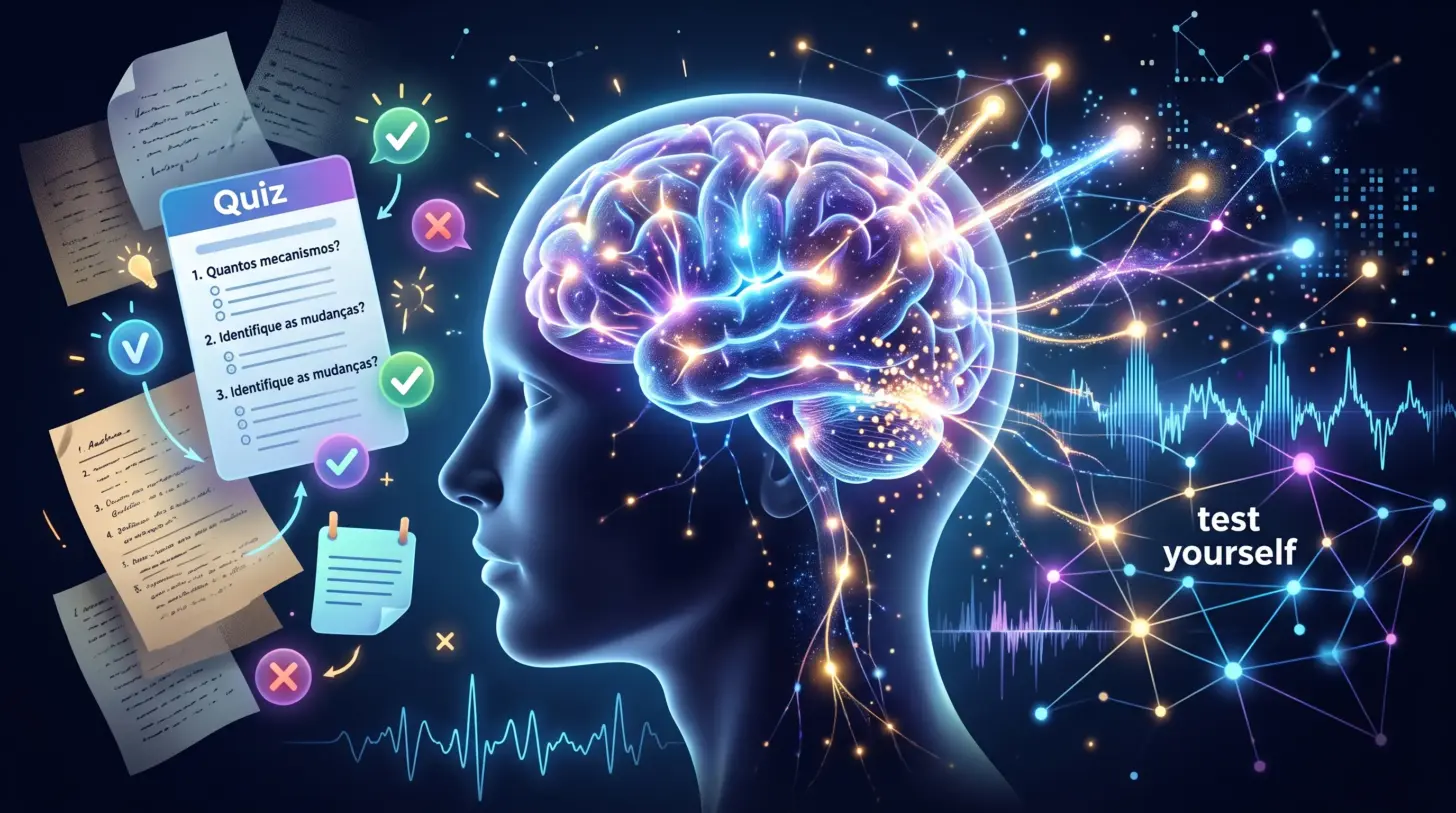
| So, in keeping with what will ultimately reveal itself to be the dominant theme of today's discussion right now, and for reasons that will become clear later, I want you to take a brief quiz. Now, the moment people hear "quiz" or "test", typically it spikes their adrenaline; they start feeling stressed. But don't worry, you're going to keep your answers to yourself, and you're doing this for a very specific purpose. | Sendo assim, em sintonia com o que no final se revelará o tema dominante da discussão de hoje agora, e por razões que se tornarão claras mais tarde, quero que você faça um pequeno teste. Agora, no momento em que as pessoas ouvem 'teste' ou 'prova', normalmente isso aumenta a adrenalina e elas começam a se sentir estressadas. Mas não se preocupe, você guardará suas respostas para si mesmo e está fazendo isso por um propósito muito específico. |
| Here's my question. This is a two-question quiz: | Aqui está a minha pergunta. Este é um teste de duas perguntas: |
| 1. How many different ways, mechanistically speaking, does neuroplasticity occur? Is it one mechanism, two mechanisms, or three mechanisms? Or is it four or five? Okay. | 1. De quantas maneiras diferentes, mecanicamente falando, a neuroplasticidade ocorre? É um mecanismo, dois mecanismos ou três mecanismos? Ou são quatro ou cinco? Certo. |
| 2. Can you name in your head two of the three major changes that the nervous system can undergo which are reflective of neuroplasticity? | 2. Você consegue nomear de cabeça duas das três principais mudanças pelas quais o sistema nervoso pode passar e que refletem a neuroplasticidade? |
| Okay, so the answer to question one is that there are three different modes of neuroplasticity, as you recall or as you may not have been able to recall. And by the way, if you were not able to recall the three different modes of neuroplasticity or mechanisms underlying neuroplasticity, that is fine. As you'll soon realize, recognizing the errors in your information retention is another critical and very useful way to retain more information, even if you got the answer wrong or you didn't know; in fact, especially if you got the answer wrong or you didn't know. So, the three ways are: first, the strengthening of neural connections; second, the weakening of neural connections; and third, through neurogenesis (the addition of new neurons). | Certo, então a resposta para a pergunta um é que existem três modos diferentes de neuroplasticidade, como você pode se lembrar ou não. E, a propósito, se você não foi capaz de se lembrar dos três modos diferentes de neuroplasticidade ou mecanismos subjacentes a ela, está tudo bem. Como você em breve perceberá, reconhecer os erros na sua retenção de informação é outra maneira crítica e muito útil de reter mais informações, mesmo se você errou a resposta ou não sabia; na verdade, especialmente se você errou a resposta ou não sabia. Então, as três maneiras são: primeiro, o fortalecimento de conexões neurais; segundo, o enfraquecimento de conexões neurais; e terceiro, através da neurogênese (a adição de novos neurônios). |
| Why did I provide this quiz? Why did I test you? Well, as you'll soon learn, if you look across the total body of research on how best to study and learn, it involves doing exactly what we just did, which is to periodically stop and test yourself on the material that you learned. Testing is not just a way of evaluating what knowledge you've acquired and which knowledge you have not managed to acquire; it also turns out to be the best tool for offsetting forgetting of any kind. | Por que forneci este teste? Por que testei você? Bem, como você aprenderá em breve, se você olhar para todo o conjunto de pesquisas sobre a melhor forma de estudar e aprender, isso envolve fazer exatamente o que acabamos de fazer, que é parar periodicamente e testar a si mesmo sobre o material que aprendeu. Testar a si mesmo não é apenas uma forma de avaliar qual conhecimento você adquiriu e qual conhecimento não conseguiu adquirir; também se revela a melhor ferramenta para compensar o esquecimento de qualquer tipo. |
| This study looked at whether or not studying material four times (so: study, study, study, study) was better in terms of locking that information into people's minds, allowing them to use that information flexibly, which is an element of creativity, essentially giving them mastery of the material, than a different group, which studied once, studied the material twice, studied the material three times, then was tested on the material; or a third group that studied material once, then took one, two, yes, three tests on the material. | Este estudo analisou se estudar o material quatro vezes (ou seja: estudar, estudar, estudar, estudar) era melhor em termos de fixar essa informação na mente das pessoas, permitindo-lhes usar essa informação de forma flexível, o que é um elemento de criatividade, essencialmente dando-lhes o domínio do material, do que um grupo diferente, que estudou uma vez, estudou o material duas vezes, estudou o material três vezes e depois foi testado sobre o material; ou um terceiro grupo que estudou o material uma vez e depois fez um, dois, sim, três testes sobre o material. |
| Now, so what I just described was three groups, all of whom read a passage (this was a passage about animals, about biology, some other topics too in different experiments). Again, three groups: | Agora, o que acabei de descrever foram três grupos, todos os quais leram um trecho (era um trecho sobre animais, sobre biologia e alguns outros tópicos também em diferentes experimentos). Novamente, três grupos: |
| - One group studies four times, then later they take a test. | - Um grupo estuda quatro vezes e depois faz um teste. |
| - The second group studies one, two, three times, takes a test on that material, and then later takes a test. | - O segundo grupo estuda uma, duas, três vezes, faz um teste sobre esse material e depois faz outro teste. |
| - The third group studies the material once, then takes three tests on the material, and then later takes a test. | - O terceiro grupo estuda o material uma vez, faz três testes sobre o material e depois faz um teste final. |
| So what's analyzed and compared between these different groups is their performance on that final test. Okay, that should be pretty much obvious given the way we've been going today in this description of tests as a way to offset forgetting. | Portanto, o que é analisado e comparado entre esses diferentes grupos é o desempenho nesse teste final. Certo, isso deve ser bem óbvio dada a forma como estamos conduzindo a descrição dos testes hoje como uma forma de compensar o esquecimento. |
| Okay, so the more tests that you take as a way to expose yourself to the material, the better you're going to perform on that material at some later point. Now, of course, at some point, you have to be exposed to the material for the first time, right? That's why it's studying and learning. But after one exposure to new material, taking more tests on that material, even if you don't perform that well on those tests, as long as you're able to see the accurate answers to those tests and compare your answers to those answers, will lead to better performance on the ultimate test and retention of that material at some later time." | Certo, então quanto mais testes você fizer como uma forma de se expor ao material, melhor será o seu desempenho nesse material em um momento posterior. Agora, é claro que em algum momento você tem que ser exposto ao material pela primeira vez, certo? É por isso que se chama estudar e aprender. Mas, após uma exposição ao material novo, fazer mais testes sobre esse material, mesmo que você não se saia tão bem nesses testes, desde que seja capaz de ver as respostas corretas e comparar suas respostas com elas, levará a um melhor desempenho no teste final e à retenção desse material em um momento posterior. |
Contagem de palavras
A tabela abaixo exibe as palavras encontradas neste vídeo, bem como o número de vezes em que aparecem.
Veja também: Para que serve esta tabela?
| Freq. | Palavra | Freq. | Palavra | Freq. | Palavra |
|---|---|---|---|---|---|
| 85 | the | 62 | of | 46 | that |
| 44 | to | 44 | is | 28 | you |
| 27 | and | 24 | or | 23 | a |
| 21 | in | 21 | connections | 18 | neurons |
| 18 | material | 16 | neuroplasticity | 15 | not |
| 15 | as | 15 | are | 14 | so |
| 14 | it | 14 | for | 13 | which |
| 12 | three | 12 | new | 11 | your |
| 11 | one | 11 | on | 10 | we |
| 10 | way | 10 | this | 10 | I |
| 9 | test | 8 | study | 8 | about |
| 7 | what | 7 | weakening | 7 | tests |
| 7 | okay | 7 | just | 7 | have |
| 7 | different | 7 | between | 7 | at |
| 6 | will | 6 | two | 6 | then |
| 6 | system | 6 | strengthening | 6 | now |
| 6 | neural | 6 | nervous | 6 | learning |
| 6 | later | 6 | information | 6 | if |
| 6 | do | 6 | be | 5 | well |
| 5 | today | 5 | they | 5 | removal |
| 5 | other | 5 | much | 5 | more |
| 5 | mechanisms | 5 | learn | 5 | know |
| 5 | important | 5 | hear | 5 | group |
| 5 | going | 5 | forgetting | 5 | did |
| 5 | but | 4 | why | 4 | was |
| 4 | want | 4 | very | 4 | times |
| 4 | those | 4 | third | 4 | takes |
| 4 | studied | 4 | some | 4 | quiz |
| 4 | motor | 4 | memory | 4 | humans |
| 4 | how | 4 | gap | 4 | form |
| 4 | discussion | 4 | best | 4 | answers |
| 3 | yourself | 3 | years | 3 | when |
| 3 | us | 3 | them | 3 | their |
| 3 | take | 3 | studying | 3 | studies |
| 3 | right | 3 | recall | 3 | question |
| 3 | once | 3 | occur | 3 | mechanism |
| 3 | many | 3 | major | 3 | let |
| 3 | involves | 3 | groups | 3 | four |
| 3 | formation | 3 | existing | 3 | can |
| 3 | by | 3 | brain | 3 | better |
| 3 | become | 3 | any | 3 | answer |
| 3 | another | 3 | an | 3 | addition |
| 3 | actually | 3 | able | 2 | wrong |
| 2 | with | 2 | ways | 2 | underlies |
| 2 | typically | 2 | time | 2 | these |
| 2 | talk | 2 | synaptic | 2 | specialized |
| 2 | soon | 2 | skills | 2 | set |
| 2 | second | 2 | say | 2 | retention |
| 2 | responsible | 2 | reflection | 2 | point |
| 2 | plasticity | 2 | performance | 2 | perform |
| 2 | people | 2 | passage | 2 | out |
| 2 | old | 2 | often | 2 | offsetting |
| 2 | offset | 2 | neurogenesis | 2 | my |
| 2 | most | 2 | modes | 2 | media |
| 2 | mechanistically | 2 | means | 2 | mastery |
| 2 | look | 2 | level | 2 | less |
| 2 | knowledge | 2 | kind | 2 | however |
| 2 | got | 2 | from | 2 | first |
| 2 | fact | 2 | even | 2 | essentially |
| 2 | especially | 2 | doing | 2 | course |
| 2 | compared | 2 | change | 2 | cells |
| 2 | called | 2 | call | 2 | been |
| 2 | all | 2 | again | 2 | adult |
| 2 | activate | 2 | across | 1 | yet |
| 1 | yes | 1 | worry | 1 | words |
| 1 | within | 1 | whom | 1 | whether |
| 1 | where | 1 | were | 1 | value |
| 1 | using | 1 | useful | 1 | use |
| 1 | upfront | 1 | until | 1 | underlying |
| 1 | undergo | 1 | ultimately | 1 | ultimate |
| 1 | twice | 1 | turns | 1 | true |
| 1 | trivial | 1 | total | 1 | topics |
| 1 | tool | 1 | took | 1 | too |
| 1 | throughout | 1 | through | 1 | think |
| 1 | things | 1 | thing | 1 | there |
| 1 | theme | 1 | than | 1 | testing |
| 1 | tested | 1 | terrific | 1 | terms |
| 1 | teen | 1 | technically | 1 | teach |
| 1 | taking | 1 | systems | 1 | synapses |
| 1 | stressed | 1 | stop | 1 | start |
| 1 | spinal | 1 | spikes | 1 | specific |
| 1 | species | 1 | speaking | 1 | sort |
| 1 | sometimes | 1 | smell | 1 | skill |
| 1 | six | 1 | should | 1 | seven |
| 1 | see | 1 | same | 1 | sake |
| 1 | robust | 1 | reviewed | 1 | reveal |
| 1 | retain | 1 | response | 1 | research |
| 1 | removing | 1 | remembering | 1 | remember |
| 1 | remain | 1 | reliable | 1 | reflective |
| 1 | recognizing | 1 | reasons | 1 | realize |
| 1 | read | 1 | rather | 1 | rare |
| 1 | purpose | 1 | provide | 1 | project |
| 1 | process | 1 | pretty | 1 | periodically |
| 1 | peer | 1 | passed | 1 | over |
| 1 | opposed | 1 | onto | 1 | olfactory |
| 1 | occurs | 1 | obvious | 1 | observes |
| 1 | nor | 1 | neuron | 1 | nerve |
| 1 | neither | 1 | near | 1 | naturally |
| 1 | name | 1 | months | 1 | moment |
| 1 | minds | 1 | mentioned | 1 | memories |
| 1 | mechanistic | 1 | may | 1 | matter |
| 1 | map | 1 | managed | 1 | makes |
| 1 | looked | 1 | long | 1 | locking |
| 1 | location | 1 | literature | 1 | lifespan |
| 1 | leave | 1 | learned | 1 | lead |
| 1 | largely | 1 | keeping | 1 | keep |
| 1 | itself | 1 | introduction | 1 | into |
| 1 | instance | 1 | inhibit | 1 | incredible |
| 1 | includes | 1 | improvement | 1 | hippocampus |
| 1 | here | 1 | head | 1 | gyrus |
| 1 | grabs | 1 | good | 1 | gleaned |
| 1 | giving | 1 | given | 1 | getting |
| 1 | get | 1 | generally | 1 | gain |
| 1 | frankly | 1 | flexibly | 1 | five |
| 1 | fine | 1 | final | 1 | feeling |
| 1 | feature | 1 | faster | 1 | exposure |
| 1 | exposed | 1 | expose | 1 | experiments |
| 1 | experience | 1 | exactly | 1 | everything |
| 1 | evaluating | 1 | errors | 1 | emphasize |
| 1 | element | 1 | earlier | 1 | dominant |
| 1 | does | 1 | discussions | 1 | discussed |
| 1 | directly | 1 | description | 1 | described |
| 1 | dentate | 1 | data | 1 | critical |
| 1 | creativity | 1 | could | 1 | cord |
| 1 | coordination | 1 | consequence | 1 | components |
| 1 | component | 1 | compare | 1 | communicate |
| 1 | cleft | 1 | clear | 1 | child |
| 1 | chemicals | 1 | changes | 1 | certain |
| 1 | bulb | 1 | brief | 1 | body |
| 1 | birth | 1 | biology | 1 | believe |
| 1 | being | 1 | before | 1 | because |
| 1 | backdrop | 1 | baby | 1 | attention |
| 1 | articles | 1 | area | 1 | appear |
| 1 | anytime | 1 | animals | 1 | analyzed |
| 1 | amount | 1 | am | 1 | also |
| 1 | already | 1 | allowing | 1 | allow |
| 1 | after | 1 | adrenaline | 1 | adolescence |
| 1 | adding | 1 | added | 1 | activity |
| 1 | acquisition | 1 | acquired | 1 | acquire |
| 1 | accurate | 1 | access | 1 | ability |