
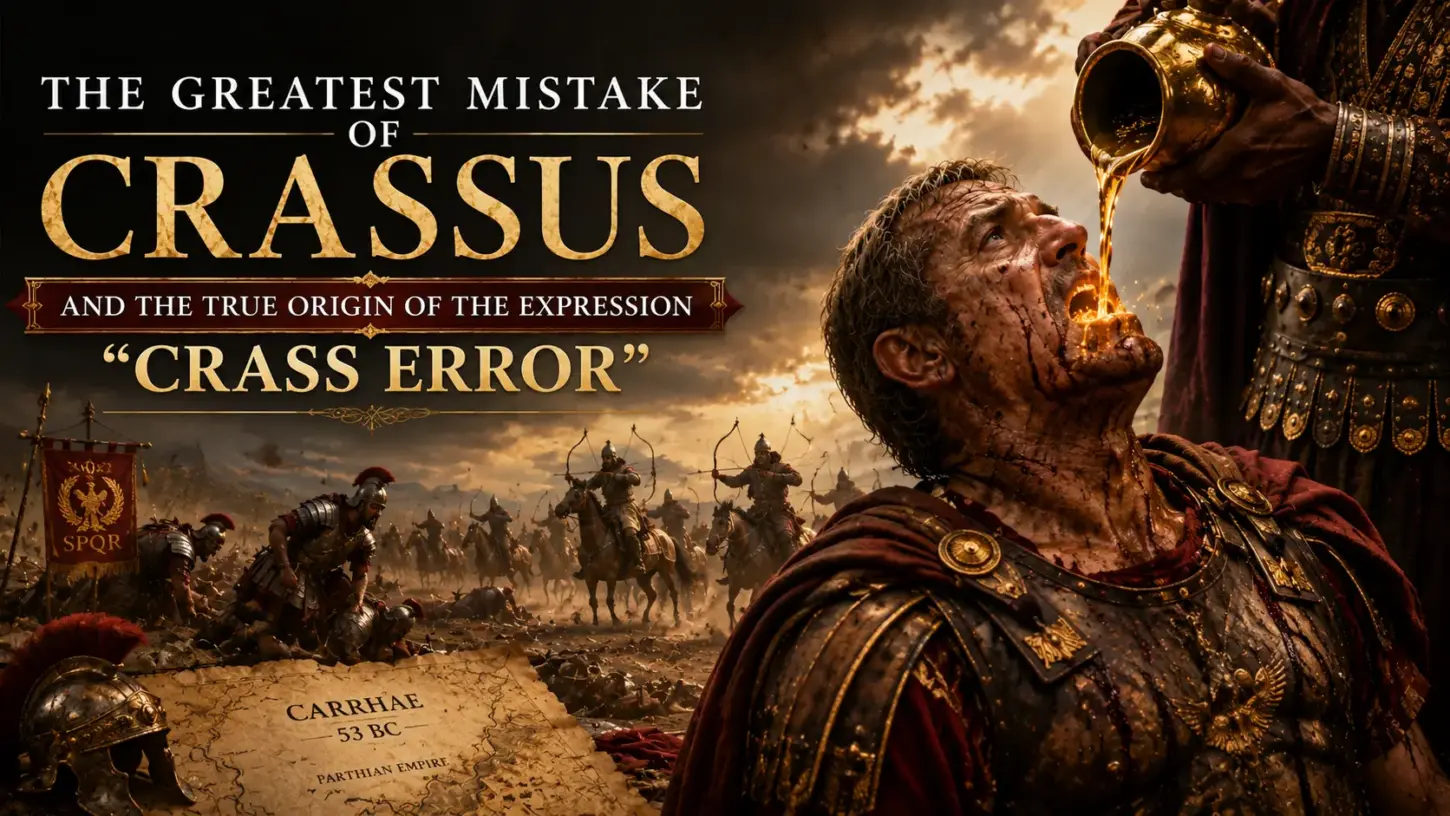
Story | The Greatest Mistake of Crassus
A ambição de um único homem pode mudar o destino de uma civilização inteira. A desastrosa campanha de Marco Licínio Crasso contra o Império Parta não apenas terminou com uma das maiores derrotas militares da história de Roma, como também desencadeou uma sequência de acontecimentos que levou ao colapso da República e ao nascimento do Império Romano. Descubra como uma decisão motivada pela busca de glória pessoal alterou para sempre o curso da história do mundo antigo.
| Audio | |
|---|---|
Normal | Slow |
| English Transcript | Tradução |
| # The Fall of a Roman Giant: How One Defeat Changed the Course of History | A Queda de um Gigante Romano: Como Uma Derrota Mudou o Curso da História. |
| History often turns on the decisions of a single individual. Few examples illustrate this better than the story of Marcus Licinius Crassus, one of the wealthiest and most influential men of the Roman Republic. Although remembered for his immense fortune and political power, his final military campaign would become one of the greatest disasters in Roman history and reshape the future of the ancient world. | A história frequentemente muda de rumo por causa das decisões de um único indivíduo. Poucos exemplos ilustram isso melhor do que a história de Marco Licínio Crasso, um dos homens mais ricos e influentes da República Romana. Embora fosse lembrado por sua imensa fortuna e poder político, sua última campanha militar se tornaria um dos maiores desastres da história romana e remodelaria o futuro do mundo antigo. |
| Crassus was a member of the First Triumvirate, an informal political alliance with Julius Caesar and Pompey the Great. While Caesar was winning victories in Gaul and Pompey had earned glory through successful campaigns in the East, Crassus sought military fame of his own. Wealth alone was no longer enough. He wanted to be remembered as one of Rome's greatest conquerors. | Crasso era membro do Primeiro Triunvirato, uma aliança política informal com Júlio César e Pompeu, o Grande. Enquanto César conquistava vitórias na Gália e Pompeu havia alcançado glória por meio de campanhas bem-sucedidas no Oriente, Crasso buscava sua própria fama militar. A riqueza, por si só, já não lhe bastava. Ele queria ser lembrado como um dos maiores conquistadores de Roma. |
| In 53 BC, he led an army into the territory of the Parthian Empire, one of Rome's strongest rivals. The campaign was controversial from the outset. Many senators questioned the necessity of the war, and experienced advisers warned that the Parthians possessed a style of warfare unlike anything the Roman legions had previously faced. | Em 53 a.C., ele conduziu um exército ao território do Império Parta, um dos mais poderosos rivais de Roma. A campanha foi controversa desde o início. Muitos senadores questionavam a necessidade da guerra, e conselheiros experientes advertiam que os partas dominavam um estilo de combate diferente de tudo o que as legiões romanas haviam enfrentado anteriormente. |
| Those warnings proved to be well founded. | Esses avisos mostraram-se plenamente justificados. |
| The decisive confrontation took place at the Battle of Carrhae, in what is now southeastern Turkey. Although the Romans outnumbered their opponents, they were poorly prepared for the Parthian army's highly mobile tactics. Mounted archers repeatedly attacked from a distance, while heavily armored cavalry struck at vulnerable points in the Roman lines. Unable to force the enemy into close combat, the Roman legions suffered devastating losses. | O confronto decisivo ocorreu na Batalha de Carras, na região correspondente ao atual sudeste da Turquia. Embora os romanos superassem os adversários em número, estavam mal preparados para enfrentar as táticas altamente móveis do exército parto. Arqueiros montados atacavam repetidamente à distância, enquanto a cavalaria pesada golpeava os pontos vulneráveis das linhas romanas. Incapazes de obrigar o inimigo a combater corpo a corpo, as legiões romanas sofreram perdas devastadoras. |
| The defeat shocked the Roman world. Thousands of soldiers were killed or captured, and several prized legionary standards fell into enemy hands, an event regarded by the Romans as a profound national humiliation. | A derrota abalou profundamente o mundo romano. Milhares de soldados foram mortos ou capturados, e diversos estandartes legionários foram perdidos para o inimigo, um acontecimento que os romanos consideravam uma profunda humilhação nacional. |
| Following the battle, Crassus attempted to negotiate with the Parthians, but the meeting ended in violence and he was killed. Ancient historians later recounted a dramatic story claiming that molten gold was poured into his mouth as a symbolic punishment for his legendary greed. Whether this event actually occurred remains uncertain, and many modern historians believe it may have been a literary invention rather than a historical fact. Nevertheless, the story became one of the most enduring legends of the ancient world. | Após a batalha, Crasso tentou negociar com os partas, mas o encontro terminou em violência e ele foi morto. Historiadores da Antiguidade relataram posteriormente uma história dramática segundo a qual ouro derretido teria sido despejado em sua boca como um castigo simbólico por sua lendária ganância. Não se sabe ao certo se esse episódio realmente aconteceu, e muitos historiadores modernos acreditam que ele possa ter sido uma criação literária, e não um fato histórico. Ainda assim, essa narrativa tornou-se uma das lendas mais duradouras do mundo antigo. |
| The consequences of Crassus' death extended far beyond the battlefield. His absence destroyed the fragile balance that had held together the First Triumvirate. Without him serving as a political counterweight, tensions between Julius Caesar and Pompey escalated rapidly. | As consequências da morte de Crasso foram muito além do campo de batalha. Sua ausência destruiu o frágil equilíbrio que mantinha unido o Primeiro Triunvirato. Sem ele atuando como contrapeso político, as tensões entre Júlio César e Pompeu cresceram rapidamente. |
| Within a few years, Rome descended into civil war. Caesar crossed the Rubicon, Pompey was ultimately defeated, and the Republic entered a period of political instability from which it would never fully recover. After Caesar's assassination and another series of civil wars, his adopted heir, Augustus, established the Roman Empire, bringing nearly five centuries of republican government to an end. | Em poucos anos, Roma mergulhou em uma guerra civil. César atravessou o Rubicão, Pompeu acabou derrotado, e a República entrou em um período de instabilidade política do qual jamais se recuperaria completamente. Após o assassinato de César e outra série de guerras civis, seu herdeiro adotivo, Augusto, estabeleceu o Império Romano, encerrando quase cinco séculos de governo republicano. |
| In hindsight, the Battle of Carrhae was far more than a military defeat. It exposed the limits of Roman expansion, demonstrated the effectiveness of new forms of warfare, and removed one of the Republic's most powerful political figures at a critical moment. A single campaign, launched in pursuit of personal glory, helped trigger a chain of events that transformed the political landscape of the Mediterranean. | Em retrospecto, a Batalha de Carras foi muito mais do que uma derrota militar. Ela revelou os limites da expansão romana, demonstrou a eficácia de novas formas de guerra e retirou de cena um dos mais poderosos líderes políticos da República em um momento decisivo. Uma única campanha, iniciada em busca de glória pessoal, ajudou a desencadear uma sequência de acontecimentos que transformou o cenário político do Mediterrâneo. |
| More than two thousand years later, the story remains a timeless reminder that ambition without careful judgment can have consequences far beyond the expectations of those who seek greatness. History is shaped not only by remarkable victories, but also by catastrophic decisions whose effects echo for generations. | Mais de dois mil anos depois, essa história continua sendo um lembrete atemporal de que a ambição sem julgamento criterioso pode produzir consequências muito além das expectativas daqueles que buscam a grandeza. A história é moldada não apenas por vitórias extraordinárias, mas também por decisões catastróficas cujos efeitos ecoam por gerações. |
Contagem de palavras
A tabela abaixo exibe as palavras encontradas neste texto, bem como o número de vezes em que aparecem.
Veja também: Para que serve esta tabela?
| Freq. | Palavra | Freq. | Palavra | Freq. | Palavra |
|---|---|---|---|---|---|
| 51 | the | 32 | of | 18 | a |
| 13 | and | 9 | roman | 9 | in |
| 8 | was | 7 | one | 7 | his |
| 6 | political | 5 | to | 5 | that |
| 5 | into | 5 | crassus | 5 | caesar |
| 4 | than | 4 | story | 4 | pompey |
| 4 | history | 4 | for | 4 | as |
| 4 | an | 3 | world | 3 | rome |
| 3 | republic | 3 | most | 3 | military |
| 3 | it | 3 | he | 3 | had |
| 3 | from | 3 | far | 3 | defeat |
| 3 | campaign | 3 | by | 3 | battle |
| 3 | at | 3 | ancient | 2 | years |
| 2 | would | 2 | without | 2 | with |
| 2 | while | 2 | were | 2 | warfare |
| 2 | war | 2 | victories | 2 | triumvirate |
| 2 | those | 2 | this | 2 | single |
| 2 | romans | 2 | remembered | 2 | remains |
| 2 | parthians | 2 | parthian | 2 | more |
| 2 | many | 2 | legions | 2 | later |
| 2 | killed | 2 | julius | 2 | is |
| 2 | historians | 2 | have | 2 | greatest |
| 2 | glory | 2 | first | 2 | few |
| 2 | event | 2 | enemy | 2 | empire |
| 2 | decisions | 2 | consequences | 2 | civil |
| 2 | carrhae | 2 | but | 2 | beyond |
| 2 | be | 2 | army | 2 | although |
| 1 | within | 1 | winning | 1 | whose |
| 1 | who | 1 | which | 1 | whether |
| 1 | what | 1 | well | 1 | wealthiest |
| 1 | wealth | 1 | wars | 1 | warnings |
| 1 | warned | 1 | wanted | 1 | vulnerable |
| 1 | violence | 1 | unlike | 1 | uncertain |
| 1 | unable | 1 | ultimately | 1 | two |
| 1 | turns | 1 | turkey | 1 | trigger |
| 1 | transformed | 1 | took | 1 | together |
| 1 | timeless | 1 | through | 1 | thousands |
| 1 | thousand | 1 | they | 1 | their |
| 1 | territory | 1 | tensions | 1 | tactics |
| 1 | symbolic | 1 | suffered | 1 | successful |
| 1 | style | 1 | struck | 1 | strongest |
| 1 | standards | 1 | southeastern | 1 | sought |
| 1 | soldiers | 1 | shocked | 1 | shaped |
| 1 | several | 1 | serving | 1 | series |
| 1 | senators | 1 | seek | 1 | rubicon |
| 1 | rivals | 1 | reshape | 1 | republican |
| 1 | repeatedly | 1 | removed | 1 | reminder |
| 1 | remarkable | 1 | regarded | 1 | recover |
| 1 | recounted | 1 | rather | 1 | rapidly |
| 1 | questioned | 1 | pursuit | 1 | punishment |
| 1 | proved | 1 | profound | 1 | prized |
| 1 | previously | 1 | prepared | 1 | powerful |
| 1 | power | 1 | poured | 1 | possessed |
| 1 | poorly | 1 | points | 1 | place |
| 1 | personal | 1 | period | 1 | own |
| 1 | outset | 1 | outnumbered | 1 | or |
| 1 | opponents | 1 | only | 1 | on |
| 1 | often | 1 | occurred | 1 | now |
| 1 | not | 1 | no | 1 | new |
| 1 | nevertheless | 1 | never | 1 | negotiate |
| 1 | necessity | 1 | nearly | 1 | national |
| 1 | mouth | 1 | mounted | 1 | moment |
| 1 | molten | 1 | modern | 1 | mobile |
| 1 | men | 1 | member | 1 | meeting |
| 1 | mediterranean | 1 | may | 1 | marcus |
| 1 | losses | 1 | longer | 1 | literary |
| 1 | lines | 1 | limits | 1 | licinius |
| 1 | legionary | 1 | legends | 1 | legendary |
| 1 | led | 1 | launched | 1 | landscape |
| 1 | judgment | 1 | invention | 1 | instability |
| 1 | informal | 1 | influential | 1 | individual |
| 1 | immense | 1 | illustrate | 1 | humiliation |
| 1 | how | 1 | historical | 1 | hindsight |
| 1 | him | 1 | highly | 1 | helped |
| 1 | held | 1 | heir | 1 | heavily |
| 1 | hands | 1 | greed | 1 | greatness |
| 1 | great | 1 | government | 1 | gold |
| 1 | giant | 1 | generations | 1 | gaul |
| 1 | future | 1 | fully | 1 | fragile |
| 1 | founded | 1 | fortune | 1 | forms |
| 1 | force | 1 | following | 1 | five |
| 1 | final | 1 | figures | 1 | fell |
| 1 | fame | 1 | fall | 1 | fact |
| 1 | faced | 1 | extended | 1 | exposed |
| 1 | experienced | 1 | expectations | 1 | expansion |
| 1 | examples | 1 | events | 1 | established |
| 1 | escalated | 1 | entered | 1 | enough |
| 1 | enduring | 1 | ended | 1 | end |
| 1 | effects | 1 | effectiveness | 1 | echo |
| 1 | east | 1 | earned | 1 | dramatic |
| 1 | distance | 1 | disasters | 1 | devastating |
| 1 | destroyed | 1 | descended | 1 | demonstrated |
| 1 | defeated | 1 | decisive | 1 | death |
| 1 | crossed | 1 | critical | 1 | course |
| 1 | counterweight | 1 | controversial | 1 | conquerors |
| 1 | confrontation | 1 | combat | 1 | close |
| 1 | claiming | 1 | changed | 1 | chain |
| 1 | centuries | 1 | cavalry | 1 | catastrophic |
| 1 | careful | 1 | captured | 1 | can |
| 1 | campaigns | 1 | bringing | 1 | between |
| 1 | better | 1 | believe | 1 | been |
| 1 | become | 1 | became | 1 | bc |
| 1 | battlefield | 1 | balance | 1 | augustus |
| 1 | attempted | 1 | attacked | 1 | assassination |
| 1 | armored | 1 | archers | 1 | anything |
| 1 | another | 1 | ambition | 1 | also |
| 1 | alone | 1 | alliance | 1 | after |
| 1 | advisers | 1 | adopted | 1 | actually |
| 1 | absence |