
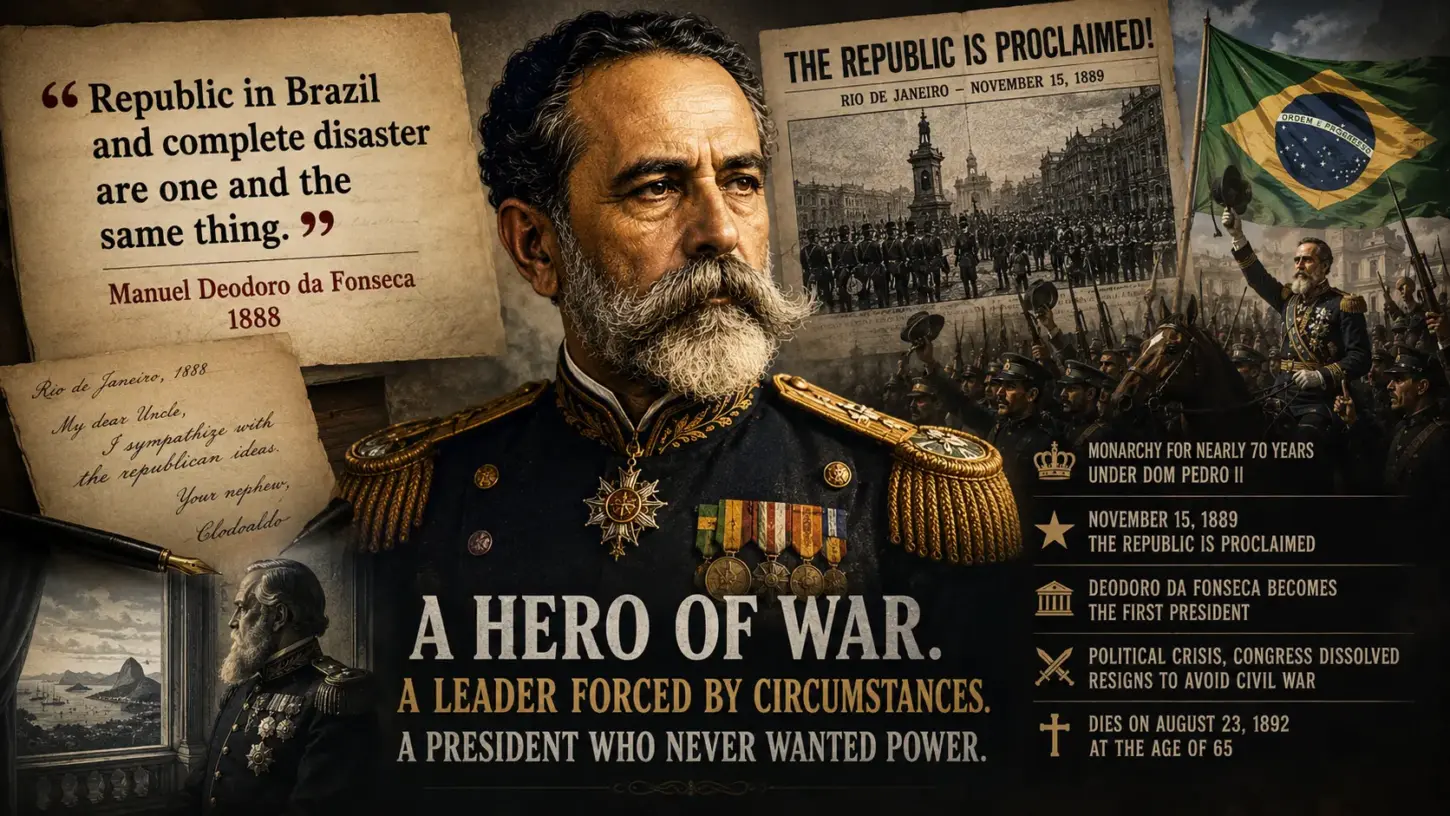
Story | Deodoro da Fonseca: The Man Who Brought Down the Empire He Wanted to Preserve
Monarquista convicto, amigo de Dom Pedro II e crítico da República, Deodoro da Fonseca parecia a pessoa menos provável para derrubar o Império. No entanto, entre boatos, rivalidades e pressões militares, tornou-se o protagonista do golpe de 15 de novembro de 1889. Conheça a trajetória contraditória do homem que proclamou um regime no qual não confiava e acabou vencido pela instabilidade que ajudou a criar.
| Audio | |
|---|---|
Normal | Slow |
| English Transcript | Tradução |
| Deodoro da Fonseca: The Man Who Brought Down the Empire He Wanted to Preserve | Deodoro da Fonseca: o homem que derrubou o Império que desejava preservar |
| "Republic in Brazil and complete disaster are one and the same thing." | “República no Brasil e desgraça completa é a mesma coisa.” |
| The sentence seems improbable when one discovers who wrote it. It was written by Manuel Deodoro da Fonseca, the marshal who, shortly afterward, would enter history as the man who proclaimed the Republic in Brazil. | A frase parece improvável quando se descobre o nome de seu autor. Ela foi escrita por Manuel Deodoro da Fonseca, o marechal que, pouco tempo depois, entraria para a história como o homem que proclamou a República no Brasil. |
| The contradiction is more than merely curious. It helps us understand that November 15, 1889, was far from being the inevitable outcome of a great popular movement. The Republic was born amid military conflicts, personal resentments, rumors, political interests, and decisions made in haste. | A contradição não é apenas curiosa. Ela ajuda a compreender que o dia 15 de novembro de 1889 esteve longe de ser o desfecho inevitável de um grande movimento popular. A República nasceu em meio a conflitos militares, ressentimentos pessoais, boatos, interesses políticos e decisões tomadas às pressas. |
| Deodoro da Fonseca belonged to a family deeply connected to the Army. He had fought in the Paraguayan War, earned great prestige among military officers, and risen to the rank of marshal. He was respected by the troops and regarded as one of the few figures capable of uniting officers of different political views. | Deodoro da Fonseca pertencia a uma família profundamente ligada ao Exército. Havia combatido na Guerra do Paraguai, conquistado prestígio entre os militares e alcançado o posto de marechal. Era respeitado pela tropa e considerado uma das poucas figuras capazes de unir oficiais de diferentes tendências. |
| Despite this, Deodoro was not a republican. | Apesar disso, Deodoro não era republicano. |
| He maintained a relationship of friendship and admiration with Emperor Dom Pedro II. It is said that he once declared he wished to accompany the emperor's coffin when he died, demonstrating the deep respect he had for the monarch. | Mantinha uma relação de amizade e admiração por Dom Pedro II. Conta-se que declarou desejar acompanhar o caixão do imperador quando este morresse, demonstrando a consideração que nutria pelo monarca. |
| His opinion about the Republic had also been expressed quite clearly. In 1888, his nephew Clodoaldo wrote to him expressing sympathy for republican ideas. Deodoro replied without hesitation: | Sua opinião sobre a República também havia sido registrada de maneira clara. Em 1888, seu sobrinho Clodoaldo escreveu-lhe manifestando simpatia pelas ideias republicanas. Deodoro respondeu sem hesitação: |
| "Republic in Brazil is an impossible thing because it will be a true disaster. Brazilians are and will remain far too unprepared for republican government. The monarchy is the only pillar supporting our Brazil. If things are bad with it, they will be even worse without it." | “República no Brasil é coisa impossível porque será uma verdadeira desgraça. Os brasileiros estão e estarão muito mal educados para republicanos. O único sustentáculo do nosso Brasil é a monarquia. Se mal com ela, pior sem ela.” |
| One year later, it would be this very man who would lead the coup that brought nearly seven decades of monarchy to an end. | Um ano depois, seria justamente ele o responsável pelo golpe que encerraria quase sete décadas de monarquia. |
| On the night of November 14, 1889, the atmosphere in Rio de Janeiro was one of growing tension. The so-called Military Question had severely damaged relations between Army officers and the imperial government. Civilian and military republicans were conspiring against the regime, yet they still lacked a leader with enough authority to set the troops in motion. | Na noite de 14 de novembro de 1889, o ambiente no Rio de Janeiro era de tensão. A chamada Questão Militar havia agravado o conflito entre oficiais do Exército e o governo imperial. Republicanos civis e militares conspiravam contra o regime, porém ainda faltava uma liderança com autoridade suficiente para colocar as tropas em movimento. |
| Deodoro was the essential figure. | Deodoro era o nome essencial. |
| The problem was that the marshal hesitated. Besides being a monarchist, he was seriously ill and showed little willingness to participate in an action aimed at overthrowing Dom Pedro II. | O problema era que o marechal hesitava. Além de monarquista, estava doente e não demonstrava disposição para participar de uma ação destinada a derrubar Dom Pedro II. |
| The conspirators then decided to put pressure on him. | Os conspiradores, então, decidiram pressioná-lo. |
| Major Frederico Sólon de Sampaio Ribeiro went to Deodoro's residence and delivered alarming information. He told him that the government was preparing to arrest military officers involved in the movement and that the marshal himself could soon be taken into custody. | O major Frederico Sólon de Sampaio Ribeiro foi até a residência de Deodoro e lhe transmitiu informações alarmantes. Disse que o governo preparava a prisão de militares envolvidos no movimento e que o próprio marechal poderia ser detido. |
| The news outraged him. | A notícia provocou sua indignação. |
| Feeling threatened and believing that the imperial government had turned against him, Deodoro agreed to lead the troops. The decision that would change the course of Brazilian history was made amid rumors whose truth had never been confirmed. | Sentindo-se ameaçado e acreditando que o governo imperial havia se voltado contra ele, Deodoro aceitou liderar as tropas. A decisão que mudaria a história do Brasil foi tomada em meio a rumores cuja veracidade jamais havia sido confirmada. |
| On the morning of November 15, the marshal marched at the head of his soldiers toward Campo da Aclamação, now known as Praça da República, in Rio de Janeiro. | Na manhã de 15 de novembro, o marechal seguiu à frente de soldados em direção ao Campo da Aclamação, atual Praça da República, no Rio de Janeiro. |
| The scene, later portrayed as a carefully planned republican march, was in reality far more confused. Most of the soldiers believed they were merely participating in the removal of the cabinet headed by the Viscount of Ouro Preto. Many had no idea that the monarchy itself was about to be abolished. | A cena, posteriormente retratada como uma marcha republicana cuidadosamente planejada, era muito mais confusa. Grande parte dos soldados acreditava estar participando apenas da derrubada do gabinete comandado pelo visconde de Ouro Preto. Muitos não sabiam que a monarquia seria abolida. |
| Deodoro himself initially appeared to be acting against the ministry rather than against the emperor. | O próprio Deodoro parecia agir inicialmente contra o ministério, e não contra o imperador. |
| Standing before the troops, he is said to have saluted Dom Pedro II by shouting, "Long live His Majesty, the Emperor!" The gesture revealed the ambiguity of that moment. The man placed at the head of the revolt was still openly expressing loyalty to the monarch he would help depose only hours later. | Diante das tropas, teria saudado Dom Pedro II com um grito de “Viva Sua Majestade, o Imperador!”. A manifestação revelava a ambiguidade daquele momento. O homem colocado à frente da revolta ainda demonstrava lealdade ao monarca que ajudaria a depor poucas horas depois. |
| The imperial cabinet fell. However, the republicans feared that Dom Pedro II might appoint a new ministry and preserve the monarchy. The movement had to go further. | O ministério imperial caiu. Entretanto, os republicanos temiam que Dom Pedro II nomeasse um novo gabinete e preservasse a monarquia. Era necessário levar o movimento além. |
| Throughout the rest of the day, pressure on Deodoro continued. Political intrigues and personal rivalries were also exploited. Word spread that the emperor intended to appoint Gaspar Silveira Martins to head the new cabinet. Deodoro was a personal enemy of Martins, and the prospect of seeing him in power only deepened his anger. | Durante o restante do dia, a pressão sobre Deodoro continuou. Intrigas políticas e rivalidades pessoais também foram exploradas. Espalhou-se a informação de que o imperador escolheria Gaspar Silveira Martins para chefiar o novo ministério. Deodoro era adversário de Martins, e a possibilidade de vê-lo no poder aumentou sua revolta. |
| That night, the Republic was proclaimed. | Naquela noite, a República foi proclamada. |
| Dom Pedro II did not organize armed resistance. Two days later, the imperial family received orders to leave Brazil. The emperor, who had reigned for nearly half a century, departed into exile without the Brazilian people ever having been consulted about the change of regime. | Dom Pedro II não organizou resistência armada. Dois dias depois, a família imperial recebeu a ordem para deixar o Brasil. O imperador, que reinara por quase meio século, partiu para o exílio sem que a população tivesse sido consultada sobre a mudança de regime. |
| Deodoro assumed leadership of the Provisional Government. He was later chosen by Congress as the first President of the Republic. | Deodoro assumiu a chefia do Governo Provisório. Posteriormente, foi escolhido pelo Congresso como o primeiro presidente da República. |
| His experience in office, however, proved to be very different from commanding troops on the battlefield. | A experiência no poder, porém, revelou-se muito diferente da liderança exercida nos quartéis. |
| The new government faced inflation, disputes among republican factions, conflicts with Congress, and growing political instability. Trained as a military officer, Deodoro struggled with the negotiations and compromises required by parliamentary life. | O novo governo enfrentou inflação, disputas entre grupos republicanos, conflitos com o Congresso e crescente instabilidade política. Deodoro, formado para comandar soldados, encontrava dificuldades diante das negociações e concessões exigidas pela vida parlamentar. |
| His health also continued to decline. | Sua saúde também se deteriorava. |
| In November 1891, under mounting political pressure, the president dissolved Congress. The authoritarian move triggered a serious constitutional crisis. Sectors of the Navy threatened to bombard Rio de Janeiro unless constitutional order was restored. | Em novembro de 1891, pressionado pela oposição, o presidente decidiu dissolver o Congresso. O gesto autoritário desencadeou uma grave crise. Setores da Marinha ameaçaram bombardear o Rio de Janeiro caso a legalidade constitucional não fosse restabelecida. |
| The country stood on the brink of civil war. | O país aproximava-se de uma guerra civil. |
| Without sufficient support to confront the uprising and fearing bloodshed, Deodoro resigned on November 23, 1891. His constitutional presidency had lasted less than one year. | Sem apoio suficiente para enfrentar a revolta e temendo o derramamento de sangue, Deodoro renunciou em 23 de novembro de 1891. Seu governo constitucional havia durado menos de um ano. |
| The marshal withdrew from public life and died in August 1892, only nine months after leaving office. He was 65 years old. | O marechal retirou-se da vida pública e morreu em agosto de 1892, apenas nove meses depois de deixar a Presidência. Tinha 65 anos. |
| His life ended marked by a profound irony. Deodoro became the symbol of a regime in which he had never truly believed, overthrew an emperor he respected, and assumed leadership of a movement whose full consequences he may never have completely understood. | Sua trajetória terminou marcada por uma profunda ironia. Deodoro tornou-se símbolo de um regime no qual não confiava, derrubou um imperador que respeitava e assumiu a liderança de um movimento cujas consequências talvez não tivesse compreendido inteiramente. |
| There is no historical consensus that he spent his final months consumed by remorse, as some popular accounts claim. There are, however, reports describing his disappointment with the direction the new regime had taken and his discomfort with the political crisis he had helped unleash. | Não há consenso entre os historiadores de que tenha vivido seus últimos meses consumido pelo arrependimento, como algumas narrativas populares afirmam. Existem, contudo, relatos de sua decepção com os rumos do novo regime e de seu desconforto diante da crise política que ajudara a desencadear. |
| The sentence he wrote before the fall of the Empire therefore remains as a kind of personal prophecy. | A frase escrita antes da queda do Império permanece, por isso, como uma espécie de profecia pessoal. |
| Deodoro feared that Brazil was not prepared for a republic. Soon afterward, he became its first president, dissolved Congress, and resigned in order to prevent the Armed Forces from turning their weapons against one another. | Deodoro temia que o Brasil não estivesse preparado para a República. Pouco depois, tornou-se seu primeiro presidente, fechou o Congresso e renunciou para impedir que as Forças Armadas entrassem em confronto. |
| The man who helped bring the monarchy to an end was ultimately defeated by the very regime he had helped create. | O homem que ajudou a acabar com a monarquia terminou vencido pelo regime que colocou no lugar dela. |
Contagem de palavras
A tabela abaixo exibe as palavras encontradas neste texto, bem como o número de vezes em que aparecem.
Veja também: Para que serve esta tabela?
| Freq. | Palavra | Freq. | Palavra | Freq. | Palavra |
|---|---|---|---|---|---|
| 97 | the | 29 | of | 27 | to |
| 23 | and | 22 | he | 21 | was |
| 19 | in | 18 | a | 16 | deodoro |
| 15 | that | 14 | had | 12 | his |
| 9 | by | 8 | republic | 8 | it |
| 8 | as | 7 | with | 7 | who |
| 7 | one | 7 | on | 7 | emperor |
| 7 | be | 6 | political | 6 | military |
| 6 | marshal | 6 | is | 6 | him |
| 6 | government | 6 | brazil | 5 | would |
| 5 | troops | 5 | republican | 5 | regime |
| 5 | pedro | 5 | november | 5 | monarchy |
| 5 | man | 5 | later | 5 | ii |
| 5 | for | 5 | dom | 5 | da |
| 5 | an | 5 | against | 4 | without |
| 4 | personal | 4 | only | 4 | officers |
| 4 | new | 4 | movement | 4 | imperial |
| 4 | from | 4 | de | 4 | congress |
| 4 | are | 3 | wrote | 3 | will |
| 3 | were | 3 | very | 3 | they |
| 3 | than | 3 | rio | 3 | pressure |
| 3 | president | 3 | not | 3 | never |
| 3 | life | 3 | janeiro | 3 | however |
| 3 | helped | 3 | head | 3 | fonseca |
| 3 | far | 3 | constitutional | 3 | cabinet |
| 3 | been | 3 | at | 3 | also |
| 3 | about | 2 | year | 2 | whose |
| 2 | when | 2 | war | 2 | threatened |
| 2 | this | 2 | thing | 2 | there |
| 2 | taken | 2 | still | 2 | soon |
| 2 | soldiers | 2 | sentence | 2 | said |
| 2 | rumors | 2 | respected | 2 | resigned |
| 2 | republicans | 2 | proclaimed | 2 | preserve |
| 2 | popular | 2 | order | 2 | office |
| 2 | no | 2 | night | 2 | nearly |
| 2 | more | 2 | months | 2 | monarch |
| 2 | ministry | 2 | merely | 2 | martins |
| 2 | made | 2 | leadership | 2 | lead |
| 2 | into | 2 | history | 2 | himself |
| 2 | have | 2 | growing | 2 | great |
| 2 | first | 2 | feared | 2 | family |
| 2 | expressing | 2 | end | 2 | empire |
| 2 | dissolved | 2 | disaster | 2 | different |
| 2 | died | 2 | crisis | 2 | continued |
| 2 | conflicts | 2 | change | 2 | brought |
| 2 | brazilian | 2 | believed | 2 | being |
| 2 | before | 2 | became | 2 | assumed |
| 2 | army | 2 | armed | 2 | appoint |
| 2 | among | 2 | amid | 2 | afterward |
| 1 | yet | 1 | years | 1 | written |
| 1 | worse | 1 | word | 1 | withdrew |
| 1 | wished | 1 | willingness | 1 | which |
| 1 | went | 1 | weapons | 1 | wanted |
| 1 | viscount | 1 | views | 1 | us |
| 1 | uprising | 1 | unprepared | 1 | unless |
| 1 | unleash | 1 | uniting | 1 | understood |
| 1 | understand | 1 | under | 1 | ultimately |
| 1 | two | 1 | turning | 1 | turned |
| 1 | truth | 1 | truly | 1 | true |
| 1 | triggered | 1 | trained | 1 | toward |
| 1 | too | 1 | told | 1 | throughout |
| 1 | things | 1 | therefore | 1 | then |
| 1 | their | 1 | tension | 1 | sympathy |
| 1 | symbol | 1 | supporting | 1 | support |
| 1 | sufficient | 1 | struggled | 1 | stood |
| 1 | standing | 1 | spread | 1 | spent |
| 1 | some | 1 | sólon | 1 | so |
| 1 | silveira | 1 | showed | 1 | shouting |
| 1 | shortly | 1 | severely | 1 | seven |
| 1 | set | 1 | seriously | 1 | serious |
| 1 | seems | 1 | seeing | 1 | sectors |
| 1 | scene | 1 | sampaio | 1 | same |
| 1 | saluted | 1 | rivalries | 1 | risen |
| 1 | ribeiro | 1 | revolt | 1 | revealed |
| 1 | restored | 1 | rest | 1 | respect |
| 1 | resistance | 1 | residence | 1 | resentments |
| 1 | required | 1 | república | 1 | reports |
| 1 | replied | 1 | removal | 1 | remorse |
| 1 | remains | 1 | remain | 1 | relationship |
| 1 | relations | 1 | reigned | 1 | regarded |
| 1 | received | 1 | reality | 1 | rather |
| 1 | rank | 1 | quite | 1 | question |
| 1 | put | 1 | public | 1 | provisional |
| 1 | proved | 1 | prospect | 1 | prophecy |
| 1 | profound | 1 | problem | 1 | prevent |
| 1 | preto | 1 | prestige | 1 | presidency |
| 1 | preparing | 1 | prepared | 1 | pra'a |
| 1 | power | 1 | portrayed | 1 | planned |
| 1 | placed | 1 | pillar | 1 | people |
| 1 | participating | 1 | participate | 1 | parliamentary |
| 1 | paraguayan | 1 | overthrowing | 1 | overthrew |
| 1 | outraged | 1 | outcome | 1 | ouro |
| 1 | our | 1 | organize | 1 | orders |
| 1 | opinion | 1 | openly | 1 | once |
| 1 | old | 1 | officer | 1 | now |
| 1 | nine | 1 | news | 1 | nephew |
| 1 | negotiations | 1 | navy | 1 | move |
| 1 | mounting | 1 | motion | 1 | most |
| 1 | morning | 1 | monarchist | 1 | moment |
| 1 | might | 1 | may | 1 | marked |
| 1 | marched | 1 | march | 1 | many |
| 1 | manuel | 1 | major | 1 | majesty |
| 1 | maintained | 1 | loyalty | 1 | long |
| 1 | live | 1 | little | 1 | less |
| 1 | leaving | 1 | leave | 1 | leader |
| 1 | lasted | 1 | lacked | 1 | known |
| 1 | kind | 1 | itself | 1 | its |
| 1 | irony | 1 | involved | 1 | intrigues |
| 1 | interests | 1 | intended | 1 | instability |
| 1 | initially | 1 | information | 1 | inflation |
| 1 | inevitable | 1 | improbable | 1 | impossible |
| 1 | ill | 1 | if | 1 | ideas |
| 1 | idea | 1 | hours | 1 | historical |
| 1 | hesitation | 1 | hesitated | 1 | helps |
| 1 | help | 1 | health | 1 | headed |
| 1 | having | 1 | haste | 1 | half |
| 1 | go | 1 | gesture | 1 | gaspar |
| 1 | further | 1 | full | 1 | friendship |
| 1 | frederico | 1 | fought | 1 | forces |
| 1 | final | 1 | figures | 1 | figure |
| 1 | few | 1 | fell | 1 | feeling |
| 1 | fearing | 1 | fall | 1 | factions |
| 1 | faced | 1 | expressed | 1 | exploited |
| 1 | experience | 1 | exile | 1 | ever |
| 1 | even | 1 | essential | 1 | enter |
| 1 | enough | 1 | enemy | 1 | ended |
| 1 | earned | 1 | down | 1 | disputes |
| 1 | discovers | 1 | discomfort | 1 | disappointment |
| 1 | direction | 1 | did | 1 | despite |
| 1 | describing | 1 | depose | 1 | departed |
| 1 | demonstrating | 1 | delivered | 1 | defeated |
| 1 | deeply | 1 | deepened | 1 | deep |
| 1 | decline | 1 | declared | 1 | decisions |
| 1 | decision | 1 | decided | 1 | decades |
| 1 | days | 1 | day | 1 | damaged |
| 1 | custody | 1 | curious | 1 | create |
| 1 | course | 1 | coup | 1 | country |
| 1 | could | 1 | contradiction | 1 | consumed |
| 1 | consulted | 1 | conspiring | 1 | conspirators |
| 1 | consequences | 1 | consensus | 1 | connected |
| 1 | confused | 1 | confront | 1 | confirmed |
| 1 | compromises | 1 | completely | 1 | complete |
| 1 | commanding | 1 | coffin | 1 | clodoaldo |
| 1 | clearly | 1 | claim | 1 | civilian |
| 1 | civil | 1 | chosen | 1 | century |
| 1 | carefully | 1 | capable | 1 | campo |
| 1 | called | 1 | brink | 1 | bring |
| 1 | brazilians | 1 | born | 1 | bombard |
| 1 | bloodshed | 1 | between | 1 | besides |
| 1 | belonged | 1 | believing | 1 | because |
| 1 | battlefield | 1 | bad | 1 | authority |
| 1 | authoritarian | 1 | august | 1 | atmosphere |
| 1 | arrest | 1 | appeared | 1 | another |
| 1 | anger | 1 | ambiguity | 1 | alarming |
| 1 | aimed | 1 | agreed | 1 | after |
| 1 | admiration | 1 | action | 1 | acting |
| 1 | aclama'ão | 1 | accounts | 1 | accompany |
| 1 | abolished |