
Learning Strategies | Neuroscience and Learning (Vídeo)
Você realmente acha que usa apenas 10% do seu cérebro? Pessoas “de cérebro esquerdo ou direito”, estilos rígidos de aprendizagem e janelas que se fecham para sempre: a ciência já provou que quase tudo o que nos ensinaram sobre como o cérebro aprende é puro neuromito. Descubra o que a neurociência moderna realmente diz sobre neuroplasticidade, atenção e a capacidade de aprender qualquer coisa em qualquer fase da vida.
| Audio | |
|---|---|
Normal | Slow |
| English Transcript | Tradução |
| Neuroscience and Learning | Neurociência e Aprendizagem |
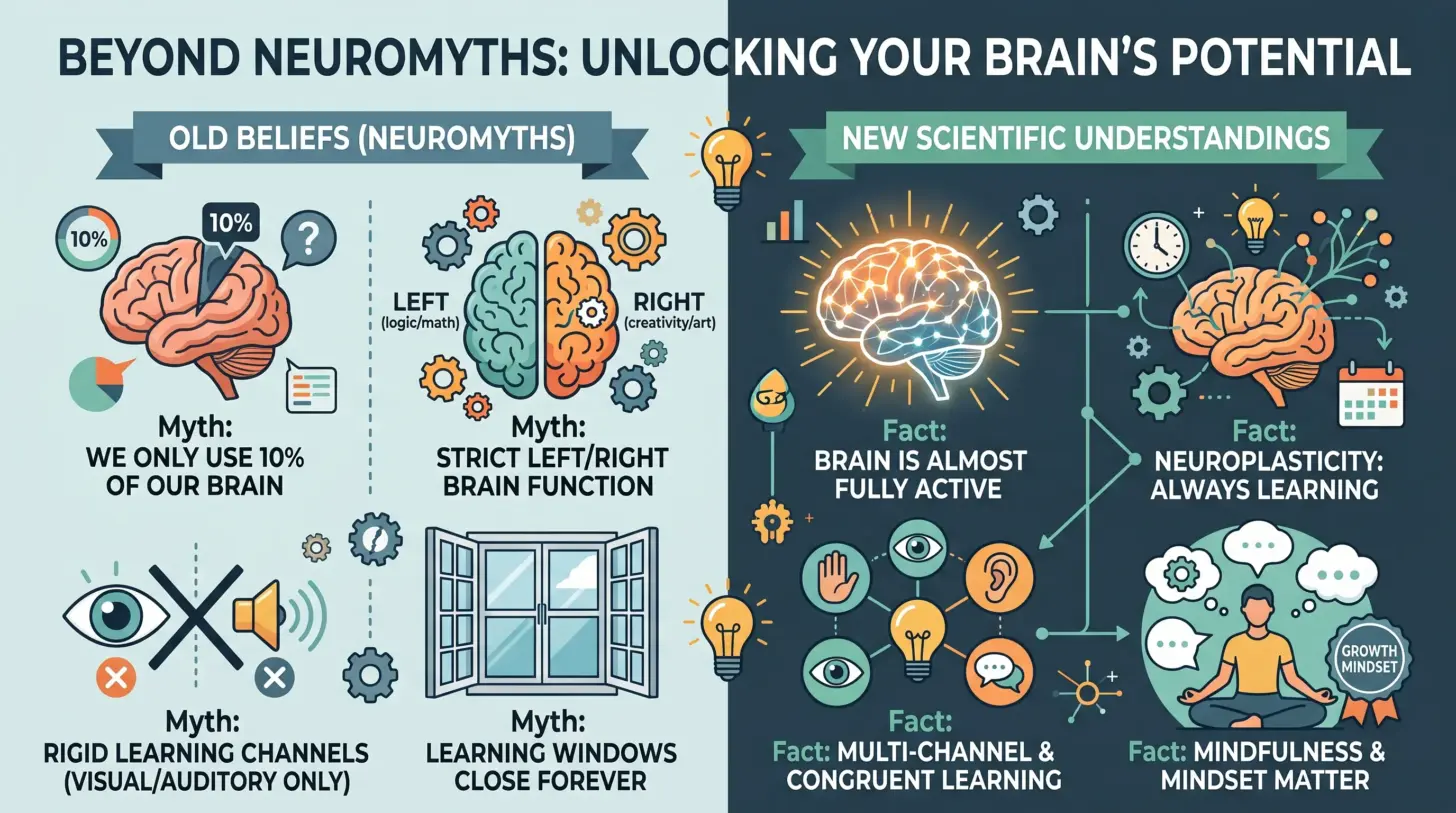
| You might have heard that you only use 10% of the capacity of your brain. It's actually not true. You're using almost all of the capacity that your brain has at any point in time. | Talvez você já tenha ouvido que usa apenas 10% da capacidade do seu cérebro. Na verdade, isso não é verdade. Você utiliza quase toda a capacidade que o seu cérebro possui em qualquer momento. |
| You might have heard that there's a left and a right brain that function completely separately and differently. While, yes, there are people that are more talented in certain things than others, it has absolutely nothing, literally nothing, to do with the hemisphere of your brain. | Talvez você já tenha ouvido que existe um cérebro esquerdo e um cérebro direito, que funcionam de maneira completamente separada e diferente. Embora existam, sim, pessoas mais talentosas em determinadas atividades do que outras, isso não tem absolutamente nada, literalmente nada, a ver com o hemisfério cerebral. |
| You might have been told once that you have a certain channel through which you learn better; some people might be visual learners, others might be auditory learners. The truth is you actually use as many channels as you can delivering a congruent message. | Talvez alguém já tenha lhe dito que você possui determinado canal por meio do qual aprende melhor; algumas pessoas seriam aprendizes visuais, enquanto outras seriam aprendizes auditivas. A verdade é que você utiliza tantos canais quanto possível para transmitir uma mensagem coerente. |
| Or you might have heard that there are certain windows of learning which, when they are closed, have no chance to be reopened again. | Ou talvez você já tenha ouvido que existem determinadas janelas de aprendizagem que, depois de fechadas, não têm nenhuma possibilidade de serem reabertas. |
| All of those are "neuromyths", statements that have been made based on early neuroscience results that found their way somehow into our learning programs, but are not substantiated by any scientific facts. There are certain windows of learning, but they are strictly confined to a couple of abilities: if you have not learned any language or you have not been exposed to proper light via a proper lens, you will not be able to relearn these abilities as you grow older. But for the rest, we can say there's neuroplasticity. So at every point in your life, you are actually able to learn, to refine, or to add new capabilities to your set of existing functions. | Todas essas ideias são “neuromitos”, afirmações elaboradas com base nos primeiros resultados da neurociência que, de alguma forma, foram incorporadas aos nossos programas de aprendizagem, mas que não são fundamentadas em nenhum fato científico. Existem determinadas janelas de aprendizagem, mas elas estão estritamente limitadas a algumas habilidades: se você não tiver aprendido nenhum idioma ou não tiver sido exposto à luz adequada por meio de uma lente apropriada, não conseguirá reaprender essas habilidades à medida que envelhecer. Em relação a todo o restante, porém, podemos afirmar que existe neuroplasticidade. Portanto, em qualquer momento de sua vida, você é realmente capaz de aprender, aperfeiçoar ou acrescentar novas capacidades ao seu conjunto de funções existentes. |
| So, number one: you can learn. But number two: it matters how mindful you are about it. Mindfulness meditation actually significantly improves your readiness to take in new knowledge, so mindfulness matters. | Assim, primeiro: você pode aprender. Entretanto, em segundo lugar: o grau de atenção consciente que você dedica a isso faz diferença. A meditação de atenção plena melhora significativamente sua disposição para assimilar novos conhecimentos, portanto, a atenção plena é importante. |
| But also, the mindset matters. When you tell a group of Asian women before a math exam that they are Asian, they will perform average or even better. If you remind them right before the exam that they're actually girls, you'll find a very different outcome of average or lower performance. So we need to find out what those stereotype threats are that make us conscious about the way that the world sees us, the way that we see ourselves, and might then lead to better or worse performance afterwards. | A mentalidade também é importante. Quando se diz a um grupo de mulheres asiáticas, antes de uma prova de matemática, que elas são asiáticas, seu desempenho será mediano ou até superior. Se, logo antes da prova, elas forem lembradas de que, na verdade, são mulheres, será observado um resultado muito diferente, com desempenho mediano ou inferior. Portanto, precisamos descobrir quais são essas ameaças associadas aos estereótipos que nos tornam conscientes da maneira como o mundo nos vê e da maneira como vemos a nós mesmos, podendo, posteriormente, resultar em um desempenho melhor ou pior. |
| On the other hand, there's something called a growth mindset: the belief that you can learn whatever life puts in front of you. If college students get told that they can actually use their brain as a muscle, train it, and learn, their exam outcomes just go skyrocket high. There were experiments done on the brain with London cab drivers who literally have the functional area of their brain enlarged where the visual blueprint of the London map is. Interestingly enough, when they retire, this area of the brain grows smaller again. This is how plastic your brain is. If you practice, practice, and repeat, you will be able to literally grow and instill the function that you would like to be there. | Por outro lado, existe algo chamado mentalidade de crescimento: a crença de que você pode aprender tudo aquilo que a vida colocar diante de você. Se estudantes universitários forem informados de que podem realmente usar o cérebro como um músculo, treiná-lo e aprender, seus resultados nas provas aumentarão extraordinariamente. Foram realizados experimentos com o cérebro de motoristas de táxi de Londres, que literalmente apresentam um aumento na área funcional do cérebro onde está armazenada a representação visual do mapa da cidade. Curiosamente, quando eles se aposentam, essa área do cérebro volta a diminuir. Esse é o grau de plasticidade do seu cérebro. Se você praticar, praticar e repetir, será capaz de literalmente desenvolver e consolidar a função que gostaria de possuir. |
| Attention is highly relevant for learning. The big mistake that's often being made is that we allow people to multitask. If you do multiple things, when you're on a BlackBerry, when you're listening to someone, your attention will switch. You're not able to hold the right amount of attention required to capture the learning. So multitasking needs to be avoided as much as literally possible in any of these learning setups. | A atenção é extremamente importante para a aprendizagem. Um grande erro cometido com frequência é permitir que as pessoas realizem várias tarefas ao mesmo tempo. Quando você faz várias coisas, como usar um BlackBerry enquanto escuta alguém, sua atenção fica alternando entre elas. Você não consegue manter o nível adequado de atenção necessário para assimilar o aprendizado. Portanto, a realização simultânea de várias tarefas precisa ser evitada, tanto quanto for literalmente possível, em qualquer uma dessas situações de aprendizagem. |
| The other thing is about the desire to learn. If you instill in people the desire to learn, if you explain to them why it is relevant that they need to learn, and you're able to create an environment in which they actually enjoy learning, this will boost the outcomes significantly. When someone learns and gets positive feedback along the way, the learning journey accelerates. | Outro aspecto diz respeito ao desejo de aprender. Se você despertar nas pessoas o desejo de aprender, explicar por que é importante que elas aprendam e conseguir criar um ambiente no qual elas realmente sintam prazer em aprender, isso melhorará significativamente os resultados. Quando alguém aprende e recebe feedback positivo ao longo do processo, a jornada de aprendizagem se acelera. |
| So the next time you see a course that speaks about the idle space in your brain that you can occupy, the left and the right brain, or the windows that you need to overcome, you should absolutely shy away. Only 7% of all CEOs are actually happy and satisfied with the outcome of the investment into leadership development. It's not surprising, because a lot of those leadership development programs don't take into consideration the latest knowledge of neurosciences, or even worse, they are built on what we call neuromyths. | Portanto, da próxima vez que você encontrar um curso que fale sobre o espaço ocioso do cérebro que pode ser ocupado, sobre o cérebro esquerdo e o direito ou sobre as janelas que precisam ser superadas, você deve definitivamente manter distância. Apenas 7% de todos os CEOs estão realmente felizes e satisfeitos com o retorno do investimento feito no desenvolvimento de lideranças. Isso não é surpreendente, pois muitos desses programas de desenvolvimento de lideranças não levam em consideração os conhecimentos mais recentes da neurociência ou, pior ainda, são construídos com base naquilo que chamamos de neuromitos. |
| It is very important to take into consideration what is really true and really matters. i.e., we talked about mindfulness exercises, we talked about the growth mindsets with which you go into a learning journey, we talked about emotional connotations, the importance of feedback, we talked about the practice and applying your learning, and the fact that you can learn if you believe you can learn and you have the desire to do so. | É muito importante levar em consideração aquilo que é realmente verdadeiro e relevante. Em outras palavras, falamos sobre exercícios de atenção plena, sobre a mentalidade de crescimento com a qual você inicia uma jornada de aprendizagem, sobre as associações emocionais, sobre a importância do feedback, sobre a prática e a aplicação daquilo que foi aprendido e sobre o fato de que você pode aprender se acreditar que é capaz e tiver o desejo de fazê-lo. |
Contagem de palavras
A tabela abaixo exibe as palavras encontradas neste vídeo, bem como o número de vezes em que aparecem.
Veja também: Para que serve esta tabela?
| Freq. | Palavra | Freq. | Palavra | Freq. | Palavra |
|---|---|---|---|---|---|
| 41 | you | 40 | the | 27 | to |
| 24 | that | 22 | of | 20 | are |
| 16 | is | 15 | and | 15 | a |
| 11 | learning | 11 | have | 11 | brain |
| 10 | your | 10 | they | 10 | learn |
| 9 | we | 9 | in | 8 | there |
| 8 | or | 8 | not | 8 | it |
| 8 | if | 8 | can | 8 | actually |
| 8 | about | 7 | so | 7 | might |
| 7 | be | 6 | will | 6 | when |
| 6 | as | 5 | on | 5 | into |
| 5 | but | 5 | able | 4 | with |
| 4 | which | 4 | way | 4 | their |
| 4 | talked | 4 | right | 4 | people |
| 4 | matters | 4 | literally | 4 | do |
| 4 | certain | 4 | any | 3 | windows |
| 3 | what | 3 | use | 3 | those |
| 3 | this | 3 | take | 3 | practice |
| 3 | need | 3 | mindfulness | 3 | heard |
| 3 | exam | 3 | desire | 3 | better |
| 3 | been | 3 | attention | 3 | all |
| 2 | worse | 2 | visual | 2 | very |
| 2 | us | 2 | true | 2 | told |
| 2 | time | 2 | things | 2 | these |
| 2 | them | 2 | someone | 2 | significantly |
| 2 | see | 2 | relevant | 2 | really |
| 2 | proper | 2 | programs | 2 | point |
| 2 | performance | 2 | outcomes | 2 | outcome |
| 2 | others | 2 | other | 2 | only |
| 2 | number | 2 | nothing | 2 | new |
| 2 | neuroscience | 2 | neuromyths | 2 | mindset |
| 2 | made | 2 | london | 2 | life |
| 2 | left | 2 | learners | 2 | leadership |
| 2 | knowledge | 2 | journey | 2 | instill |
| 2 | how | 2 | has | 2 | growth |
| 2 | grow | 2 | go | 2 | function |
| 2 | for | 2 | find | 2 | feedback |
| 2 | even | 2 | development | 2 | consideration |
| 2 | capacity | 2 | before | 2 | average |
| 2 | at | 2 | asian | 2 | area |
| 2 | again | 2 | absolutely | 2 | abilities |
| 1 | yes | 1 | would | 1 | world |
| 1 | women | 1 | why | 1 | who |
| 1 | while | 1 | where | 1 | whatever |
| 1 | were | 1 | via | 1 | using |
| 1 | two | 1 | truth | 1 | train |
| 1 | through | 1 | threats | 1 | thing |
| 1 | then | 1 | than | 1 | tell |
| 1 | talented | 1 | switch | 1 | surprising |
| 1 | substantiated | 1 | students | 1 | strictly |
| 1 | stereotype | 1 | statements | 1 | speaks |
| 1 | space | 1 | something | 1 | somehow |
| 1 | some | 1 | smaller | 1 | skyrocket |
| 1 | shy | 1 | should | 1 | setups |
| 1 | set | 1 | separately | 1 | sees |
| 1 | scientific | 1 | say | 1 | satisfied |
| 1 | retire | 1 | results | 1 | rest |
| 1 | required | 1 | repeat | 1 | reopened |
| 1 | remind | 1 | relearn | 1 | refine |
| 1 | readiness | 1 | puts | 1 | possible |
| 1 | positive | 1 | plastic | 1 | perform |
| 1 | overcome | 1 | out | 1 | ourselves |
| 1 | our | 1 | one | 1 | once |
| 1 | older | 1 | often | 1 | occupy |
| 1 | no | 1 | next | 1 | neurosciences |
| 1 | neuroplasticity | 1 | needs | 1 | muscle |
| 1 | multitasking | 1 | multitask | 1 | multiple |
| 1 | much | 1 | more | 1 | mistake |
| 1 | mindsets | 1 | mindful | 1 | message |
| 1 | meditation | 1 | math | 1 | map |
| 1 | many | 1 | make | 1 | lower |
| 1 | lot | 1 | listening | 1 | like |
| 1 | light | 1 | lens | 1 | learns |
| 1 | learned | 1 | lead | 1 | latest |
| 1 | language | 1 | just | 1 | investment |
| 1 | interestingly | 1 | improves | 1 | important |
| 1 | importance | 1 | idle | 1 | I |
| 1 | hold | 1 | highly | 1 | high |
| 1 | hemisphere | 1 | happy | 1 | hand |
| 1 | grows | 1 | group | 1 | girls |
| 1 | gets | 1 | get | 1 | functions |
| 1 | functional | 1 | front | 1 | found |
| 1 | facts | 1 | fact | 1 | exposed |
| 1 | explain | 1 | experiments | 1 | existing |
| 1 | exercises | 1 | every | 1 | environment |
| 1 | enough | 1 | enlarged | 1 | enjoy |
| 1 | emotional | 1 | early | 1 | e |
| 1 | drivers | 1 | done | 1 | differently |
| 1 | different | 1 | delivering | 1 | create |
| 1 | course | 1 | couple | 1 | conscious |
| 1 | connotations | 1 | congruent | 1 | confined |
| 1 | completely | 1 | college | 1 | closed |
| 1 | channels | 1 | channel | 1 | chance |
| 1 | ceos | 1 | capture | 1 | capabilities |
| 1 | called | 1 | call | 1 | cab |
| 1 | by | 1 | built | 1 | boost |
| 1 | blueprint | 1 | blackberry | 1 | big |
| 1 | believe | 1 | belief | 1 | being |
| 1 | because | 1 | based | 1 | away |
| 1 | avoided | 1 | auditory | 1 | applying |
| 1 | an | 1 | amount | 1 | also |
| 1 | along | 1 | almost | 1 | allow |
| 1 | afterwards | 1 | add | 1 | accelerates |