
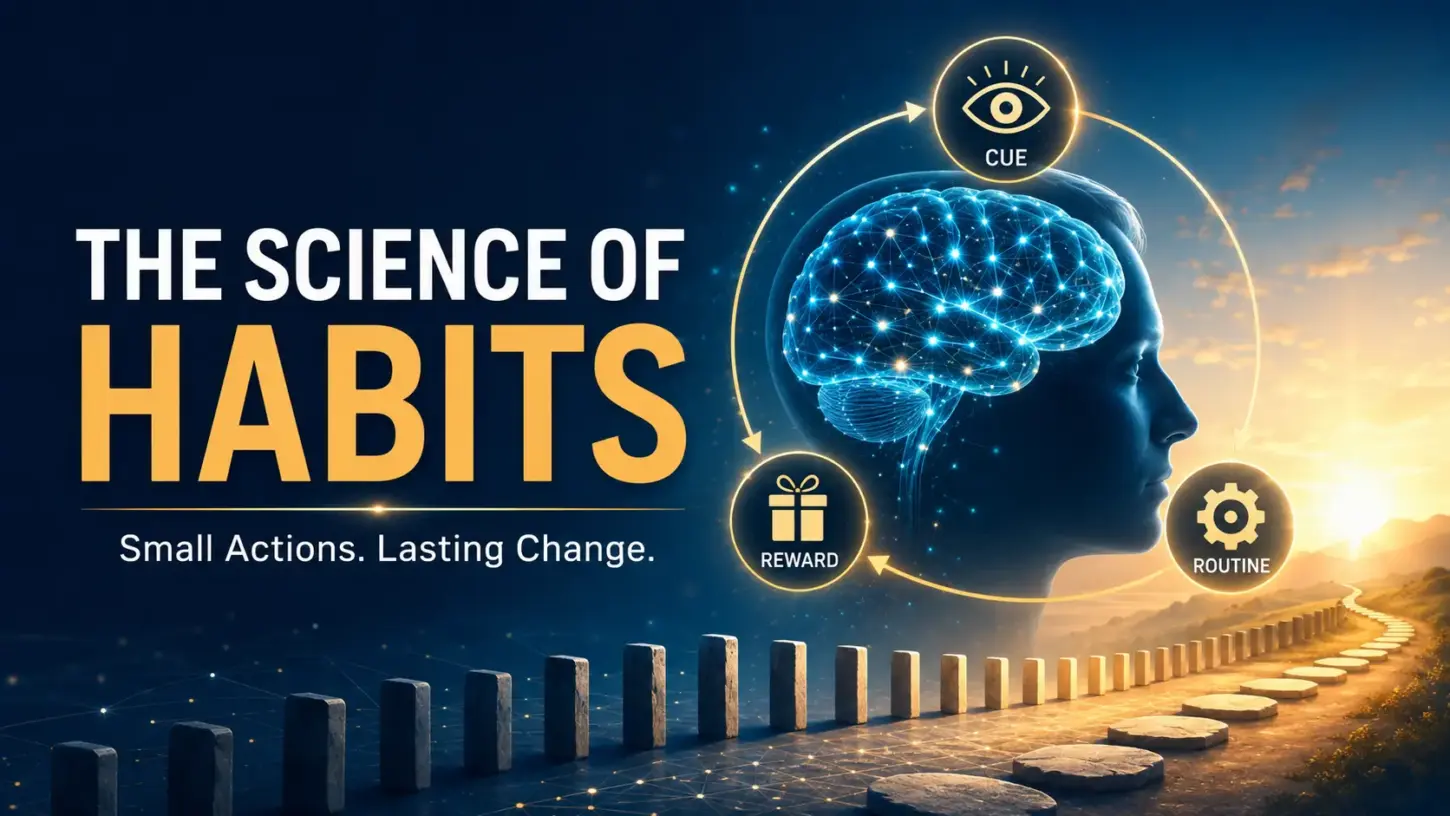
Vídeo | Explaining Habits with Neuroscience
Os hábitos controlam grande parte de nossas ações diárias e influenciam diretamente nossa saúde, felicidade e sucesso. Descubra o que acontece no cérebro durante a formação de um hábito e conheça estratégias práticas para criar comportamentos positivos, abandonar padrões prejudiciais e transformar pequenas ações em mudanças duradouras.
| Audio | |
|---|---|
Normal | Slow |
| English Transcript | Tradução |
| Explaining Habits with Neuroscience | Explicando os hábitos com a neurociência |
| What if I told you that there’s more to habits than meets the eye? Beyond the common understanding of repetitive, unconscious actions, habits really hold the key to unlocking your success, unlocking your happiness, and unlocking your health. We’re going to go on a transformative journey that unravels the fascinating science behind habits, how they can help you or hurt you, and, more importantly, what you can do to leverage them to redesign every aspect of your life. | E se eu lhe dissesse que os hábitos são muito mais do que aparentam? Para além da compreensão comum de ações repetitivas e inconscientes, os hábitos realmente contêm a chave para desbloquear seu sucesso, sua felicidade e sua saúde. Vamos embarcar em uma jornada transformadora que desvenda a fascinante ciência por trás dos hábitos, como eles podem ajudá-lo ou prejudicá-lo e, mais importante, o que você pode fazer para aproveitá-los e reformular todos os aspectos de sua vida. |
| Choose one word to describe habits. What would it be? You might be thinking about words like “automatic,” “involuntary,” or “subconscious.” I mean, after all, habits make up somewhere between 40 and 70 percent of our daily actions. At the very least, they don’t require a lot of cognitive effort. A habit is a learned behavior. It’s not a reflex. It’s something you learn, but once you learn it, it requires very little conscious effort. The way you think, decide, and behave on a day-to-day basis happens mostly automatically, through your habits. | Escolha uma palavra para descrever os hábitos. Qual seria? Talvez você esteja pensando em palavras como “automáticos”, “involuntários” ou “subconscientes”. Afinal, os hábitos representam algo entre 40% e 70% de nossas ações diárias. No mínimo, eles não exigem muito esforço cognitivo. Um hábito é um comportamento aprendido. Não é um reflexo. É algo que você aprende, mas, depois de aprendê-lo, exige muito pouco esforço consciente. A maneira como você pensa, decide e se comporta diariamente acontece, em grande parte, de forma automática, por meio de seus hábitos. |
| I’m going to add another word to this list, and that word is “primal.” One of the reasons why I describe habits as primal is that they’ve been around as long as we have. They’re over 200,000 years old. All animals, including humans, have habits. There are two main reasons why habits have persisted since the very beginning of human time. The first is that humans, like other animals, develop habits to automate certain common tasks. This frees up our attention for other actions. | Vou acrescentar outra palavra a essa lista, e essa palavra é “primitivo”. Uma das razões pelas quais descrevo os hábitos como primitivos é que eles existem há tanto tempo quanto nós. Eles têm mais de 200 mil anos. Todos os animais, incluindo os seres humanos, possuem hábitos. Existem duas razões principais pelas quais os hábitos persistem desde o início da existência humana. A primeira é que os seres humanos, assim como outros animais, desenvolvem hábitos para automatizar determinadas tarefas comuns. Isso libera nossa atenção para outras ações. |
| The second reason habits are so valuable is that they conserve energy. Eons ago, we lived in a world of scarcity. Conserving energy was incredibly critical to survival. A normal human brain is about two percent of a human’s total weight. That same brain consumes 10 to 20 percent of the body’s energy. Of all our organs, the brain uses the most energy relative to its size. The brain uses twice as much energy as the heart, which is pretty incredible, and it uses the same amount of energy as the entire muscular system. | A segunda razão pela qual os hábitos são tão valiosos é que eles conservam energia. Há eras, vivíamos em um mundo de escassez. Conservar energia era extremamente importante para a sobrevivência. Um cérebro humano normal representa cerca de 2% do peso total de uma pessoa. Esse mesmo cérebro consome de 10% a 20% da energia do corpo. Entre todos os nossos órgãos, o cérebro é o que mais utiliza energia em relação ao seu tamanho. O cérebro utiliza duas vezes mais energia que o coração, o que é bastante impressionante, e consome a mesma quantidade de energia que todo o sistema muscular. |
| If we save mental energy, that’s a really good thing because we don’t have to pay attention to every single behavior, which means we can pay attention to other things. So, let’s dive deeper into the science of habits. | Se economizarmos energia mental, isso será muito positivo, pois não precisaremos prestar atenção a cada comportamento, o que significa que poderemos prestar atenção a outras coisas. Portanto, vamos nos aprofundar na ciência dos hábitos. |
| Habits involve the formation and reinforcement of neural connections in the brain. Initially, when we’re trying to learn new habits, it requires a lot of effort, a lot of willpower, and a lot of thinking. Typically, this uses a part of the brain known as the prefrontal cortex, which is responsible for some of our more deliberate thoughts and actions. | Os hábitos envolvem a formação e o fortalecimento de conexões neurais no cérebro. Inicialmente, quando tentamos aprender novos hábitos, isso exige muito esforço, muita força de vontade e muito pensamento. Normalmente, esse processo utiliza uma parte do cérebro conhecida como córtex pré-frontal, responsável por alguns de nossos pensamentos e ações mais deliberados. |
| As the neurons involved in the habit continue to fire together, they start to wire together. This is known as Hebbian learning, after the Canadian psychologist Dr. Donald Hebb. As habits become even more automatic, the production of the behavior shifts from the prefrontal cortex to a part of the brain that is responsible for, among other things, motor planning, habit formation, and execution. This area of the brain is called the basal ganglia. | À medida que os neurônios envolvidos no hábito continuam a disparar juntos, eles começam a se conectar. Isso é conhecido como aprendizagem hebbiana, em homenagem ao psicólogo canadense Dr. Donald Hebb. À medida que os hábitos se tornam ainda mais automáticos, a produção do comportamento se desloca do córtex pré-frontal para uma parte do cérebro responsável, entre outras coisas, pelo planejamento motor, pela formação de hábitos e pela execução. Essa região do cérebro é chamada de gânglios da base. |
| But this isn’t where habit formation ends. Once the habit is well learned, the basal ganglia hands off many of its duties to the sensorimotor cortex. The sensorimotor cortex has two basic parts, as the name implies. There’s the sensory cortex, which receives signals from the environment and from our body, and then there’s the motor cortex, which is responsible for planning and sending out commands to execute voluntary movement. | Entretanto, não é aí que termina a formação dos hábitos. Quando o hábito está bem consolidado, os gânglios da base transferem muitas de suas funções para o córtex sensório-motor. Como o próprio nome sugere, o córtex sensório-motor possui duas partes básicas. Existe o córtex sensorial, que recebe sinais do ambiente e de nosso corpo, e o córtex motor, responsável por planejar e enviar comandos para executar movimentos voluntários. |
| The point of all this is that habit formation goes from a really effortful cognitive process, in which you have to think about everything, to something that’s almost a stimulus-response relationship. We get some cue from our environment, and we automatically respond to it. In the beginning, forming habits is a pretty complicated and effortful cognitive process. | O objetivo de tudo isso é mostrar que a formação de hábitos passa de um processo cognitivo que exige muito esforço, no qual você precisa pensar em tudo, para algo que funciona quase como uma relação entre estímulo e resposta. Recebemos algum sinal do ambiente e respondemos automaticamente a ele. No início, formar hábitos é um processo cognitivo bastante complicado e trabalhoso. |
| This isn’t the only reason why starting new habits is difficult. Another reason involves the reward system associated with these behaviors. The thing is, by knowing a little bit about the science, we can hack the habit cycle and the dopamine reward system that creates good habits. | Essa não é a única razão pela qual é difícil começar novos hábitos. Outra razão envolve o sistema de recompensa associado a esses comportamentos. A questão é que, conhecendo um pouco dessa ciência, podemos manipular o ciclo do hábito e o sistema de recompensa da dopamina que cria bons hábitos. |
| The habit cycle has three basic steps: stimulus, which you’ll sometimes hear called a cue; response; and reward. This last step, reward, is the one that is missed by a lot of people, but it’s incredibly important. A stimulus, sometimes called a cue, is anything that captures our attention. For example, an alarm going off in the morning can capture our attention. | O ciclo do hábito possui três etapas básicas: o estímulo, que você também poderá ouvir ser chamado de sinal; a resposta; e a recompensa. Essa última etapa, a recompensa, é ignorada por muitas pessoas, mas é extremamente importante. Um estímulo, às vezes chamado de sinal, é qualquer coisa que capte nossa atenção. Por exemplo, o despertador tocando pela manhã pode chamar nossa atenção. |
| The response is what we do as a result of that stimulus. In the case of the alarm going off in the morning, we may either get out of bed and turn off the alarm, or we may hit the snooze button and stay in bed. Finally, the reward is what we get as a result of this new habit or behavior that we’re trying to create. | A resposta é o que fazemos em consequência desse estímulo. No caso do despertador tocando pela manhã, podemos sair da cama e desligá-lo ou apertar o botão de soneca e continuar na cama. Por fim, a recompensa é aquilo que recebemos como resultado desse novo hábito ou comportamento que estamos tentando criar. |
| The problem is that we need to figure out a way to hack the system, or we’re going to default to a lot of bad habits because they just happen more easily. Here are a few suggestions. | O problema é que precisamos encontrar uma maneira de manipular o sistema ou acabaremos recorrendo a muitos hábitos ruins, porque eles simplesmente acontecem com mais facilidade. Aqui estão algumas sugestões. |
| The first suggestion I have is something that came from James Clear. What Clear suggested is that, when you’re starting a good habit, you fill a jar with two different colors of marbles. I’m going to say 100 marbles, just to make the math easy here. Ninety percent, or 90 of the marbles, are white, and 10 percent, or 10 of the marbles, are black. | A primeira sugestão que tenho veio de James Clear. Clear sugeriu que, ao iniciar um bom hábito, você encha um pote com bolinhas de gude de duas cores diferentes. Vou usar 100 bolinhas apenas para facilitar os cálculos. Noventa por cento, ou 90 bolinhas, são brancas, enquanto 10%, ou 10 bolinhas, são pretas. |
| After you complete the task, let’s say you go to the gym, you come home and, without looking, pull a marble out of the jar. If the marble is white, you receive no reward. If the marble is black, you receive a reward. This is called a variable reward schedule, and it turns out to be highly effective in motivating people. | Depois de concluir a tarefa, como ir à academia, você volta para casa e, sem olhar, retira uma bolinha do pote. Se a bolinha for branca, você não recebe nenhuma recompensa. Se a bolinha for preta, você recebe uma recompensa. Isso é chamado de esquema de recompensa variável e se mostra altamente eficaz para motivar as pessoas. |
| I like James Clear’s idea because it creates a potential immediate reward right after the delayed reward. With that said, I have a small revision for it based on the Challenge Point Framework, which we’ve made videos about, if you’re interested. I would suggest something more like a 70–30 split, with 70 percent of the marbles being white and 30 percent being black. | Gosto da ideia de James Clear porque ela cria a possibilidade de uma recompensa imediata logo após a recompensa tardia. Dito isso, tenho uma pequena alteração baseada no Modelo do Ponto de Desafio, sobre o qual fizemos vídeos, caso você esteja interessado. Eu sugeriria uma proporção mais próxima de 70 para 30, com 70% das bolinhas brancas e 30% pretas. |
| This split provides a higher success rate, and that’s really necessary for motivation, especially early in the process. It will help you stay motivated because you have a better chance of getting a reward. | Essa proporção proporciona uma taxa de sucesso maior, algo realmente necessário para a motivação, especialmente no início do processo. Isso ajudará você a permanecer motivado porque terá uma chance maior de receber uma recompensa. |
| Suggestion number two: set clear and specific objectives and goals. Identify the results you want, and then develop a habit to support those results. For example, if you want to achieve a higher level of fitness, a goal for your first month may be to walk a certain distance three times a week. The next month, you add some light jogging, and so on. | Sugestão número dois: estabeleça objetivos e metas claros e específicos. Identifique os resultados que deseja e, depois, desenvolva um hábito que favoreça esses resultados. Por exemplo, se você deseja alcançar um nível mais elevado de condicionamento físico, uma meta para o primeiro mês pode ser caminhar determinada distância três vezes por semana. No mês seguinte, você acrescenta algumas corridas leves e assim por diante. |
| Suggestion number three is the “when-then” strategy, which I think is simple and powerful. You basically use the statement, “When I _____, then I will _____.” | A sugestão número três é a estratégia “quando-então”, que considero simples e poderosa. Basicamente, você utiliza a seguinte declaração: “Quando eu _____, então farei _____”. |
| I had a friend who was extremely busy at work, so much so that, when he went into his three-year-old son’s room to tell him good night, he felt really distracted because he was still thinking about work. We created a when-then habit system to help him solve this problem: “When I walk through my son’s doorway, then I will look at him and be fully present in that moment.” | Eu tinha um amigo extremamente ocupado no trabalho, tanto que, quando entrava no quarto de seu filho de três anos para lhe desejar boa-noite, sentia-se muito distraído porque ainda estava pensando no trabalho. Criamos um sistema de hábitos “quando-então” para ajudá-lo a resolver o problema: “Quando eu passar pela porta do quarto de meu filho, então olharei para ele e estarei totalmente presente naquele momento”. |
| Walking through the doorway was the stimulus, the response was looking at his son and being fully present, and the reward was spending quality time with his son. | Passar pela porta era o estímulo, a resposta era olhar para o filho e estar totalmente presente, e a recompensa era passar um tempo de qualidade com ele. |
| The last suggestion, number four, comes from a study by Phillippa Lally and her colleagues at University College London. She found that, when people attempted to form a new habit through habit stacking, which means linking a new behavior to an existing one, the success rate increased by 91 percent. | A última sugestão, a de número quatro, vem de um estudo realizado por Phillippa Lally e seus colegas da University College London. Ela descobriu que, quando as pessoas tentavam formar um novo hábito por meio do empilhamento de hábitos, que significa associar um novo comportamento a outro já existente, a taxa de sucesso aumentava 91%. |
| Habit stacking means adding a new behavior to an existing habit. For example, if you want to floss more often or start flossing, put the floss right next to your toothbrush. Flossing will become stacked with brushing your teeth, which, hopefully, you already do. | O empilhamento de hábitos significa acrescentar um novo comportamento a um hábito já existente. Por exemplo, se você deseja usar o fio dental com maior frequência ou começar a usá-lo, coloque-o ao lado da escova de dentes. O uso do fio dental ficará associado ao hábito de escovar os dentes, algo que, espera-se, você já faça. |
| Finally, we come to bad habits and, specifically, breaking bad habits. I’m going to give you two ideas. One of them will seem pretty obvious, and the second will seem kind of crazy. | Finalmente, chegamos aos maus hábitos e, mais especificamente, à interrupção dos maus hábitos. Vou apresentar duas ideias. Uma delas parecerá bastante óbvia, enquanto a segunda parecerá um pouco maluca. |
| The one that seems obvious is that you think about the triggers for your bad habit and preload decisions about those triggers. Let me give you an example involving something that, unfortunately, I do. I’m watching Netflix. I’m watching a series, and I’ve already watched a couple of episodes. I know I need to go to bed, but then I see one episode end and the words “Next episode” appear. I can see the time bar counting down to the next episode. | A ideia que parece óbvia é pensar nos gatilhos de seu mau hábito e preparar antecipadamente decisões relacionadas a eles. Deixe-me dar um exemplo que envolve algo que, infelizmente, eu faço. Estou assistindo à Netflix. Estou acompanhando uma série e já assisti a alguns episódios. Sei que preciso ir para a cama, mas vejo um episódio terminar e as palavras “Próximo episódio” aparecerem. Consigo ver a barra de tempo fazendo a contagem regressiva para o episódio seguinte. |
| My bad habit is to say, “I’ll just watch five minutes of this.” Then, I end up watching the whole episode. The trigger here is the bar saying, “Next episode.” My response is to lie there on the couch and watch the next episode. | Meu mau hábito é dizer: “Vou assistir apenas a cinco minutos”. Então, acabo assistindo ao episódio inteiro. O gatilho, nesse caso, é a barra exibindo “Próximo episódio”. Minha resposta é permanecer deitado no sofá e assistir ao episódio seguinte. |
| In this case, I could take that trigger and, before I even start watching Netflix, say, “When this trigger appears, I will go and get a glass of water.” That means taking the same trigger and giving it a different response. It turns out that there is also a reward in this case: a glass of water. | Nesse caso, eu poderia usar esse gatilho e, antes mesmo de começar a assistir à Netflix, dizer: “Quando esse gatilho aparecer, vou buscar um copo de água”. Isso significa utilizar o mesmo gatilho e atribuir uma resposta diferente a ele. Acontece que também existe uma recompensa nesse caso: um copo de água. |
| Now, here’s a slightly crazier and more counterintuitive way to break a bad habit. When you recognize that you’ve just exhibited a bad behavior, follow it with a good behavior. In this case, recognition becomes really important as well. | Agora, aqui está uma maneira um pouco mais maluca e menos intuitiva de interromper um mau hábito. Quando perceber que acabou de apresentar um comportamento ruim, faça em seguida algo positivo. Nesse caso, o reconhecimento também se torna muito importante. |
| Again, I’m going to use the example of picking up a phone at a stoplight. Instead of getting mad at yourself for doing this, try to remember all the Italian words that you’ve been studying. I’ve been trying to study Italian, so this just comes to mind. | Novamente, utilizarei o exemplo de pegar o telefone enquanto estou parado no semáforo. Em vez de ficar irritado consigo mesmo por fazer isso, tente se lembrar de todas as palavras em italiano que você vem estudando. Tenho tentado estudar italiano, por isso esse exemplo me veio à mente. |
| It sounds a little crazy, but imagine that I pick up my phone and I’m like, “Ah!” Then, you know, I put down my phone or something. Instead, I pick up my phone, think, “Oh, molto bene,” and continue with this. | Parece um pouco estranho, mas imagine que eu pegue meu telefone e pense: “Ah!”. Então, sabe, eu abaixo o telefone ou faço alguma coisa. Em vez disso, pego o telefone, penso: “Oh, molto bene”, e continuo fazendo isso. |
| What eventually happens is that the good habit starts to override the bad habit. I won’t even have to pick up my phone anymore. I’ll just think about my phone and start practicing Italian. Eventually, I won’t even need to think about the phone. | O que acaba acontecendo é que o bom hábito começa a substituir o mau hábito. Nem precisarei mais pegar o telefone. Simplesmente pensarei nele e começarei a praticar italiano. Com o tempo, nem sequer precisarei pensar no telefone. |
| A new good habit not only disrupts the timing of the bad habit, but also shakes up the neural circuits surrounding it. Remember earlier, when we talked about Hebbian learning? Neurons that fire together wire together. Well, we’re shaking that up, and this allows you to replace the bad habit with a good habit. | Um novo hábito positivo não apenas interrompe o ritmo do mau hábito, como também modifica os circuitos neurais associados a ele. Lembra-se de quando falamos anteriormente sobre a aprendizagem hebbiana? Os neurônios que disparam juntos conectam-se entre si. Bem, estamos modificando essa conexão, e isso permite que você substitua o mau hábito por um bom hábito. |
| When it comes to habits, we vote with our actions, as James Clear and others have said. A cool part about this is that we get to vote as often as we want. One way you can do this is by asking a really simple question. | Quando se trata de hábitos, votamos por meio de nossas ações, como disseram James Clear e outras pessoas. Uma parte interessante disso é que podemos votar quantas vezes quisermos. Uma maneira de fazer isso é formular uma pergunta muito simples. |
| Let’s say you want to be fitter, which is an example we’ve used several times here. When you have just a few minutes, you can ask yourself, “If I have five minutes, as a fit person, what can I do to be the best version of that fit person?” | Digamos que você queira melhorar seu condicionamento físico, um exemplo que utilizamos várias vezes aqui. Quando tiver apenas alguns minutos, você poderá se perguntar: “Se eu tiver cinco minutos, como uma pessoa em boa forma, o que posso fazer para ser a melhor versão dessa pessoa?”. |
| The answer probably isn’t to grab your phone and scroll through TikTok. Maybe the answer is to do five push-ups. I’m working on a book right now, and the question I ask myself as a writer is, “What can I do in these next five minutes to be the best version of myself as a writer?” | A resposta provavelmente não será pegar o telefone e ficar passando vídeos no TikTok. Talvez a resposta seja fazer cinco flexões. Estou trabalhando em um livro agora, e a pergunta que faço a mim mesmo como escritor é: “O que posso fazer nos próximos cinco minutos para ser a melhor versão de mim mesmo como escritor?”. |
| The answer may be to sit down and write a couple of sentences or outline a section that I’m working on. Writing that sentence or outline is inspirational for me. The point is that doing five push-ups or writing two lines doesn’t create a big change by itself, but these actions are votes in the direction I want to go. | A resposta pode ser sentar-me e escrever algumas frases ou fazer o esboço de uma seção na qual estou trabalhando. Escrever essa frase ou esse esboço é inspirador para mim. A questão é que fazer cinco flexões ou escrever duas linhas não produz uma grande mudança isoladamente, mas essas ações são votos na direção em que desejo seguir. |
| These votes add up. When I think of myself as a writer or a fit person and behave like a writer or a fit person, that gets me moving in the direction I want. It rewards me for what I want to be rewarded for: moving in the right direction. | Esses votos se acumulam. Quando penso em mim mesmo como escritor ou como uma pessoa em boa forma e me comporto como um escritor ou uma pessoa em boa forma, isso me faz avançar na direção desejada. Isso me recompensa pelo que desejo ser recompensado: avançar na direção certa. |
| In case you’re interested, one of the really important steps is to get a sense of what your habits are. For that, we have an inventory that you can download. It’s a really simple process, but I think it will be very helpful. | Caso você esteja interessado, uma das etapas realmente importantes é compreender quais são seus hábitos. Para isso, temos um inventário que você pode baixar. É um processo muito simples, mas acredito que será bastante útil. |
| If you have comments, please put them in the comments section for us. Let us know what works for you. If you’ve adapted some things for yourself, that would be great. As always, we’re grateful for your time and attention. I hope this video was helpful for you. | Se tiver algum comentário, coloque-o na seção de comentários. Conte-nos o que funciona para você. Se tiver adaptado algumas coisas para suas próprias necessidades, seria ótimo saber. Como sempre, agradecemos seu tempo e sua atenção. Espero que este vídeo tenha sido útil para você. |
Contagem de palavras
A tabela abaixo exibe as palavras encontradas neste vídeo, bem como o número de vezes em que aparecem.
Veja também: Para que serve esta tabela?
| Freq. | Palavra | Freq. | Palavra | Freq. | Palavra |
|---|---|---|---|---|---|
| 116 | the | 81 | a | 71 | to |
| 53 | and | 51 | of | 50 | I |
| 45 | that | 44 | you | 44 | is |
| 28 | we | 25 | this | 25 | habit |
| 24 | habits | 22 | it | 22 | as |
| 21 | in | 21 | for | 14 | when |
| 14 | or | 14 | have | 13 | reward |
| 12 | your | 12 | which | 12 | what |
| 12 | be | 12 | about | 11 | with |
| 11 | can | 10 | up | 10 | re |
| 10 | if | 10 | bad | 9 | think |
| 9 | then | 9 | really | 9 | our |
| 9 | one | 9 | m | 8 | will |
| 8 | want | 8 | ve | 8 | phone |
| 8 | percent | 8 | my | 8 | more |
| 8 | good | 8 | going | 8 | do |
| 8 | but | 8 | brain | 8 | behavior |
| 7 | was | 7 | two | 7 | they |
| 7 | on | 7 | next | 7 | new |
| 7 | just | 7 | from | 7 | energy |
| 7 | at | 7 | are | 6 | there |
| 6 | something | 6 | so | 6 | response |
| 6 | out | 6 | lot | 6 | like |
| 6 | get | 6 | example | 6 | episode |
| 6 | cortex | 6 | by | 6 | attention |
| 6 | an | 6 | actions | 5 | through |
| 5 | system | 5 | stimulus | 5 | say |
| 5 | marbles | 5 | let | 5 | here |
| 5 | go | 5 | five | 5 | clear |
| 5 | case | 5 | because | 5 | all |
| 4 | writer | 4 | way | 4 | watching |
| 4 | very | 4 | uses | 4 | trigger |
| 4 | together | 4 | time | 4 | three |
| 4 | these | 4 | suggestion | 4 | start |
| 4 | son | 4 | some | 4 | right |
| 4 | process | 4 | person | 4 | other |
| 4 | off | 4 | minutes | 4 | means |
| 4 | me | 4 | may | 4 | formation |
| 4 | fit | 4 | even | 4 | called |
| 4 | after | 3 | yourself | 3 | would |
| 3 | words | 3 | word | 3 | why |
| 3 | white | 3 | well | 3 | unlocking |
| 3 | trying | 3 | thinking | 3 | things |
| 3 | them | 3 | success | 3 | simple |
| 3 | science | 3 | same | 3 | responsible |
| 3 | reason | 3 | put | 3 | pretty |
| 3 | point | 3 | pick | 3 | people |
| 3 | part | 3 | number | 3 | need |
| 3 | myself | 3 | marble | 3 | ll |
| 3 | little | 3 | learn | 3 | know |
| 3 | james | 3 | italian | 3 | isn |
| 3 | important | 3 | human | 3 | his |
| 3 | him | 3 | help | 3 | he |
| 3 | first | 3 | effort | 3 | down |
| 3 | direction | 3 | cue | 3 | comes |
| 3 | cognitive | 3 | black | 3 | being |
| 3 | been | 3 | bed | 3 | answer |
| 3 | alarm | 3 | add | 2 | writing |
| 2 | working | 2 | work | 2 | won |
| 2 | wire | 2 | water | 2 | watch |
| 2 | walk | 2 | votes | 2 | vote |
| 2 | version | 2 | use | 2 | us |
| 2 | ups | 2 | turns | 2 | triggers |
| 2 | times | 2 | those | 2 | thing |
| 2 | study | 2 | steps | 2 | stay |
| 2 | starting | 2 | stacking | 2 | split |
| 2 | sometimes | 2 | sensorimotor | 2 | seem |
| 2 | see | 2 | section | 2 | second |
| 2 | said | 2 | results | 2 | result |
| 2 | requires | 2 | remember | 2 | receive |
| 2 | reasons | 2 | rate | 2 | question |
| 2 | push | 2 | problem | 2 | primal |
| 2 | present | 2 | prefrontal | 2 | planning |
| 2 | pay | 2 | outline | 2 | only |
| 2 | once | 2 | old | 2 | often |
| 2 | obvious | 2 | now | 2 | not |
| 2 | neurons | 2 | neural | 2 | netflix |
| 2 | much | 2 | moving | 2 | motor |
| 2 | morning | 2 | month | 2 | make |
| 2 | looking | 2 | learning | 2 | learned |
| 2 | last | 2 | known | 2 | jar |
| 2 | its | 2 | into | 2 | interested |
| 2 | instead | 2 | incredibly | 2 | humans |
| 2 | higher | 2 | helpful | 2 | hebbian |
| 2 | has | 2 | happens | 2 | hack |
| 2 | glass | 2 | give | 2 | getting |
| 2 | ganglia | 2 | fully | 2 | flossing |
| 2 | floss | 2 | fire | 2 | finally |
| 2 | few | 2 | existing | 2 | every |
| 2 | eventually | 2 | environment | 2 | end |
| 2 | effortful | 2 | doorway | 2 | don |
| 2 | doing | 2 | different | 2 | develop |
| 2 | describe | 2 | day | 2 | cycle |
| 2 | creates | 2 | create | 2 | crazy |
| 2 | couple | 2 | continue | 2 | common |
| 2 | comments | 2 | come | 2 | certain |
| 2 | body | 2 | best | 2 | behave |
| 2 | beginning | 2 | become | 2 | basic |
| 2 | basal | 2 | bar | 2 | automatically |
| 2 | automatic | 2 | ask | 2 | another |
| 2 | animals | 2 | also | 2 | already |
| 2 | _____ | 1 | years | 1 | year |
| 1 | write | 1 | world | 1 | works |
| 1 | without | 1 | willpower | 1 | whole |
| 1 | who | 1 | where | 1 | went |
| 1 | weight | 1 | week | 1 | watched |
| 1 | walking | 1 | voluntary | 1 | videos |
| 1 | video | 1 | variable | 1 | valuable |
| 1 | used | 1 | unravels | 1 | university |
| 1 | unfortunately | 1 | understanding | 1 | unconscious |
| 1 | typically | 1 | twice | 1 | turn |
| 1 | try | 1 | transformative | 1 | total |
| 1 | toothbrush | 1 | told | 1 | timing |
| 1 | tiktok | 1 | thoughts | 1 | than |
| 1 | tell | 1 | teeth | 1 | tasks |
| 1 | task | 1 | talked | 1 | taking |
| 1 | take | 1 | survival | 1 | surrounding |
| 1 | support | 1 | suggestions | 1 | suggested |
| 1 | suggest | 1 | subconscious | 1 | studying |
| 1 | strategy | 1 | stoplight | 1 | still |
| 1 | step | 1 | statement | 1 | starts |
| 1 | stacked | 1 | spending | 1 | specifically |
| 1 | specific | 1 | sounds | 1 | somewhere |
| 1 | solve | 1 | snooze | 1 | small |
| 1 | slightly | 1 | size | 1 | sit |
| 1 | single | 1 | since | 1 | signals |
| 1 | shifts | 1 | she | 1 | shaking |
| 1 | shakes | 1 | several | 1 | set |
| 1 | series | 1 | sentences | 1 | sentence |
| 1 | sensory | 1 | sense | 1 | sending |
| 1 | seems | 1 | scroll | 1 | schedule |
| 1 | scarcity | 1 | saying | 1 | save |
| 1 | room | 1 | rewards | 1 | rewarded |
| 1 | revision | 1 | respond | 1 | require |
| 1 | replace | 1 | repetitive | 1 | relative |
| 1 | relationship | 1 | reinforcement | 1 | reflex |
| 1 | redesign | 1 | recognize | 1 | recognition |
| 1 | receives | 1 | quality | 1 | pull |
| 1 | psychologist | 1 | provides | 1 | production |
| 1 | probably | 1 | preload | 1 | practicing |
| 1 | powerful | 1 | potential | 1 | please |
| 1 | picking | 1 | phillippa | 1 | persisted |
| 1 | parts | 1 | override | 1 | over |
| 1 | others | 1 | organs | 1 | oh |
| 1 | objectives | 1 | normal | 1 | no |
| 1 | ninety | 1 | night | 1 | neuroscience |
| 1 | necessary | 1 | name | 1 | muscular |
| 1 | movement | 1 | motivation | 1 | motivating |
| 1 | motivated | 1 | mostly | 1 | most |
| 1 | moment | 1 | molto | 1 | missed |
| 1 | mind | 1 | might | 1 | mental |
| 1 | meets | 1 | mean | 1 | maybe |
| 1 | math | 1 | many | 1 | main |
| 1 | made | 1 | mad | 1 | look |
| 1 | long | 1 | london | 1 | lived |
| 1 | list | 1 | linking | 1 | lines |
| 1 | light | 1 | life | 1 | lie |
| 1 | leverage | 1 | level | 1 | least |
| 1 | lally | 1 | knowing | 1 | kind |
| 1 | key | 1 | journey | 1 | jogging |
| 1 | itself | 1 | involving | 1 | involves |
| 1 | involved | 1 | involve | 1 | involuntary |
| 1 | inventory | 1 | inspirational | 1 | initially |
| 1 | incredible | 1 | increased | 1 | including |
| 1 | importantly | 1 | implies | 1 | immediate |
| 1 | imagine | 1 | identify | 1 | ideas |
| 1 | idea | 1 | hurt | 1 | how |
| 1 | hopefully | 1 | hope | 1 | home |
| 1 | hold | 1 | hit | 1 | highly |
| 1 | her | 1 | hebb | 1 | heart |
| 1 | hear | 1 | health | 1 | happiness |
| 1 | happen | 1 | hands | 1 | had |
| 1 | gym | 1 | great | 1 | grateful |
| 1 | grab | 1 | goes | 1 | goals |
| 1 | goal | 1 | giving | 1 | gets |
| 1 | friend | 1 | frees | 1 | framework |
| 1 | four | 1 | found | 1 | forming |
| 1 | form | 1 | follow | 1 | fitter |
| 1 | fitness | 1 | fill | 1 | figure |
| 1 | felt | 1 | fascinating | 1 | eye |
| 1 | extremely | 1 | explaining | 1 | exhibited |
| 1 | execution | 1 | execute | 1 | everything |
| 1 | especially | 1 | episodes | 1 | eons |
| 1 | entire | 1 | ends | 1 | either |
| 1 | effective | 1 | easy | 1 | easily |
| 1 | early | 1 | earlier | 1 | duties |
| 1 | dr | 1 | download | 1 | dopamine |
| 1 | donald | 1 | doesn | 1 | dive |
| 1 | distracted | 1 | distance | 1 | disrupts |
| 1 | difficult | 1 | deliberate | 1 | delayed |
| 1 | default | 1 | deeper | 1 | decisions |
| 1 | decide | 1 | daily | 1 | critical |
| 1 | created | 1 | crazier | 1 | counting |
| 1 | counterintuitive | 1 | could | 1 | couch |
| 1 | cool | 1 | consumes | 1 | conserving |
| 1 | conserve | 1 | conscious | 1 | connections |
| 1 | complicated | 1 | complete | 1 | commands |
| 1 | colors | 1 | college | 1 | colleagues |
| 1 | circuits | 1 | choose | 1 | change |
| 1 | chance | 1 | challenge | 1 | captures |
| 1 | capture | 1 | canadian | 1 | came |
| 1 | button | 1 | busy | 1 | brushing |
| 1 | breaking | 1 | break | 1 | book |
| 1 | bit | 1 | big | 1 | beyond |
| 1 | between | 1 | better | 1 | bene |
| 1 | behind | 1 | behaviors | 1 | before |
| 1 | becomes | 1 | basis | 1 | basically |
| 1 | based | 1 | automate | 1 | attempted |
| 1 | associated | 1 | aspect | 1 | asking |
| 1 | around | 1 | area | 1 | appears |
| 1 | appear | 1 | anything | 1 | anymore |
| 1 | amount | 1 | among | 1 | always |
| 1 | almost | 1 | allows | 1 | ah |
| 1 | ago | 1 | again | 1 | adding |
| 1 | adapted | 1 | achieve |