
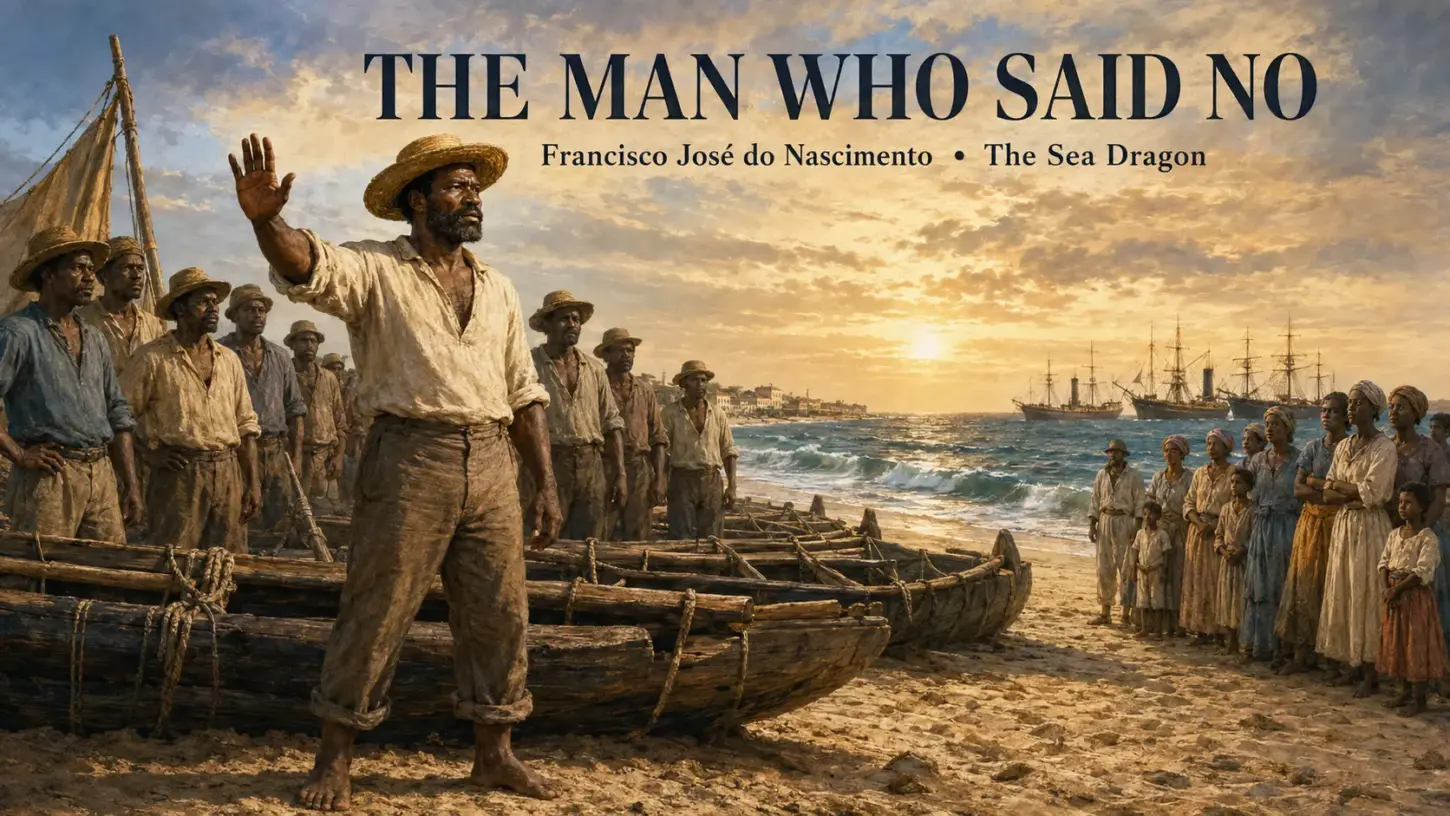
Story | Francisco José do Nascimento: The Man Who Stopped the Trafficking of Enslaved People with a Simple “No”
Com um simples e corajoso “não”, o jangadeiro Francisco José do Nascimento ajudou a interromper o tráfico de pessoas escravizadas pelo porto de Fortaleza. Conhecido como Dragão do Mar, ele enfrentou um sistema poderoso sem recorrer à violência e mostrou que a recusa em colaborar com a injustiça pode mudar o curso da história.
| Audio | |
|---|---|
Normal | Slow |
| English Transcript | Tradução |
| Francisco José do Nascimento: The Man Who Stopped the Trafficking of Enslaved People with a Simple “No” | Francisco José do Nascimento: o homem que parou o tráfico de escravizados com um simples “não” |
| There are moments when a single word, spoken with courage, can change the course of history. In nineteenth-century Ceará, Francisco José do Nascimento was neither a politician nor a writer, nor did he belong to a powerful family. He was a man of the sea, accustomed to rafts, strong winds, and the hardships of life. However, when the time came to choose between obeying an unjust system and defending freedom, he said “no.” That refusal transformed the raft fisherman known as Chico da Matilde into one of the great symbols of the struggle against slavery in Brazil. | Há momentos em que uma única palavra, pronunciada com coragem, pode alterar o curso da história. No Ceará do século XIX, Francisco José do Nascimento não era político, escritor nem integrante de uma família poderosa. Era um trabalhador do mar, acostumado às jangadas, aos ventos fortes e às dificuldades da vida. Entretanto, quando chegou o momento de escolher entre obedecer a um sistema injusto ou defender a liberdade, ele disse “não”. Essa recusa transformou o jangadeiro conhecido como Chico da Matilde em um dos grandes símbolos da luta contra a escravidão no Brasil. |
| Francisco José do Nascimento was born on April 15, 1839, in Canoa Quebrada, in the municipality of Aracati, Ceará. The son of fisherman Manoel do Nascimento and Matilde Maria da Conceição, he lost his father while he was still a child. To help support his family, he began working at a very young age in the port environment. The nickname Chico da Matilde, by which he was known for much of his life, was an affectionate reference to his mother’s name. | Francisco José do Nascimento nasceu em 15 de abril de 1839, em Canoa Quebrada, no município cearense de Aracati. Filho do pescador Manoel do Nascimento e de Matilde Maria da Conceição, perdeu o pai quando ainda era criança. Para ajudar no sustento da família, começou a trabalhar muito cedo no ambiente portuário. O apelido Chico da Matilde, pelo qual se tornou conhecido durante boa parte da vida, era uma referência carinhosa ao nome de sua mãe. |
| While still young, Francisco worked aboard vessels that traveled between ports in northern and northeastern Brazil. He gained experience as a sailor, raft fisherman, and boatman, becoming deeply familiar with the coast of Ceará. He was later appointed chief harbor pilot of the Port Authority, a position of great responsibility, because pilots were responsible for guiding ships into and out of areas where the waters, winds, and sandbanks could pose a danger. | Ainda jovem, Francisco trabalhou em embarcações que percorriam os portos do Norte e do Nordeste do Brasil. Adquiriu experiência como marinheiro, jangadeiro e condutor de embarcações, tornando-se profundo conhecedor do litoral cearense. Posteriormente, foi nomeado prático-mor da Capitania dos Portos, função de grande responsabilidade, pois cabia ao prático orientar a entrada e a saída dos navios em regiões onde as águas, os ventos e os bancos de areia poderiam representar perigo. |
| At that time, although the transatlantic trafficking of enslaved Africans had been officially prohibited since 1850, the domestic trade in human beings remained active. Men, women, and children were sold in the northeastern provinces and sent mainly to the coffee plantations of Rio de Janeiro and São Paulo. Because the port of Fortaleza lacked adequate facilities for large ships to dock, raft fishermen transported people and goods between the beach and the vessels waiting offshore. Without the work of these men, the traffickers could not take enslaved people to the ships. | Naquela época, embora o tráfico transatlântico de africanos escravizados estivesse oficialmente proibido desde 1850, o comércio interno de pessoas continuava ativo. Homens, mulheres e crianças eram vendidos nas províncias do Nordeste e enviados principalmente para as fazendas de café do Rio de Janeiro e de São Paulo. Como o porto de Fortaleza não possuía estrutura adequada para a atracação de grandes navios, os jangadeiros realizavam o transporte entre a praia e as embarcações que aguardavam no mar. Sem o trabalho desses homens, os traficantes não conseguiam levar os escravizados até os navios. |
| Francisco José do Nascimento understood that the raft fishermen occupied a strategic position. They had no weapons, political offices, or great financial resources, but they controlled the connection between the land and the ships. If they refused to provide the service, the trade in human beings through the port would be interrupted. | Francisco José do Nascimento compreendeu que os jangadeiros ocupavam uma posição estratégica. Eles não possuíam armas, cargos políticos ou grandes recursos financeiros, mas controlavam a ligação entre a terra e os navios. Se recusassem o serviço, o comércio de seres humanos pelo porto seria interrompido. |
| In January 1881, raft fishermen and abolitionists organized their first action against the shipment of enslaved people. In August of the same year, faced with another attempt to transport people who had been sold to other provinces, Francisco José do Nascimento and his companions once again refused to work. Among the movement’s leaders was also José Luís Napoleão, a Black man who had experienced slavery and had become an active participant in the abolitionist campaign. | Em janeiro de 1881, jangadeiros e abolicionistas organizaram uma primeira ação contra o embarque de escravizados. Em agosto do mesmo ano, diante de uma nova tentativa de transportar pessoas vendidas para outras províncias, Francisco José do Nascimento e seus companheiros voltaram a cruzar os braços. Entre os líderes do movimento também estava José Luís Napoleão, homem negro que havia vivido a experiência da escravidão e se tornara participante ativo da campanha abolicionista. |
| The gesture was extremely risky. The raft fishermen depended on that work for their livelihood and confronted influential merchants, slaveholders, and authorities interested in keeping the business alive. Francisco could lose his job, face persecution, or suffer violence. Even so, he stood by his decision. Tradition attributes to him a declaration that has echoed through the generations: “No more slaves will be shipped through the port of Ceará.” | O gesto era extremamente arriscado. Os jangadeiros dependiam daquele trabalho para sobreviver e enfrentavam comerciantes influentes, proprietários de escravizados e autoridades interessadas na continuidade do negócio. Francisco poderia perder o emprego, ser perseguido ou sofrer violência. Mesmo assim, manteve sua decisão. A tradição atribui a ele uma declaração que atravessou gerações: “No porto do Ceará não se embarcam mais escravos”. |
| It was a simple sentence spoken by a simple man. Yet behind it was a powerful form of resistance. Francisco did not need to attack anyone or resort to violence. He simply refused to cooperate with injustice. Since the raft fishermen controlled transportation to the vessels, the port of Fortaleza was effectively closed to the interprovincial trafficking of enslaved people. | Era uma frase simples, pronunciada por um homem simples. Contudo, por trás dela havia uma poderosa forma de resistência. Francisco não precisou atacar ninguém nem recorrer à violência. Apenas se recusou a colaborar com a injustiça. Como os jangadeiros controlavam o transporte até as embarcações, o porto de Fortaleza ficou praticamente fechado ao tráfico interprovincial de escravizados. |
| The actions of the maritime workers strengthened the abolitionist movement in Ceará. Abolitionist societies began raising money to purchase manumissions, organize demonstrations, and pressure the authorities. Resistance grew in different cities across the province until, on March 25, 1884, Ceará declared slavery abolished within its territory. This achievement took place four years before the signing of the Golden Law on May 13, 1888, and led Ceará to become known as the “Land of Light.” | A atitude dos trabalhadores do mar fortaleceu o movimento abolicionista cearense. Sociedades libertadoras passaram a arrecadar dinheiro para comprar alforrias, organizar manifestações e pressionar as autoridades. A resistência cresceu em diferentes cidades da província até que, em 25 de março de 1884, o Ceará declarou extinta a escravidão em seu território. A conquista ocorreu quatro anos antes da assinatura da Lei Áurea, em 13 de maio de 1888, e fez o Ceará ficar conhecido como a “Terra da Luz”. |
| Francisco José do Nascimento became an admired figure throughout the country. In 1884, he traveled to Rio de Janeiro, taking with him a raft named *Freedom*. He was welcomed by crowds, paraded through the streets, and received tributes from prominent representatives of the abolitionist movement. The press began calling him the “Sea Dragon,” a name that expressed both his connection with the ocean and the courage he had shown in defending freedom. | Francisco José do Nascimento tornou-se uma figura admirada em todo o país. Em 1884, viajou ao Rio de Janeiro levando uma jangada chamada "Liberdade". Foi recebido por multidões, desfilou pelas ruas e recebeu homenagens de importantes representantes do movimento abolicionista. A imprensa passou a chamá-lo de “Dragão do Mar”, nome que expressava sua ligação com o oceano e a coragem demonstrada na defesa da liberdade. |
| His story was also recorded by illustrator and journalist Angelo Agostini in the influential *Revista Illustrada*. In an allegorical image, Francisco appeared at the head of the raft fishermen, preventing the shipment of enslaved people. The image helped publicize the resistance of the workers from Ceará throughout the country and transformed the Sea Dragon into a popular symbol of abolitionism. | Sua história também foi registrada pelo ilustrador e jornalista Angelo Agostini na influente "Revista Illustrada". Em uma imagem alegórica, Francisco apareceu à frente dos jangadeiros, impedindo o embarque de pessoas escravizadas. A representação ajudou a divulgar nacionalmente a resistência dos trabalhadores cearenses e transformou o Dragão do Mar em símbolo popular do abolicionismo. |
| After the great tributes, Francisco returned to Ceará and remained connected to maritime activities. He died in Fortaleza on March 5, 1914, at the age of 74. For a long time, his contribution received less attention than the work of politicians and intellectuals of the period. Gradually, however, his memory was recovered and began to occupy the place it deserved in Brazilian history. | Depois das grandes homenagens, Francisco retornou ao Ceará e continuou ligado às atividades marítimas. Morreu em Fortaleza, em 5 de março de 1914, aos 74 anos. Durante muito tempo, sua contribuição recebeu menos atenção do que a atuação de políticos e intelectuais do período. Aos poucos, porém, sua memória foi recuperada e passou a ocupar o lugar que merecia na história brasileira. |
| In 2017, his name was inscribed in the Book of Heroes and Heroines of the Homeland, preserved at the Pantheon of the Fatherland in Brasília. In Fortaleza, the Dragão do Mar Center of Art and Culture also honors the raft fisherman who confronted human trafficking using the most powerful tool he possessed: his conscience. | Em 2017, seu nome foi inscrito no Livro dos Heróis e Heroínas da Pátria, preservado no Panteão da Pátria, em Brasília. Em Fortaleza, o Centro Dragão do Mar de Arte e Cultura também homenageia o jangadeiro que enfrentou o tráfico de seres humanos utilizando a ferramenta mais poderosa que possuía: sua consciência. |
| Francisco José do Nascimento demonstrated that ordinary people can play a decisive role in major social transformations. His action did not end slavery in Ceará by itself, because abolition resulted from the mobilization of raft fishermen, freed people, enslaved people, women, workers, and abolitionist associations. Even so, his refusal struck an essential part of the system and showed that an apparently invincible structure could be paralyzed when workers decided to stop sustaining it. | Francisco José do Nascimento demonstrou que pessoas comuns podem exercer um papel decisivo nas grandes transformações sociais. Seu ato não encerrou sozinho a escravidão no Ceará, pois a abolição foi resultado da mobilização de jangadeiros, libertos, escravizados, mulheres, trabalhadores e associações abolicionistas. Ainda assim, sua recusa atingiu um ponto essencial do sistema e mostrou que uma estrutura aparentemente invencível poderia ser paralisada quando trabalhadores decidissem deixar de sustentá-la. |
| The story of the Sea Dragon teaches us that heroism does not always arise from great speeches or violent deeds. Sometimes it begins when someone looks at an injustice accepted by many and finds the courage to say one short and definitive word: “no.” | A história do Dragão do Mar ensina que nem todo heroísmo nasce de grandes discursos ou de feitos violentos. Às vezes, ele começa quando alguém olha para uma injustiça aceita por muitos e encontra coragem para dizer uma palavra curta e definitiva: “não”. |
Contagem de palavras
A tabela abaixo exibe as palavras encontradas neste texto, bem como o número de vezes em que aparecem.
Veja também: Para que serve esta tabela?
| Freq. | Palavra | Freq. | Palavra | Freq. | Palavra |
|---|---|---|---|---|---|
| 87 | the | 41 | of | 33 | and |
| 27 | in | 26 | to | 22 | a |
| 16 | was | 16 | he | 15 | his |
| 12 | francisco | 11 | raft | 10 | that |
| 10 | people | 10 | ceará | 9 | do |
| 8 | nascimento | 8 | josé | 8 | an |
| 7 | with | 7 | fishermen | 7 | enslaved |
| 7 | by | 6 | port | 6 | had |
| 6 | at | 5 | on | 5 | no |
| 5 | it | 5 | great | 5 | for |
| 5 | abolitionist | 4 | workers | 4 | work |
| 4 | who | 4 | when | 4 | trafficking |
| 4 | through | 4 | slavery | 4 | ships |
| 4 | sea | 4 | or | 4 | not |
| 4 | man | 4 | from | 4 | fortaleza |
| 4 | fisherman | 4 | could | 4 | between |
| 4 | began | 3 | vessels | 3 | time |
| 3 | they | 3 | simple | 3 | resistance |
| 3 | refused | 3 | powerful | 3 | name |
| 3 | movement | 3 | matilde | 3 | known |
| 3 | into | 3 | human | 3 | him |
| 3 | freedom | 3 | dragon | 3 | did |
| 3 | da | 3 | courage | 3 | because |
| 3 | be | 3 | as | 3 | also |
| 2 | young | 2 | word | 2 | women |
| 2 | winds | 2 | while | 2 | were |
| 2 | violence | 2 | tributes | 2 | traveled |
| 2 | transformed | 2 | trade | 2 | throughout |
| 2 | their | 2 | system | 2 | story |
| 2 | still | 2 | spoken | 2 | sold |
| 2 | so | 2 | since | 2 | shipment |
| 2 | rio | 2 | remained | 2 | refusal |
| 2 | received | 2 | provinces | 2 | position |
| 2 | place | 2 | one | 2 | northeastern |
| 2 | nor | 2 | men | 2 | maritime |
| 2 | march | 2 | life | 2 | land |
| 2 | janeiro | 2 | injustice | 2 | influential |
| 2 | image | 2 | however | 2 | history |
| 2 | family | 2 | even | 2 | defending |
| 2 | de | 2 | country | 2 | controlled |
| 2 | connection | 2 | confronted | 2 | chico |
| 2 | can | 2 | brazil | 2 | beings |
| 2 | been | 2 | become | 2 | authorities |
| 2 | age | 2 | against | 2 | active |
| 2 | action | 1 | yet | 1 | years |
| 1 | year | 1 | writer | 1 | would |
| 1 | working | 1 | worked | 1 | without |
| 1 | within | 1 | will | 1 | which |
| 1 | where | 1 | welcomed | 1 | weapons |
| 1 | waters | 1 | waiting | 1 | violent |
| 1 | very | 1 | using | 1 | us |
| 1 | until | 1 | unjust | 1 | understood |
| 1 | transported | 1 | transportation | 1 | transport |
| 1 | transformations | 1 | transatlantic | 1 | traffickers |
| 1 | tradition | 1 | tool | 1 | took |
| 1 | this | 1 | these | 1 | there |
| 1 | than | 1 | territory | 1 | teaches |
| 1 | taking | 1 | take | 1 | symbols |
| 1 | symbol | 1 | sustaining | 1 | support |
| 1 | suffer | 1 | struggle | 1 | structure |
| 1 | struck | 1 | strong | 1 | strengthened |
| 1 | streets | 1 | strategic | 1 | stopped |
| 1 | stop | 1 | stood | 1 | speeches |
| 1 | son | 1 | sometimes | 1 | someone |
| 1 | societies | 1 | social | 1 | slaves |
| 1 | slaveholders | 1 | single | 1 | simply |
| 1 | signing | 1 | shown | 1 | showed |
| 1 | short | 1 | shipped | 1 | service |
| 1 | sentence | 1 | sent | 1 | say |
| 1 | são | 1 | sandbanks | 1 | same |
| 1 | sailor | 1 | said | 1 | role |
| 1 | risky | 1 | revista | 1 | returned |
| 1 | resulted | 1 | responsible | 1 | responsibility |
| 1 | resources | 1 | resort | 1 | representatives |
| 1 | reference | 1 | recovered | 1 | recorded |
| 1 | raising | 1 | rafts | 1 | quebrada |
| 1 | purchase | 1 | publicize | 1 | province |
| 1 | provide | 1 | prominent | 1 | prohibited |
| 1 | preventing | 1 | pressure | 1 | press |
| 1 | preserved | 1 | possessed | 1 | pose |
| 1 | ports | 1 | popular | 1 | politicians |
| 1 | politician | 1 | political | 1 | play |
| 1 | plantations | 1 | pilots | 1 | pilot |
| 1 | persecution | 1 | period | 1 | paulo |
| 1 | participant | 1 | part | 1 | paralyzed |
| 1 | paraded | 1 | pantheon | 1 | out |
| 1 | other | 1 | organized | 1 | organize |
| 1 | ordinary | 1 | once | 1 | offshore |
| 1 | officially | 1 | offices | 1 | ocean |
| 1 | occupy | 1 | occupied | 1 | obeying |
| 1 | northern | 1 | nineteenth | 1 | nickname |
| 1 | neither | 1 | need | 1 | napoleão |
| 1 | named | 1 | municipality | 1 | much |
| 1 | mother | 1 | most | 1 | more |
| 1 | money | 1 | moments | 1 | mobilization |
| 1 | merchants | 1 | memory | 1 | may |
| 1 | maria | 1 | mar | 1 | many |
| 1 | manumissions | 1 | manoel | 1 | major |
| 1 | mainly | 1 | luís | 1 | lost |
| 1 | lose | 1 | looks | 1 | long |
| 1 | livelihood | 1 | light | 1 | less |
| 1 | led | 1 | leaders | 1 | law |
| 1 | later | 1 | large | 1 | lacked |
| 1 | keeping | 1 | journalist | 1 | job |
| 1 | january | 1 | itself | 1 | its |
| 1 | invincible | 1 | interrupted | 1 | interprovincial |
| 1 | interested | 1 | intellectuals | 1 | inscribed |
| 1 | illustrator | 1 | illustrada | 1 | if |
| 1 | honors | 1 | homeland | 1 | heroism |
| 1 | heroines | 1 | heroes | 1 | helped |
| 1 | help | 1 | head | 1 | has |
| 1 | hardships | 1 | harbor | 1 | guiding |
| 1 | grew | 1 | gradually | 1 | goods |
| 1 | golden | 1 | gesture | 1 | generations |
| 1 | gained | 1 | freed | 1 | four |
| 1 | form | 1 | first | 1 | finds |
| 1 | financial | 1 | figure | 1 | fatherland |
| 1 | father | 1 | familiar | 1 | facilities |
| 1 | faced | 1 | face | 1 | extremely |
| 1 | expressed | 1 | experienced | 1 | experience |
| 1 | essential | 1 | environment | 1 | end |
| 1 | effectively | 1 | echoed | 1 | dragão |
| 1 | domestic | 1 | does | 1 | dock |
| 1 | different | 1 | died | 1 | deserved |
| 1 | depended | 1 | demonstrations | 1 | demonstrated |
| 1 | definitive | 1 | deeply | 1 | deeds |
| 1 | declared | 1 | declaration | 1 | decisive |
| 1 | decision | 1 | decided | 1 | danger |
| 1 | culture | 1 | crowds | 1 | course |
| 1 | cooperate | 1 | contribution | 1 | conscience |
| 1 | connected | 1 | concei'ão | 1 | companions |
| 1 | coffee | 1 | coast | 1 | closed |
| 1 | cities | 1 | choose | 1 | children |
| 1 | child | 1 | chief | 1 | change |
| 1 | century | 1 | center | 1 | canoa |
| 1 | campaign | 1 | came | 1 | calling |
| 1 | but | 1 | business | 1 | brazilian |
| 1 | brasília | 1 | both | 1 | born |
| 1 | book | 1 | boatman | 1 | black |
| 1 | belong | 1 | behind | 1 | begins |
| 1 | before | 1 | becoming | 1 | became |
| 1 | beach | 1 | authority | 1 | august |
| 1 | attributes | 1 | attention | 1 | attempt |
| 1 | attack | 1 | associations | 1 | art |
| 1 | arise | 1 | areas | 1 | are |
| 1 | aracati | 1 | april | 1 | appointed |
| 1 | appeared | 1 | apparently | 1 | anyone |
| 1 | another | 1 | angelo | 1 | among |
| 1 | always | 1 | although | 1 | allegorical |
| 1 | alive | 1 | agostini | 1 | again |
| 1 | after | 1 | africans | 1 | affectionate |
| 1 | admired | 1 | adequate | 1 | activities |
| 1 | actions | 1 | across | 1 | achievement |
| 1 | accustomed | 1 | accepted | 1 | abolitionists |
| 1 | abolitionism | 1 | abolition | 1 | abolished |
| 1 | aboard |