
Conversation Practice | 6 ways to be more persuasive (video)
Explicar uma ideia é apenas o primeiro passo, mas transformar um discurso em persuasão real exige derrubar velhas certezas e guiar o público por uma jornada inesquecível. Descubra como grandes palestrantes do TED usam “bombas de intuição”, o mistério das histórias de detetive e o poder do raciocínio lógico combinado ao humor para desarmar resistências, encantar a plateia e tornar seus argumentos simplesmente irrefutáveis.
| Audio | |
|---|---|
Normal | Slow |
| English Transcript | Tradução |
| 6 ways to be more persuasive | 6 Maneiras para ser mais persuasivo |
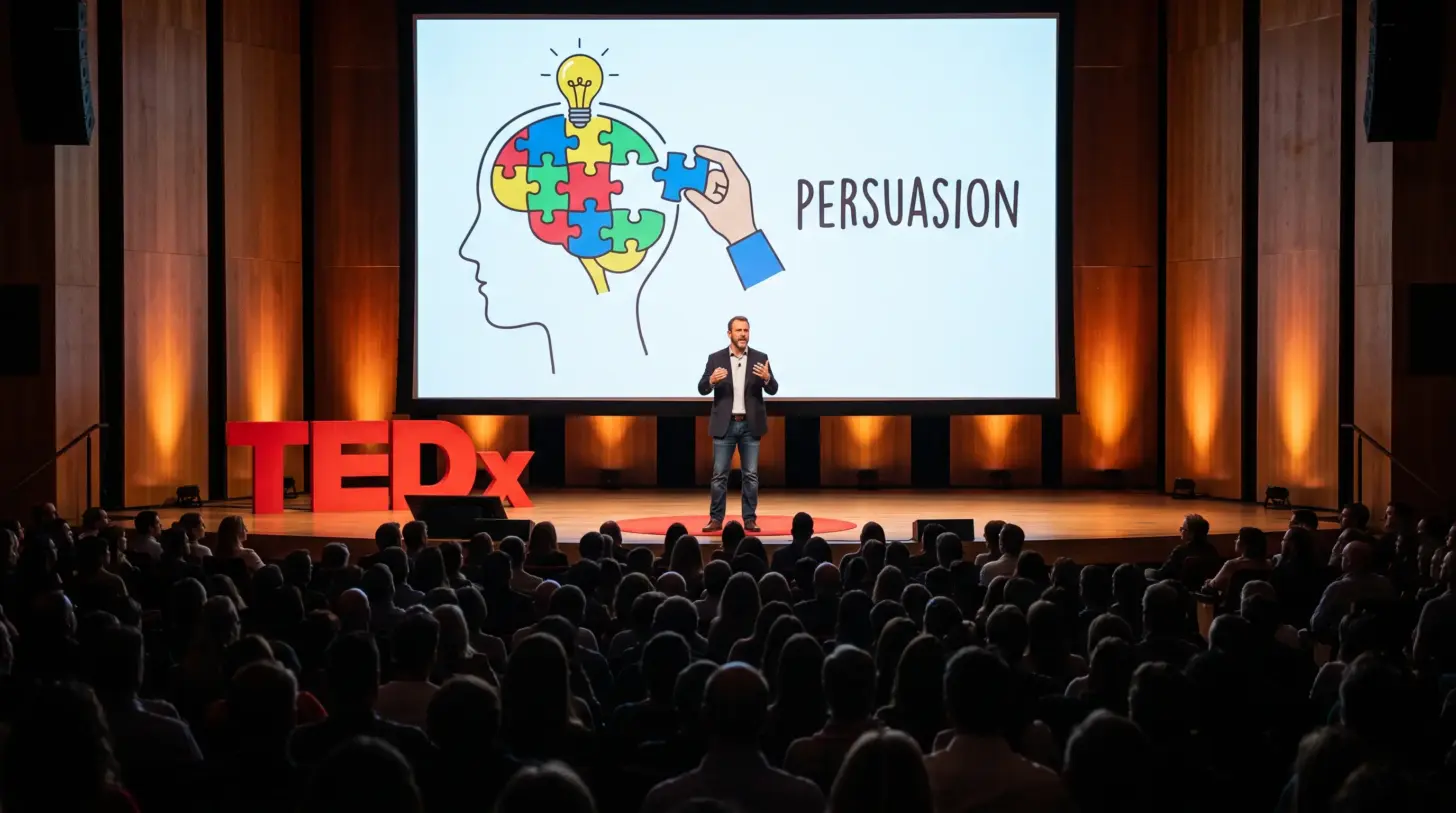
| You can't give a powerful new idea to an audience unless you can learn how to explain it. Each step builds on what the listener already knows, and metaphors and examples help show how the idea is pieced together. But if explanation is building a brand new idea in someone's mind, persuasion is something a little more. Persuasion means convincing an audience that their way of seeing something—their perspective—isn't quite right. That means taking down the parts of their thinking that aren't working and rebuilding something better. | Você não pode transmitir uma ideia nova e poderosa a um público, a menos que aprenda a explicá-la. Cada passo se baseia no que o ouvinte já sabe, e metáforas e exemplos ajudam a mostrar como a ideia é construída. Mas se a explicação é construir uma ideia totalmente nova na mente de alguém, a persuasão é algo um pouco além. Persuasão significa convencer um público de que a sua maneira de ver algo, a sua perspectiva, não está totalmente certa. Isso significa desmontar as partes do pensamento deles que não estão funcionando e reconstruir algo melhor. |
| Psychologist Barry Schwartz gave a talk that changed the way his audience thinks about choice. Many people are obsessed with maximizing choice; Schwartz sees things differently. He gave a talk on what he calls the "paradox of choice." Schwartz builds the surprising case that, in many circumstances, having too many choices actually makes people unhappy. | O psicólogo Barry Schwartz fez uma palestra que mudou a forma como o seu público pensa sobre a escolha. Muitas pessoas são obcecadas em maximizar as escolhas; Schwartz vê as coisas de forma diferente. Ele fez uma palestra sobre o que chama de "o paradoxo da escolha". Schwartz constrói o argumento surpreendente de que, em muitas circunstâncias, ter opções demais na verdade deixa as pessoas infelizes. |
| Author Elizabeth Gilbert did something similar. She showed how the power of storytelling can help persuade an audience of a new idea. Her goal was to change the way they thought about creative genius. Instead of imagining genius as something people are born with—either you have it or you don't—she wanted to persuade her audience to think of it as something people receive as a gift from time to time. Gilbert used her brilliance as a storyteller to persuade her audience of this idea. She also showed them that the term "genius" was viewed differently in history: it wasn't always thought of as a thing a person was; it used to be thought of as something that came to them. | A autora Elizabeth Gilbert fez algo semelhante. Ela mostrou como o poder da contação de histórias pode ajudar a persuadir um público sobre uma nova ideia. O objetivo dela era mudar a forma como eles pensavam sobre o gênio criativo. Em vez de imaginar o gênio como algo com o qual as pessoas nascem, ou você tem ou não tem, ela queria persuadir o seu público a pensá-lo como algo que as pessoas recebem como um presente de tempos em tempos. Gilbert usou o seu brilhantismo como contadora de histórias para persuadir o seu público dessa ideia. Ela também mostrou a eles que o termo "gênio" era visto de forma diferente na história: nem sempre foi pensado como uma coisa que uma pessoa era; costumava ser pensado como algo que vinha até elas. |
| If you're giving a talk that requires persuading an audience to see something differently, the key is to take the journey one step at a time. Prime your listener's mind for a change. The philosopher Daniel Dennett uses the term "intuition pump" to refer to any language that makes a new idea seem more believable. In Barry Schwartz's talk, *Paradox of Choice*, a shopping story he uses is an example of an intuition pump that primes his audience's mind for a change: | Se você está fazendo uma palestra que exige persuadir um público a ver algo de forma diferente, a chave é fazer a jornada um passo de cada vez. Prepare a mente do seu ouvinte para uma mudança. O filósofo Daniel Dennett usa o termo "bomba de intuição" para se referir a qualquer linguagem que faça uma nova ideia parecer mais verossímil. Na palestra de Barry Schwartz, O paradoxo da escolha, uma história de compras que ele usa é um exemplo de uma bomba de intuição que prepara a mente do seu público para uma mudança: |
| "So I went to replace my jeans after years and years of wearing these old ones. And I said, 'I, you know, want a pair of jeans. Here's my size.' And the shopkeeper said, 'Do you want slim fit, easy fit, relaxed fit? Do you want button fly or zipper fly? Do you want stonewashed or acid-washed? Do you want them distressed? Do you want boot cut? Do you want tapered?' … Blah, blah, blah, on and on. My jaw dropped, and after I recovered, I said, 'I want the kind that used to be the only kind.'" | "Então eu fui substituir meu jeans depois de anos e anos usando estes antigos. E eu disse: "Eu, você sabe, quero um par de jeans. Aqui está o meu tamanho." E o vendedor disse: "Você quer corte justo, corte fácil, corte relaxado? Você quer carcela com botões ou zíper? Você quer lavado a pedra ou lavado a ácido? Você quer eles desgastados? Você quer corte para bota? Você quer afunilado?" … Blá, blá, blá, sem parar. Meu queixo caiu e, depois que me recuperei, disse: "Eu quero o tipo que costumava ser o único tipo."" |
| Once an audience has been primed, it's much easier to make your main argument, even if it contradicts an idea the audience held true. | Assim que o público é preparado, fica muito mais fácil apresentar o seu argumento principal, mesmo que ele contradiga uma ideia que o público considerava verdadeira. |
| Another powerful tool is reason. By using reasoning, you can show how and why something is true. Each true assumption leads to a conclusion that must then also be true. Reasoning works using the tool "if… then…": If X is true, then clearly Y must be true. | Outra ferramenta poderosa é a razão. Ao usar o raciocínio, você pode mostrar como e por que algo é verdadeiro. Cada premissa verdadeira leva a uma conclusão que também deve, então, ser verdadeira. O raciocínio funciona usando a ferramenta "se… então…": Se X é verdadeiro, então claramente Y deve ser verdadeiro. |
| Another kind of reasoned argument is the detective story. Some of the most persuasive TED talks are set up like detective stories: you start with the big mystery, then travel the world of ideas in search of possible solutions to it, ruling them out one by one until there's only one solution left. A simple example is artist Siegfried Woldhek's talk. He wanted to prove that three famous drawings by Leonardo da Vinci were actually self-portraits Da Vinci made of himself at different stages of his life. He started with all of the 120 portraits of males that Leonardo is thought to have made and asked, "Were any of these self-portraits?" Then, like a detective eliminating suspects, Woldhek cut them down. Finally, only three remained. The remaining three portraits are of men of different ages and painted at different times, but they all share the same facial features, and they all match the facial features of a statue—the only known image of Da Vinci made by someone else. | Outro tipo de argumento fundamentado é a história de detetive. Algumas das palestras do TED mais persuasivas são estruturadas como histórias de detetive: você começa com o grande mistério, depois viaja pelo mundo das ideias em busca de possíveis soluções para ele, descartando-as uma a uma até restar apenas uma solução. Um exemplo simples é a palestra do artista Siegfried Woldhek. Ele queria provar que três desenhos famosos de Leonardo da Vinci eram, na verdade, autorretratos que Da Vinci fez de si mesmo em diferentes estágios de sua vida. Ele começou com todos os 120 retratos de homens que se pensa que Leonardo tenha feito e perguntou: "Algum destes era um autorretrato?" Então, como um detetive eliminando suspeitos, Woldhek os reduziu. Por fim, apenas três restaram. Os três retratos restantes são de homens de idades diferentes e pintados em momentos diferentes, mas todos compartilham os mesmos traços faciais, e todos correspondem aos traços faciais de uma estátua, a única imagem conhecida de Da Vinci feita por outra pessoa. |
| What makes the detective story persuasive is that we feel as if we have gone on the same learning journey as the speaker. | O que torna a história de detetive persuasiva é que sentimos como se tivéssemos feito a mesma jornada de aprendizado que o palestrante. |
| It can sometimes be hard to make reason-based talks really exciting to listen to. Most people can be convinced by reason, but it doesn't always leave them feeling energized. So, if you plan to use reason to persuade your audience, you may have to pick up some other tools as well: | Às vezes pode ser difícil tornar palestras baseadas na razão realmente empolgantes de ouvir. A maioria das pessoas pode ser convencida pela razão, mas isso nem sempre as deixa energizadas. Portanto, se você planeja usar a razão para persuadir seu público, pode ter que pegar algumas outras ferramentas também: |
| 1. Inject some humor early on. This says, "You're going to do some tough thinking, but we're going to have fun." | 1. Injete um pouco de humor logo no início. Isso diz: "Você vai fazer um pensamento duro, mas vamos nos divertir." |
| 2. Add an anecdote. You could tell an anecdote that shows how you became interested in the topic you've chosen. | 2. Adicione uma anedota. Você poderia contar uma anedota que mostre como ficou interessado no tópico que escolheu. |
| 3. Offer vivid examples that ignite the audience's imagination. | 3. Ofereça exemplos vívidos que acendam a imaginação do público. |
| 4. Include third-party validation. Pull in the opinions of other people who also believe your idea. | 4. Inclua validação de terceiros. Traga as opiniões de outras pessoas que também acreditam na sua ideia. |
| Persuasive talks that use reason may be harder for an audience to understand than other talks, and they may not be the most popular. However, they are extremely important. A strong, well-reasoned argument, even if it isn't immediately accepted by everyone, will gradually attract supporters until it becomes unstoppable. | Palestras persuasivas que usam a razão podem ser mais difíceis de o público entender do que outras palestras, e podem não ser as mais populares. No entanto, elas são extremamente importantes. Um argumento forte e bem fundamentado, mesmo que não seja aceito imediatamente por todos, atrairá apoiadores gradualmente até se tornar imparável. |
| We've covered a lot of great tools for sharing your ideas, but sometimes the best way is simply to show them. Learn more with our next video, or bring our public speaking tools and activities to your school or extracurricular program. Visit ed.ted.com/student_talks to learn more. | Nós cobrimos muitas ferramentas excelentes para compartilhar suas ideias, mas às vezes a melhor maneira é simplesmente mostrá-las. Saiba mais com o nosso próximo vídeo, ou leve nossas ferramentas e atividades de oratória para sua escola ou programa extracurricular. Visite ed.ted.com/student_talks para saber mais. |
Contagem de palavras
A tabela abaixo exibe as palavras encontradas neste vídeo, bem como o número de vezes em que aparecem.
Veja também: Para que serve esta tabela?
| Freq. | Palavra | Freq. | Palavra | Freq. | Palavra |
|---|---|---|---|---|---|
| 34 | the | 33 | to | 29 | of |
| 23 | a | 20 | you | 18 | that |
| 17 | is | 14 | and | 13 | audience |
| 12 | it | 11 | an | 9 | be |
| 9 | as | 9 | are | 8 | want |
| 8 | something | 8 | if | 8 | idea |
| 8 | do | 7 | them | 7 | in |
| 7 | have | 6 | your | 6 | true |
| 6 | people | 6 | on | 6 | not |
| 6 | i | 6 | by | 5 | they |
| 5 | then | 5 | talk | 5 | reason |
| 5 | or | 5 | more | 5 | how |
| 5 | he | 5 | can | 5 | but |
| 4 | with | 4 | we | 4 | way |
| 4 | was | 4 | thought | 4 | talks |
| 4 | some | 4 | schwartz | 4 | portraits |
| 4 | persuasive | 4 | persuade | 4 | only |
| 4 | one | 4 | new | 4 | her |
| 4 | for | 4 | detective | 4 | choice |
| 3 | what | 3 | vinci | 3 | used |
| 3 | tools | 3 | time | 3 | three |
| 3 | story | 3 | show | 3 | said |
| 3 | other | 3 | my | 3 | most |
| 3 | mind | 3 | may | 3 | many |
| 3 | makes | 3 | made | 3 | learn |
| 3 | kind | 3 | his | 3 | genius |
| 3 | fit | 3 | differently | 3 | different |
| 3 | da | 3 | change | 3 | blah |
| 3 | at | 3 | argument | 3 | also |
| 3 | all | 2 | years | 2 | woldhek |
| 2 | were | 2 | well | 2 | wanted |
| 2 | using | 2 | uses | 2 | use |
| 2 | up | 2 | until | 2 | tool |
| 2 | this | 2 | thinking | 2 | these |
| 2 | their | 2 | term | 2 | ted |
| 2 | step | 2 | sometimes | 2 | someone |
| 2 | so | 2 | showed | 2 | she |
| 2 | self | 2 | same | 2 | reasoning |
| 2 | reasoned | 2 | pump | 2 | powerful |
| 2 | persuasion | 2 | paradox | 2 | our |
| 2 | must | 2 | means | 2 | make |
| 2 | listener | 2 | like | 2 | leonardo |
| 2 | journey | 2 | jeans | 2 | intuition |
| 2 | ideas | 2 | help | 2 | going |
| 2 | gilbert | 2 | gave | 2 | fly |
| 2 | features | 2 | facial | 2 | examples |
| 2 | example | 2 | even | 2 | each |
| 2 | down | 2 | cut | 2 | builds |
| 2 | barry | 2 | any | 2 | another |
| 2 | anecdote | 2 | always | 2 | after |
| 2 | actually | 2 | about | 1 | zipper |
| 1 | y | 1 | x | 1 | world |
| 1 | works | 1 | working | 1 | witheither |
| 1 | will | 1 | why | 1 | who |
| 1 | went | 1 | wearing | 1 | ways |
| 1 | washed | 1 | vivid | 1 | visit |
| 1 | viewed | 1 | video | 1 | validation |
| 1 | unstoppable | 1 | unless | 1 | unhappy |
| 1 | understand | 1 | travel | 1 | tough |
| 1 | topic | 1 | too | 1 | together |
| 1 | times | 1 | third | 1 | thinks |
| 1 | think | 1 | things | 1 | thing |
| 1 | there | 1 | than | 1 | tell |
| 1 | tapered | 1 | taking | 1 | take |
| 1 | suspects | 1 | surprising | 1 | supporters |
| 1 | student_talks | 1 | strong | 1 | storytelling |
| 1 | storyteller | 1 | stories | 1 | stonewashed |
| 1 | statuethe | 1 | started | 1 | start |
| 1 | stages | 1 | speaking | 1 | speaker |
| 1 | somethingtheir | 1 | solutions | 1 | solution |
| 1 | slim | 1 | size | 1 | simply |
| 1 | simple | 1 | similar | 1 | siegfried |
| 1 | shows | 1 | shopping | 1 | shopkeeper |
| 1 | sharing | 1 | share | 1 | set |
| 1 | sees | 1 | seem | 1 | seeing |
| 1 | see | 1 | search | 1 | school |
| 1 | says | 1 | ruling | 1 | right |
| 1 | requires | 1 | replace | 1 | remaining |
| 1 | remained | 1 | relaxed | 1 | refer |
| 1 | recovered | 1 | receive | 1 | rebuilding |
| 1 | really | 1 | quite | 1 | pull |
| 1 | public | 1 | psychologist | 1 | prove |
| 1 | program | 1 | primes | 1 | primed |
| 1 | prime | 1 | power | 1 | possible |
| 1 | popular | 1 | plan | 1 | pieced |
| 1 | pick | 1 | philosopher | 1 | persuading |
| 1 | perspectiveis | 1 | person | 1 | party |
| 1 | parts | 1 | pair | 1 | painted |
| 1 | out | 1 | opinions | 1 | ones |
| 1 | once | 1 | old | 1 | offer |
| 1 | obsessed | 1 | notshe | 1 | next |
| 1 | mystery | 1 | much | 1 | metaphors |
| 1 | men | 1 | maximizing | 1 | match |
| 1 | males | 1 | main | 1 | lot |
| 1 | little | 1 | listen | 1 | life |
| 1 | left | 1 | leave | 1 | learning |
| 1 | leads | 1 | language | 1 | knows |
| 1 | known | 1 | know | 1 | key |
| 1 | jaw | 1 | interested | 1 | instead |
| 1 | inject | 1 | include | 1 | important |
| 1 | immediately | 1 | imagining | 1 | imagination |
| 1 | image | 1 | ignite | 1 | humor |
| 1 | however | 1 | history | 1 | himself |
| 1 | here | 1 | held | 1 | having |
| 1 | has | 1 | harder | 1 | hard |
| 1 | great | 1 | gradually | 1 | gone |
| 1 | goal | 1 | giving | 1 | give |
| 1 | gift | 1 | fun | 1 | from |
| 1 | finally | 1 | feeling | 1 | feel |
| 1 | famous | 1 | extremely | 1 | extracurricular |
| 1 | explanation | 1 | explain | 1 | exciting |
| 1 | everyone | 1 | energized | 1 | else |
| 1 | elizabeth | 1 | eliminating | 1 | ed |
| 1 | easy | 1 | easier | 1 | early |
| 1 | dropped | 1 | drawings | 1 | does |
| 1 | distressed | 1 | did | 1 | dennett |
| 1 | daniel | 1 | creative | 1 | covered |
| 1 | could | 1 | convincing | 1 | convinced |
| 1 | contradicts | 1 | conclusion | 1 | com |
| 1 | clearly | 1 | circumstances | 1 | chosen |
| 1 | choices | 1 | changed | 1 | case |
| 1 | cannot | 1 | came | 1 | calls |
| 1 | button | 1 | building | 1 | bring |
| 1 | brilliance | 1 | brand | 1 | born |
| 1 | boot | 1 | big | 1 | better |
| 1 | best | 1 | believe | 1 | believable |
| 1 | been | 1 | becomes | 1 | became |
| 1 | based | 1 | author | 1 | attract |
| 1 | assumption | 1 | asked | 1 | artist |
| 1 | already | 1 | ages | 1 | add |
| 1 | activities | 1 | acid | 1 | accepted |