
Conversation Topics | Could human civilization spread across the whole galaxy? (Vídeo)
Será que estamos realmente sós no universo ou a resposta para essa pergunta já está viajando em nossa direção? A humanidade mal conseguiu sair do próprio quintal espacial, mas a física teórica revela um caminho surpreendente para dominar toda a Via Láctea: máquinas autorreplicantes capazes de colonizar bilhões de estrelas em um piscar de olhos cósmico. Se essa tecnologia é teoricamente possível, por que o céu noturno continua em silêncio? Prepare-se para explorar uma jornada fascinante entre grandes mistérios da astronomia, inteligência artificial e os perigos ocultos que podem estar nos observando agora mesmo.
| Audio | |
|---|---|
Normal | Slow |
| English Transcript | Tradução |
| Could human civilization spread across the whole galaxy? | A civilização humana poderia espalhar-se por toda a galáxia da Via Láctea? |
| Could human civilization eventually spread across the whole Milky Way galaxy? Could we move beyond our small blue planet to establish colonies in the multitude of star systems out there? | A civilização humana poderia, com o tempo, espalhar-se por toda a galáxia da Via Láctea? Poderíamos ir além do nosso pequeno planeta azul para estabelecer colônias na multidão de sistemas estelares existentes por aí? |
| This question's a pretty daunting one. There are around 300 billion stars in the galaxy, which is about 160,000 light-years across. So far, we've sent a single spacecraft outside our solar system, trudging along at 0.006% of the speed of light. At that rate, it would take over 2.5 billion years just to get from one end of the galaxy to the other. And then there's the question of human survival: the gulf between stars is simply enormous, we couldn't live sustainably on most planets, and we require a lot of resources to stay alive. | Esta pergunta é bastante intimidadora. Existem cerca de 300 bilhões de estrelas na galáxia, que tem cerca de 160.000 anos-luz de extensão. Até agora, enviamos uma única espaçonave para fora do nosso sistema solar, caminhando a passos lentos a 0,006% da velocidade da luz. A essa taxa, levaria mais de 2,5 bilhões de anos apenas para ir de uma extremidade da galáxia à outra. E há ainda a questão da sobrevivência humana: o abismo entre as estrelas é simplesmente enorme, não conseguiríamos viver de forma sustentável na maioria dos planetas e precisamos de muitos recursos para nos mantermos vivos. |
| And yet, decades ago, scholars found that it's theoretically possible not just to spread human civilization across the galaxy, but to do so quite quickly, without breaking any known laws of physics. Their idea is based on the work of a mathematician named John von Neumann, who designed on paper machines that could self-replicate and create new generations of themselves. These would later come to be known as "von Neumann machines." | E, no entanto, décadas atrás, acadêmicos descobriram que é teoricamente possível não apenas espalhar a civilização humana pela galáxia, mas fazê-lo de forma bastante rápida, sem violar nenhuma lei conhecida da física. A ideia deles é baseada no trabalho de um matemático chamado John von Neumann, que projetou no papel máquinas que poderiam se autorreplicar e criar novas gerações de si mesmas. Essas máquinas viriam a ser conhecidas mais tarde como "máquinas de von Neumann". |
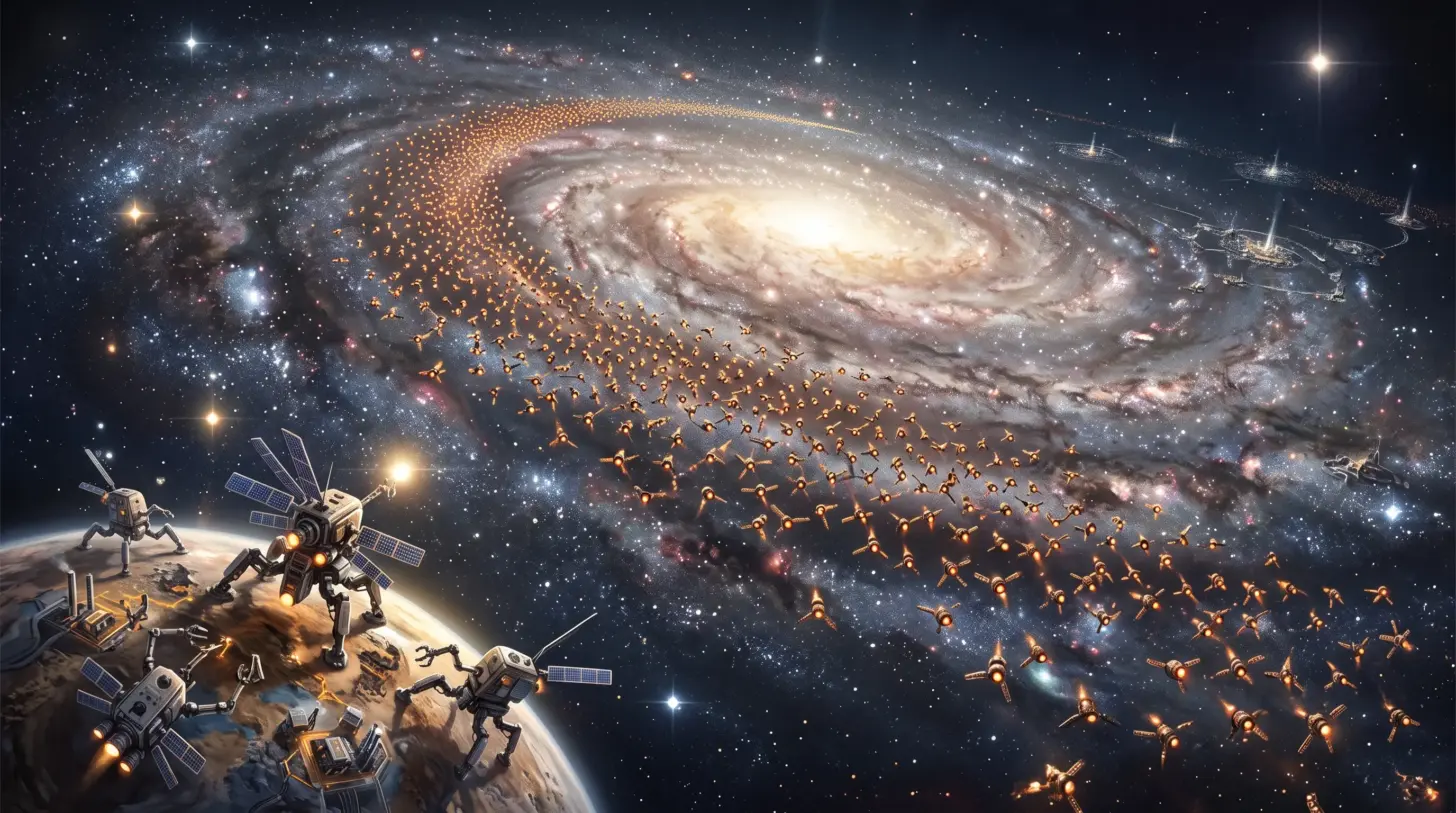
| In the context of space exploration, von Neumann machines could be built on Earth and launched into space. There, the self-sufficient machines would land on distant planets. They would then mine the available resources, harvest energy, build replicas of themselves, launch those to the nearest planets, and continue the cycle. The result is the creation of millions of probes spreading outwards into the universe like a drop of ink in a fishbowl. | No contexto da exploração espacial, as máquinas de von Neumann poderiam ser construídas na Terra e lançadas ao espaço. Lá, as máquinas autossuficientes pousariam em planetas distantes. Elas iriam então minerar os recursos disponíveis, coletar energia, construir réplicas de si mesmas, lançá-las para os planetas mais próximos e continuar o ciclo. O resultado é a criação de milhões de sondas se espalhando para fora no universo como uma gota de tinta em um aquário. |
| Scholars crunched the numbers and found that a single von Neumann machine traveling at 5% of the speed of light should be able to replicate throughout our galaxy in 4 million years or less. That may sound like a long time, but when you consider that our universe is 14 billion years old, on a cosmic scale, it's incredibly fast, the equivalent of about 2.5 hours in an entire year. | Os acadêmicos fizeram os cálculos e descobriram que uma única máquina de von Neumann viajando a 5% da velocidade da luz deveria ser capaz de se replicar por toda a nossa galáxia em 4 milhões de anos ou menos. Isso pode parecer muito tempo, mas quando se considera que o nosso universo tem 14 bilhões de anos, em uma escala cósmica, é incrivelmente rápido, o equivalente a cerca de 2,5 horas em um ano inteiro. |
| Creating von Neumann machines would require a few technologies we don't have yet, including advanced artificial intelligence, miniaturization, and better propulsion systems. If we wanted to use them to spread actual humans throughout the galaxy, we would need yet another technological leap: the ability to artificially grow biological organisms and bodies using raw elements and genetic information. | Criar máquinas de von Neumann exigiria algumas tecnologias que ainda não temos, incluindo inteligência artificial avançada, miniaturização e melhores sistemas de propulsão. Se quiséssemos usá-las para espalhar humanos reais pela galáxia, precisaríamos de outro salto tecnológico: a capacidade de cultivar artificialmente organismos e corpos biológicos usando elementos brutos e informação genética. |
| Regardless, if in the last billion years an alien civilization created such a machine and set it multiplying its way toward us, our galaxy would be swarming with them by now. So then, where are all these machines? | De qualquer forma, se no último bilhão de anos uma civilização alienígena criou tal máquina e a colocou para se multiplicar em nossa direção, nossa galáxia estaria infestada por elas a esta altura. Sendo assim, onde estão todas essas máquinas? |
| Some astronomers, like Carl Sagan, say that intelligent aliens wouldn't build self-replicating machines at all. They might hurtle out of control, scavenging planets to their cores in order to keep replicating. Others take the machines' absence as proof that intelligent alien civilizations don't exist, or that they go extinct before they can develop the necessary technologies. | Alguns astrônomos, como Carl Sagan, dizem que alienígenas inteligentes não construiriam máquinas autorreplicantes de forma alguma. Elas poderiam sair do controle, devastando planetas até seus núcleos para continuar se replicando. Outros tomam a ausência das máquinas como prova de que civilizações alienígenas inteligentes não existem, ou que entram em extinção antes que possam desenvolver as tecnologias necessárias. |
| But all this hasn't stopped people from imagining what it would be like if they were out there. Science fiction author David Brin writes about a universe in which many different von Neumann machines exist and proliferate simultaneously. Some are designed to greet young civilizations; others, to locate and destroy them before they become a threat. In fact, in Brin's story "Lungfish," some von Neumann machines are keeping a close watch over the Earth right now, waiting for us to reach a certain level of sophistication before they make their move. | Mas tudo isso não impediu as pessoas de imaginarem como seria se elas estivessem por aí. O autor de ficção científica David Brin escreve sobre um universo no qual muitas máquinas de von Neumann diferentes existem e proliferam simultaneamente. Algumas são projetadas para saudar civilizações jovens; outras, para localizá-las e destruí-las antes que se tornem uma ameaça. De fato, no conto de Brin, "Lungfish", algumas máquinas de von Neumann estão vigiando de perto a Terra neste exato momento, esperando que alcancemos um certo nível de sofisticação antes de fazerem seu movimento. |
| For now, all we have is curiosity and theory. But the next time you look at the night sky, consider that billions of self-replicating machines could be advancing between stars in our galaxy right now. If they exist, one of them will eventually land on Earth, or maybe, just maybe, they're already here. | Por enquanto, tudo o que temos é curiosidade e teoria. Mas da próxima vez que você olhar para o céu noturno, considere que bilhões de máquinas autorreplicantes podem estar avançando entre as estrelas em nossa galáxia neste exato momento. Se elas existirem, uma delas eventualmente pousará na Terra, ou talvez, apenas talvez, elas já estejam aqui. |
Contagem de palavras
A tabela abaixo exibe as palavras encontradas neste vídeo, bem como o número de vezes em que aparecem.
Veja também: Para que serve esta tabela?
| Freq. | Palavra | Freq. | Palavra | Freq. | Palavra |
|---|---|---|---|---|---|
| 30 | the | 21 | of | 17 | to |
| 15 | a | 14 | and | 12 | in |
| 11 | machines | 10 | that | 9 | would |
| 9 | they | 9 | is | 9 | galaxy |
| 8 | we | 7 | von | 7 | on |
| 7 | neumann | 7 | could | 6 | our |
| 6 | not | 6 | be | 5 | years |
| 5 | there | 5 | it | 5 | at |
| 5 | are | 4 | them | 4 | spread |
| 4 | self | 4 | planets | 4 | now |
| 4 | like | 4 | if | 4 | human |
| 4 | civilization | 4 | but | 4 | billion |
| 4 | all | 4 | across | 3 | yet |
| 3 | universe | 3 | then | 3 | their |
| 3 | stars | 3 | some | 3 | so |
| 3 | replicating | 3 | out | 3 | or |
| 3 | one | 3 | light | 3 | just |
| 3 | have | 3 | exist | 3 | earth |
| 3 | do | 3 | before | 3 | about |
| 2 | you | 2 | whole | 2 | which |
| 2 | way | 2 | us | 2 | time |
| 2 | throughout | 2 | this | 2 | these |
| 2 | themselves | 2 | technologies | 2 | take |
| 2 | systems | 2 | speed | 2 | space |
| 2 | single | 2 | scholars | 2 | right |
| 2 | resources | 2 | require | 2 | replicate |
| 2 | question | 2 | over | 2 | others |
| 2 | move | 2 | maybe | 2 | machine |
| 2 | land | 2 | known | 2 | into |
| 2 | intelligent | 2 | from | 2 | found |
| 2 | for | 2 | eventually | 2 | designed |
| 2 | consider | 2 | civilizations | 2 | build |
| 2 | brin | 2 | between | 2 | as |
| 2 | an | 2 | alien | 1 | young |
| 1 | year | 1 | writes | 1 | work |
| 1 | without | 1 | with | 1 | will |
| 1 | who | 1 | where | 1 | when |
| 1 | what | 1 | were | 1 | watch |
| 1 | wanted | 1 | waiting | 1 | using |
| 1 | use | 1 | trudging | 1 | traveling |
| 1 | toward | 1 | threat | 1 | those |
| 1 | theory | 1 | theoretically | 1 | technological |
| 1 | system | 1 | swarming | 1 | sustainably |
| 1 | survival | 1 | sufficient | 1 | such |
| 1 | story | 1 | stopped | 1 | stay |
| 1 | star | 1 | spreading | 1 | spacecraft |
| 1 | sound | 1 | sophistication | 1 | solar |
| 1 | small | 1 | sky | 1 | simultaneously |
| 1 | simply | 1 | should | 1 | set |
| 1 | sent | 1 | science | 1 | scavenging |
| 1 | scale | 1 | say | 1 | sagan |
| 1 | result | 1 | replicas | 1 | regardless |
| 1 | reach | 1 | raw | 1 | rate |
| 1 | quite | 1 | quickly | 1 | propulsion |
| 1 | proof | 1 | proliferate | 1 | probes |
| 1 | pretty | 1 | possible | 1 | planet |
| 1 | physics | 1 | people | 1 | paper |
| 1 | outwards | 1 | outside | 1 | other |
| 1 | organisms | 1 | order | 1 | old |
| 1 | numbers | 1 | night | 1 | next |
| 1 | new | 1 | need | 1 | necessary |
| 1 | nearest | 1 | named | 1 | multitude |
| 1 | multiplying | 1 | most | 1 | miniaturization |
| 1 | mine | 1 | millions | 1 | million |
| 1 | milky | 1 | might | 1 | may |
| 1 | mathematician | 1 | many | 1 | make |
| 1 | lungfish | 1 | lot | 1 | look |
| 1 | long | 1 | locate | 1 | live |
| 1 | level | 1 | less | 1 | leap |
| 1 | laws | 1 | launched | 1 | launch |
| 1 | later | 1 | last | 1 | keeping |
| 1 | keep | 1 | john | 1 | its |
| 1 | intelligence | 1 | ink | 1 | information |
| 1 | incredibly | 1 | including | 1 | imagining |
| 1 | idea | 1 | hurtle | 1 | humans |
| 1 | hours | 1 | here | 1 | has |
| 1 | harvest | 1 | gulf | 1 | grow |
| 1 | greet | 1 | go | 1 | get |
| 1 | genetic | 1 | generations | 1 | fishbowl |
| 1 | fiction | 1 | few | 1 | fast |
| 1 | far | 1 | fact | 1 | extinct |
| 1 | exploration | 1 | establish | 1 | equivalent |
| 1 | entire | 1 | enormous | 1 | energy |
| 1 | end | 1 | elements | 1 | drop |
| 1 | distant | 1 | different | 1 | develop |
| 1 | destroy | 1 | decades | 1 | david |
| 1 | daunting | 1 | cycle | 1 | curiosity |
| 1 | crunched | 1 | creation | 1 | creating |
| 1 | created | 1 | create | 1 | cosmic |
| 1 | cores | 1 | control | 1 | continue |
| 1 | context | 1 | come | 1 | colonies |
| 1 | close | 1 | certain | 1 | carl |
| 1 | can | 1 | by | 1 | built |
| 1 | breaking | 1 | bodies | 1 | blue |
| 1 | biological | 1 | billions | 1 | beyond |
| 1 | better | 1 | become | 1 | based |
| 1 | available | 1 | author | 1 | astronomers |
| 1 | artificially | 1 | artificial | 1 | around |
| 1 | any | 1 | another | 1 | already |
| 1 | along | 1 | alive | 1 | aliens |
| 1 | ago | 1 | advancing | 1 | advanced |
| 1 | actual | 1 | absence | 1 | able |
| 1 | ability |