
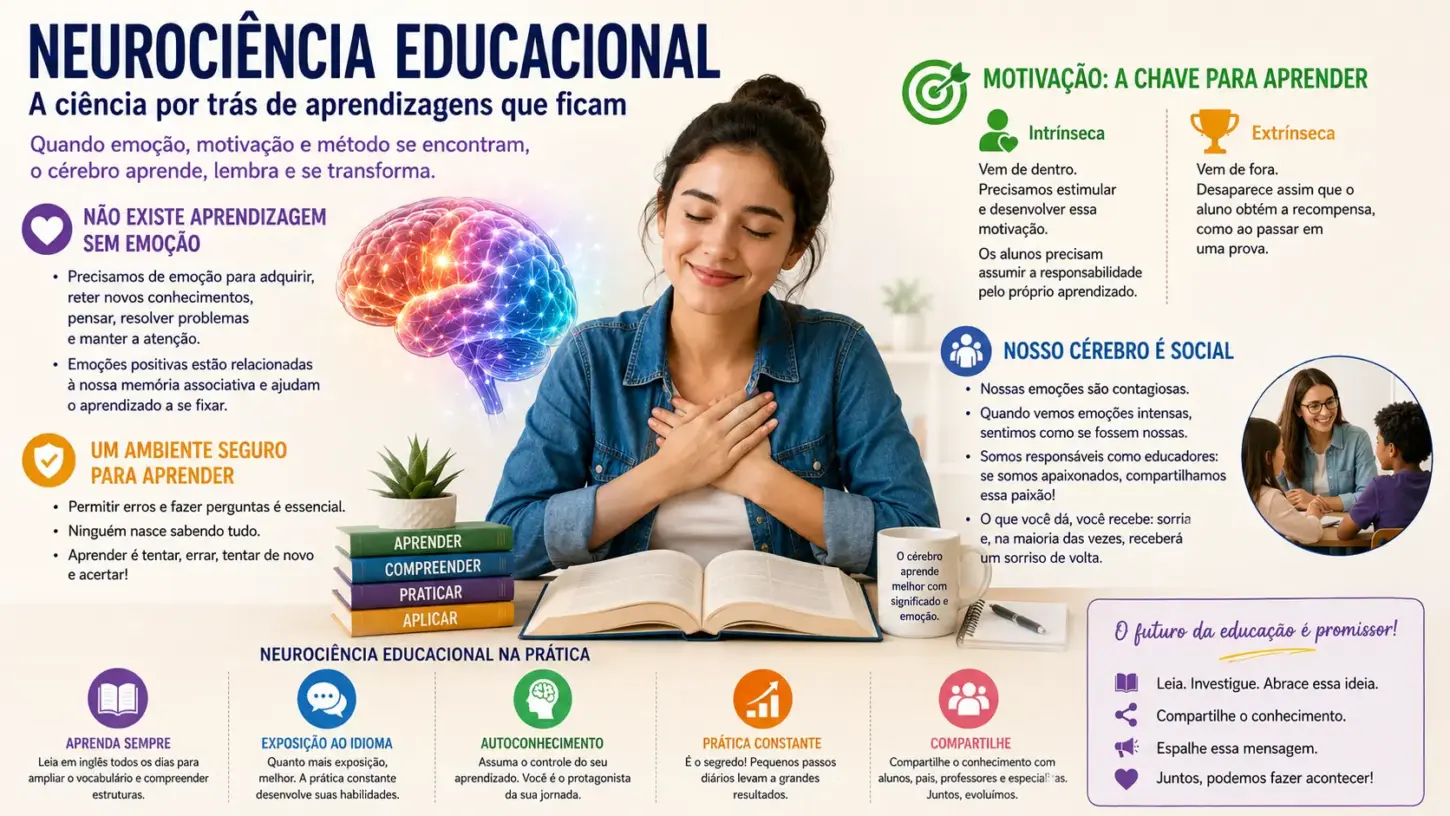
Vídeo | Using insights of neuroscience to improve teaching and learning
Aprender não depende apenas de inteligência ou dedicação: o cérebro tem um papel muito mais importante do que imaginamos. Descubra neste vídeo como as emoções, a motivação e o ambiente de aprendizagem influenciam a formação da memória e por que a neurociência educacional está transformando a maneira como ensinamos e aprendemos. Um vídeo inspirador para professores, estudantes e todos os apaixonados pelo conhecimento.
| Audio | |
|---|---|
Normal | Slow |
| English Transcript | Tradução |
| Using insights of neuroscience to improve teaching and learning | Usando os conhecimentos da neurociência para melhorar o ensino e a aprendizagem. |
| When I finished university, I left my home country to start working in tourism. I traveled the world for about seven years, and somewhere along the way, I learned languages I fell in love with. So I learned Spanish, French, and German because those were the languages that I needed for my job, and I improved my English because that was the language that I needed for international communication. | Quando terminei a universidade, deixei meu país para começar a trabalhar com turismo. Viajei pelo mundo durante cerca de sete anos e, em algum momento dessa jornada, aprendi idiomas pelos quais me apaixonei. Assim, aprendi espanhol, francês e alemão porque eram os idiomas de que eu precisava para o meu trabalho, e aperfeiçoei meu inglês porque esse era o idioma necessário para a comunicação internacional. |
| When I quit that job in tourism, people started asking me if I could help them learn French, German, or Spanish. That is when I realized that knowing a language does not necessarily give you the knowledge to teach that language. | Quando deixei esse trabalho no turismo, as pessoas começaram a me perguntar se eu poderia ajudá-las a aprender francês, alemão ou espanhol. Foi então que percebi que conhecer um idioma não significa, necessariamente, saber ensiná-lo. |
| So I started studying again. I began by pursuing a master's degree in Applied Linguistics for Teaching English as a Foreign Language, but that did not give me the knowledge that I was looking for. I was eager to find out why something that comes easily and naturally to me, like language learning, is complicated for others. | Então voltei a estudar. Comecei fazendo um mestrado em Linguística Aplicada ao Ensino de Inglês como Língua Estrangeira, mas isso não me deu o conhecimento que eu procurava. Eu queria descobrir por que algo que para mim era fácil e natural, como aprender idiomas, era tão complicado para outras pessoas. |
| I wanted to know a little bit more about how the brain works and be able to help people, so I continued studying. I became a certified NeuroLanguage Coach, went on to become a life coach, and recently finished a master's degree in Educational Neuroscience. | Eu queria entender um pouco mais sobre como o cérebro funciona e ser capaz de ajudar as pessoas, então continuei estudando. Tornei-me NeuroLanguage Coach certificada, depois também me formei como coach de vida e, recentemente, concluí um mestrado em Neurociência Educacional. |
| Educational neuroscience sounds like a very complicated discipline, and there is certainly a lot to be learned, but I like to describe it as common sense in education explained by science. | Neurociência educacional parece uma disciplina muito complicada e, certamente, há muito o que aprender, mas eu gosto de descrevê-la como bom senso na educação explicado pela ciência. |
| Educational neuroscience is where psychology, neuroscience, and education come together, and that knowledge is used to improve teaching and learning. | A neurociência educacional é o ponto de encontro entre psicologia, neurociência e educação, e esse conhecimento é utilizado para melhorar o ensino e a aprendizagem. |
| What exactly is it that makes learning stick, and how can we hope to make learning stick? | O que exatamente faz com que a aprendizagem permaneça, e como podemos fazer com que a aprendizagem realmente se fixe? |
| One thing we know is that there is no learning without emotion. | Uma coisa nós sabemos: não existe aprendizagem sem emoção. |
| We need emotion to acquire new knowledge. We need emotion to retain that new knowledge. We need emotion for thinking, for problem-solving, and we need emotion for focused attention. | Precisamos da emoção para adquirir novos conhecimentos. Precisamos da emoção para reter esses novos conhecimentos. Precisamos da emoção para pensar, resolver problemas e manter a atenção concentrada. |
| Let's try this. | Vamos fazer uma experiência. |
| May I ask you to close your eyes? | Posso pedir que vocês fechem os olhos? |
| Close your eyes and picture a happy moment. Maybe you were at the beach last week with some friends. Maybe you're going further back. Maybe you are thinking about your first boyfriend or girlfriend, your first kiss. Feel free to choose any happy memory that comes to mind. | Fechem os olhos e imaginem um momento feliz. Talvez vocês estivessem na praia na semana passada com alguns amigos. Talvez estejam voltando ainda mais no tempo. Talvez estejam pensando no primeiro namorado ou na primeira namorada, no primeiro beijo. Sintam-se à vontade para escolher qualquer lembrança feliz que venha à mente. |
| Now I would like you to remember as many details as possible. | Agora eu gostaria que vocês se lembrassem do maior número possível de detalhes. |
| Where were you? Who were you with? | Onde vocês estavam? Com quem vocês estavam? |
| What were you wearing, and what was the weather like that day? Was it hot? Was it cold? Was it a windy day? What can you smell? And how does this make you feel? | O que vocês estavam vestindo e como estava o tempo naquele dia? Estava quente? Estava frio? Ventava? Que cheiro vocês conseguem sentir? E como essa lembrança faz vocês se sentirem? |
| I'm sure that you can all remember many details. | Tenho certeza de que todos conseguem lembrar de muitos detalhes. |
| You may open your eyes now. | Agora vocês podem abrir os olhos. |
| I'm sure you can all remember many details, and why is that? | Tenho certeza de que todos conseguem lembrar de muitos detalhes, e por que isso acontece? |
| Well, our brains remember emotionally charged events better than boring ones. And although science is still a bit foggy on the details, we now know that positive emotions are related to our associative memory. | Bem, nosso cérebro lembra melhor de acontecimentos carregados de emoção do que de acontecimentos sem graça. E, embora a ciência ainda não tenha todas as respostas, hoje sabemos que emoções positivas estão relacionadas à nossa memória associativa. |
| So, if we apply that knowledge to the classroom, then we know that we need a creative, brain-friendly, and positive classroom atmosphere for learning to take place. | Portanto, se aplicarmos esse conhecimento à sala de aula, saberemos que precisamos de um ambiente criativo, acolhedor para o cérebro e positivo para que a aprendizagem aconteça. |
| So how can we help generate this much-needed positive attitude toward learning? | Então, como podemos ajudar a gerar essa atitude positiva tão necessária em relação ao aprendizado? |
| Motivated students have a positive attitude toward learning. | Alunos motivados têm uma atitude positiva diante da aprendizagem. |
| There are two different types of motivation. Students may be extrinsically or intrinsically motivated. | Existem dois tipos diferentes de motivação. Os alunos podem ser motivados de forma extrínseca ou intrínseca. |
| Now, extrinsic motivation will disappear once the student obtains the prize that was promised upon passing an exam, for example. | A motivação extrínseca desaparece assim que o aluno recebe a recompensa prometida por passar em uma prova, por exemplo. |
| The type of motivation that we are looking for is intrinsic motivation. | O tipo de motivação que buscamos é a motivação intrínseca. |
| We need to stimulate and foster that motivation that comes from within. | Precisamos estimular e desenvolver essa motivação que vem de dentro. |
| We need students to take ownership of their learning. | Precisamos que os alunos assumam a responsabilidade pelo próprio aprendizado. |
| As educators, we can offer the knowledge, but we cannot open the students' heads, put the knowledge inside, and then close the lid again. | Como educadores, podemos oferecer o conhecimento, mas não podemos abrir a cabeça dos alunos, colocar o conhecimento lá dentro e depois fechar a tampa novamente. |
| Wouldn't that be easy? | Não seria muito fácil? |
| The students themselves are responsible for that. | Os próprios alunos são responsáveis por isso. |
| So how come many students are reluctant to take on that responsibility? | Então, por que tantos alunos relutam em assumir essa responsabilidade? |
| Could it be the fear of failure? The fear of making mistakes? | Será que é o medo de fracassar? O medo de errar? |
| We don't like to make mistakes. We do not like to be seen as stupid. | Nós não gostamos de cometer erros. Não gostamos de parecer ignorantes. |
| We all feel the need to protect our egos, and that is why it is so important that the classroom is a safe place that allows for mistakes to be made and for questions to be asked. | Todos sentimos a necessidade de proteger nosso ego, e é por isso que é tão importante que a sala de aula seja um ambiente seguro, onde seja permitido errar e fazer perguntas. |
| Remember that nobody was born knowing it all. | Lembrem-se de que ninguém nasceu sabendo tudo. |
| Nobody was born knowing how to ride a bike. | Ninguém nasceu sabendo andar de bicicleta. |
| You get on your bike, you fall down, you scratch your knee, you bump your head, you get back on your bike again, and you give it another try. | Você sobe na bicicleta, cai, rala o joelho, bate a cabeça, sobe novamente na bicicleta e tenta outra vez. |
| That is what the learning experience is all about. | É disso que trata o processo de aprendizagem. |
| It is only by trying and getting it wrong the first time that you will then try again and maybe get it right the second or the third time. | É somente tentando e errando da primeira vez que você poderá tentar novamente e talvez acertar na segunda ou na terceira tentativa. |
| Now it is equally important for us to look at our own behavior. | Agora, também é igualmente importante olharmos para o nosso próprio comportamento. |
| Are we motivated? Do we allow ourselves to make mistakes? Do we ask questions? Do we accept feedback? | Nós somos motivados? Permitimos a nós mesmos cometer erros? Fazemos perguntas? Aceitamos feedback? |
| Recent research in neuroscience tells us that our emotions are contagious. | Pesquisas recentes em neurociência mostram que nossas emoções são contagiosas. |
| Our brains are social organs. | Nossos cérebros são órgãos sociais. |
| When we witness intense emotions, we feel those emotions as if they were our own. | Quando presenciamos emoções intensas, sentimos essas emoções como se fossem nossas. |
| Now that gives us a responsibility as educators. | Isso nos dá uma responsabilidade como educadores. |
| When we are passionate about our subject, we need to share that passion. We need to show that passion because nobody enjoys listening to a speaker who seems to be bored with his or her own subject. | Quando somos apaixonados pelo assunto que ensinamos, precisamos compartilhar essa paixão. Precisamos demonstrar essa paixão, porque ninguém gosta de ouvir alguém que parece entediado com o próprio assunto. |
| Our mirror neurons are responsible for the empathy and the happiness that we feel when we see another individual experiencing those same feelings. | Nossos neurônios-espelho são responsáveis pela empatia e pela felicidade que sentimos quando vemos outra pessoa experimentando essas mesmas emoções. |
| Now, there's a much easier way to say this: what you give is what you get. | Existe uma maneira muito mais simples de dizer isso: você recebe aquilo que oferece. |
| Just give it a try and smile, and you will see that your smiling face will most often be met with a smile. | Experimente sorrir e verá que, na maioria das vezes, o seu sorriso será retribuído com outro sorriso. |
| Now it is my opinion that the basic knowledge of educational neuroscience should be known by everyone. | Na minha opinião, o conhecimento básico de neurociência educacional deveria ser conhecido por todos. |
| There's no need for all of us to become neuroscientists, but I do believe that this basic knowledge of how the brain works should be a part of primary, secondary, and university education, and it should most certainly be included in teacher training programs. | Não é necessário que todos nós nos tornemos neurocientistas, mas acredito que esse conhecimento básico sobre o funcionamento do cérebro deveria fazer parte do ensino fundamental, do ensino médio, do ensino superior e, certamente, da formação de professores. |
| Now, educational neuroscience is not a magical pill that will solve all the problems in education, but it will help us find some solutions because it is only by sharing knowledge that we will stimulate an evolution in education. | A neurociência educacional não é uma pílula mágica que resolverá todos os problemas da educação, mas ela nos ajudará a encontrar algumas soluções, porque é somente compartilhando conhecimento que promoveremos uma evolução na educação. |
| We share this knowledge with students, parents, teachers, and education specialists, and that way we are all part of this natural evolution in education. | Compartilhamos esse conhecimento com alunos, pais, professores e especialistas em educação e, dessa forma, todos fazemos parte dessa evolução natural da educação. |
| Now, if you feel the same way, then I would like to invite you to start reading, to start investigating this fascinating new approach to education. | Se você pensa da mesma forma, então eu gostaria de convidá-lo a começar a ler e a pesquisar sobre essa fascinante nova abordagem da educação. |
| Embrace the idea, share the knowledge, spread the word, and together we can make this happen. | Abrace essa ideia, compartilhe o conhecimento, espalhe essa mensagem e, juntos, podemos transformar essa visão em realidade. |
| The future of education is bright. | O futuro da educação é promissor. |
| Thank you. | Muito obrigado. |
Contagem de palavras
A tabela abaixo exibe as palavras encontradas neste vídeo, bem como o número de vezes em que aparecem.
Veja também: Para que serve esta tabela?
| Freq. | Palavra | Freq. | Palavra | Freq. | Palavra |
|---|---|---|---|---|---|
| 45 | that | 42 | to | 37 | the |
| 34 | we | 34 | and | 27 | you |
| 26 | I | 25 | is | 23 | a |
| 18 | it | 18 | for | 13 | knowledge |
| 13 | be | 13 | are | 12 | of |
| 11 | need | 11 | learning | 11 | in |
| 10 | your | 10 | was | 10 | now |
| 9 | this | 9 | our | 9 | education |
| 8 | neuroscience | 8 | like | 8 | as |
| 8 | all | 7 | will | 7 | what |
| 7 | students | 7 | so | 7 | how |
| 7 | can | 6 | with | 6 | when |
| 6 | were | 6 | us | 6 | not |
| 6 | feel | 6 | do | 5 | there |
| 5 | remember | 5 | or | 5 | on |
| 5 | motivation | 5 | make | 5 | language |
| 5 | give | 5 | emotion | 5 | educational |
| 5 | by | 5 | but | 5 | about |
| 4 | way | 4 | try | 4 | then |
| 4 | positive | 4 | my | 4 | mistakes |
| 4 | maybe | 4 | many | 4 | know |
| 4 | if | 4 | help | 4 | get |
| 4 | emotions | 4 | details | 4 | because |
| 4 | again | 3 | would | 3 | why |
| 3 | those | 3 | teaching | 3 | take |
| 3 | start | 3 | should | 3 | share |
| 3 | own | 3 | nobody | 3 | new |
| 3 | needed | 3 | motivated | 3 | me |
| 3 | may | 3 | learned | 3 | knowing |
| 3 | first | 3 | eyes | 3 | comes |
| 3 | close | 3 | classroom | 3 | brain |
| 3 | bike | 2 | works | 2 | who |
| 2 | where | 2 | university | 2 | toward |
| 2 | tourism | 2 | together | 2 | time |
| 2 | thinking | 2 | sure | 2 | subject |
| 2 | studying | 2 | stimulate | 2 | stick |
| 2 | started | 2 | spanish | 2 | some |
| 2 | smile | 2 | see | 2 | science |
| 2 | same | 2 | responsible | 2 | responsibility |
| 2 | questions | 2 | place | 2 | people |
| 2 | passion | 2 | part | 2 | open |
| 2 | only | 2 | no | 2 | much |
| 2 | most | 2 | memory | 2 | master |
| 2 | looking | 2 | languages | 2 | job |
| 2 | improve | 2 | important | 2 | happy |
| 2 | german | 2 | french | 2 | finished |
| 2 | find | 2 | fear | 2 | evolution |
| 2 | english | 2 | educators | 2 | does |
| 2 | degree | 2 | day | 2 | could |
| 2 | complicated | 2 | come | 2 | coach |
| 2 | certainly | 2 | brains | 2 | born |
| 2 | bit | 2 | become | 2 | basic |
| 2 | back | 2 | attitude | 2 | at |
| 2 | ask | 2 | another | 2 | an |
| 2 | am | 1 | years | 1 | wrong |
| 1 | world | 1 | working | 1 | word |
| 1 | witness | 1 | without | 1 | within |
| 1 | windy | 1 | went | 1 | well |
| 1 | week | 1 | weather | 1 | wearing |
| 1 | wanted | 1 | very | 1 | using |
| 1 | used | 1 | upon | 1 | types |
| 1 | type | 1 | two | 1 | trying |
| 1 | traveled | 1 | training | 1 | third |
| 1 | thing | 1 | they | 1 | themselves |
| 1 | them | 1 | their | 1 | thank |
| 1 | than | 1 | tells | 1 | teachers |
| 1 | teacher | 1 | teach | 1 | stupid |
| 1 | student | 1 | still | 1 | spread |
| 1 | specialists | 1 | speaker | 1 | sounds |
| 1 | somewhere | 1 | something | 1 | solving |
| 1 | solve | 1 | solutions | 1 | social |
| 1 | smiling | 1 | smell | 1 | show |
| 1 | sharing | 1 | seven | 1 | sense |
| 1 | seen | 1 | seems | 1 | secondary |
| 1 | second | 1 | scratch | 1 | say |
| 1 | safe | 1 | right | 1 | ride |
| 1 | retain | 1 | research | 1 | reluctant |
| 1 | related | 1 | recently | 1 | recent |
| 1 | realized | 1 | reading | 1 | quit |
| 1 | put | 1 | pursuing | 1 | psychology |
| 1 | protect | 1 | promised | 1 | programs |
| 1 | problems | 1 | problem | 1 | prize |
| 1 | primary | 1 | possible | 1 | pill |
| 1 | picture | 1 | passionate | 1 | passing |
| 1 | parents | 1 | ownership | 1 | out |
| 1 | ourselves | 1 | others | 1 | organs |
| 1 | opinion | 1 | ones | 1 | one |
| 1 | once | 1 | often | 1 | offer |
| 1 | obtains | 1 | neuroscientists | 1 | neurons |
| 1 | neurolanguage | 1 | necessarily | 1 | naturally |
| 1 | natural | 1 | more | 1 | moment |
| 1 | mirror | 1 | mind | 1 | met |
| 1 | making | 1 | makes | 1 | magical |
| 1 | made | 1 | love | 1 | lot |
| 1 | look | 1 | little | 1 | listening |
| 1 | linguistics | 1 | life | 1 | lid |
| 1 | let | 1 | left | 1 | learn |
| 1 | last | 1 | known | 1 | knee |
| 1 | kiss | 1 | just | 1 | invite |
| 1 | investigating | 1 | intrinsically | 1 | intrinsic |
| 1 | international | 1 | intense | 1 | insights |
| 1 | inside | 1 | individual | 1 | included |
| 1 | improved | 1 | idea | 1 | hot |
| 1 | hope | 1 | home | 1 | his |
| 1 | her | 1 | heads | 1 | head |
| 1 | have | 1 | happiness | 1 | happen |
| 1 | going | 1 | gives | 1 | girlfriend |
| 1 | getting | 1 | generate | 1 | future |
| 1 | further | 1 | from | 1 | friends |
| 1 | friendly | 1 | free | 1 | foster |
| 1 | foreign | 1 | foggy | 1 | focused |
| 1 | fell | 1 | feelings | 1 | feedback |
| 1 | fascinating | 1 | fall | 1 | failure |
| 1 | face | 1 | extrinsically | 1 | extrinsic |
| 1 | explained | 1 | experiencing | 1 | experience |
| 1 | example | 1 | exam | 1 | exactly |
| 1 | everyone | 1 | events | 1 | equally |
| 1 | enjoys | 1 | empathy | 1 | emotionally |
| 1 | embrace | 1 | egos | 1 | easy |
| 1 | easily | 1 | easier | 1 | eager |
| 1 | down | 1 | discipline | 1 | disappear |
| 1 | different | 1 | did | 1 | describe |
| 1 | creative | 1 | country | 1 | continued |
| 1 | contagious | 1 | communication | 1 | common |
| 1 | cold | 1 | choose | 1 | charged |
| 1 | certified | 1 | cannot | 1 | bump |
| 1 | bright | 1 | boyfriend | 1 | boring |
| 1 | bored | 1 | better | 1 | believe |
| 1 | behavior | 1 | began | 1 | became |
| 1 | beach | 1 | attention | 1 | atmosphere |
| 1 | associative | 1 | asking | 1 | asked |
| 1 | approach | 1 | apply | 1 | applied |
| 1 | any | 1 | although | 1 | along |
| 1 | allows | 1 | allow | 1 | acquire |
| 1 | accept | 1 | able |