
Vídeo | Should you trust your first impression?
Você costuma confiar na primeira impressão que tem das pessoas? A psicologia mostra que nosso cérebro forma julgamentos em questão de segundos e que nem sempre novas informações são suficientes para mudá-los. Descubra por que alguns comportamentos pesam muito mais do que outros e como a ciência explica a maneira como avaliamos o caráter das pessoas.
| Audio | |
|---|---|
Normal | Slow |
| English Transcript | Tradução |
| Should you trust your first impression? | Você deve confiar em sua primeira impressão? |
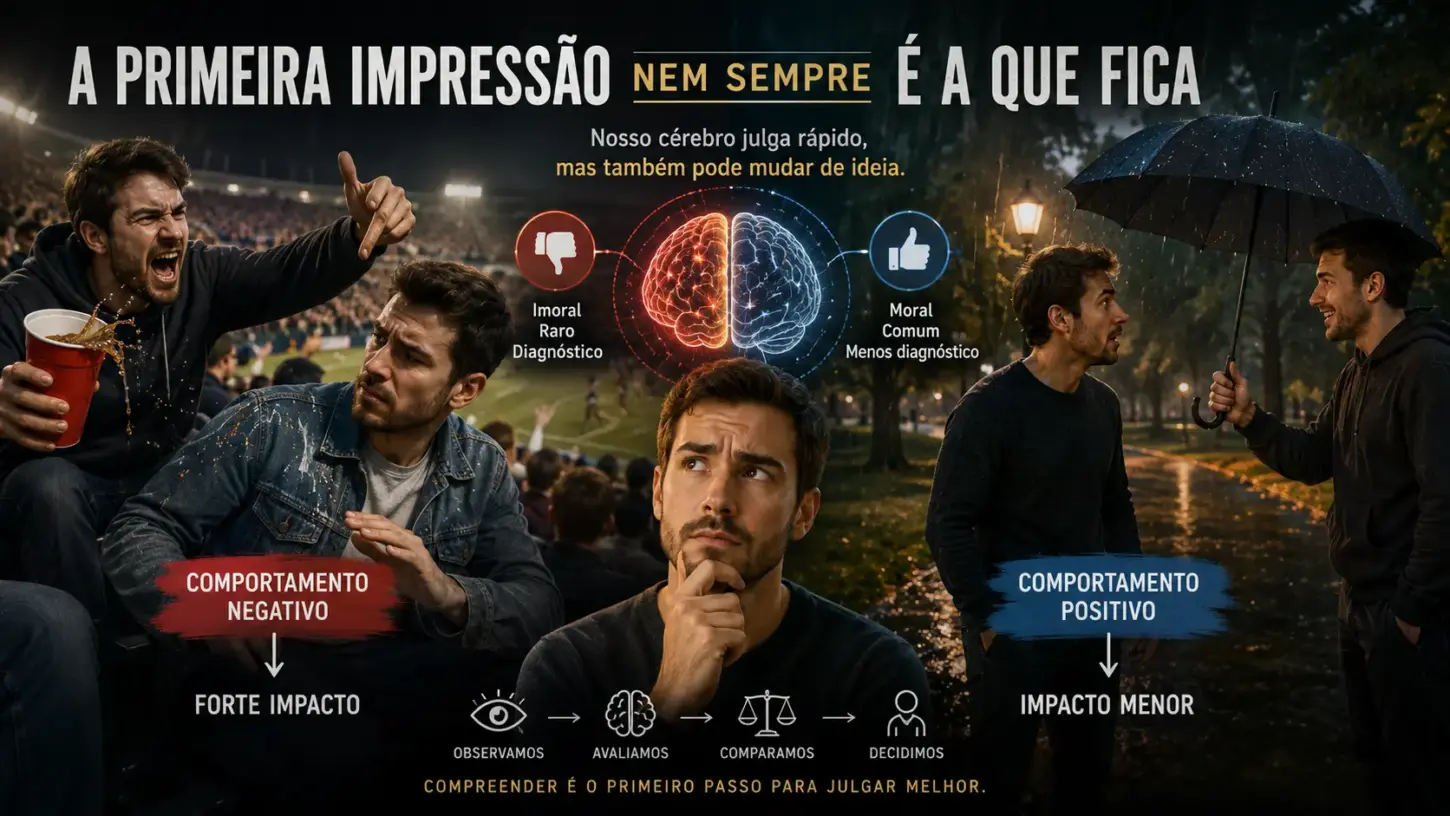
| Imagine you're at a football game when this obnoxious guy sits next to you. He's loud, he spills his drink on you, and he makes fun of your team. | Imagine que você está em um jogo de futebol quando um sujeito extremamente inconveniente se senta ao seu lado. Ele fala alto, derrama a bebida em você e ainda zomba do seu time. |
| Days later, you're walking in the park when suddenly it starts to pour rain. Who should show up at your side to offer you an umbrella? The same guy from the football game. | Dias depois, você está caminhando no parque quando, de repente, começa a cair um temporal. Quem aparece ao seu lado para lhe oferecer um guarda-chuva? O mesmo sujeito do jogo de futebol. |
| Do you change your mind about him based on this second encounter, or do you go with your first impression and write him off? | Você muda sua opinião sobre ele com base nesse segundo encontro ou mantém sua primeira impressão e o descarta de vez? |
| Research in social psychology suggests that we're quick to form lasting impressions of others based on their behaviors. We manage to do this with little effort, inferring stable character traits from a single behavior, like a harsh word or a clumsy step. | Pesquisas em psicologia social sugerem que formamos rapidamente impressões duradouras sobre as outras pessoas com base em seus comportamentos. Conseguimos fazer isso com muito pouco esforço, inferindo traços estáveis de personalidade a partir de um único comportamento, como uma palavra ríspida ou um passo desajeitado. |
| Using our impressions as guides, we can accurately predict how people are going to behave in the future. Armed with the knowledge that the guy from the football game was a jerk the first time you met him, you might expect more of the same down the road. If so, you might choose to avoid him the next time you see him. | Usando nossas impressões como guia, conseguimos prever com boa precisão como as pessoas irão se comportar no futuro. Sabendo que o sujeito do jogo de futebol foi um grosseiro na primeira vez em que você o encontrou, é provável que espere mais do mesmo dali em diante. Se for esse o caso, talvez você escolha evitá-lo na próxima vez que o encontrar. |
| That said, we can change our impressions in light of new information. Behavioral researchers have identified consistent patterns that seem to guide this process of impression updating. | Dito isso, podemos mudar nossas impressões à luz de novas informações. Pesquisadores do comportamento identificaram padrões consistentes que parecem orientar esse processo de atualização das impressões. |
| On one hand, learning very negative, highly immoral information about someone typically has a stronger impact than learning very positive, highly moral information. So, unfortunately for our new friend from the football game, his bad behavior at the game might outweigh his good behavior at the park. | Por um lado, descobrir informações muito negativas e altamente imorais sobre alguém costuma ter um impacto maior do que descobrir informações muito positivas e altamente morais. Assim, infelizmente para o nosso novo amigo do jogo de futebol, seu mau comportamento no estádio pode acabar pesando mais do que sua boa ação no parque. |
| Research suggests that this bias occurs because immoral behaviors are more diagnostic, or revealing, of a person's true character. | Pesquisas sugerem que esse viés ocorre porque comportamentos imorais são mais diagnósticos, ou seja, revelam mais sobre o verdadeiro caráter de uma pessoa. |
| Okay, so by this logic, bad is always stronger than good when it comes to updating. Well, not necessarily. | Certo, então, seguindo essa lógica, o ruim sempre pesa mais do que o bom quando se trata de atualizar nossas impressões. Bem, não necessariamente. |
| Certain types of learning don't seem to lead to this sort of negativity bias. When learning about another person's abilities and competencies, for instance, this bias flips. It's actually the positive information that gets weighted more heavily. | Certos tipos de aprendizado não parecem levar a esse tipo de viés de negatividade. Ao aprender sobre as habilidades e competências de outra pessoa, por exemplo, esse viés se inverte. Na verdade, são as informações positivas que recebem maior peso. |
| Let's go back to that football game. If a player scores a goal, it ultimately has a stronger impact on your impression of their skills than if they miss the net. | Vamos voltar ao jogo de futebol. Se um jogador marca um gol, isso acaba tendo um impacto maior na sua impressão sobre as habilidades dele do que quando ele perde a chance de marcar. |
| The two sides of the updating story are ultimately quite consistent. Overall, behaviors that are perceived as being less frequent are also the ones that people tend to weigh more heavily when forming and updating impressions: highly immoral actions and highly competent actions. | Os dois lados dessa história sobre a atualização das impressões são, no fim das contas, bastante coerentes. De modo geral, os comportamentos percebidos como menos frequentes também são aqueles aos quais as pessoas tendem a atribuir maior importância ao formar e atualizar suas impressões: ações altamente imorais e ações altamente competentes. |
| So, what's happening at the level of the brain when we're updating our impressions? | Então, o que acontece no cérebro quando estamos atualizando nossas impressões? |
| Using fMRI, or functional Magnetic Resonance Imaging, researchers have identified an extended network of brain regions that respond to new information that's inconsistent with initial impressions. These include areas typically associated with social cognition, attention, and cognitive control. | Usando a fMRI, ou imagem por ressonância magnética funcional, pesquisadores identificaram uma ampla rede de regiões cerebrais que respondem a novas informações incompatíveis com as impressões iniciais. Essas regiões incluem áreas normalmente associadas à cognição social, à atenção e ao controle cognitivo. |
| Moreover, when updating impressions based on people's behaviors, activity in the ventrolateral prefrontal cortex and the superior temporal sulcus correlates with perceptions of how frequently those behaviors occur in daily life. | Além disso, ao atualizar impressões com base no comportamento das pessoas, a atividade no córtex pré-frontal ventrolateral e no sulco temporal superior se correlaciona com a percepção da frequência com que esses comportamentos ocorrem na vida cotidiana. |
| In other words, the brain seems to be tracking low-level, statistical properties of behavior in order to make complex decisions regarding other people's character. It needs to decide: Is this person's behavior typical, or is it out of the ordinary? | Em outras palavras, o cérebro parece monitorar propriedades estatísticas básicas do comportamento para tomar decisões complexas sobre o caráter das outras pessoas. Ele precisa decidir: esse comportamento é típico dessa pessoa ou está fora do comum? |
| In the situation with the obnoxious football fan turned Good Samaritan, your brain says, "Well, in my experience, pretty much anyone would lend someone their umbrella, but the way this guy acted at the football game, that was unusual." | Na situação do torcedor inconveniente que depois se transforma em um bom samaritano, seu cérebro diz: "Bem, pela minha experiência, praticamente qualquer pessoa emprestaria um guarda-chuva a alguém, mas a maneira como esse sujeito agiu no jogo de futebol foi incomum." |
| And so, you decide to go with your first impression. | E assim, você decide confiar na sua primeira impressão. |
| There's a good moral in this data: your brain, and by extension you, might care more about the very negative, immoral things another person has done compared to the very positive, moral things, but it's a direct result of the comparative rarity of those bad behaviors. | Há uma boa lição nesses dados: seu cérebro, e por extensão você, pode dar mais importância às coisas muito negativas e imorais que outra pessoa fez do que às coisas muito positivas e morais, mas isso é consequência direta da raridade comparativa desses maus comportamentos. |
| We're more used to people being basically good, like taking time to help a stranger in need. In this context, bad might be stronger than good, but only because good is more plentiful. | Estamos mais acostumados a ver as pessoas sendo basicamente boas, como quando dedicam um tempo para ajudar um desconhecido em necessidade. Nesse contexto, o ruim pode parecer mais forte do que o bom, mas apenas porque o bom é muito mais comum. |
| Think about the last time you judged someone based on their behavior, especially a time when you really feel like you changed your mind about someone. Was the behavior that caused you to update your impression something you'd expect anyone to do, or was it something totally out of the ordinary? | Pense na última vez em que você julgou alguém com base em seu comportamento, especialmente em uma ocasião em que realmente sentiu que mudou de opinião sobre essa pessoa. O comportamento que fez você atualizar sua impressão era algo que você esperaria de qualquer pessoa ou era algo totalmente fora do comum? |
Contagem de palavras
A tabela abaixo exibe as palavras encontradas neste vídeo, bem como o número de vezes em que aparecem.
Veja também: Para que serve esta tabela?
| Freq. | Palavra | Freq. | Palavra | Freq. | Palavra |
|---|---|---|---|---|---|
| 35 | the | 23 | to | 19 | you |
| 18 | of | 14 | a | 13 | that |
| 13 | in | 12 | this | 11 | your |
| 10 | are | 9 | is | 9 | and |
| 8 | with | 8 | when | 8 | it |
| 7 | on | 7 | more | 7 | impressions |
| 7 | good | 7 | game | 7 | football |
| 7 | behavior | 6 | we | 6 | updating |
| 6 | or | 6 | impression | 6 | behaviors |
| 6 | at | 6 | about | 5 | time |
| 5 | so | 5 | people | 5 | might |
| 5 | information | 5 | him | 5 | do |
| 5 | brain | 4 | was | 4 | very |
| 4 | their | 4 | than | 4 | stronger |
| 4 | someone | 4 | person | 4 | our |
| 4 | learning | 4 | immoral | 4 | highly |
| 4 | has | 4 | guy | 4 | from |
| 4 | first | 4 | based | 4 | bad |
| 3 | positive | 3 | new | 3 | moral |
| 3 | like | 3 | if | 3 | his |
| 3 | he | 3 | go | 3 | character |
| 3 | but | 3 | bias | 2 | would |
| 2 | well | 2 | using | 2 | umbrella |
| 2 | ultimately | 2 | typically | 2 | those |
| 2 | things | 2 | suggests | 2 | something |
| 2 | social | 2 | should | 2 | seem |
| 2 | same | 2 | researchers | 2 | research |
| 2 | park | 2 | out | 2 | other |
| 2 | ordinary | 2 | obnoxious | 2 | not |
| 2 | next | 2 | negative | 2 | mind |
| 2 | level | 2 | impact | 2 | identified |
| 2 | how | 2 | heavily | 2 | have |
| 2 | for | 2 | expect | 2 | decide |
| 2 | consistent | 2 | change | 2 | can |
| 2 | by | 2 | being | 2 | because |
| 2 | be | 2 | as | 2 | anyone |
| 2 | another | 2 | an | 2 | actions |
| 1 | write | 1 | words | 1 | word |
| 1 | who | 1 | what | 1 | weighted |
| 1 | weigh | 1 | way | 1 | walking |
| 1 | ventrolateral | 1 | used | 1 | us |
| 1 | update | 1 | up | 1 | unusual |
| 1 | unfortunately | 1 | typical | 1 | types |
| 1 | two | 1 | turned | 1 | trust |
| 1 | true | 1 | traits | 1 | tracking |
| 1 | totally | 1 | think | 1 | they |
| 1 | these | 1 | there | 1 | tend |
| 1 | temporal | 1 | team | 1 | taking |
| 1 | superior | 1 | sulcus | 1 | suddenly |
| 1 | stranger | 1 | story | 1 | step |
| 1 | statistical | 1 | starts | 1 | stable |
| 1 | spills | 1 | sort | 1 | skills |
| 1 | situation | 1 | sits | 1 | single |
| 1 | sides | 1 | side | 1 | show |
| 1 | seems | 1 | see | 1 | second |
| 1 | scores | 1 | says | 1 | samaritan |
| 1 | said | 1 | road | 1 | revealing |
| 1 | result | 1 | respond | 1 | resonance |
| 1 | regions | 1 | regarding | 1 | really |
| 1 | rarity | 1 | rain | 1 | quite |
| 1 | quick | 1 | psychology | 1 | properties |
| 1 | process | 1 | pretty | 1 | prefrontal |
| 1 | predict | 1 | pour | 1 | plentiful |
| 1 | player | 1 | perceptions | 1 | perceived |
| 1 | patterns | 1 | overall | 1 | outweigh |
| 1 | others | 1 | order | 1 | only |
| 1 | ones | 1 | one | 1 | okay |
| 1 | offer | 1 | off | 1 | occurs |
| 1 | occur | 1 | network | 1 | net |
| 1 | negativity | 1 | needs | 1 | need |
| 1 | necessarily | 1 | my | 1 | much |
| 1 | moreover | 1 | miss | 1 | met |
| 1 | manage | 1 | makes | 1 | make |
| 1 | magnetic | 1 | low | 1 | loud |
| 1 | logic | 1 | little | 1 | light |
| 1 | life | 1 | let | 1 | less |
| 1 | lend | 1 | lead | 1 | later |
| 1 | lasting | 1 | last | 1 | knowledge |
| 1 | judged | 1 | jerk | 1 | instance |
| 1 | initial | 1 | inferring | 1 | inconsistent |
| 1 | include | 1 | imaging | 1 | imagine |
| 1 | help | 1 | harsh | 1 | happening |
| 1 | hand | 1 | guides | 1 | guide |
| 1 | going | 1 | goal | 1 | gets |
| 1 | future | 1 | functional | 1 | fun |
| 1 | friend | 1 | frequently | 1 | frequent |
| 1 | forming | 1 | form | 1 | fmri |
| 1 | flips | 1 | feel | 1 | fan |
| 1 | extension | 1 | extended | 1 | experience |
| 1 | especially | 1 | encounter | 1 | effort |
| 1 | drink | 1 | down | 1 | done |
| 1 | direct | 1 | diagnostic | 1 | decisions |
| 1 | days | 1 | data | 1 | daily |
| 1 | cortex | 1 | correlates | 1 | control |
| 1 | context | 1 | complex | 1 | competent |
| 1 | competencies | 1 | compared | 1 | comparative |
| 1 | comes | 1 | cognitive | 1 | cognition |
| 1 | clumsy | 1 | choose | 1 | changed |
| 1 | certain | 1 | caused | 1 | care |
| 1 | behavioral | 1 | behave | 1 | basically |
| 1 | back | 1 | avoid | 1 | attention |
| 1 | associated | 1 | armed | 1 | areas |
| 1 | always | 1 | also | 1 | actually |
| 1 | activity | 1 | acted | 1 | accurately |
| 1 | abilities |