
Vídeo | Can 100% renewable energy power the world?
Com o petróleo e o gás à beira do esgotamento e o impacto ambiental em nível crítico, a transição para fontes limpas tornou-se urgente. Mas se o Sol sozinho fornece quase 10.000 vezes mais energia do que a humanidade precisa, por que ainda dependemos dos combustíveis fósseis para cobrir 87% das nossas necessidades? Descubra as barreira técnicas, desde o gargalo do transporte e das redes elétricas até o dilema das baterias de alta densidade para aviões e navios e conheça as inovações que prometem revolucionar nosso futuro energético.
| Audio | |
|---|---|
Normal | Slow |
| English Transcript | Tradução |
| Can 100% renewable energy power the world? | Pode a energia 100% renovável fornecer energia para o mundo? |
| Every year, the world uses 35 billion barrels of oil. | A cada ano, o mundo usa 35 bilhões de barris de petróleo. |
| This massive scale of fossil fuel dependence pollutes the Earth, and it won't last forever. Scientists estimate that we've consumed about 40 percent of the world's oil. According to present estimates, at this rate, we'll run out of oil and gas in 50 years or so, and in about a century for coal. On the flip side, we have abundant Sun, water, and wind. These are renewable energy sources, meaning that we won't use them up over time. What if we could exchange our fossil fuel dependence for an existence based solely on renewables? | Esta escala massiva de dependência de combustíveis fósseis polui a Terra e não durará para sempre. Os cientistas estimam que já consumimos cerca de 40 por cento do petróleo do mundo. De acordo com as estimativas atuais, neste ritmo, ficaremos sem petróleo e gás em 50 anos ou mais, e em cerca de um século para o carvão. Por outro lado, temos Sol, água e vento abundantes. Estas são fontes de energia renovável, o que significa que não as esgotaremos com o tempo. E se pudéssemos trocar a nossa dependência de combustíveis fósseis por uma existência baseada exclusivamente em renováveis? |
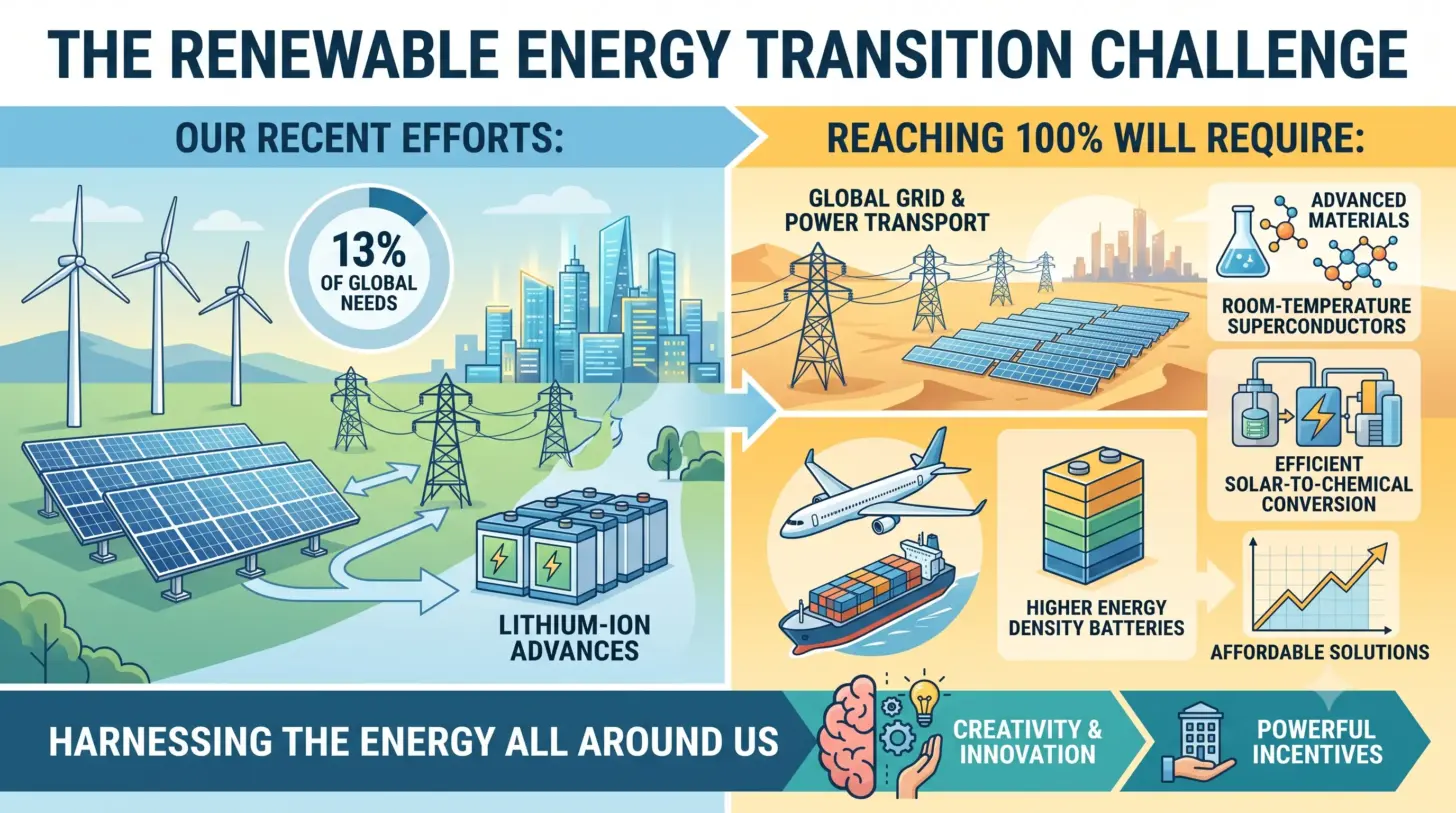
| We've pondered that question for decades, and yet renewable energy still only provides about 13 percent of our needs. That's because reaching 100% requires renewable energy that's inexpensive and accessible. This represents a huge challenge. Even if we ignore the politics involved and focus on the science and engineering, we can better understand the problem by understanding how we use energy. Global energy use is a diverse and complex system, and the different elements require their own solutions, but for now, we'll focus on two of the most familiar in everyday life: electricity and liquid fuels. | Ponderamos essa questão há décadas e, no entanto, a energia renovável ainda fornece apenas cerca de 13 por cento das nossas necessidades. Isso ocorre porque atingir 100% requer energia renovável que seja barata e acessível. Isso representa um enorme desafio. Mesmo se ignorarmos a política envolvida e nos concentrarmos na ciência e na engenharia, podemos entender melhor o problema compreendendo como usamos a energia. A utilização global de energia é um sistema diverso e complexo, e os diferentes elementos exigem as suas próprias soluções, mas, por enquanto, focar-nos-emos em dois dos mais familiares no dia a dia: eletricidade e combustíveis líquidos. |
| Electricity powers blast furnaces, elevators, computers, and all manner of things in homes, businesses, and manufacturing. Meanwhile, liquid fuels play a crucial role in almost all forms of transportation. | A eletricidade alimenta altos-fornos, elevadores, computadores e todo tipo de coisas em casas, empresas e indústrias. Enquanto isso, os combustíveis líquidos desempenham um papel crucial em quase todas as formas de transporte. |
| Let's consider the electrical portion first. The great news is that our technology is already advanced enough to capture all that energy from renewables, and there's an ample supply. The Sun continuously radiates about 173 quadrillion watts of solar energy at the Earth, which is almost 10,000 times our present needs. It's been estimated that a surface that spans several hundred thousand kilometers would be needed to power humanity at our present usage levels. | Vamos considerar a parte elétrica primeiro. A grande notícia é que a nossa tecnologia já é avançada o suficiente para capturar toda essa energia de fontes renováveis, e há um suprimento abundante. O Sol radia continuamente cerca de 173 quatrilhões de watts de energia solar para a Terra, o que é quase 10.000 vezes as nossas necessidades atuais. Estimou-se que uma superfície que se estenda por centenas de milhares de quilômetros seria necessária para alimentar a humanidade nos nossos níveis atuais de uso. |
| So, why don't we build that? Because there are other hurdles in the way, like efficiency and energy transportation. To maximize efficiency, solar plants must be located in areas with lots of sunshine year-round, like deserts, but those are far away from densely populated regions where energy demand is high. There are other forms of renewable energy we could draw from, such as hydroelectric, geothermal, and biomass, but they also have limits based on availability and location. | Então, por que não construímos isso? Porque existem outros obstáculos no caminho, como a eficiência e o transporte de energia. Para maximizar a eficiência, as usinas solares devem ser localizadas em áreas com muito sol o ano todo, como desertos, mas essas áreas estão distantes de regiões densamente povoadas onde a demanda por energia é alta. Existem outras formas de energia renovável das quais poderíamos retirar energia, tais como hidrelétrica, geotérmica e biomassa, mas elas também têm limites baseados na disponibilidade e localização. |
| In principle, a connected electrical energy network with power lines crisscrossing the globe would enable us to transport power from where it's generated to where it's needed, but building a system on this scale faces an astronomical price tag. We could lower the cost by developing advanced technologies to capture energy more efficiently. | Em princípio, uma rede de energia elétrica conectada, com linhas de transmissão cruzando o globo, nos permitiria transportar energia de onde ela é gerada para onde é necessária, mas construir um sistema nessa escala enfrenta um custo astronômico. Poderíamos reduzir o custo desenvolvendo tecnologias avançadas para capturar energia de forma mais eficiente. |
| The infrastructure for transporting energy would also have to change drastically. Present-day power lines lose about six to eight percent of the energy they carry because wire material dissipates energy through resistance. Longer power lines would mean more energy loss. Superconductors could be one solution; such materials can transport electricity without dissipation. Unfortunately, they only work if cooled to low temperatures, which requires energy and defeats the purpose. To benefit from that technology, we'd need to discover new superconducting materials that operate at room temperature. | A infraestrutura para transportar energia também teria de mudar drasticamente. As linhas de transmissão atuais perdem cerca de seis a oito por cento da energia que carregam porque o material dos fios dissipa energia através da resistência. Linhas de transmissão mais longas significariam mais perda de energia. Supercondutores poderiam ser uma solução; tais materiais podem transportar eletricidade sem dissipação. Infelizmente, eles só funcionam se resfriados a baixas temperaturas, o que requer energia e anula o propósito. Para nos beneficiarmos dessa tecnologia, precisaríamos descobrir novos materiais supercondutores que operem à temperatura ambiente. |
| And what about the all-important petroleum-derived liquid fuels? The scientific challenge there is to store renewable energy in an easily transportable form. Recently, we've gotten better at producing lithium-ion batteries, which are lightweight and have high energy density. But even the best of these store about 2.5 megajoules per kilogram—that's about 20 times less than the energy in one kilogram of gasoline. To be truly competitive, car batteries would have to store much more energy without adding cost. | E quanto aos tão importantes combustíveis líquidos derivados do petróleo? O desafio científico aí é armazenar energia renovável em uma forma facilmente transportável. Recentemente, ficamos melhores na produção de baterias de íons de lítio, que são leves e têm alta densidade energética. Mas mesmo as melhores destas armazenam cerca de 2,5 megajoules por quilograma — isso é cerca de 20 vezes menos do que a energia em um quilograma de gasolina. Para serem verdadeiramente competitivas, as baterias de carros teriam de armazenar muito mais energia sem aumentar o custo. |
| The challenges only increase for bigger vessels like ships and planes. To power a trans-Atlantic flight for a jet, we need a battery weighing about 1,000 tons. This, too, demands a technological leap towards new materials, higher energy density, and better storage. One promising solution would be to find efficient ways to convert solar into chemical energy. This is already happening in labs, but the efficiency is still too low to allow it to reach the market. | Os desafios só aumentam para veículos maiores, como navios e aviões. Para alimentar um voo transatlântico de um avião a jato, precisaríamos de uma bateria pesando cerca de 1.000 toneladas. Isto também exige um salto tecnológico em direção a novos materiais, maior densidade energética e melhor armazenamento. Uma solução promissora seria encontrar maneiras eficientes de converter energia solar em energia química. Isso já está acontecendo em laboratórios, mas a eficiência ainda é muito baixa para permitir que alcance o mercado. |
| To find novel solutions, we'll need lots of creativity, innovation, and powerful incentives. The transition towards all-renewable energy is a complex problem involving technology, economics, and politics. Priorities on how to tackle this challenge depend on the specific assumptions we have to make when trying to solve such a multifaceted problem. | Para encontrar soluções inovadoras, precisaremos de muita criatividade, inovação e incentivos poderosos. A transição em direção a energias totalmente renováveis é um problema complexo que envolve tecnologia, economia e política. As prioridades sobre como enfrentar esse desafio dependem das premissas específicas que temos de fazer ao tentar resolver um problema tão multifacetado. |
| But there's ample reason to be optimistic that we'll get there. Top scientific minds around the world are working on these problems and making breakthroughs all the time, and many governments and businesses are investing in technologies that harness the energy all around us. | Mas há amplas razões para estarmos otimistas de que chegaremos lá. As mentes científicas mais brilhantes de todo o mundo estão trabalhando nesses problemas e fazendo descobertas a todo momento, e muitos governos e empresas estão investindo em tecnologias que aproveitam a energia ao nosso redor. |
| TED-Ed is a non-profit. If you value our work, please consider supporting it on patreon.com/teded. | A TED-Ed é uma organização sem fins lucrativos; se você valoriza nosso trabalho, considere apoiá-lo no patreon.com/teded |
Contagem de palavras
A tabela abaixo exibe as palavras encontradas neste vídeo, bem como o número de vezes em que aparecem.
Veja também: Para que serve esta tabela?
| Freq. | Palavra | Freq. | Palavra | Freq. | Palavra |
|---|---|---|---|---|---|
| 32 | the | 27 | and | 26 | energy |
| 25 | to | 19 | we | 18 | is |
| 15 | of | 14 | that | 14 | a |
| 12 | in | 10 | on | 9 | have |
| 9 | about | 7 | would | 7 | this |
| 7 | renewable | 7 | power | 7 | for |
| 7 | but | 7 | are | 7 | all |
| 6 | will | 6 | there | 6 | our |
| 6 | it | 6 | be | 5 | from |
| 5 | at | 4 | world | 4 | present |
| 4 | if | 4 | could | 4 | an |
| 3 | which | 3 | where | 3 | use |
| 3 | us | 3 | they | 3 | these |
| 3 | technology | 3 | such | 3 | store |
| 3 | solar | 3 | problem | 3 | percent |
| 3 | only | 3 | one | 3 | oil |
| 3 | not | 3 | need | 3 | more |
| 3 | materials | 3 | liquid | 3 | lines |
| 3 | like | 3 | fuels | 3 | electricity |
| 3 | efficiency | 3 | challenge | 3 | can |
| 3 | better | 3 | because | 2 | year |
| 2 | work | 2 | without | 2 | with |
| 2 | what | 2 | transportation | 2 | transport |
| 2 | towards | 2 | too | 2 | times |
| 2 | time | 2 | technologies | 2 | system |
| 2 | sun | 2 | still | 2 | solutions |
| 2 | solution | 2 | so | 2 | scientific |
| 2 | scale | 2 | requires | 2 | renewables |
| 2 | politics | 2 | other | 2 | new |
| 2 | needs | 2 | needed | 2 | low |
| 2 | lots | 2 | how | 2 | high |
| 2 | fuel | 2 | fossil | 2 | forms |
| 2 | focus | 2 | find | 2 | even |
| 2 | electrical | 2 | earth | 2 | dependence |
| 2 | density | 2 | cost | 2 | consider |
| 2 | complex | 2 | capture | 2 | by |
| 2 | businesses | 2 | batteries | 2 | based |
| 2 | around | 2 | ample | 2 | also |
| 2 | already | 2 | almost | 2 | advanced |
| 1 | you | 1 | yet | 1 | years |
| 1 | working | 1 | wire | 1 | wind |
| 1 | why | 1 | when | 1 | weighing |
| 1 | ways | 1 | way | 1 | watts |
| 1 | water | 1 | vessels | 1 | value |
| 1 | uses | 1 | usage | 1 | up |
| 1 | unfortunately | 1 | understanding | 1 | understand |
| 1 | two | 1 | trying | 1 | truly |
| 1 | transporting | 1 | transportable | 1 | transition |
| 1 | trans | 1 | top | 1 | tons |
| 1 | through | 1 | thousand | 1 | those |
| 1 | things | 1 | them | 1 | their |
| 1 | than | 1 | temperatures | 1 | temperature |
| 1 | teded | 1 | ted | 1 | technological |
| 1 | tag | 1 | tackle | 1 | surface |
| 1 | supporting | 1 | supply | 1 | superconductors |
| 1 | superconducting | 1 | sunshine | 1 | storage |
| 1 | specific | 1 | spans | 1 | sources |
| 1 | solve | 1 | solely | 1 | six |
| 1 | side | 1 | ships | 1 | several |
| 1 | scientists | 1 | science | 1 | run |
| 1 | round | 1 | room | 1 | role |
| 1 | resistance | 1 | require | 1 | represents |
| 1 | regions | 1 | recently | 1 | reason |
| 1 | reaching | 1 | reach | 1 | rate |
| 1 | radiates | 1 | question | 1 | quadrillion |
| 1 | purpose | 1 | provides | 1 | promising |
| 1 | profit | 1 | producing | 1 | problems |
| 1 | priorities | 1 | principle | 1 | price |
| 1 | powers | 1 | powerful | 1 | portion |
| 1 | populated | 1 | pondered | 1 | pollutes |
| 1 | please | 1 | play | 1 | plants |
| 1 | planes | 1 | petroleum | 1 | per |
| 1 | patreon | 1 | own | 1 | over |
| 1 | out | 1 | or | 1 | optimistic |
| 1 | operate | 1 | now | 1 | novel |
| 1 | non | 1 | news | 1 | network |
| 1 | must | 1 | multifaceted | 1 | much |
| 1 | most | 1 | minds | 1 | megajoules |
| 1 | meanwhile | 1 | meaning | 1 | mean |
| 1 | maximize | 1 | material | 1 | massive |
| 1 | market | 1 | many | 1 | manufacturing |
| 1 | manner | 1 | making | 1 | make |
| 1 | lower | 1 | loss | 1 | lose |
| 1 | longer | 1 | location | 1 | located |
| 1 | lithium | 1 | limits | 1 | lightweight |
| 1 | life | 1 | levels | 1 | let |
| 1 | less | 1 | leap | 1 | last |
| 1 | labs | 1 | kilometers | 1 | kilogramthat |
| 1 | kilogram | 1 | jet | 1 | ion |
| 1 | involving | 1 | involved | 1 | investing |
| 1 | into | 1 | innovation | 1 | infrastructure |
| 1 | inexpensive | 1 | increase | 1 | incentives |
| 1 | important | 1 | ignore | 1 | hydroelectric |
| 1 | hurdles | 1 | hundred | 1 | humanity |
| 1 | huge | 1 | homes | 1 | higher |
| 1 | harness | 1 | happening | 1 | great |
| 1 | governments | 1 | gotten | 1 | globe |
| 1 | global | 1 | get | 1 | geothermal |
| 1 | generated | 1 | gasoline | 1 | gas |
| 1 | furnaces | 1 | form | 1 | forever |
| 1 | flip | 1 | flight | 1 | first |
| 1 | far | 1 | familiar | 1 | faces |
| 1 | existence | 1 | exchange | 1 | everyday |
| 1 | every | 1 | estimates | 1 | estimated |
| 1 | estimate | 1 | enough | 1 | engineering |
| 1 | enable | 1 | elevators | 1 | elements |
| 1 | eight | 1 | efficiently | 1 | efficient |
| 1 | ed | 1 | economics | 1 | easily |
| 1 | draw | 1 | drastically | 1 | do |
| 1 | diverse | 1 | dissipation | 1 | dissipates |
| 1 | discover | 1 | different | 1 | developing |
| 1 | deserts | 1 | derived | 1 | depend |
| 1 | densely | 1 | demands | 1 | demand |
| 1 | defeats | 1 | decades | 1 | day |
| 1 | crucial | 1 | crisscrossing | 1 | creativity |
| 1 | cooled | 1 | convert | 1 | continuously |
| 1 | consumed | 1 | connected | 1 | computers |
| 1 | competitive | 1 | com | 1 | coal |
| 1 | chemical | 1 | change | 1 | challenges |
| 1 | century | 1 | carry | 1 | car |
| 1 | building | 1 | build | 1 | breakthroughs |
| 1 | blast | 1 | biomass | 1 | billion |
| 1 | bigger | 1 | best | 1 | benefit |
| 1 | been | 1 | battery | 1 | barrels |
| 1 | away | 1 | availability | 1 | atlantic |
| 1 | astronomical | 1 | assumptions | 1 | as |
| 1 | areas | 1 | allow | 1 | adding |
| 1 | according | 1 | accessible | 1 | abundant |