
Vídeo | How does the space station never run out of oxygen?
Como é possível produzir ar respirável a centenas de quilômetros da Terra sem depender de enormes tanques de oxigênio? Descubra como a Estação Espacial Internacional recicla água, transforma eletricidade em oxigênio e como uma nova tecnologia baseada em campos magnéticos poderá tornar as futuras missões a Marte mais seguras, confiáveis e eficientes.
| Audio | |
|---|---|
Normal | Slow |
| English Transcript | Tradução |
| How does the space station never run out of oxygen? | Como os Astronautas Produzem Oxigênio no Espaço |
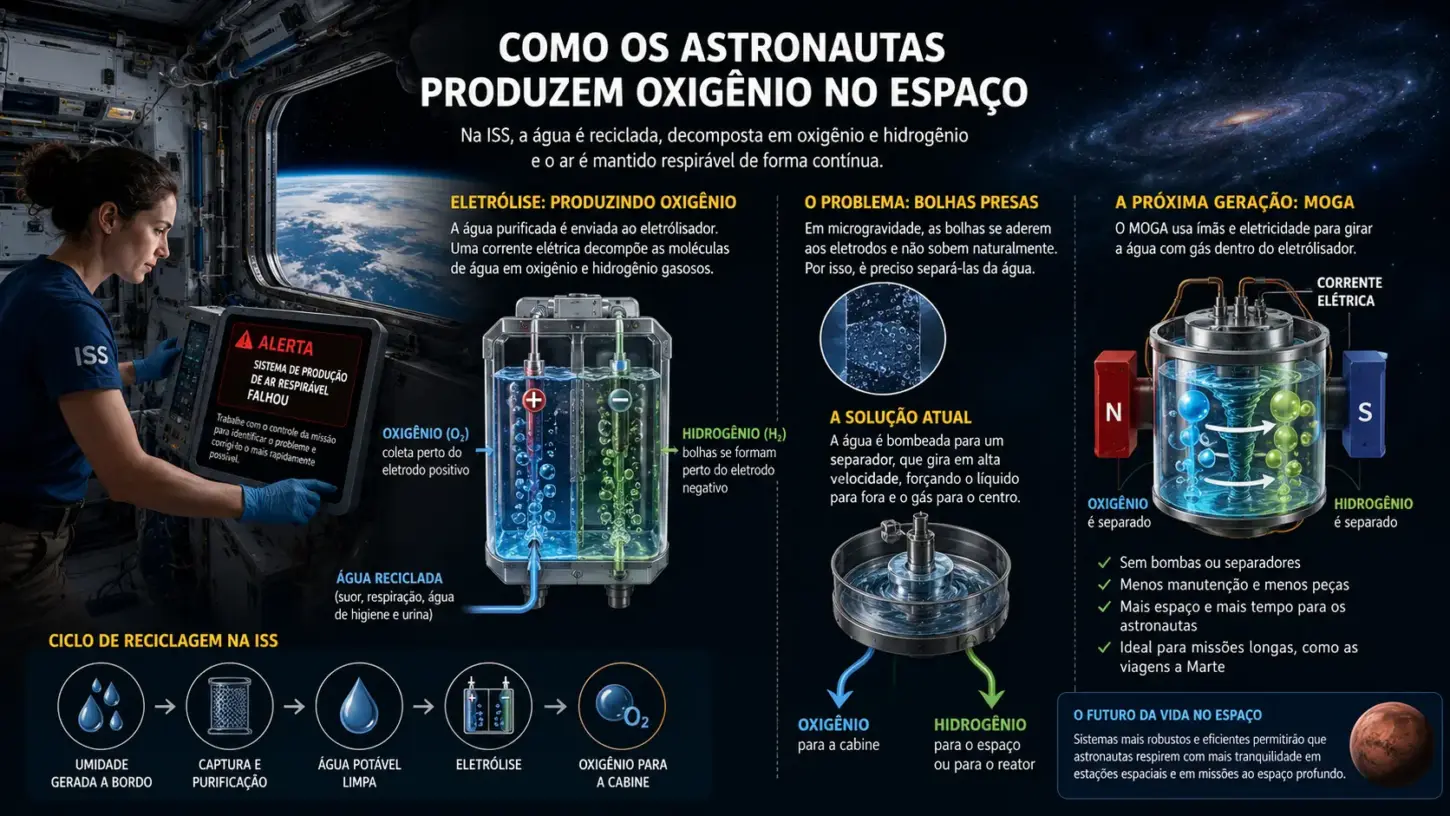
| You're an astronaut orbiting 400 km above Earth when suddenly an alert flashes across your display. The system responsible for producing the breathable air on board has failed. Now you and your crewmates must work with mission control to identify the problem and fix it as quickly as possible. | Imagine que você é um astronauta orbitando a 400 km acima da Terra quando, de repente, um alerta aparece na tela à sua frente. O sistema responsável por produzir o ar respirável a bordo falhou. Agora você e seus companheiros de tripulação precisam trabalhar com o controle da missão para identificar o problema e corrigi-lo o mais rapidamente possível. |
| This might seem like a scene from a sci-fi thriller, but for astronauts on the International Space Station, dealing with situations like this is a reality of life. For over 25 years, the ISS's air supply systems have revolutionized space missions. Yet the need for regular maintenance, repairs, and upgrades has pushed engineers to develop even more reliable systems for future spacecraft. | Isso pode parecer uma cena de um filme de ficção científica, mas, para os astronautas da Estação Espacial Internacional, lidar com situações como essa faz parte da realidade. Há mais de 25 anos, os sistemas de fornecimento de ar da ISS vêm revolucionando as missões espaciais. Ainda assim, a necessidade de manutenção, reparos e atualizações constantes levou os engenheiros a desenvolver sistemas ainda mais confiáveis para as futuras espaçonaves. |
| Creating breathable air in space has two requirements: supplying oxygen and removing exhaled carbon dioxide before it builds up. Every astronaut in space needs, on average, about 0.8 kg of oxygen a day. Most early space missions met this demand by storing oxygen on board in pressurized tanks. For example, the 8-day Apollo 11 mission to the Moon carried three astronauts along with around 50 kg of oxygen for life support, more than enough for the crew to survive. Canisters containing lithium hydroxide would chemically react with carbon dioxide, scrubbing it from the cabin. | Produzir ar respirável no espaço exige duas coisas: fornecer oxigênio e remover o dióxido de carbono exalado antes que ele se acumule. Cada astronauta no espaço precisa, em média, de cerca de 0,8 kg de oxigênio por dia. A maioria das primeiras missões espaciais atendia a essa necessidade armazenando oxigênio a bordo em tanques pressurizados. Por exemplo, a missão Apollo 11, que durou oito dias e foi até a Lua, levou três astronautas juntamente com cerca de 50 kg de oxigênio para suporte à vida, mais do que o suficiente para a sobrevivência da tripulação. Recipientes contendo hidróxido de lítio reagiam quimicamente com o dióxido de carbono, removendo-o do interior da cabine. |
| But the launch of the first space station marked a turning point. For the first time, crews would remain in orbit for months, not days. A typical six- to eight-month expedition with seven crew members might require over 1,000 kg of oxygen, demanding about 30 large tanks. Constantly shipping this massive load to and from orbit would be expensive. So engineers developed a solution using water and a process called electrolysis, a system that makes oxygen directly on board. | Mas o lançamento da primeira estação espacial marcou um ponto de virada. Pela primeira vez, as tripulações permaneceriam em órbita durante meses, e não apenas dias. Uma missão típica de seis a oito meses, com sete tripulantes, pode exigir mais de 1.000 kg de oxigênio, o equivalente a cerca de 30 grandes tanques. Transportar continuamente toda essa carga para a órbita e de volta seria extremamente caro. Por isso, os engenheiros desenvolveram uma solução utilizando água e um processo chamado eletrólise, um sistema capaz de produzir oxigênio diretamente a bordo. |
| Water is relatively easy to come by on the ISS thanks to its robust recovery system. It captures nearly all moisture on board, from sweat, exhalation, wash water, and even urine, and purifies it into fresh, potable water. This clean water is routed to an electrolyzer, a device equipped with two electrodes, one positive and one negative. When an electric current is applied, the electrolyzer breaks down water molecules into oxygen and hydrogen gases. Oxygen collects near the positive electrode, and hydrogen gas bubbles form near the negative electrode. | A água é relativamente fácil de obter na ISS graças ao seu avançado sistema de recuperação. Ele captura praticamente toda a umidade produzida a bordo, proveniente do suor, da respiração, da água utilizada para higiene e até da urina, purificando-a até transformá-la em água potável. Essa água purificada é enviada para um eletrólisador, um dispositivo equipado com dois eletrodos, um positivo e outro negativo. Quando uma corrente elétrica é aplicada, o eletrólisador decompõe as moléculas de água em oxigênio e hidrogênio gasosos. O oxigênio se acumula próximo ao eletrodo positivo, enquanto bolhas de hidrogênio se formam junto ao eletrodo negativo. |
| But there's a problem: getting these gases out of the water. On Earth, bubbles naturally float to the top of denser liquids due to gravity. But in orbit, where everything is in free fall, bubbles tend to cling to the electrodes. One solution is to pump water through the electrolyzer, carrying the bubbles away to a separator. Here, the gas-filled water is spun, much like a washing machine in its final spin cycle, forcing the liquid outward while the gas collects in the center. In the end, oxygen is released into the cabin. Hydrogen gas is either vented into space or routed to a reactor, where it combines with captured exhaled carbon dioxide to make methane and water. | Mas existe um problema: retirar esses gases da água. Na Terra, as bolhas naturalmente sobem até a superfície dos líquidos mais densos devido à gravidade. Porém, em órbita, onde tudo está em queda livre, as bolhas tendem a permanecer aderidas aos eletrodos. Uma solução consiste em bombear a água através do eletrólisador, levando as bolhas até um separador. Ali, a água contendo gás é colocada em rotação, de forma semelhante ao ciclo de centrifugação de uma máquina de lavar, forçando o líquido para a parte externa enquanto o gás se concentra no centro. No final, o oxigênio é liberado para a cabine. O hidrogênio é liberado no espaço ou encaminhado para um reator, onde reage com o dióxido de carbono capturado da respiração da tripulação para produzir metano e água. |
| But this system isn't perfect. The process for separating bubbles from water relies on many complex moving parts that are prone to breaking or malfunctioning. As space agencies set their sights on expeditions deeper into space, like year-long crewed trips to Mars, this approach becomes increasingly impractical. | Mas esse sistema não é perfeito. O processo de separação das bolhas da água depende de diversos componentes mecânicos complexos, sujeitos a falhas e desgastes. À medida que as agências espaciais voltam seus objetivos para missões ainda mais distantes, como viagens tripuladas de um ano até Marte, essa abordagem torna-se cada vez menos prática. |
| So researchers are exploring new ways to separate out this gas. One promising solution is to spin the gas-filled water inside the electrolyzer using magnets. This system takes advantage of a fundamental property of how electrons and magnets interact. When negatively charged molecules move perpendicularly through a magnetic field, the field applies a force on the molecules called the Lorentz force. It pushes them sideways at a right angle to both the electric and magnetic fields. By positioning the magnets and current path in just the right way, this Lorentz force can swirl the liquid, separating out the oxygen and hydrogen gases. No pump or separator is needed. | Por isso, os pesquisadores estão explorando novas formas de separar esses gases. Uma solução promissora consiste em fazer a água contendo gás girar dentro do próprio eletrólisador utilizando ímãs. Esse sistema aproveita uma propriedade fundamental da interação entre elétrons e campos magnéticos. Quando partículas eletricamente carregadas se movem perpendicularmente através de um campo magnético, esse campo exerce sobre elas uma força conhecida como força de Lorentz. Essa força as empurra lateralmente, em um ângulo reto em relação aos campos elétrico e magnético. Assim, posicionando os ímãs e o caminho da corrente elétrica da maneira correta, essa força de Lorentz pode fazer o líquido girar, separando o oxigênio e o hidrogênio. Não são necessárias bombas nem separadores. |
| This magnetohydrodynamic oxygen generation assembly, or MOGA, has no moving parts, so it requires less maintenance and replacement hardware, freeing up space on board and allowing astronauts to spend more time on other endeavors. MOGA is still in the research phase, but it holds promise. With a more robust oxygen system, astronauts on future space stations and deep-space missions should be able to breathe a little easier. | Esse conjunto magnetohidrodinâmico de geração de oxigênio, conhecido como MOGA, não possui partes móveis e, por isso, exige menos manutenção e menos peças de reposição, liberando espaço a bordo e permitindo que os astronautas dediquem mais tempo a outras atividades. O MOGA ainda está em fase de pesquisa, mas apresenta um enorme potencial. Com um sistema de produção de oxigênio mais robusto, os astronautas das futuras estações espaciais e das missões ao espaço profundo poderão respirar um pouco mais tranquilos. |
| Not ready to come back down to Earth? Watch these videos, or subscribe to our channel to keep exploring the science, philosophy, and mystery of the universe. | Ainda não está pronto para voltar à Terra? Assista aos próximos vídeos ou inscreva-se em nosso canal para continuar explorando a ciência, a filosofia e os mistérios do universo. |
Contagem de palavras
A tabela abaixo exibe as palavras encontradas neste vídeo, bem como o número de vezes em que aparecem.
Veja também: Para que serve esta tabela?
| Freq. | Palavra | Freq. | Palavra | Freq. | Palavra |
|---|---|---|---|---|---|
| 43 | the | 28 | to | 20 | and |
| 20 | a | 14 | on | 14 | is |
| 13 | space | 13 | oxygen | 12 | water |
| 11 | this | 11 | of | 11 | in |
| 11 | for | 9 | it | 8 | with |
| 6 | system | 6 | gas | 6 | but |
| 5 | or | 5 | into | 5 | from |
| 5 | bubbles | 5 | board | 4 | out |
| 4 | one | 4 | more | 4 | like |
| 4 | hydrogen | 4 | has | 4 | electrolyzer |
| 4 | astronauts | 4 | an | 3 | would |
| 3 | when | 3 | station | 3 | solution |
| 3 | so | 3 | orbit | 3 | not |
| 3 | molecules | 3 | missions | 3 | magnets |
| 3 | kg | 3 | gases | 3 | force |
| 3 | earth | 3 | dioxide | 3 | carbon |
| 3 | by | 3 | as | 3 | are |
| 3 | air | 2 | your | 2 | you |
| 2 | where | 2 | using | 2 | up |
| 2 | two | 2 | time | 2 | through |
| 2 | these | 2 | that | 2 | tanks |
| 2 | systems | 2 | spin | 2 | separator |
| 2 | separating | 2 | routed | 2 | robust |
| 2 | right | 2 | pump | 2 | process |
| 2 | problem | 2 | positive | 2 | parts |
| 2 | over | 2 | no | 2 | negative |
| 2 | near | 2 | moving | 2 | moga |
| 2 | mission | 2 | might | 2 | maintenance |
| 2 | magnetic | 2 | lorentz | 2 | liquid |
| 2 | life | 2 | its | 2 | iss |
| 2 | how | 2 | future | 2 | first |
| 2 | filled | 2 | field | 2 | exploring |
| 2 | exhaled | 2 | even | 2 | engineers |
| 2 | electrodes | 2 | electrode | 2 | electric |
| 2 | down | 2 | day | 2 | current |
| 2 | crew | 2 | come | 2 | collects |
| 2 | called | 2 | cabin | 2 | breathable |
| 2 | be | 2 | astronaut | 2 | about |
| 1 | yet | 1 | years | 1 | year |
| 1 | work | 1 | while | 1 | ways |
| 1 | way | 1 | watch | 1 | washing |
| 1 | wash | 1 | videos | 1 | vented |
| 1 | urine | 1 | upgrades | 1 | universe |
| 1 | typical | 1 | turning | 1 | trips |
| 1 | top | 1 | thriller | 1 | three |
| 1 | there | 1 | them | 1 | their |
| 1 | thanks | 1 | than | 1 | tend |
| 1 | takes | 1 | swirl | 1 | sweat |
| 1 | survive | 1 | support | 1 | supplying |
| 1 | supply | 1 | suddenly | 1 | subscribe |
| 1 | storing | 1 | still | 1 | stations |
| 1 | spun | 1 | spend | 1 | spacecraft |
| 1 | six | 1 | situations | 1 | sights |
| 1 | sideways | 1 | should | 1 | shipping |
| 1 | seven | 1 | set | 1 | separate |
| 1 | seem | 1 | scrubbing | 1 | science |
| 1 | sci | 1 | scene | 1 | run |
| 1 | revolutionized | 1 | responsible | 1 | researchers |
| 1 | research | 1 | requires | 1 | requirements |
| 1 | require | 1 | replacement | 1 | repairs |
| 1 | removing | 1 | remain | 1 | relies |
| 1 | reliable | 1 | released | 1 | relatively |
| 1 | regular | 1 | recovery | 1 | reality |
| 1 | ready | 1 | reactor | 1 | react |
| 1 | quickly | 1 | pushes | 1 | pushed |
| 1 | purifies | 1 | property | 1 | prone |
| 1 | promising | 1 | promise | 1 | producing |
| 1 | pressurized | 1 | potable | 1 | possible |
| 1 | positioning | 1 | point | 1 | philosophy |
| 1 | phase | 1 | perpendicularly | 1 | perfect |
| 1 | path | 1 | outward | 1 | our |
| 1 | other | 1 | orbiting | 1 | now |
| 1 | new | 1 | never | 1 | negatively |
| 1 | needs | 1 | needed | 1 | need |
| 1 | nearly | 1 | naturally | 1 | mystery |
| 1 | must | 1 | much | 1 | move |
| 1 | most | 1 | moon | 1 | months |
| 1 | month | 1 | moisture | 1 | methane |
| 1 | met | 1 | members | 1 | massive |
| 1 | mars | 1 | marked | 1 | many |
| 1 | malfunctioning | 1 | makes | 1 | make |
| 1 | magnetohydrodynamic | 1 | machine | 1 | long |
| 1 | load | 1 | little | 1 | lithium |
| 1 | liquids | 1 | less | 1 | launch |
| 1 | large | 1 | km | 1 | keep |
| 1 | just | 1 | international | 1 | interact |
| 1 | inside | 1 | increasingly | 1 | impractical |
| 1 | identify | 1 | hydroxide | 1 | holds |
| 1 | here | 1 | have | 1 | hardware |
| 1 | gravity | 1 | getting | 1 | generation |
| 1 | fundamental | 1 | fresh | 1 | freeing |
| 1 | free | 1 | form | 1 | forcing |
| 1 | float | 1 | flashes | 1 | fix |
| 1 | final | 1 | fields | 1 | fi |
| 1 | fall | 1 | failed | 1 | expensive |
| 1 | expeditions | 1 | expedition | 1 | exhalation |
| 1 | example | 1 | everything | 1 | every |
| 1 | equipped | 1 | enough | 1 | endeavors |
| 1 | end | 1 | electrons | 1 | electrolysis |
| 1 | either | 1 | eight | 1 | easy |
| 1 | easier | 1 | early | 1 | due |
| 1 | does | 1 | display | 1 | directly |
| 1 | device | 1 | developed | 1 | develop |
| 1 | denser | 1 | demanding | 1 | demand |
| 1 | deeper | 1 | deep | 1 | dealing |
| 1 | days | 1 | cycle | 1 | crews |
| 1 | crewmates | 1 | crewed | 1 | creating |
| 1 | control | 1 | containing | 1 | constantly |
| 1 | complex | 1 | combines | 1 | cling |
| 1 | clean | 1 | chemically | 1 | charged |
| 1 | channel | 1 | center | 1 | carrying |
| 1 | carried | 1 | captures | 1 | captured |
| 1 | canisters | 1 | can | 1 | builds |
| 1 | breathe | 1 | breaks | 1 | breaking |
| 1 | both | 1 | before | 1 | becomes |
| 1 | back | 1 | away | 1 | average |
| 1 | at | 1 | assembly | 1 | around |
| 1 | approach | 1 | applies | 1 | applied |
| 1 | apollo | 1 | angle | 1 | along |
| 1 | allowing | 1 | all | 1 | alert |
| 1 | agencies | 1 | advantage | 1 | across |
| 1 | above | 1 | able |