
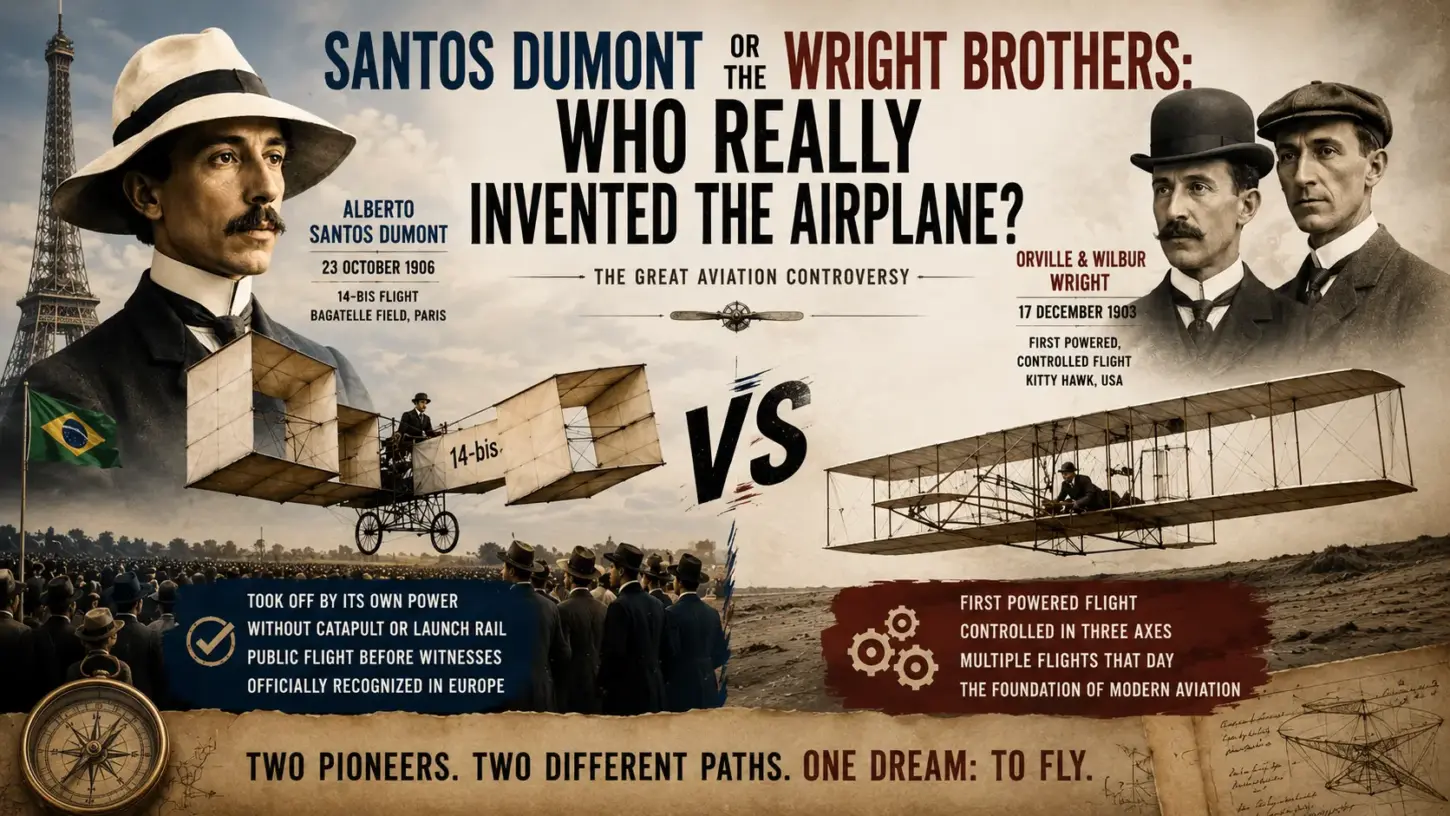
Story | Santos Dumont or the Wright Brothers: Who Really Invented the Airplane?
Para os americanos, os irmãos Wright dominaram os céus em 1903. Para os brasileiros, Santos Dumont e seu 14-bis foram os verdadeiros pioneiros em 1906. Afinal, quem está certo? Entre trilhos, catapultas, voos públicos e segredos de patente, descubra como diferentes critérios históricos e um toque de orgulho nacional transformaram a origem da aviação em uma das maiores polêmicas da tecnologia.
| Audio | |
|---|---|
Normal | Slow |
| English Transcript | Tradução |
| Santos Dumont or the Wright Brothers: Who Really Invented the Airplane? | Santos Dumont ou os irmãos Wright: quem realmente inventou o avião? |
| Few questions in the history of technology provoke such different answers as this one: who invented the airplane? For much of the world, especially in the United States, the answer is the Wright brothers, Orville and Wilbur, who reportedly carried out the first powered and controlled flight of a heavier-than-air machine on December 17, 1903. In Brazil, however, millions of people have learned that the true Father of Aviation was Alberto Santos Dumont, whose historic flight of the 14-bis took place in Paris on October 23, 1906. | Poucas perguntas da história da tecnologia provocam respostas tão diferentes quanto esta: quem inventou o avião? Para grande parte do mundo, especialmente nos Estados Unidos, os responsáveis foram os irmãos Orville e Wilbur Wright, que teriam realizado o primeiro voo de uma máquina motorizada e controlável em 17 de dezembro de 1903. No Brasil, porém, milhões de pessoas aprenderam que o verdadeiro Pai da Aviação foi Alberto Santos Dumont, autor do histórico voo do 14-bis em Paris, no dia 23 de outubro de 1906. |
| At first glance, comparing the dates would seem enough. If the Wright brothers flew in 1903 and Santos Dumont only in 1906, the matter would appear to be settled. The controversy arises, however, because the two events took place under very different conditions and because there is no universally accepted definition of the requirements a machine must meet for its performance to be considered the first true airplane flight. | À primeira vista, bastaria comparar as datas. Se os irmãos Wright voaram em 1903 e Santos Dumont somente em 1906, a questão pareceria resolvida. A controvérsia, entretanto, surge porque os dois acontecimentos ocorreram em condições muito diferentes e porque não existe uma definição universalmente aceita sobre quais requisitos uma máquina deveria cumprir para que seu desempenho fosse considerado o primeiro voo verdadeiro de um avião. |
| The Wright brothers were bicycle mechanics from Dayton, Ohio. Fascinated by the problem of flight, they experimented with gliders, built a small wind tunnel, and carefully studied the shape of wings and aircraft control. Their greatest contribution was not merely attaching an engine to a winged structure, but developing a system that allowed the pilot to control the aircraft along the three fundamental axes of flight. | Os irmãos Wright eram mecânicos de bicicletas em Dayton, no estado norte-americano de Ohio. Fascinados pelo problema do voo, realizaram experiências com planadores, construíram um pequeno túnel de vento e estudaram cuidadosamente a forma das asas e o controle da aeronave. Sua principal contribuição não foi apenas colocar um motor em uma estrutura com asas, mas desenvolver um sistema que permitia ao piloto controlar o aparelho nos três eixos fundamentais do voo. |
| On December 17, 1903, on the dunes of Kill Devil Hills, near Kitty Hawk, North Carolina, Orville Wright piloted the Flyer for approximately twelve seconds, covering about 36 meters. Three additional flights took place that same day, and the last one, flown by Wilbur, remained airborne for 59 seconds and traveled approximately 260 meters. The Smithsonian National Air and Space Museum regards this event as the first powered and controlled flight of a heavier-than-air machine. | No dia 17 de dezembro de 1903, nas dunas de Kill Devil Hills, perto de Kitty Hawk, na Carolina do Norte, Orville Wright pilotou o Flyer durante aproximadamente doze segundos, percorrendo cerca de 36 metros. Outros três voos foram realizados naquele mesmo dia, e o último deles, conduzido por Wilbur, permaneceu no ar por 59 segundos e percorreu aproximadamente 260 metros. O Smithsonian National Air and Space Museum considera esse episódio o primeiro voo motorizado e controlado de uma máquina mais pesada que o ar. ([Museu Nacional do Ar e do Espaço][1]) |
| The Flyer had its own engine and propellers, but it did not use wheels. The aircraft slid along a small launching rail while strong winds helped it achieve the lift required for takeoff. Contrary to what is often claimed, the flights of December 17, 1903, did not use a catapult. That device would only be developed later and used beginning in September 1904, when the brothers started flying in an area where winds were less favorable. | O Flyer possuía motor próprio e hélices, mas não utilizava rodas. A aeronave deslizava sobre um pequeno carro colocado em um trilho de lançamento, enquanto um vento forte contribuía para que alcançasse a sustentação necessária. Ao contrário do que muitas vezes se afirma, os voos de 17 de dezembro de 1903 não utilizaram uma catapulta. Esse equipamento seria desenvolvido pelos irmãos e empregado somente a partir de setembro de 1904, quando passaram a realizar experiências em uma área com ventos menos favoráveis. ([Wright Brothers][2]) |
| This distinction is important because one of the most frequently repeated arguments against the Wright brothers claims that the Flyer was launched into the air by a catapult from the very beginning. That assertion does not match what happened at Kitty Hawk. Even so, it is correct to say that the aircraft depended on a launching rail and favorable winds, rather than taking off in a manner similar to modern airplanes. | Essa distinção é importante porque um dos argumentos mais repetidos contra os Wright afirma que o Flyer teria sido arremessado ao ar por uma catapulta desde o primeiro voo. A afirmação não corresponde ao que aconteceu em Kitty Hawk. Ainda assim, é correto dizer que a aeronave dependia de um trilho e de condições favoráveis de vento, não decolando de maneira semelhante aos aviões modernos. |
| Another factor that fueled the controversy was the secrecy maintained by the Wright brothers. Concerned about securing patents and preventing others from copying their ideas, they avoided revealing the full details of their experiments. The 1903 flight was witnessed by only a handful of people and documented in a single photograph, but it did not take place before an aeronautical commission, independent experts, or a large public audience. | Outro elemento que alimentou as dúvidas foi a discrição dos irmãos Wright. Preocupados com o registro de patentes e com a possibilidade de terem suas ideias copiadas, eles evitaram revelar todos os detalhes de suas experiências. O voo de 1903 foi acompanhado por apenas algumas testemunhas e registrado em uma fotografia, mas não ocorreu diante de uma comissão aeronáutica, de especialistas independentes ou de uma grande multidão. |
| Over the following years, the Wright brothers rapidly improved their aircraft. By 1904, they had succeeded in making complete turns, and by 1905 the Wright Flyer III was capable of remaining airborne for several minutes, flying in circles, and covering several kilometers. These achievements demonstrated that they had created a controllable flying machine rather than merely making a brief and accidental hop. | Nos anos seguintes, os Wright aperfeiçoaram rapidamente suas aeronaves. Em 1904, conseguiram realizar curvas completas, e, em 1905, o Wright Flyer III já era capaz de permanecer no ar por vários minutos, realizar círculos e percorrer quilômetros. Essas experiências demonstraram que os irmãos haviam criado uma máquina controlável e não apenas realizado um salto breve e acidental. |
| Meanwhile, in Paris, Alberto Santos Dumont had already become an international celebrity. Born in the Brazilian state of Minas Gerais, he had gained worldwide recognition through his balloons and dirigibles. In 1901, he won the Deutsch Prize by flying his No. 6 airship around the Eiffel Tower and returning to the starting point within the required time. His work was closely followed by the press, specialists, and the French public. | Enquanto isso, em Paris, Alberto Santos Dumont já era uma celebridade internacional. Nascido em Minas Gerais, ele havia se tornado famoso por seus balões e dirigíveis. Em 1901, conquistou o Prêmio Deutsch ao contornar a Torre Eiffel com seu dirigível número 6 e retornar ao ponto de partida dentro do tempo estabelecido. Seu trabalho era acompanhado de perto pela imprensa, pelos especialistas e pelo público francês. |
| Santos Dumont believed that inventions should be shared. He did not try to hide his machines and allowed his projects to be observed and photographed. Rather than conducting secret experiments, he turned every attempt into a public event. This attitude helped create an image very different from that associated with the Wright brothers. | Santos Dumont acreditava que as invenções deveriam ser compartilhadas. Não procurava esconder suas máquinas e permitia que seus projetos fossem observados e fotografados. Em vez de realizar experiências secretas, transformava cada tentativa em um acontecimento público. Essa atitude ajudou a criar uma imagem muito diferente daquela associada aos irmãos Wright. |
| On October 23, 1906, at the Bagatelle Field in Paris, Santos Dumont set the 14-bis in motion before a large crowd. The aircraft ran across the ground on its own wheels, lifted off under its own power, and flew approximately 60 meters. The flight was witnessed and officially recognized by representatives of the Aero Club of France. | Em 23 de outubro de 1906, no Campo de Bagatelle, em Paris, Santos Dumont colocou o 14-bis em movimento diante de uma multidão. A aeronave correu pelo terreno utilizando suas próprias rodas, deixou o solo e percorreu aproximadamente 60 metros. O voo foi observado e reconhecido por representantes do Aeroclube da França. |
| Only a few weeks later, on November 12, the Brazilian aviator gave an even more impressive demonstration. The 14-bis flew 220 meters in 21.5 seconds, reaching an altitude of approximately six meters. The performance established one of the earliest aviation records officially recognized by the Fédération Aéronautique Internationale. The organization itself describes the event as the first officially observed flight in Europe covering a distance greater than 25 meters. | Poucas semanas depois, em 12 de novembro, o brasileiro realizou uma demonstração ainda mais impressionante. O 14-bis percorreu 220 metros em 21,5 segundos, atingindo uma altura aproximada de seis metros. O desempenho estabeleceu um dos primeiros recordes oficialmente reconhecidos pela Federação Aeronáutica Internacional. A própria entidade descreve o acontecimento como o primeiro voo oficialmente observado na Europa com distância superior a 25 metros. ([fai.org][3]) |
| The significance of the 14-bis lay in the fact that it took off using only its own engine, rolling on wheels across level ground without the assistance of rails, catapults, or any external launching devices. For Santos Dumont's supporters, this is the decisive point: a true airplane must be capable of leaving the ground entirely under its own power. | A importância do 14-bis estava no fato de que a máquina decolava utilizando apenas o próprio motor, correndo sobre rodas em terreno plano e sem o auxílio de trilhos, catapultas ou dispositivos externos. Para os defensores de Santos Dumont, esse é o ponto decisivo: um avião verdadeiro precisa conseguir sair do chão por seus próprios meios. |
| That is how two different ways of answering the same question emerged. | Foi assim que surgiram duas maneiras diferentes de responder à mesma pergunta. |
| For supporters of the Wright brothers, the essential achievement was demonstrating sustained, powered, and controlled flight. According to this criterion, the Americans solved the problem in 1903, three years before Santos Dumont. The Flyer had an engine, propellers, control surfaces, and a pilot capable of guiding the aircraft throughout the flight. | Para os defensores dos irmãos Wright, o elemento essencial é a capacidade de realizar um voo motorizado, sustentado e controlado. Segundo esse critério, os norte-americanos resolveram o problema em 1903, três anos antes de Santos Dumont. O Flyer possuía motor, hélices, superfícies de controle e um piloto capaz de dirigir a aeronave durante o voo. |
| For supporters of Santos Dumont, the first airplane must have been capable of taking off publicly under its own power, before independent witnesses and according to previously established rules. According to this criterion, the 14-bis achieved, in 1906, the first officially recognized flight of a heavier-than-air aircraft capable of taking off without external assistance. The Brazilian Aerospace Museum presents the 14-bis as the first heavier-than-air airplane to take off under its own power. | Para os defensores de Santos Dumont, o primeiro avião deveria decolar publicamente por seus próprios meios, diante de testemunhas independentes e de acordo com regras previamente estabelecidas. Segundo esse critério, o 14-bis realizou, em 1906, o primeiro voo oficialmente reconhecido de uma aeronave mais pesada que o ar capaz de deixar o solo sem assistência externa. O Museu Aeroespacial brasileiro apresenta o 14-bis como o primeiro avião mais pesado que o ar a decolar por seus próprios meios. ([FAB][4]) |
| There is also a difference between inventing a functional machine and publicly demonstrating a technology beyond dispute. The Wright brothers achieved earlier and technically sophisticated results, but they worked for years under great secrecy. Santos Dumont presented his achievement before specialists, journalists, and spectators, offering the world a demonstration that could immediately be verified. | Também existe uma diferença entre inventar uma máquina funcional e apresentar publicamente uma tecnologia de maneira incontestável. Os Wright alcançaram resultados anteriores e tecnicamente avançados, mas trabalharam durante anos com grande reserva. Santos Dumont realizou sua conquista diante de especialistas, jornalistas e espectadores, oferecendo ao público uma demonstração que podia ser imediatamente verificada. |
| The controversy has also been reinforced by nationalism. In the United States, the Wright brothers became symbols of American ingenuity and entrepreneurship. In Brazil, Santos Dumont represents Brazilian creativity and the ability of a Latin American inventor to occupy a central place in one of humanity's greatest technological revolutions. | A controvérsia também foi fortalecida pelo nacionalismo. Nos Estados Unidos, os irmãos Wright se transformaram em símbolos da inventividade e do espírito empreendedor do país. No Brasil, Santos Dumont representa a criatividade brasileira e a capacidade de um inventor latino-americano ocupar posição central em uma das maiores transformações tecnológicas da humanidade. |
| Most aviation historians around the world credit the Wright brothers with the first powered, sustained, and controlled flight of a heavier-than-air aircraft. That does not mean, however, that Santos Dumont was merely a secondary figure or that his contribution can be overlooked. The flight of the 14-bis was a public, documented, and officially recognized milestone that also played a major role in the development of aviation in Europe. | A maior parte dos historiadores internacionais da aviação atribui aos irmãos Wright o primeiro voo motorizado, sustentado e controlado de uma aeronave mais pesada que o ar. Isso não significa, contudo, que Santos Dumont tenha sido apenas um personagem secundário ou que sua contribuição possa ser ignorada. O voo do 14-bis foi um marco público, documentado e oficialmente reconhecido, além de ter exercido enorme influência sobre o desenvolvimento da aviação na Europa. |
| Perhaps the greatest mistake is to imagine that the airplane was created from a single idea, on a single day, by a single person. Before both Santos Dumont and the Wright brothers, inventors such as George Cayley, Otto Lilienthal, Octave Chanute, and Clément Ader had already contributed important knowledge about aerodynamics, gliders, engines, and aircraft structures. The conquest of flight was the result of decades of experimentation, failures, and accumulated discoveries. | Talvez o maior erro seja imaginar que o avião surgiu de uma única ideia, criada em um único dia por uma única pessoa. Antes de Santos Dumont e dos Wright, inventores como George Cayley, Otto Lilienthal, Octave Chanute e Clément Ader já haviam contribuído com conhecimentos sobre aerodinâmica, planadores, motores e estruturas. A conquista do voo foi o resultado de décadas de experimentação, fracassos e descobertas acumuladas. |
| The Wright brothers demonstrated that a powered heavier-than-air machine could sustain controlled flight. Santos Dumont demonstrated that possibility openly before the world, taking off in front of the public with an aircraft capable of leaving the ground under its own power. | Os irmãos Wright demonstraram que uma máquina motorizada mais pesada que o ar podia permanecer em voo e ser controlada. Santos Dumont mostrou essa possibilidade abertamente ao mundo, decolando diante do público com uma aeronave que utilizava seus próprios meios. |
| The fairest answer, therefore, depends on the question we ask. Who first achieved powered and controlled flight? The available evidence favors the Wright brothers. Who carried out the first public, officially documented flight with an aircraft capable of autonomous takeoff before an official commission? In that case, the credit belongs to Alberto Santos Dumont. | A resposta mais justa, portanto, depende da pergunta que fazemos. Quem realizou primeiro um voo motorizado e controlado? As evidências favorecem os irmãos Wright. Quem realizou o primeiro voo público, oficialmente registrado e com decolagem autônoma diante de uma comissão? Nesse caso, o mérito pertence a Alberto Santos Dumont. |
| The debate will probably never disappear because it involves different criteria, historical traditions, and national pride. What remains beyond dispute is that both the Wright brothers and Santos Dumont played fundamental roles in transforming one of humanity's oldest dreams into reality. Rather than reducing this story to the selection of a single winner, we can recognize that aviation was born through the work of many pioneers and that, among them, Santos Dumont and the Wright brothers occupy places that can hardly ever be replaced. | A disputa talvez nunca desapareça, pois envolve diferentes critérios, tradições históricas e sentimentos nacionais. O que permanece indiscutível é que tanto os irmãos Wright quanto Santos Dumont tiveram papéis fundamentais na transformação de um antigo sonho humano em realidade. Em vez de reduzir essa história à escolha de um único vencedor, podemos reconhecer que a aviação nasceu do trabalho de vários pioneiros e que, entre todos eles, Santos Dumont e os irmãos Wright ocupam lugares que dificilmente poderão ser substituídos. |
Contagem de palavras
A tabela abaixo exibe as palavras encontradas neste texto, bem como o número de vezes em que aparecem.
Veja também: Para que serve esta tabela?
| Freq. | Palavra | Freq. | Palavra | Freq. | Palavra |
|---|---|---|---|---|---|
| 122 | the | 47 | of | 44 | and |
| 38 | a | 30 | in | 26 | that |
| 19 | wright | 18 | to | 18 | flight |
| 18 | brothers | 17 | santos | 17 | dumont |
| 14 | was | 13 | by | 12 | aircraft |
| 11 | than | 11 | on | 11 | first |
| 11 | an | 10 | is | 10 | for |
| 9 | its | 9 | be | 8 | this |
| 8 | own | 8 | before | 8 | air |
| 7 | under | 7 | off | 7 | not |
| 7 | his | 7 | had | 7 | capable |
| 7 | bis | 7 | airplane | 6 | public |
| 6 | powered | 6 | one | 6 | officially |
| 6 | meters | 6 | machine | 6 | it |
| 6 | heavier | 6 | controlled | 5 | with |
| 5 | who | 5 | they | 5 | single |
| 5 | power | 5 | place | 5 | only |
| 5 | from | 5 | flyer | 5 | different |
| 5 | aviation | 5 | as | 4 | world |
| 4 | took | 4 | their | 4 | taking |
| 4 | recognized | 4 | rather | 4 | or |
| 4 | he | 4 | ground | 4 | flying |
| 4 | engine | 4 | did | 4 | but |
| 4 | brazilian | 4 | because | 4 | approximately |
| 3 | years | 3 | would | 3 | winds |
| 3 | wheels | 3 | what | 3 | very |
| 3 | true | 3 | three | 3 | supporters |
| 3 | seconds | 3 | paris | 3 | must |
| 3 | merely | 3 | launching | 3 | into |
| 3 | however | 3 | greatest | 3 | flew |
| 3 | event | 3 | documented | 3 | demonstrated |
| 3 | december | 3 | covering | 3 | controversy |
| 3 | control | 3 | can | 3 | at |
| 3 | also | 3 | alberto | 3 | achieved |
| 3 | according | 3 | about | 2 | work |
| 2 | witnessed | 2 | without | 2 | wilbur |
| 2 | were | 2 | we | 2 | use |
| 2 | united | 2 | two | 2 | through |
| 2 | there | 2 | technology | 2 | takeoff |
| 2 | take | 2 | sustained | 2 | such |
| 2 | states | 2 | specialists | 2 | small |
| 2 | several | 2 | secrecy | 2 | same |
| 2 | required | 2 | rail | 2 | question |
| 2 | publicly | 2 | propellers | 2 | problem |
| 2 | point | 2 | played | 2 | pilot |
| 2 | performance | 2 | people | 2 | out |
| 2 | orville | 2 | october | 2 | occupy |
| 2 | observed | 2 | no | 2 | national |
| 2 | museum | 2 | most | 2 | making |
| 2 | leaving | 2 | later | 2 | large |
| 2 | kitty | 2 | invented | 2 | independent |
| 2 | important | 2 | humanity | 2 | helped |
| 2 | hawk | 2 | have | 2 | gliders |
| 2 | fundamental | 2 | flights | 2 | few |
| 2 | favorable | 2 | external | 2 | experiments |
| 2 | even | 2 | europe | 2 | established |
| 2 | does | 2 | dispute | 2 | demonstration |
| 2 | demonstrating | 2 | day | 2 | criterion |
| 2 | credit | 2 | created | 2 | could |
| 2 | contribution | 2 | commission | 2 | catapult |
| 2 | carried | 2 | brazil | 2 | both |
| 2 | born | 2 | beyond | 2 | beginning |
| 2 | been | 2 | assistance | 2 | around |
| 2 | answer | 2 | american | 2 | already |
| 2 | along | 2 | allowed | 2 | airborne |
| 2 | across | 2 | achievement | 1 | worldwide |
| 1 | worked | 1 | won | 1 | witnesses |
| 1 | within | 1 | winner | 1 | wings |
| 1 | winged | 1 | wind | 1 | will |
| 1 | whose | 1 | while | 1 | where |
| 1 | when | 1 | weeks | 1 | ways |
| 1 | verified | 1 | using | 1 | used |
| 1 | universally | 1 | twelve | 1 | turns |
| 1 | turned | 1 | tunnel | 1 | try |
| 1 | traveled | 1 | transforming | 1 | traditions |
| 1 | tower | 1 | time | 1 | throughout |
| 1 | these | 1 | therefore | 1 | them |
| 1 | technological | 1 | technically | 1 | system |
| 1 | symbols | 1 | sustain | 1 | surfaces |
| 1 | succeeded | 1 | studied | 1 | structures |
| 1 | structure | 1 | strong | 1 | story |
| 1 | state | 1 | starting | 1 | started |
| 1 | spectators | 1 | space | 1 | sophisticated |
| 1 | solved | 1 | so | 1 | smithsonian |
| 1 | slid | 1 | six | 1 | similar |
| 1 | significance | 1 | should | 1 | shared |
| 1 | shape | 1 | settled | 1 | set |
| 1 | september | 1 | selection | 1 | seem |
| 1 | securing | 1 | secret | 1 | secondary |
| 1 | say | 1 | rules | 1 | rolling |
| 1 | roles | 1 | role | 1 | revolutions |
| 1 | revealing | 1 | returning | 1 | results |
| 1 | result | 1 | requirements | 1 | represents |
| 1 | representatives | 1 | reportedly | 1 | replaced |
| 1 | repeated | 1 | remains | 1 | remaining |
| 1 | remained | 1 | reinforced | 1 | regards |
| 1 | reducing | 1 | records | 1 | recognize |
| 1 | recognition | 1 | really | 1 | reality |
| 1 | reaching | 1 | rapidly | 1 | ran |
| 1 | rails | 1 | questions | 1 | provoke |
| 1 | projects | 1 | probably | 1 | prize |
| 1 | pride | 1 | previously | 1 | preventing |
| 1 | press | 1 | presents | 1 | presented |
| 1 | possibility | 1 | places | 1 | pioneers |
| 1 | piloted | 1 | photographed | 1 | photograph |
| 1 | person | 1 | perhaps | 1 | patents |
| 1 | overlooked | 1 | over | 1 | otto |
| 1 | others | 1 | organization | 1 | openly |
| 1 | oldest | 1 | ohio | 1 | often |
| 1 | official | 1 | offering | 1 | octave |
| 1 | november | 1 | north | 1 | never |
| 1 | near | 1 | nationalism | 1 | much |
| 1 | motion | 1 | more | 1 | modern |
| 1 | mistake | 1 | minutes | 1 | minas |
| 1 | millions | 1 | milestone | 1 | meet |
| 1 | mechanics | 1 | meanwhile | 1 | mean |
| 1 | matter | 1 | match | 1 | many |
| 1 | manner | 1 | major | 1 | maintained |
| 1 | machines | 1 | lilienthal | 1 | lifted |
| 1 | lift | 1 | level | 1 | less |
| 1 | learned | 1 | lay | 1 | launched |
| 1 | latin | 1 | last | 1 | knowledge |
| 1 | kilometers | 1 | kill | 1 | journalists |
| 1 | itself | 1 | involves | 1 | inventors |
| 1 | inventor | 1 | inventions | 1 | inventing |
| 1 | internationale | 1 | international | 1 | ingenuity |
| 1 | improved | 1 | impressive | 1 | immediately |
| 1 | imagine | 1 | image | 1 | iii |
| 1 | if | 1 | ideas | 1 | idea |
| 1 | how | 1 | hop | 1 | history |
| 1 | historical | 1 | historic | 1 | historians |
| 1 | hills | 1 | hide | 1 | has |
| 1 | hardly | 1 | happened | 1 | handful |
| 1 | guiding | 1 | greater | 1 | great |
| 1 | glance | 1 | gerais | 1 | george |
| 1 | gave | 1 | gained | 1 | functional |
| 1 | full | 1 | fueled | 1 | front |
| 1 | frequently | 1 | french | 1 | france |
| 1 | following | 1 | followed | 1 | flown |
| 1 | figure | 1 | field | 1 | fédération |
| 1 | favors | 1 | father | 1 | fascinated |
| 1 | fairest | 1 | failures | 1 | factor |
| 1 | fact | 1 | experts | 1 | experimented |
| 1 | experimentation | 1 | evidence | 1 | every |
| 1 | ever | 1 | events | 1 | essential |
| 1 | especially | 1 | entrepreneurship | 1 | entirely |
| 1 | enough | 1 | engines | 1 | emerged |
| 1 | eiffel | 1 | earliest | 1 | earlier |
| 1 | dunes | 1 | dreams | 1 | distinction |
| 1 | distance | 1 | discoveries | 1 | disappear |
| 1 | dirigibles | 1 | difference | 1 | devil |
| 1 | devices | 1 | device | 1 | development |
| 1 | developing | 1 | developed | 1 | deutsch |
| 1 | details | 1 | describes | 1 | depends |
| 1 | depended | 1 | definition | 1 | decisive |
| 1 | decades | 1 | debate | 1 | dayton |
| 1 | dates | 1 | crowd | 1 | criteria |
| 1 | creativity | 1 | create | 1 | correct |
| 1 | copying | 1 | controllable | 1 | contributed |
| 1 | contrary | 1 | considered | 1 | conquest |
| 1 | conducting | 1 | conditions | 1 | concerned |
| 1 | complete | 1 | comparing | 1 | club |
| 1 | closely | 1 | clément | 1 | claims |
| 1 | claimed | 1 | circles | 1 | chanute |
| 1 | central | 1 | celebrity | 1 | cayley |
| 1 | catapults | 1 | case | 1 | carolina |
| 1 | carefully | 1 | built | 1 | brief |
| 1 | bicycle | 1 | between | 1 | belongs |
| 1 | believed | 1 | become | 1 | became |
| 1 | balloons | 1 | bagatelle | 1 | axes |
| 1 | avoided | 1 | aviator | 1 | available |
| 1 | autonomous | 1 | audience | 1 | attitude |
| 1 | attempt | 1 | attaching | 1 | associated |
| 1 | assertion | 1 | ask | 1 | arises |
| 1 | arguments | 1 | area | 1 | appear |
| 1 | any | 1 | answers | 1 | answering |
| 1 | another | 1 | among | 1 | americans |
| 1 | altitude | 1 | airship | 1 | airplanes |
| 1 | against | 1 | aerospace | 1 | aéronautique |
| 1 | aeronautical | 1 | aerodynamics | 1 | aero |
| 1 | ader | 1 | additional | 1 | achievements |
| 1 | achieve | 1 | accumulated | 1 | accidental |
| 1 | accepted | 1 | ability |