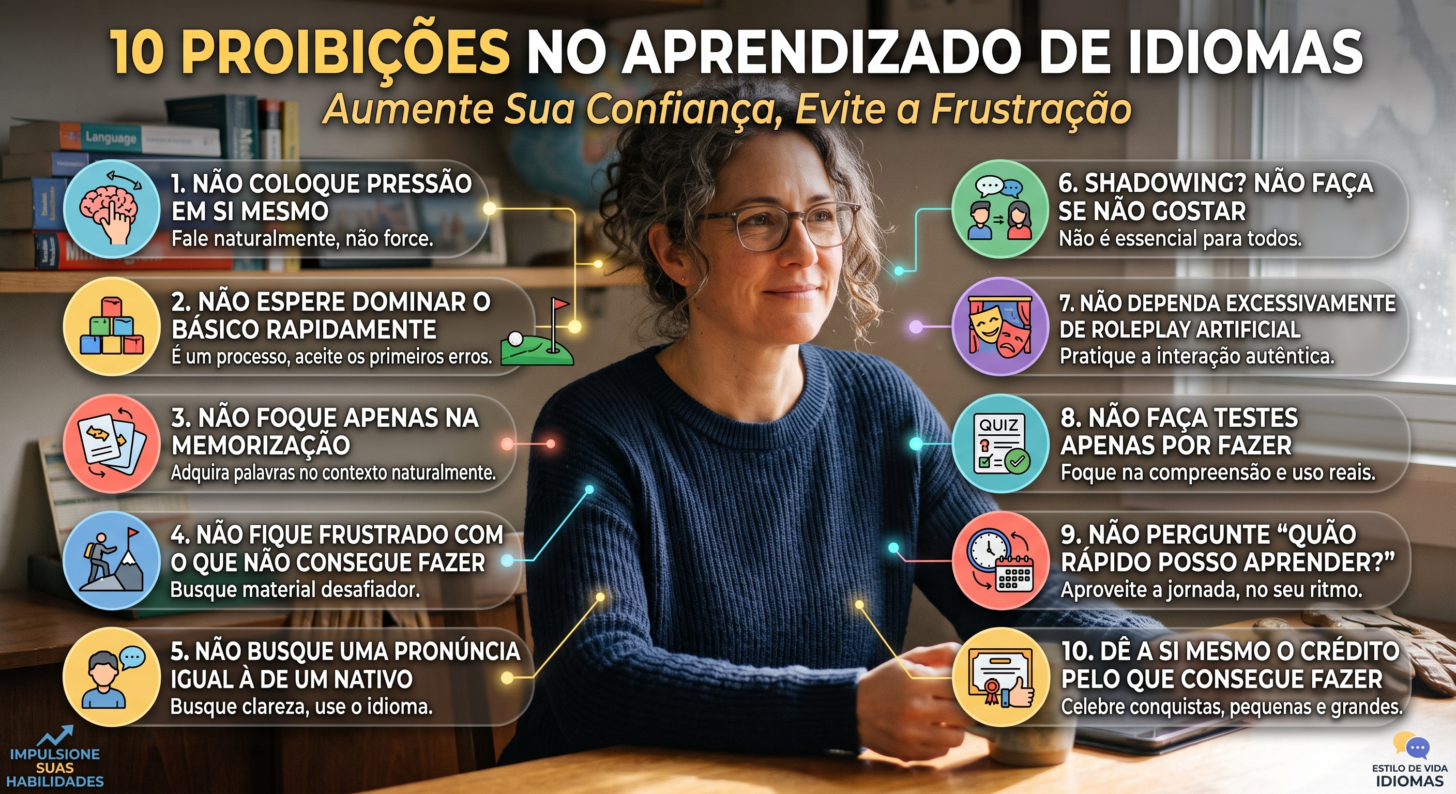
Vídeo | 10 things I never do when learning a language
Aprender um idioma não precisa ser uma maratona de frustrações! Você sabia que tentar “dominar o básico”, fazer testes ou buscar a pronúncia perfeita pode estar destruindo a sua confiança?
Neste vídeo o poliglota Steve Kaufmann compartilha conosco as 10 coisas que você NUNCA deve fazer ao aprender uma nova língua. Pare de se cobrar tanto, mude sua perspectiva e aprenda a aproveitar de verdade o processo.
| Audio | |
|---|---|
Normal | Slow |
| English Transcript | Tradução |
| 10 things I never do when learning a language | 10 Coisas que Nunca Faço ao Aprender um Idioma |
| Hi. Today, I want to talk about 10 things you shouldn't do, 10 don'ts when it comes to language learning. I'm not trying to put those out there as negative things, because these are things that I feel sap your confidence, and confidence is so important in language learning. And I relate it to golf. Actually, I'm a very poor golfer. For my age, I'm relatively flexible, relatively strong, relatively athletic. A lot of people who are not as athletic as I am are much better golfers. And that's because I struggle with some of the very same issues in my golf that I think some language learners struggle with in their language learning. So, here we go. | Olá. Hoje, eu quero falar sobre 10 coisas que você não deveria fazer, 10 proibições quando se trata de aprendizado de idiomas. Eu não estou tentando colocar essas coisas como algo negativo, porque são coisas que eu sinto que esgotam a sua confiança, e a confiança é muito importante no aprendizado de idiomas. E eu relaciono isso ao golfe. Na verdade, eu sou um péssimo jogador de golfe. Para a minha idade, eu sou relativamente flexível, relativamente forte, relativamente atlético. Muitas pessoas que não são tão atléticas quanto eu são jogadores de golfe muito melhores. E isso é porque eu luto com alguns dos mesmos problemas no meu golfe que eu acho que alguns aprendizes de idiomas enfrentam no aprendizado de idiomas. Então, aqui vamos nós. |
| Number one: Don't put pressure on yourself. Don't put pressure on yourself not to speak, don't put pressure on yourself to speak, don't put pressure on yourself to speak well. Speak when you want to, and let it all come out, rely on your instincts, don't put pressure on yourself. | Número um: Não coloque pressão sobre si mesmo. Não coloque pressão sobre si mesmo para não falar, não coloque pressão sobre si mesmo para falar, não coloque pressão sobre si mesmo para falar bem. Fale quando você quiser, e deixe tudo fluir, confie nos seus instintos, não coloque pressão sobre si mesmo. |
| [Number two:] Don't think you're going to master the basics. We often hear this, "just master the basics," as if there's something basic, whether it be a vocabulary item or a structure in the language. First of all, you can't master it. It doesn't prevent you from acquiring more words, from acquiring more familiarity with the language. It's a bit, again, like the golf swing. Whenever I try to have a perfect golf swing, try to remember all the things that I'm supposed to do, I play more poorly. If I just swing naturally, with confidence, I do better. In fact, one of the things that triggered this video was an audiobook that my son suggested to me, because we played golf yesterday in Palm Springs and I didn't do very well, as usual. And he said, "You've got to listen to this book by Dr. Bob Rotella, where he talks about the psychological side of golf, where you can't expect to be perfect all the time." And so, don't try to master the basics. It's a futile exercise. It will lead to more frustration, and it'll sap your confidence, because, in fact, it's very difficult to master the basics. You will continue to make mistakes with the basics for a long, long time. And certainly, if you haven't had a lot of exposure to the language, like early on, I think it's impossible to master the basics. | [Número dois:] Não pense que você vai dominar o básico. Nós frequentemente ouvimos isso, "apenas domine o básico", como se houvesse algo básico, seja um item de vocabulário ou uma estrutura no idioma. Em primeiro lugar, você não pode dominá-lo. Isso não impede você de adquirir mais palavras, de adquirir mais familiaridade com o idioma. É um pouco, de novo, como o tacada no golfe. Sempre que eu tento ter uma tacada perfeita no golfe, tentando me lembrar de todas as coisas que eu deveria fazer, eu jogo pior. Se eu apenas tacar naturalmente, com confiança, eu me saio melhor. Na verdade, uma das coisas que motivou este vídeo foi um audiolivro que meu filho me sugeriu, porque nós jogamos golfe ontem em Palm Springs e eu não me saí muito bem, como de costume. E ele disse: "Você tem que ouvir este livro do Dr. Bob Rotella, onde ele fala sobre o lado psicológico do golfe, onde você não pode esperar ser perfeito o tempo todo." E então, não tente dominar o básico. É um exercício inútil. Isso levará a mais frustração, e vai esgotar a sua confiança, porque, na verdade, é muito difícil dominar o básico. Você continuará a cometer erros com o básico por um longo, longo tempo. E certamente, se você não teve muita exposição ao idioma, como no início, eu acho que é impossível dominar o básico. |
| Number three: Don't focus on memorization. Again, it's going to sap your confidence, because we are always going to forget. We'll put a lot of effort into a spaced repetition system or a memorization system, and for most of us—there's undoubtedly exceptions out there, and people who swear by this as a method of learning—but I find that if the focus is on memorization, you're going to be more frustrated when you can't remember. If the focus is on enjoying the language, acquiring the words naturally in a—not a spaced repetition system, but a random repetition system through the content that you're listening to—and research tends to indicate that we retain things better when we encounter them in different contexts, rather than trying to zero in on a list of words. Not to mention all of the other inconveniences with SRS, but some people like them, fine. But I feel that it saps your confidence, because you are going to forget. So, don't focus on memorization. You're setting yourself up for frustration. So, focus on memorization? No. | Número três: Não se concentre na memorização. De novo, isso vai esgotar a sua confiança, porque nós sempre vamos esquecer. Nós vamos colocar muito esforço em um sistema de repetição espaçada ou em um sistema de memorização, e para a maioria de nós — sem dúvida há exceções por aí, e pessoas que juram por isso como um método de aprendizado —, mas eu acho que se o foco for a memorização, você ficará mais frustrado quando não conseguir se lembrar. Se o foco for aproveitar o idioma, adquirir as palavras naturalmente em um — não um sistema de repetição espaçada, mas um sistema de repetição aleatória através do conteúdo que você está ouvindo — e as pesquisas tendem a indicar que retemos melhor as coisas quando as encontramos em contextos diferentes, em vez de tentar se concentrar em uma lista de palavras. Sem mencionar todos os outros inconvenientes com o SRS, mas algumas pessoas gostam deles, tudo bem. Mas eu sinto que isso esgota a sua confiança, porque você vai esquecer. Então, não se concentre na memorização. Você está se preparando para a frustração. Então, focar na memorização? Não. |
| Number four: Don't get frustrated at what you can't do. One of the keys to success and progress in language learning, in my opinion, is to make good use of easier material, material with a lot of repetition, like the mini-stories, or even graded readers, but then push yourself forward into more challenging material, more interesting material, and don't get frustrated when you can't progress as easily, where there are words that, if you're on LingQ, that are yellow, that you've looked up before and now you don't know what they mean. Don't just stay with the easy material. They are a stepping stone, but you have to move beyond those easy readers, graded readers, mini-stories. Staying with learner material, staying with graded readers, to me, that's a no-no. | Número quatro: Não fique frustrado com o que você não consegue fazer. Uma das chaves para o sucesso e progresso no aprendizado de idiomas, na minha opinião, é fazer bom uso de materiais mais fáceis, materiais com muita repetição, como as mini-histórias, ou até mesmo leitores graduados, mas depois se impulsionar para materiais mais desafiadores, materiais mais interessantes, e não ficar frustrado quando você não conseguir progredir tão facilmente, onde há palavras que, se você estiver no LingQ, estão em amarelo, que você já pesquisou antes e agora não sabe o que significam. Não fique apenas com o material fácil. Eles são um degrau, mas você tem que ir além desses leitores fáceis, leitores graduados, mini-histórias. Ficar com material para aprendizes, ficar com leitores graduados, para mim, é algo inaceitável. |
| Number five: Don't try to pursue native-like pronunciation. It's a futile task. You will be disappointed. I don't use the International Phonetic Alphabet, because if I were learning English, and I listen to Australians, and I listen to people from the US South, or from, you know, Ulster, Scotland, they're all going to pronounce the vowels a little differently. So, how does that International Phonetic Alphabet symbol help me? I've got to put the time into listening. My focus is not on perfecting my pronunciation. I never spend any time on pitch accent in Japanese, for example. And throughout my life, I've done business with people whose native language was not English, and I hear them on television, and if they use the language well and elegantly and eloquently, as I say, the accent almost adds a little bit of class to their English, and I'm sure the same is true in other languages. So, don't focus too much on having perfect pronunciation. It doesn't matter, it can only lead to frustration. | Número cinco: Não tente buscar uma pronúncia como a de um nativo. É uma tarefa inútil. Você ficará decepcionado. Eu não uso o Alfabeto Fonético Internacional, porque se eu estivesse aprendendo inglês, e ouvisse australianos, e ouvisse pessoas do sul dos EUA, ou de, você sabe, Ulster, Escócia, todos eles vão pronunciar as vogais de forma um pouco diferente. Então, como esse símbolo do Alfabeto Fonético Internacional me ajuda? Eu tenho que dedicar tempo para ouvir. Meu foco não é aperfeiçoar minha pronúncia. Eu nunca dedico tempo ao sotaque de entonação no japonês, por exemplo. E ao longo da minha vida, eu fiz negócios com pessoas cuja língua materna não era o inglês, e eu as ouço na televisão, e se elas usam o idioma bem e de forma elegante e eloquente, como eu digo, o sotaque quase adiciona um pouco de classe ao inglês delas, e tenho certeza de que o mesmo é verdade em outros idiomas. Então, não se concentre demais em ter uma pronúncia perfeita. Isso não importa, só pode levar à frustração. |
| Number six: Shadowing. I don't shadow. I'm not saying you shouldn't shadow. If you like shadowing, you should do things that you like to do. I tried it, I found it frustrating. I found that either I was listening to very easy material, like the mini-stories where I knew the content, and then for a while I could shadow, but then I lost interest because it's not really meaningful to me. Or, if I'm listening to interesting content that's new to me, full of interesting information on history or whatever it might be, I want to focus in on the meaning. So, whatever I do, I like it to be meaningful and authentic. To me, although many people rave about shadowing, it's not something that I do. Bear in mind that my "don'ts" here are not telling people what to do. It's more a matter of, based on my experience, these are things that I don't find useful, or which, in many cases, sap my confidence and my momentum in learning the language. But everyone doesn't have to agree with me. | Número seis: *Shadowing*. Eu não faço *shadowing*. Não estou dizendo que você não deva fazer *shadowing*. Se você gosta de *shadowing*, você deve fazer as coisas que gosta de fazer. Eu tentei, achei frustrante. Eu percebi que ou estava ouvindo um material muito fácil, como as mini-histórias onde eu conhecia o conteúdo, e então por um tempo eu conseguia fazer *shadowing*, mas depois perdia o interesse porque não era realmente significativo para mim. Ou, se estou ouvindo um conteúdo interessante que é novo para mim, cheio de informações interessantes sobre história ou o que quer que seja, quero me concentrar no significado. Então, faça o que eu fizer, gosto que seja significativo e autêntico. Para mim, embora muitas pessoas elogiem bastante o *shadowing*, não é algo que eu faça. Tenha em mente que as minhas "proibições" aqui não estão dizendo às pessoas o que fazer. É mais uma questão de, com base na minha experiência, estas são coisas que não acho úteis, ou que, em muitos casos, esgotam minha confiança e meu impulso no aprendizado do idioma. Mas nem todo mundo tem que concordar comigo. |
| Number seven: Roleplay. Roleplaying is a staple of many language courses. The idea is that we'll pretend that, you know, you're a doctor and I'm a patient, and we have an artificial conversation about that situation, and we play these different roles: doctor or patient. Personally, I don't enjoy doing these. I think they are not authentic, they give you a false sense of security, which will lead to frustration, because if you are actually in a scenario like buying a ticket at the train station, and you have been practicing that, and you say something to the teller at the train station, and he or she comes back with something typically quite different, then you're frustrated. So, you are far better, in my view, in working on improving your overall level in the language, in order to be able to deal with all the possible situations that could arise in any given scenario. So, trying to master the scenario is a shortcut that doesn't work. It distracts you from the goal, the real goal, which is to elevate your level in the language, and through lots of listening and reading and speaking to many different people on many different subjects, your overall confidence level in the language will increase, and you're then in a better position to just let it go, rather than, as me with my golf swing, trying to remember what I'm supposed to say in this particular scenario. | Número sete: *Roleplay*. O *roleplay* é um elemento básico de muitos cursos de idiomas. A ideia é que vamos fingir que, você sabe, você é um médico e eu sou um paciente, e temos uma conversa artificial sobre essa situação, e desempenhamos esses papéis diferentes: médico ou paciente. Pessoalmente, não me agrada fazer isso, acho que não são autênticos, dão uma falsa sensação de segurança, o que levará à frustração, porque se você estiver realmente em um cenário como comprar um bilhete na estação de trem, e tiver praticado isso, e disser algo ao atendedor na estação de trem, e ele ou ela responder com algo tipicamente bem diferente, então você fica frustrado. Então, na minha opinião, é muito melhor trabalhar para melhorar o seu nível geral no idioma, a fim de ser capaz de lidar com todas as situações possíveis que possam surgir em qualquer cenário específico. Portanto, tentar dominar o cenário é um atalho que não funciona. Isso atrai a sua atenção para fora do objetivo, o verdadeiro objetivo, que é elevar o seu nível no idioma, e através de muita escuta e leitura e conversando com muitas pessoas diferentes sobre muitos assuntos diferentes, seu nível geral de confiança no idioma aumentará, e você estará em uma posição melhor para simplesmente deixar fluir, em vez de, como eu com minha tacada de golfe, tentar me lembrar do que eu deveria dizer neste cenário em particular. |
| Next, testing. Don't test. Unless you need the test for your job or entrance into university, which is perfectly understandable, but if you are learning for fun, testing—whether it be a 10-question questionnaire or an hour-long test—is a lot of pressure, a lot of self-doubt, and actually it's not necessary. The only real test is, when you're listening to something, do you understand? When you're interacting with people, do they understand you? Do you feel comfortable? This is what we should be trying to achieve in our language learning. And if we gear ourselves for the test, we end up doing some of the same things that I am very much against here, like studying long lists of words, vocabulary for TOEFL. And of course, we know from research on the brain that the more time we spend deliberately trying to, you know, focus in on certain words, the less we learn. The brain gets turned off. The brain likes new things. The brain likes seeing words in different contexts. So, the test approach tends to direct learners into learning activities that are not helpful in the long-term goal of improving their language skills. And of course, we get things wrong, there's pressure, we feel frustrated when we keep on making mistakes. So, unless you need the test, don't test. | Em seguida, testes. Não faça testes. A menos que você precise do teste para o seu trabalho ou para entrar na universidade, o que é perfeitamente compreensível, mas se você estiver aprendendo por diversão, fazer testes — seja um questionário de 10 perguntas ou um teste de uma hora de duração — é muita pressão, muita dúvida sobre si mesmo e, na verdade, não é necessário. O único teste real é: quando você está ouvindo algo, você entende? Quando você está interagindo com as pessoas, elas entendem você? Você se sente confortável? É isso que deveríamos estar tentando alcançar em nosso aprendizado de idiomas. E se nos prepararmos para o teste, acabamos fazendo algumas das mesmas coisas das quais sou muito contra aqui, como estudar longas listas de palavras, vocabulário para o TOEFL. E, claro, sabemos a partir de pesquisas sobre o cérebro que quanto mais tempo passamos tentando deliberadamente, você sabe, focar em certas palavras, menos aprendemos. O cérebro se desliga. O cérebro gosta de coisas novas. O cérebro gosta de ver palavras em diferentes contextos. Assim, a abordagem de testes tende a direcionar os aprendizes para atividades de aprendizado que não ajudam no objetivo de longo prazo de melhorar suas habilidades no idioma. E, claro, nós erramos as coisas, há pressão, nos sentimos frustrados quando continuamos cometendo erros. Portanto, a menos que você precise do teste, não faça testes. |
| Here's another no-no: Don't always ask, "How quickly can I learn?" We have videos, you know, "Learn this language in a week, in three months." It'll take as long as it takes. Don't put pressure on yourself to learn quickly. Rather, you should be looking at, "How can I enjoy the learning process?" I enjoy what I'm doing in Persian. I've been at Persian, Arabic, and Turkish now for three, four, five years. I enjoy it! Now, maybe some people are in a hurry. I think I would have, you know, been more successful in those three languages if I focused in on one, and if I spent more time every day. So, those are some of the things that affect how quickly you're going to proceed and how quickly you're going to progress in the language. But don't put pressure on yourself to learn it in a short period of time. I think it's counterproductive, it saps your confidence. | Aqui está outro erro: Não pergunte sempre "Quão rápido eu posso aprender?". Temos vídeos do tipo "Aprenda este idioma em uma semana, em três meses". Vai levar o tempo que for necessário. Não coloque pressão sobre si mesmo para aprender rapidamente. Em vez disso, você deveria estar buscando: "Como posso aproveitar o processo de aprendizado?". Eu gosto do que estou fazendo em persa. Eu estou no persa, árabe e turco há três, quatro, cinco anos. Eu gosto disso! Agora, talvez algumas pessoas estejam com pressa. Eu acho que teria, você sabe, mais sucesso nesses três idiomas se tivesse me concentrado em um, e se tivesse dedicado mais tempo todos os dias. Então, essas são algumas das coisas que afetam a rapidez com que você vai avançar e a rapidez com que vai progredir no idioma. Mas não coloque pressão sobre si mesmo para aprendê-lo em um curto período de tempo. Eu acho que é contraproducente, esgota a sua confiança. |
| And finally, number 10, which kind of relates to all of these parts: Give yourself credit for what you can do. This comes out in the audiobook that I started listening to on golf. If I play a game of golf, and all I think about is the shots that I missed, I come away from that golf game generally unhappy. If I can remember the good shots, if I can feel happy with what I was able to achieve, then I'm more confident, more motivated, more likely to continue. There are always moments in language learning where we forget, we don't understand, we're disappointed, but we shouldn't be disappointed, because we should pick out those things that we are able to do. In other words, "I started the language two years ago, I now understand a lot, I'm able to say certain things." Maybe I met someone at the—somewhere who I spoke to in Farsi, a store, we were buying, which is a real case, buying, you know, kitchen appliances, and I had a fairly lengthy conversation in Farsi. So, I have to try to remember those positive moments when I felt that I had some success, rather than focusing in on moments when we didn't achieve or didn't perform as well as we would have liked to. So, don't beat yourself up. Give yourself credit for what you can do. | E finalmente, número 10, que de certa forma se relaciona com todas essas partes: Dê a si mesmo o crédito pelo que você consegue fazer. Isso aparece no audiolivro que comecei a ouvir sobre golfe. Se eu jogo uma partida de golfe e só penso nas tacadas que errei, eu saio dessa partida de golfe geralmente infeliz. Se eu consigo me lembrar das boas tacadas, se consigo me sentir feliz com o que fui capaz de alcançar, então fico mais confiante, mais motivado, com mais chances de continuar. Sempre há momentos no aprendizado de idiomas em que esquecemos, não entendemos, ficamos desapontados, mas não deveríamos ficar desapontados, porque deveríamos destacar aquelas coisas que somos capazes de fazer. Em outras palavras, "Eu comecei o idioma dois anos atrás, agora eu entendo muito, sou capaz de dizer certas coisas." Talvez eu tenha conhecido alguém — em algum lugar com quem falei em persa, uma loja, estávamos comprando, o que é um caso real, comprando, você sabe, eletrodomésticos de cozinha, e eu tive uma conversa razoavelmente longa em persa. Então, eu tenho que tentar me lembrar daqueles momentos positivos em que senti que tive algum sucesso, em vez de me concentrar em momentos em que não alcançamos ou não nos saímos tão bem quanto gostaríamos. Portanto, não se cobre tanto. Dê a si mesmo o crédito pelo que você consegue fazer. |
| And if you follow these 10 don'ts—and I don't want to be, I don't want to be like dictatorial, "you must do this or do that," because amongst the things that I suggest you don't do, there are things that people do enjoy doing, and if they enjoy doing them, do them! Because ultimately, the main thing is to enjoy the process, feel good about yourself, so that you continue learning the language. | E se você seguir estas 10 proibições — e eu não quero ser, não quero ser ditatorial, "você deve fazer isso ou aquilo", porque entre as coisas que sugiro que você não faça, há coisas que as pessoas gostam de fazer, e se elas gostam de fazê-las, façam-nas! Porque, em última análise, o principal é aproveitar o processo, sentir-se bem consigo mesmo, para que você continue aprendendo o idioma. |
| Thank you for listening. Bye. | Obrigado por ouvir. Tchau. |
Contagem de palavras
A tabela abaixo exibe as palavras encontradas neste vídeo, bem como o número de vezes em que aparecem.
Veja também: Para que serve esta tabela?
| Freq. | Palavra | Freq. | Palavra | Freq. | Palavra |
|---|---|---|---|---|---|
| 81 | to | 81 | I | 70 | the |
| 58 | you | 54 | do | 53 | not |
| 47 | and | 46 | in | 44 | a |
| 40 | that | 34 | it | 34 | is |
| 34 | are | 32 | of | 31 | on |
| 29 | we | 24 | language | 20 | if |
| 17 | with | 17 | things | 16 | so |
| 15 | have | 14 | more | 14 | for |
| 14 | am | 13 | yourself | 13 | or |
| 13 | my | 13 | learning | 13 | be |
| 13 | as | 12 | like | 12 | because |
| 11 | when | 11 | people | 10 | your |
| 10 | put | 10 | golf | 10 | but |
| 9 | will | 9 | what | 9 | this |
| 9 | pressure | 9 | focus | 9 | confidence |
| 9 | all | 8 | words | 8 | they |
| 8 | number | 8 | me | 8 | listening |
| 8 | know | 8 | going | 7 | time |
| 7 | think | 7 | there | 7 | test |
| 7 | some | 7 | should | 7 | material |
| 7 | master | 7 | lot | 7 | from |
| 7 | enjoy | 7 | can | 6 | which |
| 6 | very | 6 | trying | 6 | those |
| 6 | these | 6 | then | 6 | long |
| 6 | feel | 6 | different | 6 | basics |
| 6 | at | 6 | about | 5 | where |
| 5 | want | 5 | try | 5 | them |
| 5 | something | 5 | remember | 5 | out |
| 5 | no | 5 | memorization | 5 | many |
| 5 | learn | 5 | into | 5 | how |
| 5 | frustrated | 5 | doing | 5 | does |
| 5 | cannot | 5 | better | 4 | well |
| 4 | was | 4 | up | 4 | understand |
| 4 | three | 4 | system | 4 | swing |
| 4 | speak | 4 | scenario | 4 | say |
| 4 | sap | 4 | repetition | 4 | readers |
| 4 | rather | 4 | quickly | 4 | one |
| 4 | now | 4 | just | 4 | here |
| 4 | frustration | 4 | brain | 4 | able |
| 3 | who | 3 | use | 3 | their |
| 3 | than | 3 | stories | 3 | shadowing |
| 3 | shadow | 3 | same | 3 | relatively |
| 3 | real | 3 | pronunciation | 3 | progress |
| 3 | play | 3 | perfect | 3 | other |
| 3 | much | 3 | moments | 3 | mini |
| 3 | listen | 3 | level | 3 | lead |
| 3 | interesting | 3 | he | 3 | had |
| 3 | graded | 3 | good | 3 | goal |
| 3 | give | 3 | get | 3 | forget |
| 3 | english | 3 | easy | 3 | disappointed |
| 3 | did | 3 | continue | 3 | content |
| 3 | comes | 3 | buying | 3 | been |
| 3 | an | 3 | always | 3 | actually |
| 3 | acquiring | 3 | achieve | 2 | years |
| 2 | would | 2 | whatever | 2 | were |
| 2 | vocabulary | 2 | unless | 2 | two |
| 2 | train | 2 | through | 2 | tends |
| 2 | supposed | 2 | success | 2 | struggle |
| 2 | staying | 2 | station | 2 | started |
| 2 | spend | 2 | spaced | 2 | shots |
| 2 | saps | 2 | research | 2 | process |
| 2 | phonetic | 2 | persian | 2 | patient |
| 2 | overall | 2 | only | 2 | nots |
| 2 | new | 2 | never | 2 | need |
| 2 | naturally | 2 | native | 2 | mistakes |
| 2 | meaningful | 2 | maybe | 2 | matter |
| 2 | make | 2 | little | 2 | likes |
| 2 | let | 2 | learners | 2 | languages |
| 2 | international | 2 | improving | 2 | hear |
| 2 | got | 2 | go | 2 | game |
| 2 | futile | 2 | four | 2 | found |
| 2 | five | 2 | find | 2 | farsi |
| 2 | fact | 2 | doctor | 2 | credit |
| 2 | course | 2 | could | 2 | conversation |
| 2 | contexts | 2 | come | 2 | certain |
| 2 | by | 2 | bit | 2 | authentic |
| 2 | audiobook | 2 | athletic | 2 | any |
| 2 | alphabet | 2 | again | 2 | accent |
| 1 | zero | 1 | yesterday | 1 | yellow |
| 1 | wrong | 1 | working | 1 | work |
| 1 | whose | 1 | while | 1 | whether |
| 1 | whenever | 1 | week | 1 | vowels |
| 1 | view | 1 | videos | 1 | video |
| 1 | usual | 1 | usthere | 1 | useful |
| 1 | us | 1 | university | 1 | unhappy |
| 1 | undoubtedly | 1 | understandable | 1 | ultimately |
| 1 | ulster | 1 | typically | 1 | turned |
| 1 | turkish | 1 | true | 1 | triggered |
| 1 | tried | 1 | too | 1 | toefl |
| 1 | today | 1 | toand | 1 | ticket |
| 1 | throughout | 1 | thing | 1 | thesomewhere |
| 1 | thank | 1 | testis | 1 | testingwhether |
| 1 | testing | 1 | term | 1 | telling |
| 1 | teller | 1 | television | 1 | task |
| 1 | talks | 1 | talk | 1 | takes |
| 1 | take | 1 | symbol | 1 | swear |
| 1 | sure | 1 | suggested | 1 | suggest |
| 1 | successful | 1 | subjects | 1 | studying |
| 1 | structure | 1 | strong | 1 | store |
| 1 | stone | 1 | stepping | 1 | stay |
| 1 | staple | 1 | srs | 1 | springs |
| 1 | spoke | 1 | spent | 1 | speaking |
| 1 | south | 1 | son | 1 | someone |
| 1 | skills | 1 | six | 1 | situations |
| 1 | situation | 1 | side | 1 | shortcut |
| 1 | short | 1 | she | 1 | seven |
| 1 | setting | 1 | sense | 1 | self |
| 1 | seeing | 1 | security | 1 | scotland |
| 1 | saying | 1 | said | 1 | rotella |
| 1 | roles | 1 | roleplaying | 1 | roleplay |
| 1 | retain | 1 | rely | 1 | relates |
| 1 | relate | 1 | really | 1 | reading |
| 1 | rave | 1 | random | 1 | quite |
| 1 | questionnaire | 1 | question | 1 | push |
| 1 | pursue | 1 | psychological | 1 | pronounce |
| 1 | proceed | 1 | prevent | 1 | pretend |
| 1 | practicing | 1 | possible | 1 | positive |
| 1 | position | 1 | poorly | 1 | poor |
| 1 | played | 1 | pitch | 1 | pick |
| 1 | personally | 1 | period | 1 | perform |
| 1 | perfectly | 1 | perfecting | 1 | parts |
| 1 | particular | 1 | palm | 1 | ourselves |
| 1 | our | 1 | order | 1 | opinion |
| 1 | often | 1 | off | 1 | notsand |
| 1 | next | 1 | negative | 1 | necessary |
| 1 | must | 1 | move | 1 | motivated |
| 1 | most | 1 | months | 1 | momentum |
| 1 | missed | 1 | mind | 1 | might |
| 1 | method | 1 | met | 1 | mention |
| 1 | meaning | 1 | mean | 1 | making |
| 1 | main | 1 | lots | 1 | lost |
| 1 | looking | 1 | looked | 1 | lists |
| 1 | list | 1 | lingq | 1 | likely |
| 1 | liked | 1 | life | 1 | less |
| 1 | lengthy | 1 | learningbut | 1 | learner |
| 1 | knew | 1 | kitchen | 1 | kind |
| 1 | keys | 1 | keep | 1 | job |
| 1 | japanese | 1 | item | 1 | issues |
| 1 | interest | 1 | interacting | 1 | instincts |
| 1 | information | 1 | indicate | 1 | increase |
| 1 | inconveniences | 1 | impossible | 1 | important |
| 1 | idea | 1 | hurry | 1 | hour |
| 1 | history | 1 | hi | 1 | helpful |
| 1 | help | 1 | having | 1 | happy |
| 1 | golfers | 1 | golfer | 1 | given |
| 1 | gets | 1 | generally | 1 | gear |
| 1 | fun | 1 | full | 1 | frustrating |
| 1 | forward | 1 | follow | 1 | focusing |
| 1 | focused | 1 | flexible | 1 | first |
| 1 | fine | 1 | finally | 1 | felt |
| 1 | far | 1 | familiarity | 1 | false |
| 1 | fairly | 1 | exposure | 1 | experience |
| 1 | expect | 1 | exercise | 1 | exceptions |
| 1 | example | 1 | everyone | 1 | every |
| 1 | even | 1 | entrance | 1 | enjoying |
| 1 | end | 1 | encounter | 1 | eloquently |
| 1 | elevate | 1 | elegantly | 1 | either |
| 1 | effort | 1 | easily | 1 | easier |
| 1 | early | 1 | dr | 1 | doubt |
| 1 | done | 1 | distracts | 1 | direct |
| 1 | difficult | 1 | differently | 1 | dictatorial |
| 1 | deliberately | 1 | deal | 1 | day |
| 1 | courses | 1 | counterproductive | 1 | confident |
| 1 | comfortable | 1 | class | 1 | challenging |
| 1 | certainly | 1 | cases | 1 | case |
| 1 | bye | 1 | business | 1 | book |
| 1 | bob | 1 | beyond | 1 | before |
| 1 | beat | 1 | bear | 1 | basic |
| 1 | based | 1 | back | 1 | away |
| 1 | australians | 1 | ask | 1 | artificial |
| 1 | arise | 1 | arabic | 1 | approach |
| 1 | appliances | 1 | another | 1 | anot |
| 1 | amongst | 1 | although | 1 | almost |
| 1 | agree | 1 | ago | 1 | age |
| 1 | against | 1 | affect | 1 | adds |
| 1 | activities |