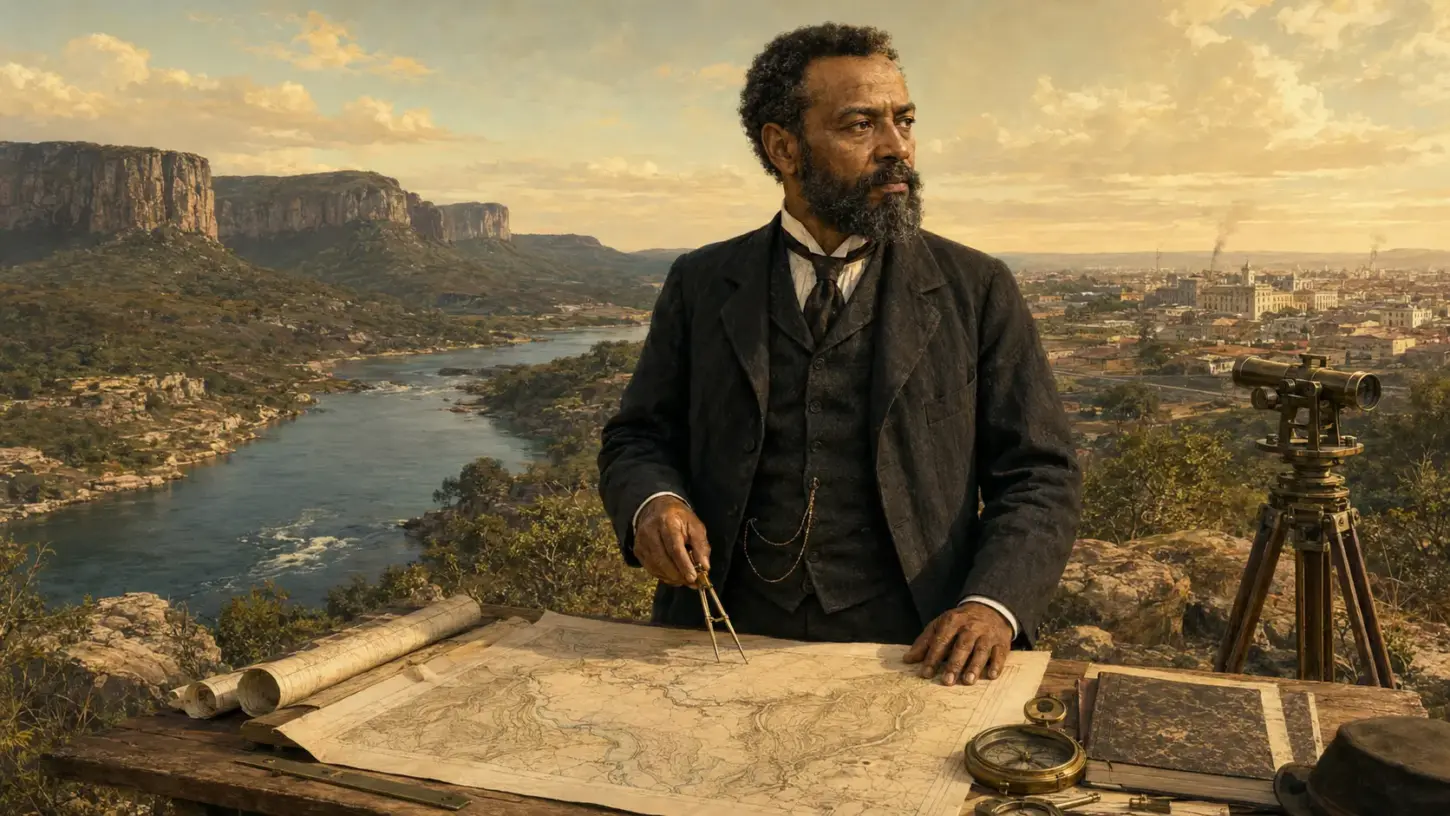
Story | Teodoro Sampaio: The Engineer Who Helped Explore and Build Brazil
Engenheiro, cartógrafo, historiador e sanitarista, Teodoro Sampaio foi um dos intelectuais mais brilhantes do Brasil. Nascido na escravidão na Bahia, ele superou barreiras raciais e sociais do século XIX para mapear o interior do país, planejar a infraestrutura de São Paulo e Salvador e revelar as raízes indígenas na nossa geografia, influenciando até obras como Os Sertões. Descubra a história extraordinária do homem que ajudou a desenhar o Brasil e cujo legado batiza ruas e cidades por todo o país.
| Audio | |
|---|---|
Normal | Slow |
| English Transcript | Tradução |
| Teodoro Sampaio: The Engineer Who Helped Explore and Build Brazil | Teodoro Sampaio: o engenheiro que ajudou a conhecer e construir o Brasil |
| When we walk along a street named Teodoro Sampaio or encounter this name on the map of two Brazilian municipalities, one in Bahia and the other in São Paulo, we rarely imagine the importance of the person being honored. Teodoro Fernandes Sampaio was an engineer, geographer, cartographer, historian, ethnographer, writer, urban planner, and politician. At a time when knowledge about much of Brazilian territory was still incomplete, he traveled across rivers and backlands, produced maps, designed sanitation systems, studied Indigenous languages, and made important contributions to understanding the country’s historical and geographical formation. | Quando passamos por uma rua chamada Teodoro Sampaio ou encontramos esse nome no mapa de dois municípios brasileiros, um na Bahia e outro em São Paulo, raramente imaginamos a dimensão do personagem homenageado. Teodoro Fernandes Sampaio foi engenheiro, geógrafo, cartógrafo, historiador, etnógrafo, escritor, urbanista e político. Em uma época na qual o conhecimento sobre grande parte do território brasileiro ainda era incompleto, ele percorreu rios e sertões, elaborou mapas, projetou sistemas de saneamento, estudou línguas indígenas e deixou contribuições importantes para a compreensão da formação histórica e geográfica do país. |
| His name was originally spelled “Theodoro,” the form found in period documents and in many publications today. He was born on January 7, 1855, at Engenho Canabrava, in Santo Amaro da Purificação, in Bahia’s Recôncavo region. He was the son of Domingas da Paixão do Carmo, an enslaved Black woman. Information about his paternity varies among biographers, although the best-known accounts associate his upbringing with Father Manuel Fernandes Sampaio. Teodoro was reportedly freed at the baptismal font, while some of his siblings remained enslaved. Years later, when he was already working as an engineer, he purchased the freedom of three of them. His life must be understood within a slaveholding society, profoundly marked by racism and by enormous barriers that prevented Black people from accessing education and prestigious professions. | Seu nome era originalmente grafado “Theodoro”, forma encontrada em documentos da época e em muitas publicações atuais. Nascido em 7 de janeiro de 1855, no Engenho Canabrava, em Santo Amaro da Purificação, no Recôncavo Baiano, era filho de Domingas da Paixão do Carmo, uma mulher negra escravizada. As informações sobre sua paternidade divergem entre os biógrafos, embora as versões mais conhecidas associem sua criação ao padre Manuel Fernandes Sampaio. Teodoro teria sido libertado na pia batismal, enquanto alguns de seus irmãos permaneceram escravizados. Anos depois, quando já trabalhava como engenheiro, ele comprou a liberdade de três deles. Sua trajetória deve ser compreendida dentro de uma sociedade escravocrata, profundamente marcada pelo racismo e por enormes barreiras ao acesso da população negra à educação e às profissões de prestígio. |
| While still a child, Teodoro left Bahia and moved to Rio de Janeiro, where he studied at Colégio São Salvador. In 1871, he entered the Civil Engineering program at the then Escola Central, which was later incorporated into the Polytechnic School of Rio de Janeiro. During his education, he studied physical sciences, mathematics, drawing, topography, and engineering. He was also a student of André Rebouças, another great Black Brazilian engineer and an important abolitionist activist. To support himself, Teodoro worked as a teacher and as a draftsman at the National Museum, an activity that helped him develop the graphic precision that would later appear in his maps and field surveys. According to the Chamber of Deputies, he completed his engineering education in 1876. | Ainda criança, Teodoro deixou a Bahia e seguiu para o Rio de Janeiro, onde estudou no Colégio São Salvador. Em 1871, ingressou no curso de Engenharia Civil da então Escola Central, posteriormente integrada à Escola Politécnica do Rio de Janeiro. Durante sua formação, estudou ciências físicas, matemática, desenho, topografia e engenharia. Também foi aluno de André Rebouças, outro grande engenheiro negro brasileiro e importante militante abolicionista. Para se sustentar, Teodoro trabalhou como professor e como desenhista no Museu Nacional, atividade que contribuiu para desenvolver a precisão gráfica que mais tarde apareceria em seus mapas e levantamentos de campo. Segundo a Câmara dos Deputados, ele concluiu sua formação em engenharia em 1876. |
| At the beginning of his career, Teodoro participated in studies related to the ports of Santos and Rio de Janeiro. In 1879, he was chosen to join the Imperial Hydraulic Commission, created during the government of Emperor Pedro II to study ports, rivers, and navigation conditions. He was the only Brazilian engineer on a team that also included American specialists. Among them was the geologist Orville Derby, with whom Teodoro established a long professional and intellectual collaboration. | No início da carreira, Teodoro participou de estudos relacionados aos portos de Santos e do Rio de Janeiro. Em 1879, foi escolhido para integrar a Comissão Hidráulica do Império, criada durante o governo de D. Pedro II para estudar portos, rios e condições de navegação. Era o único engenheiro brasileiro em uma equipe formada também por especialistas norte-americanos. Entre eles estava o geólogo Orville Derby, com quem Teodoro estabeleceu uma longa colaboração profissional e intelectual. |
| His participation in this commission led Teodoro Sampaio to one of the most important experiences of his life: the expedition along the São Francisco River and through the Chapada Diamantina. The work required much more than engineering knowledge. It was necessary to observe the terrain, measure distances, record waterways, identify navigation possibilities, and understand the economic and social conditions of the regions they crossed. His notes brought together information about nature, local populations, economic activities, towns, and routes through the country’s interior. | A participação nessa comissão levou Teodoro Sampaio a uma das experiências mais importantes de sua vida: a expedição pelo rio São Francisco e pela Chapada Diamantina. O trabalho exigia muito mais do que conhecimentos de engenharia. Era necessário observar o relevo, medir distâncias, registrar cursos de água, identificar possibilidades de navegação e compreender as condições econômicas e sociais das regiões percorridas. Suas anotações reuniam informações sobre a natureza, as populações, as atividades produtivas, as cidades e os caminhos do interior do país. |
| Years later, these studies resulted in the book "The São Francisco River and the Chapada Diamantina", one of his best-known works. The text combines scientific observation, geographical description, and travel writing, offering a valuable portrait of the Brazilian backlands at the end of the 19th century. Teodoro later became chief engineer of the São Francisco River Clearing Commission and also worked on extending the railway that connected Salvador to the region of the great river. | Esses estudos deram origem, anos depois, ao livro "O Rio São Francisco e a Chapada Diamantina", uma de suas obras mais conhecidas. O texto reúne observação científica, descrição geográfica e relato de viagem, oferecendo um retrato valioso do sertão brasileiro no final do século XIX. Posteriormente, Teodoro tornou-se engenheiro-chefe da Comissão de Desobstrução do Rio São Francisco e também trabalhou no prolongamento da estrada de ferro que ligava Salvador à região do grande rio. |
| In 1886, his career entered a new phase. Teodoro was invited to work for the recently created Geographical and Geological Commission of São Paulo, an institution responsible for studying and mapping the state’s territory. At the age of 31, he led the commission’s first topographical and geographical survey expedition. At that time, the expansion of coffee cultivation, railways, and economic occupation made the production of reliable maps an urgent necessity. Rivers, mountain ranges, soils, routes, and territorial boundaries had to be studied in order to plan roads, cities, and economic activities. | Em 1886, sua carreira entrou em uma nova fase. Teodoro foi convidado a trabalhar na recém-criada Comissão Geográfica e Geológica de São Paulo, instituição encarregada de estudar e mapear o território paulista. Aos 31 anos, chefiou a primeira expedição de levantamento topográfico e geográfico da comissão. Naquele período, o avanço da cafeicultura, das ferrovias e da ocupação econômica tornava urgente a produção de mapas confiáveis. Era preciso conhecer rios, serras, solos, caminhos e limites territoriais para planejar estradas, cidades e atividades produtivas. |
| Teodoro’s work helped expand knowledge of the interior of São Paulo. His surveys combined direct observation, field measurements, and cartographic representation. For him, cartography was an essential tool for understanding the territory and guiding public decisions. By transforming rivers, mountains, and routes into maps, Teodoro helped make visible a country that still knew very little about itself. | O trabalho desenvolvido por Teodoro ajudou a ampliar o conhecimento sobre o interior de São Paulo. Seus levantamentos combinaram observação direta, medições de campo e representação cartográfica. A cartografia, para ele, era uma ferramenta essencial para compreender o território e orientar decisões públicas. Ao transformar rios, montanhas e caminhos em mapas, Teodoro contribuía para tornar visível um país que ainda conhecia muito pouco de si mesmo. |
| His contribution to São Paulo went beyond geographical exploration. Between the end of the 19th century and the beginning of the 20th, he held important positions in São Paulo’s public administration and participated in planning urban infrastructure. He rose to the position of director and chief sanitation engineer for the state, a role he held during a period of rapid growth in the capital. The city was receiving thousands of new residents while facing epidemics, a shortage of treated water, unhealthy housing, and inadequate sewer systems. | Sua contribuição para São Paulo ultrapassou os trabalhos de exploração geográfica. Entre o final do século XIX e o início do século XX, ele ocupou posições importantes na administração pública paulista e participou do planejamento da infraestrutura urbana. Chegou ao cargo de diretor e engenheiro-chefe do saneamento do estado, função que exerceu durante um período de crescimento acelerado da capital. A cidade recebia milhares de novos habitantes, enquanto enfrentava epidemias, falta de água tratada, moradias insalubres e redes de esgoto insuficientes. |
| Teodoro participated in projects related to the collection and distribution of water from the Cantareira system, the sanitation of urban areas, and studies of São Paulo’s rivers. He also chaired a commission responsible for inspecting workers’ housing and tenements in the Santa Ifigênia district. His work took place within a complex historical context in which necessary sanitation policies were frequently mixed with hygienist ideas and prejudice against poor people. Even so, the presence of a Black intellectual directing major public works in a society that had abolished slavery only a few years earlier was an extraordinary achievement. | Teodoro participou de projetos relacionados à captação e à distribuição das águas da Cantareira, ao saneamento de áreas urbanas e aos estudos sobre os rios paulistanos. Presidiu também uma comissão encarregada de examinar habitações operárias e cortiços no distrito de Santa Ifigênia. Sua atuação ocorreu em um contexto histórico complexo, no qual as necessárias políticas de saneamento frequentemente se misturavam a ideias higienistas e preconceituosas contra a população pobre. Ainda assim, a presença de um intelectual negro na direção de importantes obras públicas, em uma sociedade que havia abolido a escravidão havia poucos anos, constitui um feito extraordinário. |
| Teodoro also participated in the discussions that led to the creation of the Polytechnic School of São Paulo in 1893 and was one of the founders of the Historical and Geographical Institute of São Paulo in 1894. In these institutions, he brought engineering closer to geography, history, and the study of society. For him, understanding Brazilian territory required comprehending both its natural features and the history of the peoples who inhabited it. | Teodoro também participou das discussões que levaram à criação da Escola Politécnica de São Paulo, em 1893, e foi um dos fundadores do Instituto Histórico e Geográfico de São Paulo, em 1894. Nessas instituições, aproximou a engenharia da geografia, da história e do estudo da sociedade. Para ele, conhecer o território brasileiro exigia compreender tanto suas características naturais quanto a trajetória dos povos que o habitavam. |
| This perspective appears clearly in "Tupi in National Geography", published in 1901. In the book, Teodoro studied the presence of the Tupi language in the names of Brazilian rivers, mountain ranges, plants, animals, cities, and regions. He demonstrated that place names of Indigenous origin preserved information about the characteristics of locations and constituted records of the territory’s history. Names spoken every day by Brazilians could reveal the appearance of a river, the vegetation of a region, or the presence of a particular animal. His interest in the subject also resulted in studies of other Indigenous peoples, including the Krahô of the Rio Preto, accompanied by a vocabulary and an ethnographic map. | Essa visão aparece com clareza em "O Tupi na Geografia Nacional", publicado em 1901. Na obra, Teodoro estudou a presença da língua tupi nos nomes de rios, serras, plantas, animais, cidades e regiões brasileiras. Ele demonstrou que os topônimos de origem indígena guardavam informações sobre as características dos lugares e constituíam registros da história do território. Nomes repetidos diariamente pelos brasileiros podiam revelar a aparência de um rio, a vegetação de uma região ou a presença de determinado animal. Seu interesse pelo tema também resultou em estudos sobre outros povos indígenas, entre eles os Krahô do rio Preto, acompanhados de vocabulário e carta etnográfica. |
| At the beginning of the 20th century, Teodoro returned to Bahia, where he continued working as an engineer and urban planner. He prepared a cadastral map of Salvador and presented proposals for modernizing the Bahian capital’s water and sewer systems. He also designed buildings, conducted urban studies, and, in 1919, created the plan for the so-called City of Light, a development that contributed to the formation of the present-day Pituba neighborhood. | No início do século XX, Teodoro regressou à Bahia, onde continuou trabalhando como engenheiro e urbanista. Elaborou uma planta cadastral de Salvador e apresentou propostas para a modernização dos sistemas de água e esgoto da capital baiana. Também projetou edifícios, realizou estudos urbanos e, em 1919, produziu o plano para a chamada Cidade da Luz, empreendimento que contribuiu para a formação do atual bairro da Pituba. |
| Alongside engineering, he devoted increasing attention to historical research. He studied the founding of Salvador, the occupation of Brazilian territory, old churches, the catechization of Indigenous peoples, and the role of expeditions into the backlands in shaping the country. His publications include "Atlas of the United States of Brazil", "Tupi in National Geography", "The São Francisco River and the Chapada Diamantina", and several historical, geographical, and ethnographic studies. His "History of the Founding of the City of Salvador" was published posthumously. | Paralelamente à engenharia, dedicou-se cada vez mais à pesquisa histórica. Estudou a fundação de Salvador, a ocupação do território brasileiro, as antigas igrejas, a catequese dos povos indígenas e o papel das expedições sertanistas na formação do país. Entre suas publicações estão "Atlas dos Estados Unidos do Brasil", "O Tupi na Geografia Nacional", "O Rio São Francisco e a Chapada Diamantina" e diversos estudos históricos, geográficos e etnográficos. Sua "História da Fundação da Cidade do Salvador" foi publicada postumamente. |
| Teodoro maintained contact with some of the leading Brazilian intellectuals of his time. One of them was Euclides da Cunha, to whom he provided information, maps, and knowledge about the backlands of Bahia. Before writing "Rebellion in the Backlands", Euclides consulted materials produced by the engineer and benefited from his direct experience in the region of Canudos and the Chapada Diamantina. This collaboration shows how Teodoro’s work also influenced one of the fundamental works of Brazilian literature. | Teodoro manteve contato com alguns dos principais intelectuais brasileiros de seu tempo. Um deles foi Euclides da Cunha, a quem forneceu informações, mapas e conhecimentos sobre o sertão baiano. Antes de escrever "Os Sertões", Euclides consultou materiais produzidos pelo engenheiro e se beneficiou de sua experiência direta na região de Canudos e da Chapada Diamantina. Essa colaboração mostra como o trabalho de Teodoro influenciou também uma das obras fundamentais da literatura brasileira. |
| In Bahia, he played a prominent role in the Geographical and Historical Institute of Bahia, an institution he eventually presided over. He was also a member of the Brazilian Historical and Geographical Institute, presided over the Fifth Brazilian Congress of Geography, participated in the founding of the Bahia Academy of Letters, and entered politics later in life. In 1927, he took office as a federal deputy for Bahia, serving during the 1927–1929 legislature. In 1937, shortly before his death, he presided in Salvador over the Second Afro-Brazilian Congress, a meeting dedicated to studying and valuing Black cultures in Brazil. | Na Bahia, teve participação destacada no Instituto Geográfico e Histórico da Bahia, instituição que chegou a presidir. Foi ainda sócio do Instituto Histórico e Geográfico Brasileiro, presidiu o V Congresso Brasileiro de Geografia, participou da fundação da Academia de Letras da Bahia e, já na maturidade, ingressou na política. Em 1927, tomou posse como deputado federal pela Bahia, exercendo o mandato durante a legislatura de 1927 a 1929. Em 1937, pouco antes de sua morte, presidiu em Salvador o Segundo Congresso Afro-Brasileiro, encontro dedicado ao estudo e à valorização das culturas negras no Brasil. |
| Teodoro Sampaio died in Rio de Janeiro on October 11, 1937, at the age of 82. Throughout his life, he received recognition in scientific and professional circles, although his presence in popular memory became much smaller than the importance of his achievements. His name remained attached to streets, schools, and cities, although many people are unaware of the history behind these tributes. | Teodoro Sampaio faleceu no Rio de Janeiro em 11 de outubro de 1937, aos 82 anos. Ao longo da vida, recebeu reconhecimento em círculos científicos e profissionais, porém sua presença na memória popular tornou-se muito menor do que a importância de suas realizações. Seu nome permaneceu em ruas, escolas e cidades, embora muitas pessoas desconheçam a história que existe por trás dessas homenagens. |
| Learning about Teodoro Sampaio means discovering a figure who united science, public service, and a profound interest in Brazil. He helped map regions that were still little known, participated in the modernization of major cities, studied the Indigenous contribution to national geography, produced historical works, and opened paths in professional environments from which Black people were systematically excluded. His life reveals the ability to transform knowledge into action and shows that the building of Brazil also passed through the hands, maps, and ideas of one of the greatest Black intellectuals in our history. | Conhecer Teodoro Sampaio significa descobrir um personagem que reuniu ciência, serviço público e profundo interesse pelo Brasil. Ele ajudou a mapear regiões ainda pouco conhecidas, participou da modernização de grandes cidades, estudou a contribuição indígena para a geografia nacional, produziu trabalhos históricos e abriu caminhos em ambientes profissionais dos quais os negros eram sistematicamente excluídos. Sua vida revela a capacidade de transformar conhecimento em ação e mostra que a construção do Brasil também passou pelas mãos, pelos mapas e pelas ideias de um dos maiores intelectuais negros de nossa história. |
Contagem de palavras
A tabela abaixo exibe as palavras encontradas neste texto, bem como o número de vezes em que aparecem.
Veja também: Para que serve esta tabela?
| Freq. | Palavra | Freq. | Palavra | Freq. | Palavra |
|---|---|---|---|---|---|
| 125 | the | 86 | of | 69 | and |
| 53 | in | 32 | he | 32 | a |
| 28 | his | 26 | to | 21 | was |
| 21 | teodoro | 13 | that | 13 | são |
| 13 | brazilian | 12 | at | 12 | an |
| 10 | for | 10 | also | 9 | geographical |
| 9 | engineer | 9 | bahia | 8 | paulo |
| 8 | historical | 7 | studied | 7 | sampaio |
| 7 | one | 7 | black | 7 | about |
| 6 | territory | 6 | studies | 6 | salvador |
| 6 | rivers | 6 | river | 6 | participated |
| 6 | maps | 6 | later | 6 | history |
| 6 | engineering | 6 | commission | 6 | by |
| 5 | work | 5 | urban | 5 | rio |
| 5 | on | 5 | life | 5 | knowledge |
| 5 | indigenous | 5 | helped | 5 | geography |
| 5 | brazil | 5 | backlands | 5 | as |
| 4 | works | 4 | with | 4 | this |
| 4 | th | 4 | still | 4 | sanitation |
| 4 | region | 4 | public | 4 | presence |
| 4 | people | 4 | national | 4 | map |
| 4 | janeiro | 4 | into | 4 | information |
| 4 | important | 4 | from | 4 | francisco |
| 4 | economic | 4 | during | 4 | diamantina |
| 4 | de | 4 | country | 4 | cities |
| 4 | chapada | 3 | years | 3 | who |
| 3 | while | 3 | which | 3 | when |
| 3 | were | 3 | water | 3 | understanding |
| 3 | tupi | 3 | time | 3 | through |
| 3 | these | 3 | them | 3 | systems |
| 3 | society | 3 | routes | 3 | role |
| 3 | regions | 3 | professional | 3 | produced |
| 3 | presided | 3 | peoples | 3 | over |
| 3 | names | 3 | name | 3 | much |
| 3 | led | 3 | known | 3 | institute |
| 3 | him | 3 | founding | 3 | entered |
| 3 | education | 3 | da | 3 | created |
| 3 | city | 3 | century | 3 | beginning |
| 3 | although | 2 | writing | 2 | working |
| 2 | worked | 2 | within | 2 | whom |
| 2 | where | 2 | we | 2 | united |
| 2 | took | 2 | than | 2 | surveys |
| 2 | studying | 2 | study | 2 | state |
| 2 | some | 2 | so | 2 | shows |
| 2 | sewer | 2 | scientific | 2 | school |
| 2 | resulted | 2 | responsible | 2 | required |
| 2 | remained | 2 | related | 2 | ranges |
| 2 | published | 2 | publications | 2 | ports |
| 2 | polytechnic | 2 | planner | 2 | plan |
| 2 | place | 2 | period | 2 | other |
| 2 | or | 2 | only | 2 | occupation |
| 2 | observation | 2 | new | 2 | necessary |
| 2 | navigation | 2 | mountain | 2 | many |
| 2 | major | 2 | made | 2 | little |
| 2 | it | 2 | interior | 2 | interest |
| 2 | intellectuals | 2 | intellectual | 2 | institution |
| 2 | importance | 2 | ideas | 2 | housing |
| 2 | held | 2 | had | 2 | great |
| 2 | formation | 2 | field | 2 | fernandes |
| 2 | expedition | 2 | euclides | 2 | ethnographic |
| 2 | enslaved | 2 | end | 2 | direct |
| 2 | designed | 2 | day | 2 | contribution |
| 2 | congress | 2 | conditions | 2 | collaboration |
| 2 | chief | 2 | career | 2 | capital |
| 2 | brought | 2 | book | 2 | best |
| 2 | before | 2 | became | 2 | be |
| 2 | among | 2 | along | 2 | age |
| 2 | activities | 1 | writer | 1 | would |
| 1 | workers | 1 | woman | 1 | went |
| 1 | waterways | 1 | walk | 1 | vocabulary |
| 1 | visible | 1 | very | 1 | vegetation |
| 1 | varies | 1 | valuing | 1 | valuable |
| 1 | urgent | 1 | upbringing | 1 | unhealthy |
| 1 | understood | 1 | understand | 1 | unaware |
| 1 | two | 1 | tributes | 1 | treated |
| 1 | traveled | 1 | travel | 1 | transforming |
| 1 | transform | 1 | towns | 1 | topography |
| 1 | topographical | 1 | tool | 1 | together |
| 1 | today | 1 | throughout | 1 | three |
| 1 | thousands | 1 | they | 1 | theodoro |
| 1 | then | 1 | text | 1 | territorial |
| 1 | terrain | 1 | tenements | 1 | team |
| 1 | teacher | 1 | systematically | 1 | system |
| 1 | survey | 1 | support | 1 | subject |
| 1 | student | 1 | streets | 1 | street |
| 1 | states | 1 | spoken | 1 | spelled |
| 1 | specialists | 1 | son | 1 | soils |
| 1 | social | 1 | smaller | 1 | slavery |
| 1 | slaveholding | 1 | siblings | 1 | shortly |
| 1 | shortage | 1 | shaping | 1 | several |
| 1 | serving | 1 | service | 1 | second |
| 1 | sciences | 1 | science | 1 | schools |
| 1 | santos | 1 | santo | 1 | santa |
| 1 | rose | 1 | roads | 1 | reveals |
| 1 | reveal | 1 | returned | 1 | residents |
| 1 | research | 1 | representation | 1 | reportedly |
| 1 | reliable | 1 | records | 1 | record |
| 1 | recôncavo | 1 | recognition | 1 | recently |
| 1 | receiving | 1 | received | 1 | rebou'as |
| 1 | rebellion | 1 | rarely | 1 | rapid |
| 1 | railways | 1 | railway | 1 | racism |
| 1 | purifica'ão | 1 | purchased | 1 | provided |
| 1 | proposals | 1 | prominent | 1 | projects |
| 1 | program | 1 | profoundly | 1 | profound |
| 1 | professions | 1 | production | 1 | prevented |
| 1 | preto | 1 | prestigious | 1 | preserved |
| 1 | presented | 1 | present | 1 | prepared |
| 1 | prejudice | 1 | precision | 1 | posthumously |
| 1 | possibilities | 1 | positions | 1 | position |
| 1 | portrait | 1 | populations | 1 | popular |
| 1 | poor | 1 | politics | 1 | politician |
| 1 | policies | 1 | played | 1 | plants |
| 1 | planning | 1 | pituba | 1 | physical |
| 1 | phase | 1 | perspective | 1 | person |
| 1 | pedro | 1 | paths | 1 | paternity |
| 1 | passed | 1 | particular | 1 | participation |
| 1 | paixão | 1 | our | 1 | orville |
| 1 | originally | 1 | origin | 1 | order |
| 1 | opened | 1 | old | 1 | office |
| 1 | offering | 1 | october | 1 | observe |
| 1 | notes | 1 | neighborhood | 1 | necessity |
| 1 | nature | 1 | natural | 1 | named |
| 1 | must | 1 | museum | 1 | municipalities |
| 1 | moved | 1 | mountains | 1 | most |
| 1 | more | 1 | modernizing | 1 | modernization |
| 1 | mixed | 1 | memory | 1 | member |
| 1 | meeting | 1 | measurements | 1 | measure |
| 1 | means | 1 | mathematics | 1 | materials |
| 1 | marked | 1 | mapping | 1 | manuel |
| 1 | make | 1 | maintained | 1 | long |
| 1 | locations | 1 | local | 1 | literature |
| 1 | light | 1 | letters | 1 | legislature |
| 1 | left | 1 | learning | 1 | leading |
| 1 | languages | 1 | language | 1 | krahô |
| 1 | knew | 1 | join | 1 | january |
| 1 | itself | 1 | its | 1 | invited |
| 1 | institutions | 1 | inspecting | 1 | inhabited |
| 1 | infrastructure | 1 | influenced | 1 | increasing |
| 1 | incorporated | 1 | incomplete | 1 | including |
| 1 | included | 1 | include | 1 | inadequate |
| 1 | imperial | 1 | imagine | 1 | ii |
| 1 | ifigênia | 1 | identify | 1 | hygienist |
| 1 | hydraulic | 1 | how | 1 | honored |
| 1 | historian | 1 | himself | 1 | hands |
| 1 | guiding | 1 | growth | 1 | greatest |
| 1 | graphic | 1 | government | 1 | geologist |
| 1 | geological | 1 | geographer | 1 | fundamental |
| 1 | frequently | 1 | freedom | 1 | freed |
| 1 | founders | 1 | found | 1 | form |
| 1 | font | 1 | first | 1 | figure |
| 1 | fifth | 1 | few | 1 | federal |
| 1 | features | 1 | father | 1 | facing |
| 1 | extraordinary | 1 | extending | 1 | explore |
| 1 | exploration | 1 | experiences | 1 | experience |
| 1 | expeditions | 1 | expansion | 1 | expand |
| 1 | excluded | 1 | every | 1 | eventually |
| 1 | even | 1 | ethnographer | 1 | established |
| 1 | essential | 1 | escola | 1 | epidemics |
| 1 | environments | 1 | enormous | 1 | engenho |
| 1 | encounter | 1 | emperor | 1 | earlier |
| 1 | drawing | 1 | draftsman | 1 | domingas |
| 1 | documents | 1 | do | 1 | district |
| 1 | distribution | 1 | distances | 1 | discussions |
| 1 | discovering | 1 | director | 1 | directing |
| 1 | died | 1 | devoted | 1 | development |
| 1 | develop | 1 | description | 1 | derby |
| 1 | deputy | 1 | deputies | 1 | demonstrated |
| 1 | dedicated | 1 | decisions | 1 | death |
| 1 | cunha | 1 | cultures | 1 | cultivation |
| 1 | crossed | 1 | creation | 1 | could |
| 1 | contributions | 1 | contributed | 1 | continued |
| 1 | context | 1 | contact | 1 | consulted |
| 1 | constituted | 1 | connected | 1 | conducted |
| 1 | comprehending | 1 | complex | 1 | completed |
| 1 | combines | 1 | combined | 1 | collection |
| 1 | colégio | 1 | coffee | 1 | closer |
| 1 | clearly | 1 | clearing | 1 | civil |
| 1 | circles | 1 | churches | 1 | chosen |
| 1 | child | 1 | characteristics | 1 | chamber |
| 1 | chaired | 1 | central | 1 | catechization |
| 1 | cartography | 1 | cartographic | 1 | cartographer |
| 1 | carmo | 1 | canudos | 1 | cantareira |
| 1 | canabrava | 1 | called | 1 | cadastral |
| 1 | buildings | 1 | building | 1 | build |
| 1 | brazilians | 1 | boundaries | 1 | both |
| 1 | born | 1 | biographers | 1 | beyond |
| 1 | between | 1 | benefited | 1 | being |
| 1 | behind | 1 | barriers | 1 | baptismal |
| 1 | bahian | 1 | attention | 1 | attached |
| 1 | atlas | 1 | associate | 1 | areas |
| 1 | are | 1 | appears | 1 | appearance |
| 1 | appear | 1 | another | 1 | animals |
| 1 | animal | 1 | andré | 1 | american |
| 1 | amaro | 1 | already | 1 | alongside |
| 1 | against | 1 | afro | 1 | administration |
| 1 | activity | 1 | activist | 1 | action |
| 1 | across | 1 | achievements | 1 | achievement |
| 1 | accounts | 1 | according | 1 | accompanied |
| 1 | accessing | 1 | academy | 1 | abolitionist |
| 1 | abolished | 1 | ability |