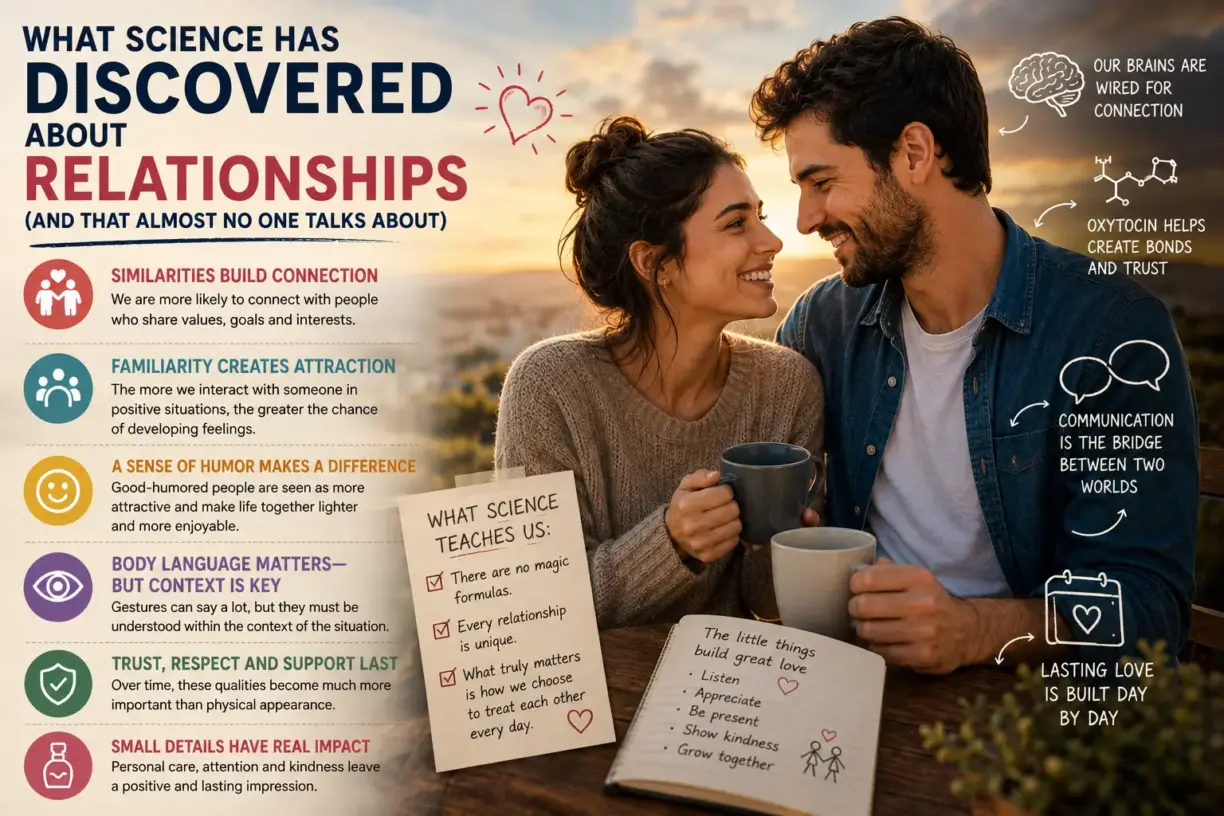
Story | What Science Has Discovered About Relationships
Será que os opostos realmente se atraem? Um sorriso é suficiente para revelar interesse? Existe mesmo um tempo “cientificamente comprovado” para alguém se apaixonar? Neste texto, você vai descobrir o que décadas de pesquisas em Psicologia realmente revelam sobre a atração, a formação dos relacionamentos e por que muitas das afirmações que circulam nas redes sociais têm muito mais de mito do que de ciência.
| Audio | |
|---|---|
Normal | Slow |
| English Transcript | Tradução |
| What Science Has Discovered About Relationships (And That Almost No One Talks About) | O Que a Ciência Descobriu Sobre os Relacionamentos (E Que Quase Ninguém Conta) |
| It only takes a few minutes on social media to come across lists of supposed "psychological facts" about relationships. Some claim that a man falls in love in just a few seconds. Others insist that there is an exact percentage of your crush liking you or that simply observing the dilation of someone's pupils is enough to tell whether your feelings are reciprocated. | Basta passar alguns minutos nas redes sociais para encontrar listas com supostos “fatos psicológicos” sobre relacionamentos. Algumas garantem que um homem leva apenas alguns segundos para se apaixonar. Outras afirmam que existe uma porcentagem exata de chance de o seu crush gostar de você ou que basta observar a dilatação da pupila para descobrir se o interesse é correspondido. |
| The problem is that most of these claims have never been scientifically proven. Many originated in posts with no references at all and were copied repeatedly until they acquired the appearance of truth. Meanwhile, decades of research conducted by psychologists have revealed far more interesting discoveries about how we become attracted to other people. | O problema é que a maior parte dessas afirmações nunca foi comprovada cientificamente. Muitas surgiram em publicações sem qualquer referência e foram sendo copiadas até adquirirem aparência de verdade. Enquanto isso, as pesquisas realizadas por psicólogos ao longo de décadas revelaram descobertas muito mais interessantes sobre a forma como nos aproximamos das pessoas. |
| One of the first conclusions is that the old idea that "opposites attract" works much better as a movie script than as a description of real life. Happy couples can, of course, have different personalities. One partner may be more outgoing, while the other prefers quieter activities. However, studies show that relationships tend to be more stable when partners are similar in important areas, such as values, life goals, worldview, and interests. It is much easier to build a life together when both people are moving in the same direction. | Uma das primeiras conclusões é que a velha ideia de que “os opostos se atraem” costuma funcionar melhor como roteiro de cinema do que como descrição da vida real. Casais felizes podem, naturalmente, ter personalidades diferentes. Um pode ser mais extrovertido, enquanto o outro prefere programas tranquilos. No entanto, estudos mostram que relacionamentos tendem a ser mais estáveis quando existe semelhança em aspectos importantes, como valores, objetivos de vida, visão de mundo e interesses. É muito mais fácil construir uma vida em comum quando ambos caminham na mesma direção. |
| Another factor that strongly influences attraction is familiarity. There is a phenomenon known as the "mere exposure effect," according to which we tend to develop positive feelings toward people we encounter frequently. This helps explain why so many relationships begin at school, college, work, or in groups where people share a hobby. The more opportunities we have to get to know someone in positive situations, the greater the chances that a genuine connection will develop. | Outro fator que influencia bastante a atração é a convivência. Existe um fenômeno conhecido como “efeito da mera exposição”, segundo o qual tendemos a desenvolver simpatia por pessoas com quem convivemos frequentemente. Isso ajuda a explicar por que tantos relacionamentos começam na escola, na faculdade, no ambiente de trabalho ou em grupos que compartilham um hobby. Quanto mais oportunidades temos de conhecer alguém em situações positivas, maiores são as chances de surgir afinidade. |
| This does not mean that spending time together is enough by itself. It simply creates opportunities for other qualities to emerge. It is through conversations, shared challenges, and relaxed moments that we begin to notice another person's character, intelligence, sense of humor, and the way they treat those around them. | Isso não significa que a convivência, por si só, seja suficiente. Ela apenas cria oportunidades para que outras qualidades apareçam. É durante conversas, desafios compartilhados e momentos descontraídos que começamos a perceber o caráter, a inteligência, o bom humor e a forma como a outra pessoa trata quem está ao seu redor. |
| Humor, by the way, deserves a chapter of its own. Numerous studies show that people with a good sense of humor are generally perceived as more attractive. Not because they know how to tell jokes, but because they make being together more enjoyable. Someone who smiles easily, can laugh at themselves, and handles life's small setbacks with ease conveys emotional security, a quality that is valued in any relationship. | O humor, aliás, merece um capítulo à parte. Diversas pesquisas mostram que pessoas bem-humoradas costumam ser vistas como mais atraentes. Não porque saibam decorar piadas, mas porque conseguem tornar a convivência mais leve. Alguém que sorri com facilidade, sabe rir de si mesmo e encara pequenos contratempos com tranquilidade transmite segurança emocional, uma característica valorizada em qualquer relacionamento. |
| It is also true that our communication goes far beyond words. A genuine smile, maintaining eye contact while listening to someone, and showing sincere interest in what the other person is saying usually create a very positive impression. On the other hand, trying to interpret a single gesture as proof of romantic interest can easily lead to mistakes. A person may look away because they are shy, raise their eyebrows because they are surprised, or laugh at a bad joke simply out of politeness. Body language only makes sense when we consider the full set of signals and the context in which they occur. | Também é verdade que nossa comunicação vai muito além das palavras. Um sorriso sincero, manter contato visual enquanto ouvimos alguém e demonstrar interesse genuíno pelo que a outra pessoa está dizendo costumam produzir uma impressão muito positiva. Por outro lado, tentar interpretar um único gesto como prova de paixão pode levar a erros. Uma pessoa pode desviar o olhar porque é tímida, levantar as sobrancelhas porque ficou surpresa ou rir de uma piada ruim apenas por educação. A linguagem corporal faz sentido quando observamos o conjunto dos sinais e o contexto em que eles aparecem. |
| Another interesting aspect is that our perception of beauty changes as we get to know someone. Psychologists refer to this phenomenon as the halo effect. When we admire qualities such as kindness, intelligence, competence, or generosity, we tend to see that person as more attractive and interesting. That is why it is not uncommon to hear people say that they did not feel an immediate attraction, only to discover, over time, that they had met someone truly special. | Outro aspecto curioso é que nossa percepção da beleza muda conforme conhecemos alguém. Psicólogos chamam esse fenômeno de efeito halo. Quando admiramos características como gentileza, inteligência, competência ou generosidade, tendemos a enxergar essa pessoa de forma mais bonita e interessante. É por isso que não são raras as histórias de pessoas que afirmam não terem sentido uma atração imediata, mas que, com o passar do tempo, descobriram alguém extremamente especial. |
| Physical appearance remains important, especially when making first impressions. However, its importance gradually decreases as a relationship matures. Couples who stay together for many years often point to other factors as being essential: trust, respect, the ability to talk through problems, support during difficult times, and mutual admiration. These qualities rarely appear in a photograph or on a social media profile, yet they make all the difference in everyday life. | A aparência física continua tendo importância, especialmente nas primeiras impressões. No entanto, ela perde espaço à medida que o relacionamento amadurece. Casais que permanecem juntos por muitos anos costumam destacar outros fatores como fundamentais: confiança, respeito, capacidade de conversar sobre problemas, apoio nos momentos difíceis e admiração mútua. Essas qualidades dificilmente aparecem em uma fotografia ou em um perfil de rede social, mas fazem toda a diferença na vida cotidiana. |
| There is also one detail that is often overlooked: small acts of personal care have a real influence on how we are perceived. Dressing appropriately for the occasion, maintaining good hygiene, wearing a subtle fragrance, and paying close attention during a conversation all help create a positive impression. These are not magic formulas, but rather signs of consideration for yourself and for the people around you. | Há ainda um detalhe frequentemente ignorado: pequenos cuidados pessoais exercem influência real sobre a forma como somos percebidos. Estar bem vestido para a ocasião, cuidar da higiene, usar um perfume de maneira discreta e demonstrar atenção durante uma conversa contribuem para criar uma impressão positiva. Não são fórmulas mágicas, mas sinais de consideração consigo mesmo e com quem está ao seu lado. |
| Perhaps the greatest lesson science has taught us is this: relationships cannot be reduced to percentages or universal rules. There is no number that can predict when someone will fall in love, nor is there a single gesture capable of revealing with complete certainty what another person is feeling. Human behavior is far richer and more complex than viral lists would have us believe. | Talvez a principal lição deixada pela ciência seja justamente esta: relacionamentos não podem ser reduzidos a porcentagens ou regras universais. Não existe um número que indique quando alguém irá se apaixonar, nem um gesto capaz de revelar com absoluta certeza o que outra pessoa está sentindo. O comportamento humano é muito mais rico e complexo do que as listas virais fazem parecer. |
| Paradoxically, that may be excellent news. If love followed mathematical formulas, all we would have to do would be follow a script to win anyone's heart. In real life, however, it is authenticity, shared experiences, trust built over time, and mutual respect that create the most enduring relationships. These conclusions may not generate headlines as eye-catching as "12 Psychological Facts You Didn't Know," but they have one important advantage: they are supported by decades of research and come much closer to the reality that all of us experience. | Paradoxalmente, essa pode ser uma excelente notícia. Se o amor obedecesse a fórmulas matemáticas, bastaria seguir um roteiro para conquistar qualquer pessoa. Na vida real, porém, são a autenticidade, a convivência, a confiança construída ao longo do tempo e o respeito mútuo que criam os relacionamentos mais duradouros. Talvez essas conclusões não rendam manchetes tão chamativas quanto “12 fatos psicológicos que você não sabia”, mas têm uma vantagem importante: elas são sustentadas por décadas de pesquisa e se aproximam muito mais da experiência que todos nós vivemos. |
Contagem de palavras
A tabela abaixo exibe as palavras encontradas neste texto, bem como o número de vezes em que aparecem.
Veja também: Para que serve esta tabela?
| Freq. | Palavra | Freq. | Palavra | Freq. | Palavra |
|---|---|---|---|---|---|
| 26 | to | 26 | a | 25 | the |
| 25 | that | 23 | is | 21 | of |
| 15 | and | 14 | in | 14 | as |
| 12 | they | 11 | we | 9 | are |
| 8 | more | 8 | have | 7 | someone |
| 7 | people | 7 | not | 7 | it |
| 6 | when | 6 | relationships | 6 | other |
| 6 | or | 6 | life | 5 | there |
| 5 | person | 5 | one | 5 | for |
| 5 | be | 5 | all | 4 | with |
| 4 | together | 4 | this | 4 | these |
| 4 | positive | 4 | on | 4 | may |
| 4 | know | 4 | can | 4 | by |
| 4 | because | 4 | at | 4 | another |
| 4 | about | 3 | you | 3 | would |
| 3 | what | 3 | us | 3 | time |
| 3 | tend | 3 | simply | 3 | sense |
| 3 | real | 3 | qualities | 3 | only |
| 3 | no | 3 | much | 3 | many |
| 3 | love | 3 | interesting | 3 | important |
| 3 | humor | 3 | however | 3 | how |
| 3 | far | 3 | create | 3 | but |
| 2 | your | 2 | will | 2 | why |
| 2 | who | 2 | while | 2 | which |
| 2 | way | 2 | trust | 2 | through |
| 2 | than | 2 | tell | 2 | such |
| 2 | studies | 2 | social | 2 | small |
| 2 | single | 2 | show | 2 | shared |
| 2 | script | 2 | science | 2 | respect |
| 2 | research | 2 | relationship | 2 | psychologists |
| 2 | psychological | 2 | phenomenon | 2 | perceived |
| 2 | over | 2 | our | 2 | opportunities |
| 2 | often | 2 | mutual | 2 | most |
| 2 | media | 2 | make | 2 | maintaining |
| 2 | lists | 2 | laugh | 2 | its |
| 2 | interest | 2 | intelligence | 2 | impression |
| 2 | has | 2 | good | 2 | get |
| 2 | gesture | 2 | genuine | 2 | formulas |
| 2 | first | 2 | few | 2 | feelings |
| 2 | facts | 2 | eye | 2 | enough |
| 2 | effect | 2 | easily | 2 | during |
| 2 | did | 2 | develop | 2 | decades |
| 2 | couples | 2 | conclusions | 2 | come |
| 2 | being | 2 | begin | 2 | attractive |
| 2 | attraction | 2 | around | 2 | appearance |
| 2 | an | 2 | also | 1 | yourself |
| 1 | yet | 1 | years | 1 | worldview |
| 1 | works | 1 | work | 1 | words |
| 1 | win | 1 | whether | 1 | where |
| 1 | were | 1 | wearing | 1 | viral |
| 1 | very | 1 | values | 1 | valued |
| 1 | usually | 1 | until | 1 | universal |
| 1 | uncommon | 1 | trying | 1 | truth |
| 1 | truly | 1 | true | 1 | treat |
| 1 | toward | 1 | times | 1 | those |
| 1 | themselves | 1 | them | 1 | their |
| 1 | taught | 1 | talks | 1 | talk |
| 1 | takes | 1 | surprised | 1 | supposed |
| 1 | supported | 1 | support | 1 | subtle |
| 1 | strongly | 1 | stay | 1 | stable |
| 1 | spending | 1 | special | 1 | some |
| 1 | so | 1 | smiles | 1 | smile |
| 1 | situations | 1 | sincere | 1 | similar |
| 1 | signs | 1 | signals | 1 | shy |
| 1 | showing | 1 | share | 1 | setbacks |
| 1 | set | 1 | see | 1 | security |
| 1 | seconds | 1 | scientifically | 1 | school |
| 1 | saying | 1 | say | 1 | same |
| 1 | rules | 1 | romantic | 1 | richer |
| 1 | revealing | 1 | revealed | 1 | repeatedly |
| 1 | remains | 1 | relaxed | 1 | references |
| 1 | refer | 1 | reduced | 1 | reciprocated |
| 1 | reality | 1 | rather | 1 | rarely |
| 1 | raise | 1 | quieter | 1 | quality |
| 1 | pupils | 1 | proven | 1 | proof |
| 1 | profile | 1 | problems | 1 | problem |
| 1 | prefers | 1 | predict | 1 | posts |
| 1 | politeness | 1 | point | 1 | physical |
| 1 | photograph | 1 | personalities | 1 | personal |
| 1 | perhaps | 1 | perception | 1 | percentages |
| 1 | percentage | 1 | paying | 1 | partners |
| 1 | partner | 1 | paradoxically | 1 | own |
| 1 | overlooked | 1 | outgoing | 1 | out |
| 1 | others | 1 | originated | 1 | opposites |
| 1 | old | 1 | occur | 1 | occasion |
| 1 | observing | 1 | numerous | 1 | number |
| 1 | notice | 1 | nor | 1 | news |
| 1 | never | 1 | moving | 1 | movie |
| 1 | moments | 1 | mistakes | 1 | minutes |
| 1 | met | 1 | mere | 1 | meanwhile |
| 1 | mean | 1 | matures | 1 | mathematical |
| 1 | man | 1 | making | 1 | makes |
| 1 | magic | 1 | look | 1 | listening |
| 1 | liking | 1 | lesson | 1 | lead |
| 1 | language | 1 | known | 1 | kindness |
| 1 | just | 1 | jokes | 1 | joke |
| 1 | itself | 1 | interpret | 1 | interests |
| 1 | insist | 1 | influences | 1 | influence |
| 1 | impressions | 1 | importance | 1 | immediate |
| 1 | if | 1 | idea | 1 | hygiene |
| 1 | human | 1 | hobby | 1 | helps |
| 1 | help | 1 | heart | 1 | hear |
| 1 | headlines | 1 | happy | 1 | handles |
| 1 | hand | 1 | halo | 1 | had |
| 1 | groups | 1 | greatest | 1 | greater |
| 1 | gradually | 1 | goes | 1 | goals |
| 1 | generosity | 1 | generate | 1 | generally |
| 1 | full | 1 | frequently | 1 | fragrance |
| 1 | followed | 1 | follow | 1 | feeling |
| 1 | feel | 1 | familiarity | 1 | falls |
| 1 | fall | 1 | factors | 1 | factor |
| 1 | eyebrows | 1 | exposure | 1 | explain |
| 1 | experiences | 1 | experience | 1 | excellent |
| 1 | exact | 1 | everyday | 1 | essential |
| 1 | especially | 1 | enjoyable | 1 | enduring |
| 1 | encounter | 1 | emotional | 1 | emerge |
| 1 | easier | 1 | ease | 1 | dressing |
| 1 | does | 1 | do | 1 | discoveries |
| 1 | discovered | 1 | discover | 1 | direction |
| 1 | dilation | 1 | difficult | 1 | different |
| 1 | difference | 1 | detail | 1 | deserves |
| 1 | description | 1 | decreases | 1 | crush |
| 1 | creates | 1 | course | 1 | copied |
| 1 | conveys | 1 | conversations | 1 | conversation |
| 1 | context | 1 | contact | 1 | consideration |
| 1 | consider | 1 | connection | 1 | conducted |
| 1 | complex | 1 | complete | 1 | competence |
| 1 | communication | 1 | college | 1 | closer |
| 1 | close | 1 | claims | 1 | claim |
| 1 | character | 1 | chapter | 1 | changes |
| 1 | chances | 1 | challenges | 1 | certainty |
| 1 | catching | 1 | care | 1 | capable |
| 1 | cannot | 1 | built | 1 | build |
| 1 | both | 1 | body | 1 | beyond |
| 1 | better | 1 | believe | 1 | behavior |
| 1 | been | 1 | become | 1 | beauty |
| 1 | bad | 1 | away | 1 | authenticity |
| 1 | attracted | 1 | attract | 1 | attention |
| 1 | aspect | 1 | areas | 1 | appropriately |
| 1 | appear | 1 | anyone | 1 | any |
| 1 | almost | 1 | advantage | 1 | admire |
| 1 | admiration | 1 | acts | 1 | activities |
| 1 | across | 1 | acquired | 1 | according |
| 1 | ability |