
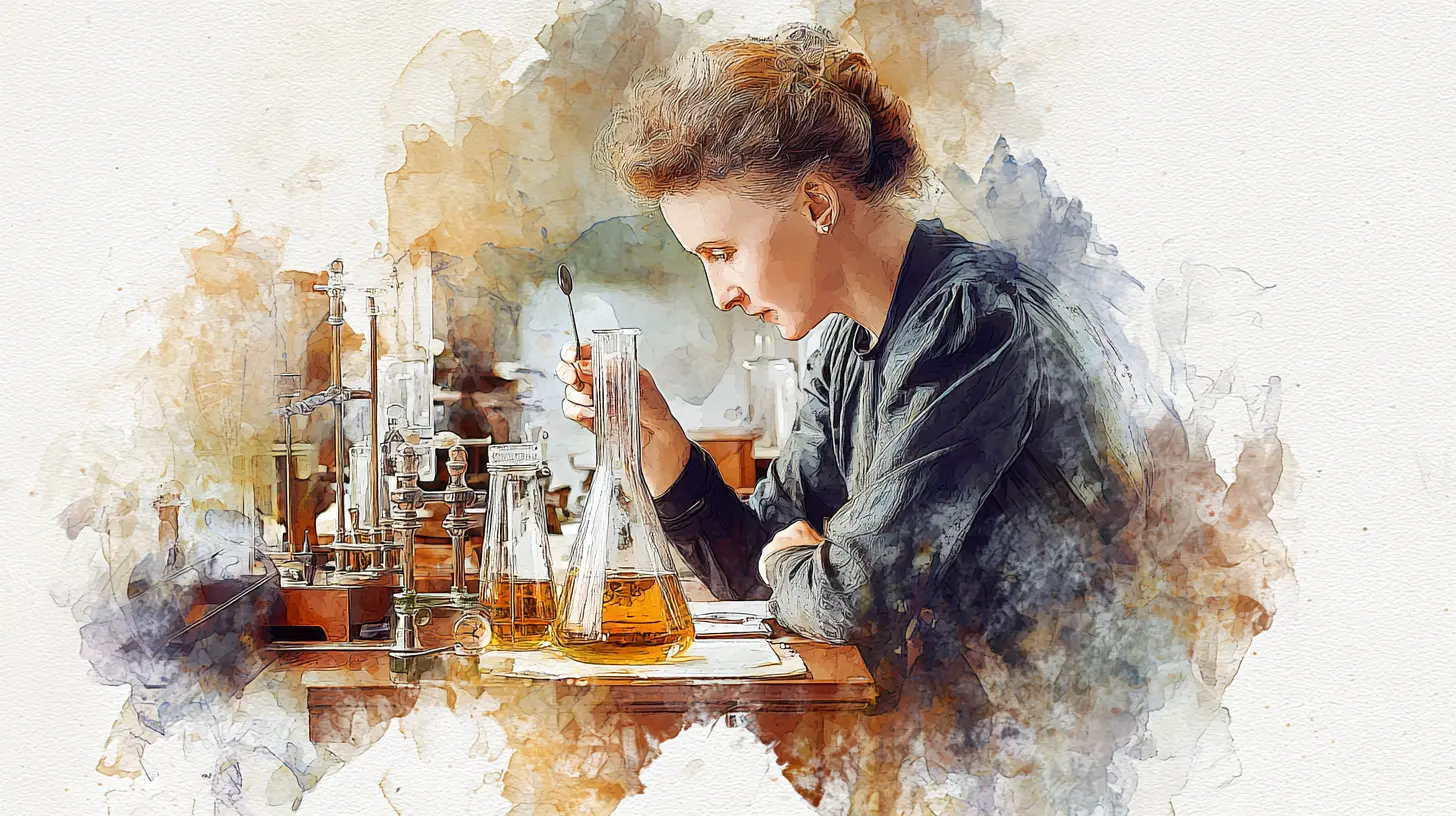
Story | The Extraordinary Life of Marie Curie
Dos estudos clandestinos na Polônia ocupada às descobertas que transformaram a ciência para sempre, a vida de Marie Curie é uma história de determinação silenciosa e coragem extraordinária. Enfrentando pobreza, preconceito e perdas profundas, ela perseguiu o conhecimento com uma intensidade que a levaria a dois Prêmios Nobel — e, em última instância, custaria sua própria vida. Esta não é apenas a história de uma cientista, mas de uma mulher que iluminou o invisível e redefiniu o que é possível por meio da persistência e do propósito.
| Audio | |
|---|---|
Normal | Slow |
| English Transcript | Tradução |
| The Extraordinay Life of Marie Curie | A Vida Extraordinária de Marie Curie |
| Marie Curie was not only one of the greatest scientists in history, but also a woman who quietly reshaped the limits of what a human being could endure, discover, and give to the world. | Marie Curie não foi apenas uma das maiores cientistas da história, mas também uma mulher que silenciosamente redefiniu os limites do que um ser humano pode suportar, descobrir e oferecer ao mundo. |
| Born in Warsaw in 1867, when Poland was under Russian control, she grew up in a family that valued education deeply, even though opportunities—especially for women—were severely restricted. | Nascida em Varsóvia em 1867, quando a Polônia estava sob controle russo, ela cresceu em uma família que valorizava profundamente a educação, mesmo que as oportunidades — especialmente para mulheres — fossem severamente restritas. |
| Universities in her homeland did not accept women, so she studied in secret through what was known as the “Flying University,” a clandestine educational movement that defied imperial restrictions. | As universidades em sua terra natal não aceitavam mulheres, então ela estudou em segredo por meio do que ficou conhecido como “Universidade Voadora”, um movimento educacional clandestino que desafiava as restrições imperiais. |
| Determined to pursue science at the highest level, she moved to Paris at the age of 24. Life there was far from romantic. She lived in a small, unheated room, often surviving on little more than bread, butter, and tea. There are documented accounts of her fainting from hunger during her early years at the Sorbonne. Yet, despite these hardships, she graduated at the top of her class in physics and later in mathematics, demonstrating a level of focus and discipline that would define her entire life. | Determinada a seguir a ciência no mais alto nível, ela se mudou para Paris aos 24 anos. A vida lá estava longe de ser romântica. Ela vivia em um pequeno quarto sem aquecimento, frequentemente sobrevivendo com pouco mais do que pão, manteiga e chá. Há relatos documentados de que ela desmaiava de fome durante seus primeiros anos na Sorbonne. Ainda assim, apesar dessas dificuldades, ela se formou no topo de sua turma em física e, posteriormente, em matemática, demonstrando um nível de foco e disciplina que definiria toda a sua vida. |
| It was in Paris that she met Pierre Curie, her scientific partner and husband. Their collaboration would become one of the most important in the history of science. Inspired by the recent discovery of radioactivity by Henri Becquerel, Marie began investigating uranium rays. Through years of painstaking work in a poorly equipped laboratory—a converted shed with a leaky roof—she processed tons of pitchblende ore. Stirring large vats of boiling material by hand, she eventually isolated two new elements: polonium, named after her homeland, and radium. | Foi em Paris que ela conheceu Pierre Curie, seu parceiro científico e marido. A colaboração entre os dois se tornaria uma das mais importantes da história da ciência. Inspirada pela recente descoberta da radioatividade feita por Henri Becquerel, Marie começou a investigar os raios do urânio. Por meio de anos de trabalho árduo em um laboratório mal equipado — um galpão adaptado com um telhado com vazamentos — ela processou toneladas de minério de pechblenda. Mexendo grandes recipientes de material em ebulição com as próprias mãos, ela acabou isolando dois novos elementos: polônio, nomeado em homenagem à sua terra natal, e rádio. |
| In 1903, Marie Curie became the first woman to win a Nobel Prize, sharing the Nobel Prize in Physics with Pierre Curie and Henri Becquerel. But recognition did not shield her from tragedy. In 1906, Pierre died suddenly in a street accident, leaving her widowed with two young daughters. Despite the devastation, she continued their work and became the first woman to teach at the Sorbonne, taking over Pierre’s position. | Em 1903, Marie Curie se tornou a primeira mulher a ganhar um Prêmio Nobel, compartilhando o Nobel de Física com Pierre Curie e Henri Becquerel. Mas o reconhecimento não a protegeu da tragédia. Em 1906, Pierre morreu repentinamente em um acidente de rua, deixando-a viúva com duas filhas pequenas. Apesar da devastação, ela continuou o trabalho dos dois e se tornou a primeira mulher a lecionar na Sorbonne, assumindo o cargo de Pierre. |
| Her scientific achievements did not stop there. In 1911, she won a second Nobel Prize—this time in Chemistry—for her work in isolating pure radium. She remains the only person to have received Nobel Prizes in two different scientific fields. During World War I, she took her knowledge beyond the laboratory and into the battlefield. She developed mobile X-ray units, known as “Little Curies,” and personally trained technicians, even driving some of the vehicles herself to assist wounded soldiers. | Suas conquistas científicas não pararam por aí. Em 1911, ela ganhou um segundo Prêmio Nobel — desta vez em Química — por seu trabalho no isolamento do rádio puro. Ela continua sendo a única pessoa a ter recebido Prêmios Nobel em duas áreas científicas diferentes. Durante a Primeira Guerra Mundial, ela levou seu conhecimento para além do laboratório e para o campo de batalha. Ela desenvolveu unidades móveis de raio-X, conhecidas como “Pequenas Curies”, e treinou pessoalmente técnicos, chegando inclusive a dirigir alguns dos veículos para ajudar soldados feridos. |
| What makes her story even more striking is that she worked without fully understanding the dangers of radiation. She carried test tubes of radium in her pockets and kept glowing samples by her bedside, fascinated by their light. The long-term effects of this exposure would eventually cost her life. Marie Curie died in 1934 from aplastic anemia, a condition linked to prolonged radiation exposure. | O que torna sua história ainda mais impressionante é que ela trabalhou sem compreender plenamente os perigos da radiação. Ela carregava tubos de ensaio com rádio nos bolsos e mantinha amostras brilhantes ao lado de sua cama, fascinada por sua luminosidade. Os efeitos de longo prazo dessa exposição acabariam por custar sua vida. Marie Curie morreu em 1934 de anemia aplástica, uma condição ligada à exposição prolongada à radiação. |
| Even today, her notebooks remain so radioactive that they are stored in lead-lined boxes and can only be handled with protective gear. It is a haunting reminder of both her brilliance and the price she paid. | Até hoje, seus cadernos permanecem tão radioativos que são armazenados em caixas revestidas de chumbo e só podem ser manuseados com equipamentos de proteção. É um lembrete impressionante tanto de seu brilhantismo quanto do preço que ela pagou. |
| Marie Curie’s life is not just a story of scientific discovery. It is a story of persistence in the face of poverty, courage in the face of loss, and an almost unbreakable commitment to knowledge. She did not chase fame, yet she changed the world—and in doing so, illuminated paths that others could follow. | A vida de Marie Curie não é apenas uma história de descoberta científica. É uma história de persistência diante da pobreza, coragem diante da perda e um compromisso quase inabalável com o conhecimento. Ela não buscou a fama, mas mudou o mundo — e, ao fazer isso, iluminou caminhos que outros poderiam seguir. |
Contagem de palavras
A tabela abaixo exibe as palavras encontradas neste texto, bem como o número de vezes em que aparecem.
Veja também: Para que serve esta tabela?
| Freq. | Palavra | Freq. | Palavra | Freq. | Palavra |
|---|---|---|---|---|---|
| 27 | the | 26 | in | 22 | of |
| 18 | her | 17 | she | 15 | a |
| 14 | and | 9 | to | 7 | that |
| 7 | Curie | 6 | not | 6 | Marie |
| 5 | was | 5 | life | 5 | by |
| 5 | at | 4 | with | 4 | scientific |
| 4 | Pierre | 4 | nobel | 4 | is |
| 4 | from | 4 | even | 4 | did |
| 3 | would | 3 | work | 3 | woman |
| 3 | what | 3 | two | 3 | there |
| 3 | their | 3 | story | 3 | so |
| 3 | radium | 3 | only | 3 | it |
| 2 | yet | 2 | years | 2 | world |
| 2 | through | 2 | Sorbonne | 2 | science |
| 2 | radiation | 2 | prize | 2 | physics |
| 2 | paris | 2 | one | 2 | more |
| 2 | little | 2 | level | 2 | known |
| 2 | knowledge | 2 | homeland | 2 | history |
| 2 | henri | 2 | first | 2 | face |
| 2 | exposure | 2 | eventually | 2 | during |
| 2 | discovery | 2 | died | 2 | despite |
| 2 | could | 2 | but | 2 | becquerel |
| 2 | became | 2 | as | 2 | are |
| 1 | young | 1 | x | 1 | wounded |
| 1 | worldand | 1 | worked | 1 | won |
| 1 | womenwere | 1 | women | 1 | without |
| 1 | win | 1 | widowed | 1 | who |
| 1 | when | 1 | warsaw | 1 | war |
| 1 | vehicles | 1 | vats | 1 | valued |
| 1 | uranium | 1 | up | 1 | university |
| 1 | universities | 1 | units | 1 | unheated |
| 1 | understanding | 1 | under | 1 | unbreakable |
| 1 | tubes | 1 | trained | 1 | tragedy |
| 1 | top | 1 | took | 1 | tons |
| 1 | today | 1 | time | 1 | though |
| 1 | this | 1 | they | 1 | these |
| 1 | than | 1 | test | 1 | term |
| 1 | technicians | 1 | teach | 1 | tea |
| 1 | taking | 1 | surviving | 1 | suddenly |
| 1 | studied | 1 | striking | 1 | street |
| 1 | stored | 1 | stop | 1 | stirring |
| 1 | some | 1 | soldiers | 1 | small |
| 1 | shield | 1 | shed | 1 | sharing |
| 1 | severely | 1 | secret | 1 | second |
| 1 | scientists | 1 | samples | 1 | russian |
| 1 | room | 1 | roofshe | 1 | romantic |
| 1 | restrictions | 1 | restricted | 1 | reshaped |
| 1 | reminder | 1 | remains | 1 | remain |
| 1 | recognition | 1 | recent | 1 | received |
| 1 | rays | 1 | ray | 1 | radioactivity |
| 1 | radioactive | 1 | quietly | 1 | pursue |
| 1 | pure | 1 | protective | 1 | prolonged |
| 1 | processed | 1 | prizethis | 1 | prizes |
| 1 | price | 1 | poverty | 1 | position |
| 1 | poorly | 1 | polonium | 1 | poland |
| 1 | pockets | 1 | pitchblende | 1 | personally |
| 1 | person | 1 | persistence | 1 | paths |
| 1 | partner | 1 | painstaking | 1 | paid |
| 1 | over | 1 | others | 1 | ore |
| 1 | opportunitiesespecially | 1 | on | 1 | often |
| 1 | notebooks | 1 | new | 1 | named |
| 1 | movement | 1 | moved | 1 | most |
| 1 | mobile | 1 | met | 1 | mathematics |
| 1 | material | 1 | makes | 1 | loss |
| 1 | long | 1 | lived | 1 | linked |
| 1 | lined | 1 | limits | 1 | light |
| 1 | leaving | 1 | leaky | 1 | lead |
| 1 | later | 1 | large | 1 | laboratorya |
| 1 | laboratory | 1 | kept | 1 | just |
| 1 | isolating | 1 | isolated | 1 | investigating |
| 1 | into | 1 | inspired | 1 | important |
| 1 | imperial | 1 | illuminated | 1 | i |
| 1 | husband | 1 | hunger | 1 | human |
| 1 | highest | 1 | herself | 1 | have |
| 1 | haunting | 1 | hardships | 1 | handled |
| 1 | hand | 1 | grew | 1 | greatest |
| 1 | graduated | 1 | glowing | 1 | give |
| 1 | gear | 1 | fully | 1 | for |
| 1 | follow | 1 | focus | 1 | flying |
| 1 | fields | 1 | fascinated | 1 | far |
| 1 | family | 1 | fame | 1 | fainting |
| 1 | extraordinay | 1 | equipped | 1 | entire |
| 1 | endure | 1 | elements | 1 | effects |
| 1 | educational | 1 | education | 1 | early |
| 1 | driving | 1 | doing | 1 | documented |
| 1 | discover | 1 | discipline | 1 | different |
| 1 | developed | 1 | devastation | 1 | determined |
| 1 | demonstrating | 1 | define | 1 | defied |
| 1 | deeply | 1 | daughters | 1 | dangers |
| 1 | Curies | 1 | courage | 1 | cost |
| 1 | converted | 1 | control | 1 | continued |
| 1 | condition | 1 | commitment | 1 | collaboration |
| 1 | class | 1 | clandestine | 1 | chemistryfor |
| 1 | chase | 1 | changed | 1 | carried |
| 1 | can | 1 | butter | 1 | brilliance |
| 1 | bread | 1 | boxes | 1 | both |
| 1 | born | 1 | boiling | 1 | beyond |
| 1 | being | 1 | began | 1 | bedside |
| 1 | become | 1 | be | 1 | battlefield |
| 1 | assist | 1 | aplastic | 1 | anemia |
| 1 | an | 1 | also | 1 | almost |
| 1 | age | 1 | after | 1 | achievements |
| 1 | accounts | 1 | accident | 1 | accept |