
Story | Brazil’s Forgotten Visionary Engineer
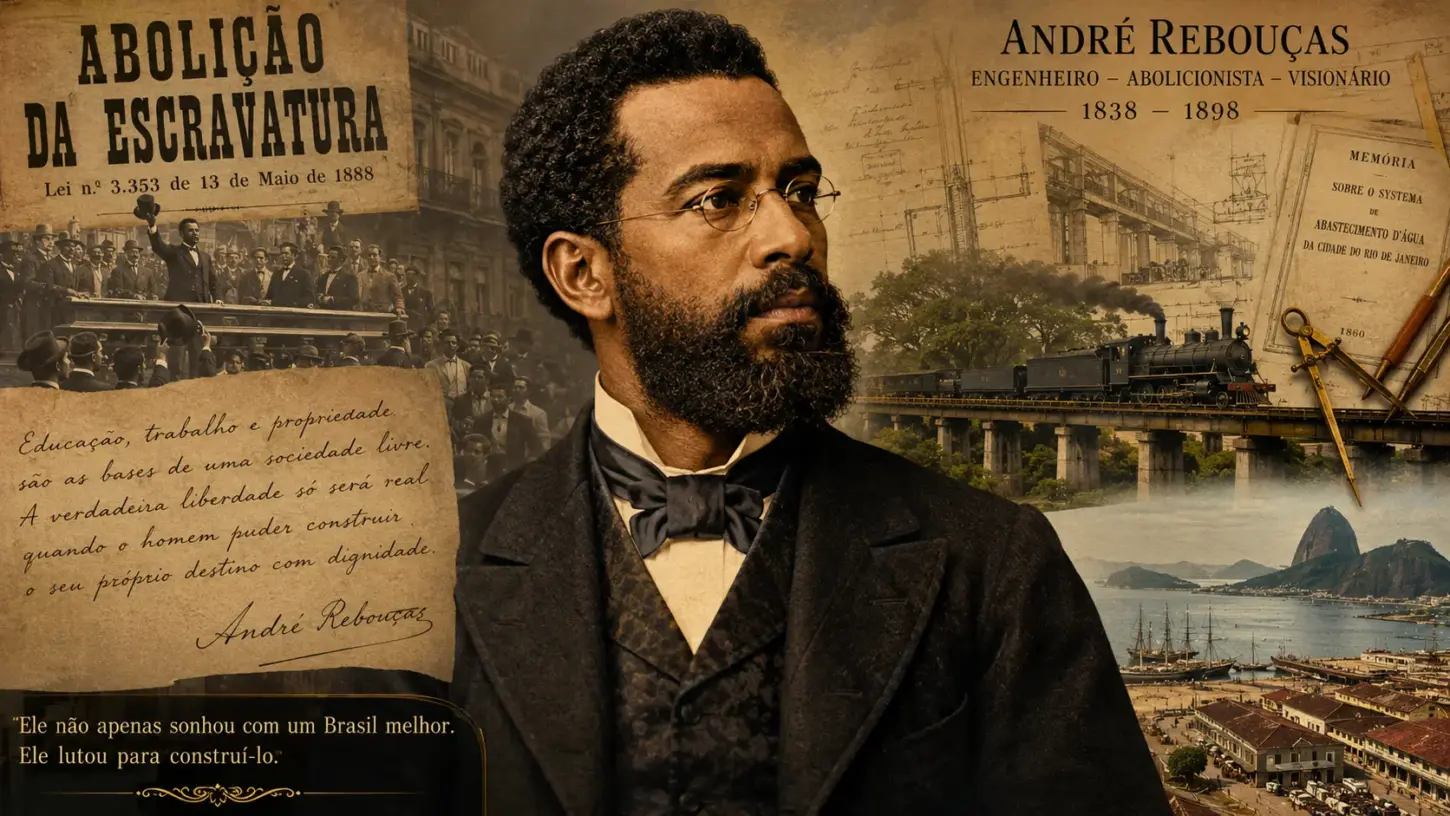
Filho de um homem negro que superou barreiras quase impossíveis no Brasil escravocrata do século XIX, André Rebouças tornou-se um dos maiores engenheiros de sua geração, um amigo próximo do Imperador Dom Pedro II e uma das vozes mais brilhantes do movimento abolicionista. Mas a sua história vai muito além da engenharia e da política. Rebouças vislumbrou um país muito diferente daquele diante de seus olhos: um Brasil industrializado, mais justo, mais humano e repleto de oportunidades para os mais pobres. Em uma era marcada pelo preconceito racial e pelos privilégios de uma elite minúscula, ele ousou imaginar um futuro que, talvez, o país ainda não tenha alcançado plenamente.
| Audio | |
|---|---|
Normal | Slow |
| English Transcript | Tradução |
| # André Rebouças: The Man Who Dreamed of a Better Brazil | André Rebouças: O Homem que Sonhou um Brasil Melhor |
| There are figures in Brazilian history who seem to have lived far ahead of their time. People who could see possibilities invisible to most of their contemporaries and who, precisely because of that, carried within themselves a permanent sense of restlessness. André Rebouças was one of those men. A brilliant engineer, refined intellectual, passionate abolitionist, and tireless dreamer of a more modern and more just Brazil, he spent the nineteenth century trying to build not only bridges of iron and stone, but also social bridges in a profoundly unequal country. His life is remarkable not only because of his extraordinary talent, but because of the strength required simply to exist as a Black man in a slaveholding society that constantly tried to remind people like him of the “place” they were expected to occupy. | Há personagens da história brasileira que parecem ter vivido muito à frente de seu tempo. Pessoas que enxergavam possibilidades invisíveis para a maioria dos seus contemporâneos e que, justamente por isso, carregavam consigo uma espécie de inquietação permanente. André Rebouças foi um desses homens. Engenheiro brilhante, intelectual refinado, defensor apaixonado da abolição da escravidão e sonhador incansável de um Brasil mais moderno e mais justo, ele atravessou o século XIX tentando construir pontes não apenas de ferro e pedra, mas também pontes sociais em um país profundamente desigual. Sua trajetória impressiona não apenas pelo talento extraordinário, mas pela força necessária para existir como homem negro em uma sociedade escravista que insistia diariamente em lembrar qual deveria ser o “lugar” reservado para pessoas como ele. |
| André Pinto Rebouças was born in 1838 in Cachoeira, Bahia, in a Brazil still ruled by the Empire and economically sustained by slavery. His father, Antônio Pereira Rebouças, was already an extraordinary figure for that era. The son of a formerly enslaved woman and a Portuguese tailor, Antônio managed to become a lawyer despite facing almost insurmountable social barriers. He later became an advisor to the Empire and built a respected career in a country where the rise of a Black man was viewed almost as an anomaly. It was in this environment of intellectual discipline and respect for education that André grew up. From an early age, he displayed enormous talent for study, especially in mathematics and technical subjects, something that would later lead him into military engineering. | André Pinto Rebouças nasceu em 1838, em Cachoeira, na Bahia, em um Brasil ainda governado pelo Império e sustentado economicamente pela escravidão. Seu pai, Antônio Pereira Rebouças, já era uma figura singular para a época. Filho de uma ex-escrava e de um alfaiate português, Antônio conseguiu formar-se advogado mesmo enfrentando barreiras sociais quase intransponíveis. Tornou-se conselheiro do Império e construiu uma carreira respeitada num país em que a ascensão de um homem negro era vista quase como uma anomalia. Foi nesse ambiente de valorização da educação e da disciplina intelectual que André cresceu. Desde cedo demonstrava enorme facilidade para os estudos, especialmente nas áreas técnicas e matemáticas, algo que mais tarde o levaria à engenharia militar. |
| Alongside his brother Antônio Rebouças Filho, André entered the Military School of Rio de Janeiro, one of the country’s most important technical institutions at the time. Brazil still possessed extremely poor infrastructure. Roads were inadequate, ports inefficient, and cities grew in a disorganized way. Engineering emerged as a symbol of modernization, progress, and national transformation. André quickly distinguished himself. He was regarded as an exceptionally competent, meticulous, and innovative professional. He traveled to Europe, where he encountered more advanced technologies and witnessed firsthand the speed of the industrial transformations reshaping the world during that century. Those journeys profoundly expanded his vision of what a nation could become. While observing modern railways, efficient port systems, and rapidly industrializing cities, he realized how deeply Brazil remained trapped in archaic economic structures sustained by slave labor. | Ao lado do irmão Antônio Rebouças Filho, André ingressou na Escola Militar do Rio de Janeiro, um dos centros de formação técnica mais importantes do país naquele período. O Brasil ainda possuía infraestrutura extremamente precária. Estradas eram ruins, portos deficientes e cidades cresciam de maneira desorganizada. A engenharia surgia como símbolo de modernidade, progresso e transformação nacional. André destacou-se rapidamente. Era visto como um profissional extremamente competente, detalhista e inovador. Viajou para a Europa, onde entrou em contato com tecnologias mais avançadas e observou de perto a velocidade das transformações industriais que remodelavam o mundo naquele século. Essas viagens ampliaram profundamente sua visão de país. Enquanto observava ferrovias modernas, sistemas portuários eficientes e cidades em rápida industrialização, percebia o quanto o Brasil permanecia preso a estruturas econômicas arcaicas sustentadas pelo trabalho escravo. |
| After returning to Brazil, he participated in important engineering projects, especially those related to port modernization and water supply systems. He worked on projects in Rio de Janeiro, Salvador, Recife, and other regions of the country, earning enormous technical prestige. He became known for his expertise in hydraulic engineering and for his ability to find creative solutions to highly complex problems. His reputation grew to the point that he became close to the imperial family itself. Emperor Pedro II deeply admired scientists, intellectuals, and engineers, and found in André Rebouças a brilliant intellectual companion. The two developed a relationship of friendship and mutual respect that lasted for many years. In a profoundly racist society, André’s presence within the highest circles of the Empire created quiet discomfort among part of the elite, but his intelligence made him impossible to ignore. | De volta ao Brasil, participou de importantes projetos de engenharia, especialmente ligados à modernização de portos e sistemas de abastecimento de água. Trabalhou em obras no Rio de Janeiro, em Salvador, Recife e em outras regiões do país, conquistando grande prestígio técnico. Tornou-se conhecido pela competência em projetos hidráulicos e pela capacidade de encontrar soluções criativas para problemas complexos. Sua reputação cresceu a ponto de aproximá-lo da própria família imperial. Dom Pedro II admirava profundamente homens de ciência, intelectuais e engenheiros, e encontrou em André Rebouças um interlocutor brilhante. Os dois desenvolveram uma relação de amizade e respeito intelectual que duraria muitos anos. Em uma sociedade profundamente racista, a presença de André nos círculos mais elevados do Império causava desconforto silencioso em parte da elite, mas sua inteligência tornava impossível ignorá-lo. |
| Despite his professional success, André could never remain indifferent to the brutality of slavery. The more he traveled, studied, and reflected on the development of modern nations, the more he understood that slave labor was not only a moral monstrosity, but also an obstacle to Brazil’s economic future. He then drew closer to the abolitionist movement and became one of its most influential voices. Alongside figures such as Joaquim Nabuco and José do Patrocínio, he began defending the immediate abolition of slavery. But André saw an even larger problem. For him, abolishing slavery without creating real economic opportunities for formerly enslaved people would merely replace one form of oppression with another. He dreamed of a country of small landowners in which land would be distributed to poor workers and freed people, allowing millions of Brazilians to achieve economic independence and dignity. | Apesar do sucesso profissional, André jamais conseguiu permanecer indiferente à brutalidade da escravidão. Quanto mais viajava, estudava e refletia sobre o desenvolvimento das nações modernas, mais percebia que o trabalho escravo não era apenas uma monstruosidade moral, mas também um obstáculo ao futuro econômico do Brasil. Aproximou-se então do movimento abolicionista e tornou-se uma de suas vozes mais influentes. Ao lado de nomes como Joaquim Nabuco e José do Patrocínio, passou a defender o fim imediato da escravidão. Mas André enxergava um problema ainda maior. Para ele, abolir a escravidão sem criar oportunidades econômicas reais para os ex-escravizados seria apenas trocar uma forma de opressão por outra. Sonhava com um país de pequenos proprietários rurais, no qual terras fossem distribuídas para trabalhadores pobres e libertos, permitindo que milhões de brasileiros tivessem independência econômica e dignidade. |
| That vision was revolutionary for the time. Nineteenth-century Brazil was dominated by large landowners who concentrated wealth, political power, and social influence. Defending land reform, land distribution, and opportunities for the poor meant directly challenging the structure that had sustained the country since colonial times. André understood that slavery was not merely a labor system, but an enormous mechanism for concentrating power. Perhaps that is why he became a figure so admired by some and so unsettling to others. His ideas were far too modern for a country still deeply imprisoned by hierarchies inherited from the colonial era. | Essa visão era revolucionária para a época. O Brasil do século XIX era dominado por grandes latifundiários que concentravam riqueza, poder político e influência social. Defender reforma agrária, distribuição de terras e oportunidades para os mais pobres significava desafiar diretamente a estrutura que sustentava o país desde o período colonial. André compreendia que a escravidão não era apenas um sistema de trabalho, mas um mecanismo gigantesco de concentração de poder. Talvez por isso tenha se tornado uma figura tão admirada por uns e tão desconfortável para outros. Seu pensamento era moderno demais para um país ainda profundamente preso às hierarquias herdadas da colônia. |
| When slavery was finally abolished in 1888, André celebrated the victory intensely. But the joy lasted only a short time. The following year, the Proclamation of the Republic overthrew the monarchy and plunged the country into political instability. Rebouças was deeply loyal to Emperor Pedro II and believed the emperor represented an important moderating force for Brazil. He refused to support the new republican regime and decided to accompany the imperial family into exile. It was a painful decision. He was leaving behind the country for which he had worked his entire life. | Quando a escravidão finalmente foi abolida em 1888, André comemorou intensamente a vitória. Mas a alegria durou pouco. No ano seguinte, a Proclamação da República derrubou a monarquia e lançou o país em uma enorme instabilidade política. Rebouças era profundamente leal a Dom Pedro II e acreditava que o imperador representava uma força moderadora importante para o Brasil. Recusou-se a aderir ao novo regime republicano e decidiu acompanhar a família imperial no exílio. Foi uma escolha dolorosa. Deixava para trás o país pelo qual havia trabalhado durante toda a vida. |
| The final years of André Rebouças’s life were marked by sadness, loneliness, and a profound sense of defeat. He lived in Portugal, spent time in Africa, and tried to rebuild his life far from Brazil. The man who had dreamed of modernizing the nation now watched from afar as the country remained trapped in deep inequality. In 1898, on the island of Madeira, Portugal, André died tragically after falling from a cliff. To this day, debate continues regarding the circumstances of his death. Some believe it was an accident. Others speak of suicide, caused by deep depression intensified by exile and political disillusionment. | Os anos finais de André Rebouças foram marcados por tristeza, solidão e sensação de derrota. Viveu em Portugal, passou pela África e tentou reorganizar a própria vida longe do Brasil. O homem que havia sonhado modernizar o país observava de longe uma nação que seguia mergulhada em desigualdades profundas. Em 1898, na ilha da Madeira, em Portugal, André morreu tragicamente ao cair de um penhasco. Até hoje existem debates sobre as circunstâncias de sua morte. Alguns acreditam em acidente. Outros falam em suicídio, resultado de uma profunda depressão agravada pelo exílio e pelo desencanto político. |
| More than a century later, André Rebouças’s life remains deeply inspiring precisely because many of the problems that troubled him are still present today. He defended education, social inclusion, economic modernization, and real opportunities for the poor during a period when almost nobody discussed such issues seriously. He dreamed of a Brazil that was more efficient, more humane, and less unequal. Perhaps that is why his story remains so powerful. André Rebouças was not merely a great engineer or an important abolitionist. He was a man who tried to imagine a better country long before Brazil itself was capable of imagining that future. | Mais de um século depois, a vida de André Rebouças continua impressionando justamente porque muitos dos problemas que o angustiavam ainda permanecem atuais. Ele defendia educação, inclusão social, modernização econômica e oportunidades reais para os mais pobres em um período em que quase ninguém discutia esses temas seriamente. Sonhava com um Brasil mais eficiente, mais humano e menos desigual. Talvez por isso sua trajetória continue tão poderosa. André Rebouças não foi apenas um grande engenheiro ou um importante abolicionista. Foi um homem que tentou imaginar um país melhor antes mesmo que o próprio Brasil fosse capaz de imaginar esse futuro. |
Contagem de palavras
A tabela abaixo exibe as palavras encontradas neste texto, bem como o número de vezes em que aparecem.
Veja também: Para que serve esta tabela?
| Freq. | Palavra | Freq. | Palavra | Freq. | Palavra |
|---|---|---|---|---|---|
| 51 | the | 41 | of | 36 | and |
| 35 | a | 28 | to | 24 | he |
| 22 | in | 19 | was | 17 | that |
| 16 | andré | 15 | his | 15 | for |
| 12 | brazil | 11 | country | 11 | an |
| 10 | rebou'as | 9 | by | 8 | more |
| 7 | who | 7 | but | 6 | slavery |
| 6 | as | 5 | time | 5 | not |
| 5 | man | 5 | life | 5 | him |
| 5 | from | 5 | economic | 5 | deeply |
| 5 | became | 4 | were | 4 | still |
| 4 | social | 4 | poor | 4 | people |
| 4 | only | 4 | one | 4 | modern |
| 4 | important | 4 | engineering | 4 | dreamed |
| 4 | century | 4 | because | 3 | would |
| 3 | tried | 3 | those | 3 | technical |
| 3 | sustained | 3 | so | 3 | profoundly |
| 3 | political | 3 | opportunities | 3 | on |
| 3 | most | 3 | modernization | 3 | merely |
| 3 | later | 3 | land | 3 | labor |
| 3 | it | 3 | is | 3 | into |
| 3 | intellectual | 3 | had | 3 | grew |
| 3 | far | 3 | enormous | 3 | empire |
| 3 | emperor | 3 | could | 3 | antônio |
| 3 | almost | 3 | abolitionist | 2 | years |
| 2 | worked | 2 | within | 2 | why |
| 2 | which | 2 | where | 2 | when |
| 2 | vision | 2 | unequal | 2 | understood |
| 2 | traveled | 2 | trapped | 2 | this |
| 2 | their | 2 | talent | 2 | systems |
| 2 | such | 2 | spent | 2 | some |
| 2 | society | 2 | slave | 2 | sense |
| 2 | rio | 2 | respect | 2 | remains |
| 2 | remained | 2 | real | 2 | projects |
| 2 | professional | 2 | problems | 2 | precisely |
| 2 | power | 2 | portugal | 2 | port |
| 2 | perhaps | 2 | pedro | 2 | others |
| 2 | nineteenth | 2 | nation | 2 | military |
| 2 | many | 2 | lived | 2 | lasted |
| 2 | landowners | 2 | janeiro | 2 | itself |
| 2 | imperial | 2 | ii | 2 | future |
| 2 | formerly | 2 | figures | 2 | figure |
| 2 | family | 2 | extraordinary | 2 | exile |
| 2 | especially | 2 | era | 2 | enslaved |
| 2 | engineer | 2 | efficient | 2 | education |
| 2 | during | 2 | despite | 2 | defending |
| 2 | deep | 2 | de | 2 | colonial |
| 2 | cities | 2 | brilliant | 2 | bridges |
| 2 | black | 2 | better | 2 | become |
| 2 | are | 2 | also | 2 | alongside |
| 2 | after | 2 | admired | 1 | year |
| 1 | world | 1 | workers | 1 | woman |
| 1 | witnessed | 1 | without | 1 | with |
| 1 | while | 1 | what | 1 | wealth |
| 1 | way | 1 | water | 1 | watched |
| 1 | voices | 1 | viewed | 1 | victory |
| 1 | up | 1 | unsettling | 1 | two |
| 1 | trying | 1 | troubled | 1 | transformations |
| 1 | transformation | 1 | tragically | 1 | too |
| 1 | today | 1 | tireless | 1 | times |
| 1 | they | 1 | there | 1 | then |
| 1 | themselves | 1 | than | 1 | technologies |
| 1 | tailor | 1 | system | 1 | symbol |
| 1 | support | 1 | supply | 1 | suicide |
| 1 | success | 1 | subjects | 1 | study |
| 1 | studied | 1 | structures | 1 | structure |
| 1 | strength | 1 | story | 1 | stone |
| 1 | speed | 1 | speak | 1 | son |
| 1 | something | 1 | solutions | 1 | small |
| 1 | slaveholding | 1 | since | 1 | simply |
| 1 | short | 1 | seriously | 1 | seem |
| 1 | see | 1 | scientists | 1 | school |
| 1 | saw | 1 | salvador | 1 | sadness |
| 1 | ruled | 1 | roads | 1 | rise |
| 1 | revolutionary | 1 | returning | 1 | restlessness |
| 1 | respected | 1 | reshaping | 1 | required |
| 1 | reputation | 1 | republican | 1 | republic |
| 1 | represented | 1 | replace | 1 | remind |
| 1 | remarkable | 1 | remain | 1 | relationship |
| 1 | related | 1 | regions | 1 | regime |
| 1 | regarding | 1 | regarded | 1 | refused |
| 1 | reform | 1 | reflected | 1 | refined |
| 1 | recife | 1 | rebuild | 1 | realized |
| 1 | rapidly | 1 | railways | 1 | racist |
| 1 | quiet | 1 | quickly | 1 | progress |
| 1 | profound | 1 | proclamation | 1 | problem |
| 1 | prestige | 1 | present | 1 | presence |
| 1 | powerful | 1 | possibilities | 1 | possessed |
| 1 | portuguese | 1 | ports | 1 | point |
| 1 | plunged | 1 | place | 1 | pinto |
| 1 | permanent | 1 | period | 1 | pereira |
| 1 | patrocínio | 1 | passionate | 1 | participated |
| 1 | part | 1 | painful | 1 | overthrew |
| 1 | other | 1 | or | 1 | oppression |
| 1 | occupy | 1 | obstacle | 1 | observing |
| 1 | now | 1 | nobody | 1 | new |
| 1 | never | 1 | nations | 1 | national |
| 1 | nabuco | 1 | mutual | 1 | movement |
| 1 | moral | 1 | monstrosity | 1 | monarchy |
| 1 | modernizing | 1 | moderating | 1 | millions |
| 1 | meticulous | 1 | men | 1 | mechanism |
| 1 | meant | 1 | mathematics | 1 | marked |
| 1 | managed | 1 | madeira | 1 | made |
| 1 | loyal | 1 | long | 1 | loneliness |
| 1 | like | 1 | less | 1 | leaving |
| 1 | lead | 1 | lawyer | 1 | larger |
| 1 | large | 1 | known | 1 | just |
| 1 | joy | 1 | journeys | 1 | josé |
| 1 | joaquim | 1 | its | 1 | issues |
| 1 | island | 1 | iron | 1 | invisible |
| 1 | intensified | 1 | intensely | 1 | intelligence |
| 1 | intellectuals | 1 | insurmountable | 1 | institutions |
| 1 | instability | 1 | inspiring | 1 | innovative |
| 1 | inherited | 1 | infrastructure | 1 | influential |
| 1 | influence | 1 | inequality | 1 | inefficient |
| 1 | industrializing | 1 | industrial | 1 | indifferent |
| 1 | independence | 1 | inclusion | 1 | inadequate |
| 1 | imprisoned | 1 | impossible | 1 | immediate |
| 1 | imagining | 1 | imagine | 1 | ignore |
| 1 | ideas | 1 | hydraulic | 1 | humane |
| 1 | how | 1 | history | 1 | himself |
| 1 | highly | 1 | highest | 1 | hierarchies |
| 1 | have | 1 | great | 1 | friendship |
| 1 | freed | 1 | found | 1 | form |
| 1 | force | 1 | following | 1 | firsthand |
| 1 | find | 1 | finally | 1 | final |
| 1 | filho | 1 | father | 1 | falling |
| 1 | facing | 1 | extremely | 1 | expertise |
| 1 | expected | 1 | expanded | 1 | exist |
| 1 | exceptionally | 1 | even | 1 | europe |
| 1 | environment | 1 | entire | 1 | entered |
| 1 | engineers | 1 | encountered | 1 | emerged |
| 1 | elite | 1 | economically | 1 | earning |
| 1 | early | 1 | drew | 1 | dreamer |
| 1 | dominated | 1 | do | 1 | distribution |
| 1 | distributed | 1 | distinguished | 1 | displayed |
| 1 | disorganized | 1 | disillusionment | 1 | discussed |
| 1 | discomfort | 1 | discipline | 1 | directly |
| 1 | dignity | 1 | died | 1 | development |
| 1 | developed | 1 | depression | 1 | defended |
| 1 | defeat | 1 | decision | 1 | decided |
| 1 | debate | 1 | death | 1 | day |
| 1 | creative | 1 | creating | 1 | created |
| 1 | continues | 1 | contemporaries | 1 | constantly |
| 1 | concentrating | 1 | concentrated | 1 | complex |
| 1 | competent | 1 | companion | 1 | closer |
| 1 | close | 1 | cliff | 1 | circumstances |
| 1 | circles | 1 | challenging | 1 | celebrated |
| 1 | caused | 1 | carried | 1 | career |
| 1 | capable | 1 | cachoeira | 1 | built |
| 1 | build | 1 | brutality | 1 | brother |
| 1 | brazilians | 1 | brazilian | 1 | born |
| 1 | believed | 1 | believe | 1 | behind |
| 1 | began | 1 | before | 1 | be |
| 1 | barriers | 1 | bahia | 1 | at |
| 1 | archaic | 1 | another | 1 | anomaly |
| 1 | among | 1 | already | 1 | allowing |
| 1 | ahead | 1 | age | 1 | africa |
| 1 | afar | 1 | advisor | 1 | advanced |
| 1 | achieve | 1 | accompany | 1 | accident |
| 1 | abolition | 1 | abolishing | 1 | abolished |
| 1 | ability |