Story | When Fear Took Over America
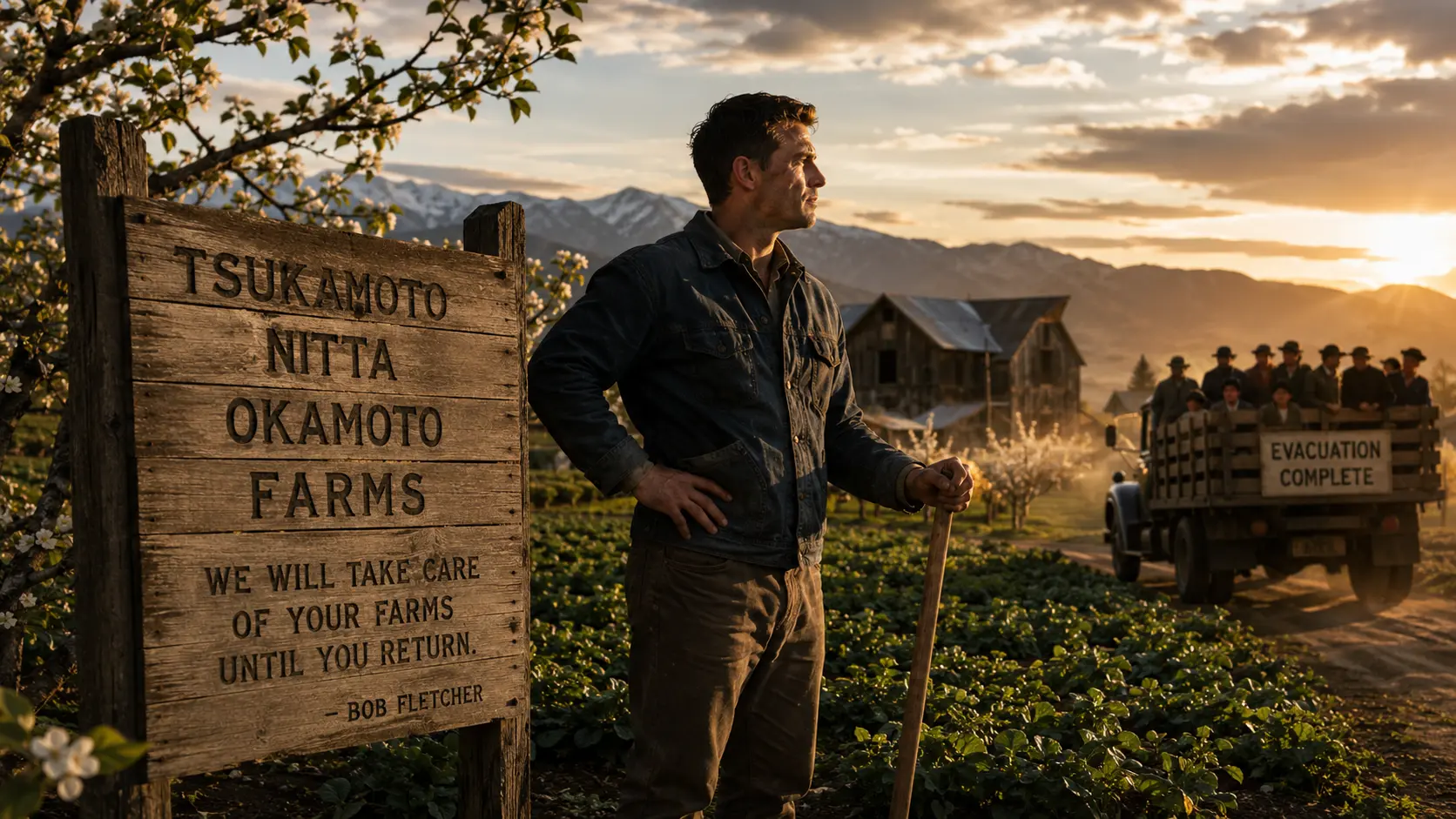
Em 1942, milhares de famílias nipo-americanas foram arrancadas de suas casas e enviadas para campos de detenção nos Estados Unidos. Fazendas foram abandonadas, negócios destruídos e vizinhos transformados em suspeitos da noite para o dia. No meio daquele medo coletivo, um homem simples decidiu fazer algo quase impensável: cuidar das terras daqueles que todos haviam aprendido a odiar. Sob ameaças, isolamento e sacrifício, Bob Fletcher preservou não apenas fazendas e plantações, mas algo muito mais raro em tempos de guerra: a própria humanidade.
| Audio | |
|---|---|
Normal | Slow |
| English Transcript | Tradução |
| When Fear Took Over America | Quando o Medo Dominou a América |
| The valley of Florin, California, was a place where life moved according to the rhythm of the seasons. In the spring, the strawberry fields burst with color and the orchards stretched in long green rows beneath the open sky. Families woke before sunrise, worked until their bodies demanded rest, and built their lives around that fertile land. Among the most respected farmers were the Tsukamotos, the Nittas, and the Okamotos, Japanese-American families who had spent decades transforming hard soil into prosperity. They were known for their tireless work, their quiet discipline, and their ability to endure hardship without complaint. But all of that began to collapse after Pearl Harbor. Fear spread across the United States like wildfire carried by the wind, and Japanese ancestry alone was enough for thousands of American citizens to suddenly be viewed as potential enemies. | O vale de Florin, na Califórnia, era um lugar onde a vida seguia o ritmo das estações. Na primavera, os campos de morango se enchiam de cor e os pomares desenhavam longas fileiras verdes sob o céu aberto. As famílias acordavam antes do amanhecer, trabalhavam até o corpo pedir descanso e construíam suas vidas em torno daquela terra fértil. Entre os agricultores mais respeitados estavam os Tsukamoto, os Nitta e os Okamoto, famílias nipo-americanas que haviam passado décadas transformando o solo duro em prosperidade. Eram conhecidos pelo trabalho incansável, pela disciplina silenciosa e pela capacidade de suportar dificuldades sem reclamar. Mas tudo aquilo começou a desmoronar depois de Pearl Harbor. O medo espalhou-se pelos Estados Unidos como fogo seco levado pelo vento, e bastou a ascendência japonesa para que milhares de cidadãos americanos passassem a ser vistos como inimigos em potencial. |
| Then came the executive order. Within days, entire families were instructed to abandon their homes, their shops, their crops, and nearly everything they had built throughout their lives. Many sold their belongings for almost nothing because they had no choice. Others simply locked their doors without knowing whether they would ever return. Trucks began crossing the California roads carrying men, women, elderly people, and children to camps surrounded by barbed wire in remote parts of the country. Standing beside one of those roads was Bob Fletcher, a young agricultural inspector who had known those families for years. He watched the trucks slowly disappear while a cloud of dust swallowed the horizon. He did not see traitors. He did not see spies. He saw neighbors being torn away from their lives by fear, hysteria, and prejudice. | Então veio a ordem executiva. Em poucos dias, famílias inteiras receberam instruções para abandonar suas casas, suas lojas, suas plantações e praticamente toda a vida que haviam construído. Muitos venderam bens por valores ridículos porque não tinham alternativa. Outros simplesmente fecharam as portas sem saber se algum dia voltariam. Os caminhões começaram a atravessar as estradas da Califórnia levando homens, mulheres, idosos e crianças para campos cercados por arame farpado em regiões afastadas do país. Na beira de uma daquelas estradas estava Bob Fletcher, um jovem inspetor agrícola que conhecia aquelas famílias havia anos. Ele observava os caminhões desaparecerem lentamente enquanto uma nuvem de poeira cobria o horizonte. Não via traidores. Não via espiões. Via apenas vizinhos sendo arrancados de suas vidas por medo, histeria e preconceito. |
| After the convoys departed, the valley fell into a strange silence. The abandoned properties quickly began to decay. Irrigation systems stopped working. Weeds spread across the fields. Broken fences creaked in the wind. Many residents of the region saw opportunity in the situation. Some lands were looted. Equipment disappeared. Entire farms were sold for almost nothing. There were those who said the Japanese would never return and that it was better to take advantage of what had been left behind. Bob Fletcher, however, made a different choice. He sought out representatives of the families and promised that he would care for the properties until they returned. It was an enormous promise for one man alone. The farms required constant labor: pruning trees, irrigating crops, harvesting fruit, repairing machinery, negotiating sales, and preventing everything from being destroyed by neglect. Even so, he accepted the responsibility without even knowing whether those families would ever come back. | Depois que os comboios partiram, o vale mergulhou num silêncio estranho. As propriedades abandonadas começaram rapidamente a se deteriorar. Sistemas de irrigação pararam de funcionar. Ervas daninhas tomaram conta dos campos. Cercas quebradas rangiam ao vento. Muitos moradores da região enxergaram naquilo uma oportunidade. Algumas terras foram saqueadas. Equipamentos desapareceram. Fazendas inteiras foram vendidas por quase nada. Havia quem dissesse que os japoneses nunca voltariam e que seria melhor aproveitar o que restara. Bob Fletcher, porém, tomou outra decisão. Procurou representantes das famílias e prometeu que cuidaria das propriedades até que retornassem. Era uma promessa enorme para um homem sozinho. As fazendas exigiam trabalho constante: podar árvores, irrigar plantações, colher frutas, reparar máquinas, negociar vendas e impedir que tudo fosse destruído pelo abandono. Mesmo assim, ele aceitou a responsabilidade sem saber sequer se aquelas famílias voltariam um dia. |
| The following months completely transformed his life. Bob worked to exhaustion, often beginning before sunrise and finishing late at night. The land would not wait. The crops needed daily attention. Beneath the heavy California heat, he spent endless hours cleaning irrigation canals, repairing equipment, and saving entire harvests almost entirely on his own. But the physical strain was not the hardest part. The hostility of his own neighbors became constant. Many called him a traitor. Others said he was defending enemies of America. His car tires were slashed. Tools disappeared. Equipment was vandalized during the night. Threatening notes appeared near the property. In times of war, a simple act of humanity was enough to turn someone into a target of suspicion. Bob endured everything in silence. He did not argue. He did not answer the insults. He simply kept working. | Os meses seguintes transformaram completamente sua vida. Bob trabalhava até a exaustão, muitas vezes começando antes do nascer do sol e terminando tarde da noite. A terra não esperava. As plantações precisavam de atenção diária. Sob o calor pesado da Califórnia, ele passava horas limpando canais de irrigação, consertando equipamentos e salvando colheitas inteiras praticamente sozinho. Mas o desgaste físico não era a parte mais difícil. A hostilidade dos próprios vizinhos tornou-se constante. Muitos o chamavam de traidor. Outros diziam que ele estava defendendo inimigos da América. Seu carro aparecia com pneus furados. Ferramentas desapareciam. Equipamentos eram danificados durante a noite. Bilhetes ameaçadores surgiam perto da propriedade. Em tempos de guerra, bastava um gesto de humanidade para transformar alguém em alvo de suspeita. Bob suportava tudo em silêncio. Não discutia. Não respondia aos insultos. Apenas continuava trabalhando. |
| The interned families even offered him their homes so he could live in them while they were away. It would have been comfortable, logical, and perfectly justifiable. But Bob refused. Instead, he chose to live in a simple shack used by migrant workers, a rough place that was freezing in winter and unbearably hot in summer. Even after marrying Teresa Cassieri, nothing changed. Teresa began working alongside him, helping keep alive properties that officially belonged to people considered suspicious by the American government itself. She rarely appears in shortened versions of this story, but her presence was essential. While much of the country allowed itself to be consumed by fear, the two of them spent their days protecting the work and property of absent families who might never return. | As famílias internadas chegaram a oferecer suas casas para que ele morasse nelas enquanto estivessem ausentes. Seria confortável, lógico e perfeitamente justificável. Mas Bob recusou. Preferiu viver em um barracão simples usado por trabalhadores migrantes, um lugar precário, desconfortável, gelado durante o inverno e sufocante no verão. Mesmo depois de se casar com Teresa Cassieri, nada mudou. Teresa passou a trabalhar ao lado dele, ajudando a manter vivas propriedades que oficialmente pertenciam a pessoas consideradas suspeitas pelo próprio governo americano. Ela raramente aparece nas versões resumidas dessa história, mas sua presença foi essencial. Enquanto grande parte do país se deixava consumir pelo medo, os dois passavam os dias protegendo o trabalho e o patrimônio de famílias ausentes que talvez nunca mais vissem. |
| What makes the story even more remarkable is that Bob could easily have become rich from the situation. No one monitored his finances. No one controlled the money generated by the harvests. In many parts of the United States, the properties of Japanese-American families simply vanished into the hands of opportunists. He could have kept the profits and nobody would likely have questioned him. But Bob Fletcher carefully documented everything the farms produced. He protected the portion that belonged to the interned families and managed the land as though he were safeguarding something sacred. For three years he endured financial hardship, social isolation, physical exhaustion, and loneliness without breaking the promise he had made beside that dusty road in 1942. | O mais impressionante era que Bob poderia ter ficado rico com aquilo. Ninguém fiscalizava suas contas. Ninguém controlava o destino do dinheiro das colheitas. Em muitas regiões dos Estados Unidos, propriedades de famílias nipo-americanas simplesmente desapareceram nas mãos de oportunistas. Bastaria embolsar os lucros e ninguém questionaria. Mas Bob Fletcher mantinha registros cuidadosos de tudo o que produzia. Guardava a parte que cabia às famílias internadas e administrava as fazendas como alguém que protege algo sagrado. Durante três anos atravessou dificuldades financeiras, isolamento social, desgaste físico e solidão sem quebrar a palavra dada à beira daquela estrada poeirenta em 1942. |
| When the war ended in 1945 and the camps finally began to close, thousands of families returned only to find ruins. Homes had been looted, businesses destroyed, and lands lost. Many had to rebuild their lives almost from nothing. But when the Tsukamotos, the Nittas, and the Okamotos returned to Florin, they found something almost unbelievable. The orchards were still alive. The properties had been preserved. The equipment was still functioning. And there was money waiting for them. Bob Fletcher had fulfilled every promise. For three years, while the entire country seemed consumed by fear, he had simply refused to abandon his conscience. | Quando a guerra terminou em 1945 e os campos começaram a ser fechados, milhares de famílias voltaram para encontrar apenas ruínas. Casas saqueadas, negócios destruídos, terras perdidas. Muitos tiveram de reconstruir a vida praticamente do zero. Mas quando os Tsukamoto, os Nitta e os Okamoto retornaram a Florin, encontraram algo quase inacreditável. Os pomares continuavam vivos. As propriedades estavam preservadas. Os equipamentos permaneciam funcionando. E havia dinheiro guardado esperando por eles. Bob Fletcher havia cumprido cada promessa. Durante três anos, enquanto o país inteiro parecia dominado pelo medo, ele simplesmente se recusara a abandonar a própria consciência. |
| Decades later, already an old man, Bob finally began to receive recognition. Historians, journalists, and members of the Japanese-American community started recording his story. The old Tsukamoto farm became a historical landmark, a quiet symbol of one of the darkest chapters in American history. But Bob never seemed comfortable with the attention. He did not see himself as a hero. He did not believe he had done anything extraordinary. Whenever people asked why he had accepted such sacrifice, he always answered in the same simple way, almost shyly: “It was the right thing to do.” | Décadas depois, já idoso, Bob começou finalmente a receber reconhecimento. Historiadores, jornalistas e membros da comunidade nipo-americana passaram a registrar sua trajetória. A antiga fazenda dos Tsukamoto tornou-se um marco histórico, símbolo silencioso de um período sombrio da história americana. Mas Bob nunca pareceu confortável com homenagens. Não se via como herói. Não acreditava ter feito algo extraordinário. Quando perguntavam por que havia assumido tamanho sacrifício, respondia sempre da mesma maneira, quase com simplicidade constrangida: “Era a coisa certa a fazer.” |
| Perhaps that is precisely what makes his story so powerful. Bob Fletcher did not command armies, did not deliver speeches to crowds, and did not try to change the entire world. He simply refused to accept that fear could justify the dehumanization of innocent people. While many allowed themselves to be swept away by collective hysteria, he chose to remain human. And sometimes that is exactly how dignity survives the darkest periods of history: through ordinary people who continue doing what is right even when almost nobody else is willing to do so. | Talvez seja justamente isso que torna sua história tão poderosa. Bob Fletcher não comandou exércitos, não discursou para multidões e não tentou mudar o mundo inteiro. Apenas recusou-se a aceitar que o medo justificasse a desumanização de pessoas inocentes. Enquanto muitos se deixaram levar pela histeria coletiva, ele escolheu permanecer humano. E às vezes é exatamente assim que a dignidade sobrevive aos períodos mais sombrios da história: através de pessoas comuns que continuam fazendo o que é certo, mesmo quando quase ninguém mais está disposto a fazê-lo. |
Contagem de palavras
A tabela abaixo exibe as palavras encontradas neste texto, bem como o número de vezes em que aparecem.
Veja também: Para que serve esta tabela?
| Freq. | Palavra | Freq. | Palavra | Freq. | Palavra |
|---|---|---|---|---|---|
| 76 | the | 28 | of | 27 | to |
| 27 | he | 26 | and | 17 | in |
| 15 | their | 14 | was | 13 | had |
| 13 | a | 12 | that | 11 | not |
| 11 | families | 11 | bob | 10 | were |
| 10 | for | 10 | by | 9 | did |
| 8 | his | 7 | would | 7 | they |
| 7 | but | 7 | almost | 6 | many |
| 6 | fear | 6 | even | 6 | began |
| 6 | american | 5 | who | 5 | while |
| 5 | simply | 5 | properties | 5 | people |
| 5 | one | 5 | japanese | 5 | is |
| 5 | fletcher | 5 | entire | 4 | without |
| 4 | when | 4 | what | 4 | those |
| 4 | story | 4 | so | 4 | nothing |
| 4 | lives | 4 | it | 4 | into |
| 4 | him | 4 | have | 4 | from |
| 4 | everything | 4 | equipment | 4 | could |
| 4 | been | 3 | years | 3 | working |
| 3 | them | 3 | spent | 3 | simple |
| 3 | see | 3 | returned | 3 | return |
| 3 | refused | 3 | promise | 3 | no |
| 3 | never | 3 | land | 3 | homes |
| 3 | farms | 3 | crops | 3 | country |
| 3 | california | 3 | be | 3 | away |
| 3 | as | 3 | after | 2 | worked |
| 2 | work | 2 | with | 2 | wind |
| 2 | whether | 2 | war | 2 | valley |
| 2 | until | 2 | united | 2 | tsukamotos |
| 2 | trucks | 2 | three | 2 | thousands |
| 2 | there | 2 | teresa | 2 | sunrise |
| 2 | still | 2 | states | 2 | spread |
| 2 | something | 2 | sold | 2 | situation |
| 2 | silence | 2 | seemed | 2 | saw |
| 2 | said | 2 | roads | 2 | right |
| 2 | repairing | 2 | quiet | 2 | property |
| 2 | place | 2 | physical | 2 | parts |
| 2 | own | 2 | others | 2 | orchards |
| 2 | old | 2 | okamotos | 2 | nobody |
| 2 | nittas | 2 | night | 2 | neighbors |
| 2 | money | 2 | man | 2 | makes |
| 2 | made | 2 | looted | 2 | live |
| 2 | life | 2 | lands | 2 | known |
| 2 | knowing | 2 | kept | 2 | itself |
| 2 | irrigation | 2 | interned | 2 | hysteria |
| 2 | history | 2 | harvests | 2 | hardship |
| 2 | florin | 2 | finally | 2 | fields |
| 2 | exhaustion | 2 | ever | 2 | enough |
| 2 | enemies | 2 | endured | 2 | do |
| 2 | disappeared | 2 | destroyed | 2 | decades |
| 2 | days | 2 | darkest | 2 | consumed |
| 2 | constant | 2 | comfortable | 2 | chose |
| 2 | choice | 2 | camps | 2 | built |
| 2 | beside | 2 | beneath | 2 | belonged |
| 2 | being | 2 | before | 2 | became |
| 2 | attention | 2 | an | 2 | america |
| 2 | alone | 2 | allowed | 2 | alive |
| 2 | across | 2 | accepted | 2 | abandon |
| 1 | young | 1 | world | 1 | workers |
| 1 | women | 1 | woke | 1 | within |
| 1 | wire | 1 | winter | 1 | willing |
| 1 | wildfire | 1 | why | 1 | where |
| 1 | whenever | 1 | weeds | 1 | way |
| 1 | watched | 1 | waiting | 1 | wait |
| 1 | viewed | 1 | versions | 1 | vanished |
| 1 | vandalized | 1 | used | 1 | unbelievable |
| 1 | unbearably | 1 | two | 1 | turn |
| 1 | tsukamoto | 1 | try | 1 | trees |
| 1 | transforming | 1 | transformed | 1 | traitors |
| 1 | traitor | 1 | torn | 1 | tools |
| 1 | took | 1 | tires | 1 | tireless |
| 1 | times | 1 | throughout | 1 | through |
| 1 | threatening | 1 | though | 1 | this |
| 1 | thing | 1 | then | 1 | themselves |
| 1 | target | 1 | take | 1 | systems |
| 1 | symbol | 1 | swept | 1 | swallowed |
| 1 | suspicious | 1 | suspicion | 1 | survives |
| 1 | surrounded | 1 | summer | 1 | suddenly |
| 1 | such | 1 | stretched | 1 | strawberry |
| 1 | strange | 1 | strain | 1 | stopped |
| 1 | started | 1 | standing | 1 | spring |
| 1 | spies | 1 | speeches | 1 | sought |
| 1 | sometimes | 1 | someone | 1 | some |
| 1 | soil | 1 | social | 1 | slowly |
| 1 | slashed | 1 | sky | 1 | shyly |
| 1 | shortened | 1 | shops | 1 | she |
| 1 | shack | 1 | seasons | 1 | saving |
| 1 | same | 1 | sales | 1 | safeguarding |
| 1 | sacrifice | 1 | sacred | 1 | ruins |
| 1 | rows | 1 | rough | 1 | road |
| 1 | rich | 1 | rhythm | 1 | rest |
| 1 | responsibility | 1 | respected | 1 | residents |
| 1 | required | 1 | representatives | 1 | remote |
| 1 | remarkable | 1 | remain | 1 | region |
| 1 | recording | 1 | recognition | 1 | receive |
| 1 | rebuild | 1 | rarely | 1 | quickly |
| 1 | questioned | 1 | pruning | 1 | protecting |
| 1 | protected | 1 | prosperity | 1 | promised |
| 1 | profits | 1 | produced | 1 | preventing |
| 1 | preserved | 1 | presence | 1 | prejudice |
| 1 | precisely | 1 | powerful | 1 | potential |
| 1 | portion | 1 | periods | 1 | perhaps |
| 1 | perfectly | 1 | pearl | 1 | part |
| 1 | over | 1 | out | 1 | ordinary |
| 1 | order | 1 | opportunity | 1 | opportunists |
| 1 | open | 1 | only | 1 | on |
| 1 | often | 1 | officially | 1 | offered |
| 1 | notes | 1 | negotiating | 1 | neglect |
| 1 | needed | 1 | nearly | 1 | near |
| 1 | much | 1 | moved | 1 | most |
| 1 | more | 1 | months | 1 | monitored |
| 1 | migrant | 1 | might | 1 | men |
| 1 | members | 1 | marrying | 1 | managed |
| 1 | machinery | 1 | lost | 1 | long |
| 1 | loneliness | 1 | logical | 1 | locked |
| 1 | likely | 1 | like | 1 | left |
| 1 | later | 1 | late | 1 | landmark |
| 1 | labor | 1 | keep | 1 | justify |
| 1 | justifiable | 1 | journalists | 1 | isolation |
| 1 | irrigating | 1 | insults | 1 | instructed |
| 1 | instead | 1 | inspector | 1 | innocent |
| 1 | humanity | 1 | human | 1 | however |
| 1 | how | 1 | hours | 1 | hot |
| 1 | hostility | 1 | horizon | 1 | historical |
| 1 | historians | 1 | himself | 1 | hero |
| 1 | her | 1 | helping | 1 | heavy |
| 1 | heat | 1 | harvesting | 1 | hardest |
| 1 | hard | 1 | harbor | 1 | hands |
| 1 | green | 1 | government | 1 | generated |
| 1 | functioning | 1 | fulfilled | 1 | fruit |
| 1 | freezing | 1 | found | 1 | following |
| 1 | finishing | 1 | find | 1 | financial |
| 1 | finances | 1 | fertile | 1 | fences |
| 1 | fell | 1 | farmers | 1 | farm |
| 1 | extraordinary | 1 | executive | 1 | exactly |
| 1 | every | 1 | essential | 1 | entirely |
| 1 | enormous | 1 | endure | 1 | endless |
| 1 | ended | 1 | else | 1 | elderly |
| 1 | easily | 1 | dusty | 1 | dust |
| 1 | during | 1 | doors | 1 | done |
| 1 | doing | 1 | documented | 1 | discipline |
| 1 | disappear | 1 | dignity | 1 | different |
| 1 | departed | 1 | demanded | 1 | deliver |
| 1 | dehumanization | 1 | defending | 1 | decay |
| 1 | daily | 1 | crowds | 1 | crossing |
| 1 | creaked | 1 | convoys | 1 | controlled |
| 1 | continue | 1 | considered | 1 | conscience |
| 1 | completely | 1 | complaint | 1 | community |
| 1 | command | 1 | come | 1 | color |
| 1 | collective | 1 | collapse | 1 | cloud |
| 1 | close | 1 | cleaning | 1 | citizens |
| 1 | children | 1 | chapters | 1 | changed |
| 1 | change | 1 | cassieri | 1 | carrying |
| 1 | carried | 1 | carefully | 1 | care |
| 1 | car | 1 | canals | 1 | came |
| 1 | called | 1 | businesses | 1 | burst |
| 1 | broken | 1 | breaking | 1 | bodies |
| 1 | better | 1 | belongings | 1 | believe |
| 1 | behind | 1 | beginning | 1 | become |
| 1 | because | 1 | barbed | 1 | back |
| 1 | at | 1 | asked | 1 | around |
| 1 | armies | 1 | argue | 1 | appears |
| 1 | appeared | 1 | anything | 1 | answered |
| 1 | answer | 1 | ancestry | 1 | among |
| 1 | always | 1 | already | 1 | alongside |
| 1 | all | 1 | agricultural | 1 | advantage |
| 1 | act | 1 | according | 1 | accept |
| 1 | absent | 1 | ability | 1 | abandoned |